
The Little Red Dots Mystery: Webb Telescopes Latest Puzzle
TL;DR

The James Webb Space Telescope has uncovered mysterious little red dots scattered throughout the early universe, challenging our understanding of galaxy formation and black hole evolution. These tiny, red-tinted objects appear to be young supermassive black holes hidden within dense gas clouds, rewriting the story of how cosmic structures formed in the universes first billion years.

The Little Red Dots Mystery: Webb Telescope's Latest Puzzle

The James Webb Space Telescope (JWST) found thousands of tiny ruby colored objects where astronomers expected to see empty space? These "little red dots" exist in the very early universe, appearing as early as 600 million years after the Big Bang. They are so small and bright that they challenge how you might think galaxies and stars grow.

You can imagine the surprise when these dots began appearing in almost every deep space image. Researchers initially thought they were just distant galaxies covered in dust. The light coming from them is too intense and concentrated for a normal collection of stars. By about 1.5 billion years after the Big Bang, these mysterious objects mostly disappear from view, leaving a gap in the history of the cosmos.

What Are These Distant Crimson Objects?

The little red dots are a specific class of astronomical bodies that look like tiny pinpricks of deep red light. When you look at their light signatures, they do not match the patterns of typical stars or galaxies. Scientists are currently debating if the are single massive objects or entire systems packed into a very small area.

Data from 2026 shows that these objects have multiple unique traits

  • They are extremely compact, often appearing smaller than the smallest known galaxies.
  • Their light spectra show signs of hot, ionized gas moving at high speeds.
  • They exist only in a specific window of cosmic time between 600 million and 1.5 billion years after the Big Bang.


Hidden Giants Inside Gas Cocoons

The most popular explanation right now is that you are looking at "black hole stars" In this scenario, a supermassive black hole is growing rapidly inside a thick, dense shell of gas - this gas cocoon absorbs the intense radiation from the black hole and glows with a heat that translates to red light across the vast distances of space.

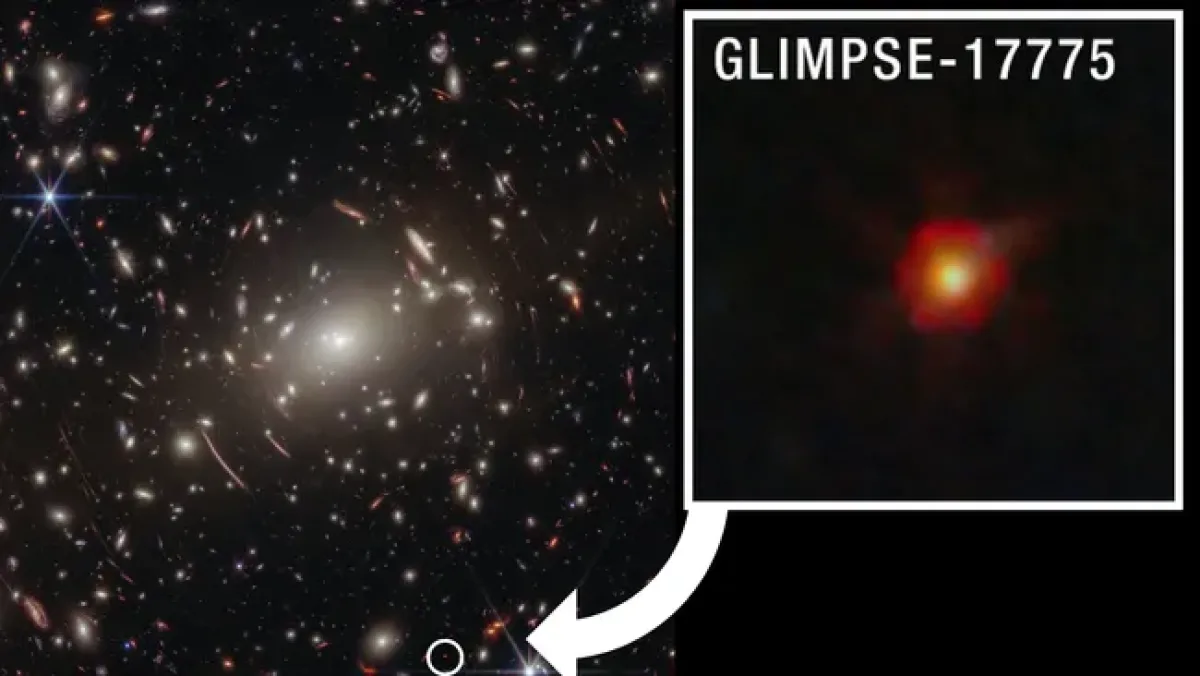
Recent studies of an object named GLIMPSE-17775 support this idea. NASA reported X-ray emissions from at least one of these dots in 2026. Because X-rays usually come from the violent environment around a black hole, this discovery makes the "growing black hole" theory the lead contender. The gas acts like a heavy blanket, hiding the bright center while letting the red glow escape.

The Case for Supermassive Stars

Some researchers from Harvard have a different idea for you to consider. They suggest that some little red dots are actually single, gargantuan stars - these are not like the Sun - they are millions of times heavier - these supermassive stars would be very short lived and unstable, which explains why they vanish from the universe so quickly.

This model is attractive because it explains the specific brightness and colors JWST sees without needing a black hole. In this view

  1. Large clouds of hydrogen collapse directly into one giant star.
  2. The star burns incredibly bright for a few million years.
  3. The star eventually collapses into a black hole or explodes, ending the "red dot" phase.

Why the Early Universe Looks Red

You might wonder why the objects are specifically red rather than blue or white - this happens because of the expansion of space. As light travels toward your telescope over billions of years, the fabric of space stretches - this stretching turns short, blue light waves into long, red light waves, a process called redshift.

Additionally, the environments around these objects are full of cosmic dust. Similar to how a sunset looks red because the atmosphere scatters other colors, the thick dust clouds around these early objects block blue light - this leaves only the deep crimson tones for the Webb telescope to detect.

Solving the Cosmic Puzzle

Astronomers are not but sure if all little red dots are the same thing. It is possible that some are black holes while others are supermassive stars. Each dot you see might represent a different stage of how a galaxy begins its life. The variety in their light signals suggests a complex family of objects rather than a single type.

As you read this, telescopes continue to collect more light from the distant points. Future observations will look for more X-ray signals and clearer chemical signatures. For now, these dots remain one of the most exciting mysteries in space, forcing experts to rewrite the timeline of how the universe grew its first massive structures.

FAQ

Are the little red dots actually red?

No, they probably glow with intense white or blue light at their source. They only look red to you because their light stretches while traveling across the expanding universe and passes through thick clouds of dust.

Can you see these dots with a backyard telescope?

You cannot see them without specialized equipment - These objects are so far away and their light is so faint that only the James Webb Space Telescope has the power to detect them in the infrared spectrum.

Are the objects dangerous to Earth?

These objects are billions of light years away and ceased to exist in this form billions of years ago. You are looking at "ghosts" of the early universe - they have no physical effect on your life today.

References

  1. Little Red Dots - Wikipedia
  2. Space.com - Webb Telescope Evidence for Black Hole Stars
  3. Harvard-Smithsonian Center for Astrophysics - New Theory for Little Red Dots
  4. NASA Science - Webb Telescope Latest Discoveries
  5. Science News Today - Astronomers Baffled by Little Red Dots
  6. Custom Map Poster - Webb Telescope Cosmic Mystery
  7. ESA Webb - News Archive 2025
  8. Futura-Sciences - What the Red Dots Really Are
J

Jonathan Bala

Contributing writer for ALLTHINGSGEO.

Related Articles