
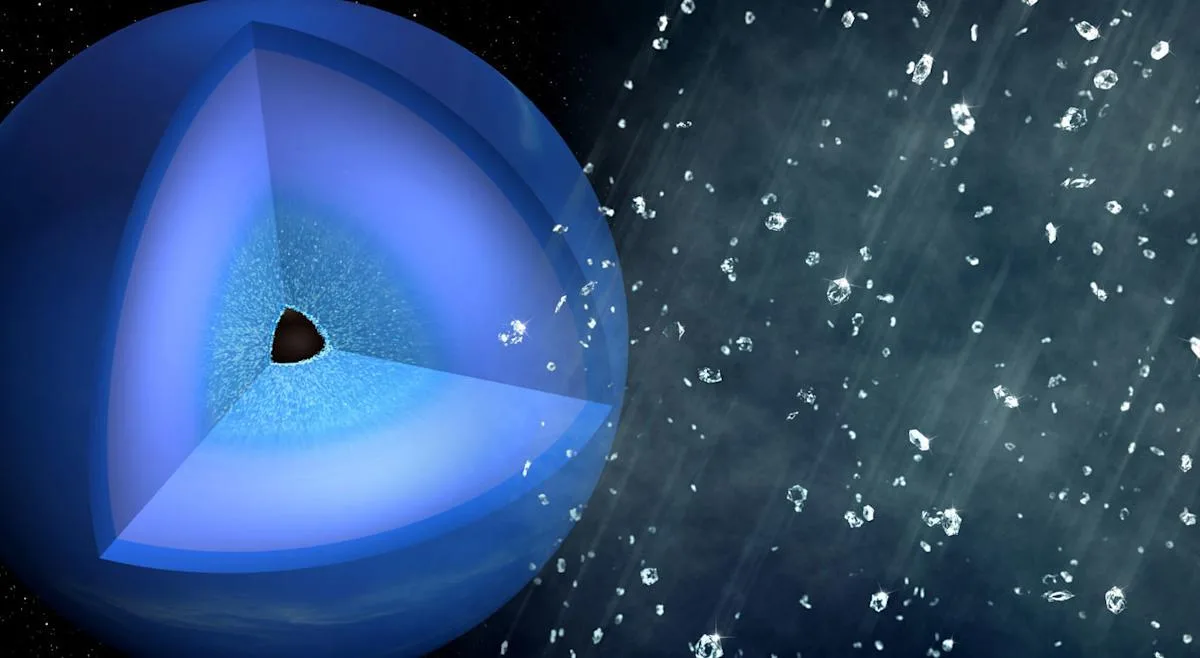
Diamond Rain on Neptune: High-Pressure Atmospheric Physics
Scientists believe that diamonds may form deep inside Neptune when extreme pressure and temperature break apart carbon-containing compounds. The resulting diamond particles could slowly sink towards the planet's interior, creating a phenomenon known as diamond rain. Laboratory experiments, including research published in Nature Astronomy in January 2024, have provided strong experimental evidence that this process can happen under conditions similar to those inside Neptune and Uranus. Scientists are also investigating whether falling diamonds help explain the unusual magnetic fields of these distant planets.
Introduction
Imagine a planet where diamonds could form naturally, not inside a jewellery factory or beneath Earth's surface, but thousands of kilometres below an atmosphere of hydrogen, helium and methane. This is one of the most fascinating possibilities in planetary science.
Neptune, the eighth planet from the Sun, is believed to have an interior where extreme pressure and temperature can transform carbon-containing materials into diamonds. Scientists call this process diamond rain because the newly formed diamond particles are expected to sink deeper into the planet under gravity.
Although researchers have not directly observed diamonds raining inside Neptune, laboratory experiments have recreated important parts of the process and strengthened the scientific evidence behind the theory.
Source: NASA – Neptune Facts and Planetary Structure.
What Is Diamond Rain on Neptune?
Diamond rain describes a possible process in which carbon separates from hydrogen-rich compounds under enormous pressure and temperature inside an ice giant. The carbon atoms can arrange themselves into solid diamond structures.
These particles are denser than much of the surrounding material. Consequently, gravity is expected to pull them towards deeper layers of the planet. This downward movement resembles rainfall, although it has nothing to do with ordinary water droplets falling through clouds.
The term does not mean that diamonds fall from Neptune's visible blue clouds. The proposed process takes place deep inside the planet, where conditions are completely different from those found in Earth's atmosphere.
Source: SLAC National Accelerator Laboratory – Diamond Rain on Icy Planets.
The Science Behind Neptune's Extreme Pressure
Neptune is classified as an ice giant, although its interior is not made of ordinary frozen ice. NASA explains that much of its mass consists of hot, dense fluid materials associated with water, ammonia and methane, surrounding a relatively small rocky core.
Its outer atmosphere contains mainly hydrogen and helium, with methane contributing to its familiar blue appearance. As scientists model conditions deeper inside the planet, they encounter increasing pressure and temperature.
Under these extreme conditions, familiar chemical compounds can behave very differently. Methane and other hydrocarbons contain carbon and hydrogen. When subjected to sufficient pressure and heat, their chemical structures can break apart, allowing carbon atoms to form diamond crystals.
Source: NASA – Neptune's Atmosphere and Internal Structure.
How Do Diamonds Form Under Extreme Pressure?

Diamond formation depends on how carbon atoms arrange themselves. Under suitable conditions, carbon atoms can bond into the strong crystal structure associated with natural diamonds.
Scientists have investigated this process using specialised laboratory equipment, including diamond anvil cells and powerful X-ray lasers. A diamond anvil cell squeezes a tiny material sample between two extremely hard diamond tips, creating enormous pressure.
In a major experiment published on January 8, 2024, researchers used a polystyrene film as a carbon source. They compressed the material and heated it with high-energy X-rays at the European X-ray Free-Electron Laser facility in Germany.
The researchers observed diamond formation at temperatures above 2,500 kelvin and pressures between 19 and 27 gigapascals. These conditions are considered representative of relatively shallow regions inside Neptune and Uranus.
The experiment was important because it allowed researchers to study diamond formation over longer timescales than earlier experiments using extremely short laser-driven compression.
Why Diamond Rain Could Influence Neptune's Magnetic Field

One of the most interesting parts of diamond rain research is its possible connection to Neptune's unusual magnetic field.
Earth's magnetic field is broadly organised around its rotational axis, but Neptune's magnetic field is significantly tilted and offset. This unusual arrangement has encouraged scientists to investigate whether electrical currents in conducting layers inside the planet contribute to its magnetic behaviour.
Research published in 2024 suggests that falling diamond particles could stir electrically conducting material as they move deeper into Neptune. These movements may help generate currents that contribute to the planet's magnetic field.
This does not mean scientists have completely solved Neptune's magnetic mystery. Rather, diamond precipitation provides another possible explanation that researchers can investigate through laboratory experiments and planetary models.
Source: Carnegie Science – Could Diamonds Drive Neptune and Uranus' Magnetic Fields?.
What Did Scientists Discover in 2024?

The January 2024 research was an important development because scientists demonstrated that diamond formation could occur under less extreme conditions than some earlier experiments had suggested.
The international research team, led by scientists associated with SLAC National Accelerator Laboratory, used the European XFEL to examine how carbon-containing material responded to extreme pressure and heat.
Their findings suggested that diamond formation could begin at shallower depths inside ice giants than previously estimated. This matters because the location where diamonds form may influence how heat and materials move through the planet.
Earlier research published in 2022 also found that oxygen could encourage diamond formation. This suggested that the chemical composition of Neptune and Uranus might make diamond precipitation possible across a wider range of conditions.
Sources: SLAC – 2024 Diamond Rain Research | SLAC – 2022 Discovery About Oxygen and Diamond Formation.
Could Diamond Rain Also Happen on Uranus and Other Planets?

Neptune is not the only planet associated with this theory. Uranus has a similar classification and contains many of the same important chemical ingredients. Scientists therefore believe that diamond precipitation could also occur deep inside Uranus.
The 2024 findings have also increased interest in smaller planets outside our solar system known as mini-Neptunes. These planets are common among discovered exoplanets, and some may experience pressure and temperature conditions suitable for similar chemical processes.
However, scientists cannot assume that every Neptune-like planet produces diamonds. Its internal composition, temperature, pressure and chemical reactions all influence whether diamond formation is possible.
Source: SLAC – Diamond Rain and Its Possible Occurrence on Other Planets.
What Scientists Still Do Not Know
Despite the progress made in laboratory research, several questions remain unanswered.
Scientists have not sent a spacecraft into Neptune's deep interior to observe diamond precipitation directly. The evidence comes from experiments that reproduce selected conditions and computer models that help researchers understand how materials might behave inside the planet.
The exact quantity, size and distribution of diamonds inside Neptune are also uncertain. Researchers continue to investigate how different chemical mixtures influence the formation and movement of diamond particles.
As of November 23, 2026, the January 2024 Nature Astronomy experiment remains an important published experimental milestone in this area. It provides evidence for the physical process, but it does not constitute direct observation of diamond rain inside Neptune.
Source: Nature Astronomy – Original Experimental Research.
Why Diamond Rain Matters to Science
Diamond rain is more than an interesting space discovery. It offers scientists a way to understand how planetary interiors work, how heat moves through distant worlds and how unusual magnetic fields develop.
The same research methods may also help scientists investigate the internal structures of exoplanets beyond our solar system. By recreating extreme planetary conditions on Earth, researchers can examine materials that would otherwise be impossible to study directly.
Neptune remains one of the least explored planets in our solar system. Its possible diamond rain is a reminder that the universe contains physical processes that are very different from anything we experience on Earth.
Source: European XFEL – New Findings on Diamond Rain on Ice Planets.
Frequently Asked Questions
1. Does it really rain diamonds on Neptune?
Scientists have strong experimental evidence that diamond formation is possible under conditions similar to those inside Neptune. However, the process has not been directly observed inside the planet.
Source: SLAC – Diamond Rain Research.
2. How are diamonds formed on Neptune?
Extreme pressure and temperature can break apart carbon-containing compounds. The carbon atoms can then rearrange into diamond structures.
Source: Nature Astronomy – Diamond Formation Experiments.
3. Do diamonds fall from Neptune's clouds?
No. The proposed diamond precipitation occurs deep inside the planet, not in its visible atmosphere.
Source: NASA – Neptune Facts.
4. Has diamond rain been observed directly?
No. Scientists have recreated important parts of the process in laboratories, but nobody has directly witnessed diamond rain inside Neptune.
Source: SLAC – 2024 Experimental Findings.
5. Does Uranus also experience diamond rain?
Researchers believe diamond formation may occur inside Uranus because it shares important chemical and physical characteristics with Neptune.
Source: Carnegie Science – Diamond Rain and Magnetic Fields.
6. What temperature is required to form diamonds?
The 2024 experiment observed diamond formation above 2,500 kelvin, under pressures between 19 and 27 gigapascals. These are experimental conditions, not a single universal formation threshold.
Source: Nature Astronomy – 2024 Research Paper.
7. Can scientists collect diamonds from Neptune?
There is currently no practical way to collect diamonds from Neptune. The process is believed to happen far beneath its atmosphere, under extreme pressure and temperature.
Source: NASA – Neptune's Internal Structure.
8. Why is diamond rain important?
It could help explain how heat moves inside ice giants and contribute to understanding their unusual magnetic fields.
Source: SLAC – Diamond Rain and Planetary Magnetic Fields.