
Why High-Redshift Galaxies Defy Standard Cosmic Evolution Models
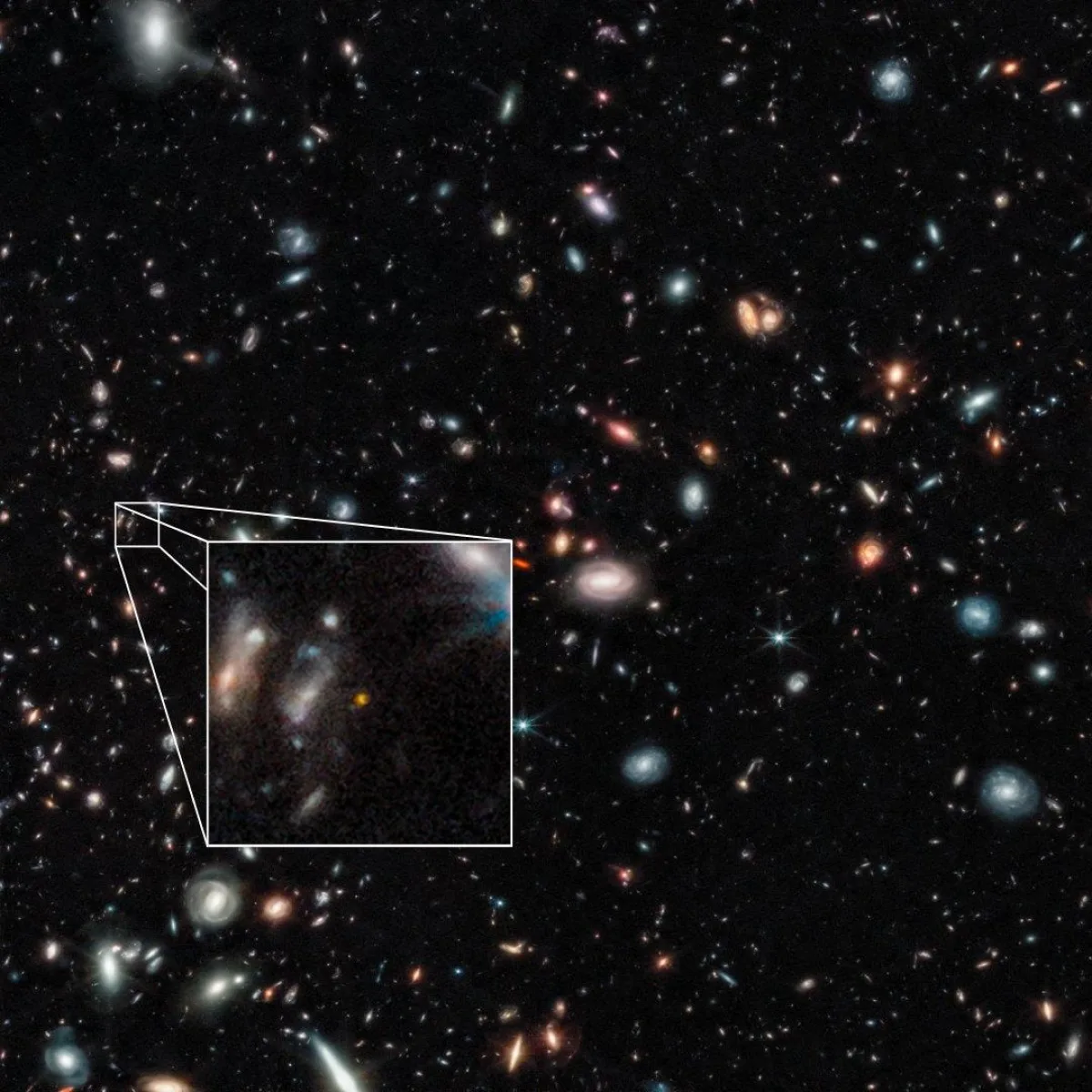
High-redshift galaxies are challenging astronomers' understanding of how the universe evolved after the Big Bang. Some galaxies observed in the early universe appear brighter, more massive, more developed, or more numerous than many standard models predicted. Discoveries made with the James Webb Space Telescope (JWST) have raised important questions about how quickly stars formed, how galaxies gathered matter, and how black holes grew when the universe was still young. However, these findings do not automatically mean that the standard model of cosmology is wrong. Scientists are investigating whether the differences can be explained by improved observations, more accurate measurements, unusual star formation, rapidly growing black holes, or changes to existing models of galaxy formation.
Summary
-
Topic: High-redshift galaxies and the evolution of the early universe.
-
Main challenge: Some early galaxies appear to have formed stars and accumulated mass faster than expected.
-
Scientific background: The standard cosmological model explains the universe's expansion, its large-scale structure, and the growth of matter under gravity.
-
Major telescope: The James Webb Space Telescope, which observes distant galaxies in infrared light.
-
Meaning of redshift: The stretching of light toward longer wavelengths as the universe expands.
-
Main discovery: Some early galaxy candidates appear unexpectedly bright or massive, raising questions about how quickly galaxies developed.
-
Possible explanations: Efficient star formation, different stellar populations, growing black holes, measurement uncertainties, and revisions to galaxy formation models.
-
Important distinction: A galaxy can look surprisingly mature without necessarily contradicting the underlying laws of cosmology.
-
Scientific importance: These galaxies provide evidence that can help scientists improve models of how the first stars, galaxies, and black holes formed.
-
Current research direction: Confirming galaxy distances, measuring stellar masses more accurately, and comparing observations with increasingly detailed computer simulations.

Introduction: A Universe That Developed Faster Than Expected
For decades, astronomers have used observations, mathematics, and computer simulations to understand how the universe changed after the Big Bang. Their models describe how matter gathered under gravity, how the first stars formed, and how small collections of matter eventually became the galaxies we see today.
The basic picture seemed clear. The early universe began as a hot, dense environment. As it expanded and cooled, matter gradually gathered into larger structures. Gas collected inside dark matter halos, stars formed, and young galaxies grew through the accumulation of gas and the merging of smaller systems.
Then the James Webb Space Telescope began observing the distant universe.
Webb revealed galaxies that appeared surprisingly bright and developed at times when astronomers expected galaxies to be smaller, fainter, and less common. Some observations suggested that early galaxies were building up their stars much faster than many existing models predicted.
The discoveries created a major question: Did galaxies develop faster than scientists expected, or did astronomers underestimate how much complexity was possible in the early universe?
Research published through 2026 continues to explore both possibilities. Some studies suggest that improvements to galaxy formation models can explain much of the apparent mismatch. Other research investigates whether changes to the early universe's physical conditions could have helped galaxies form more quickly.
The answer matters because galaxies are not isolated objects. Their growth depends on the universe's expansion, the behavior of dark matter, the supply of ordinary matter, and the processes that turn gas into stars. Understanding these distant systems can therefore test several connected ideas about cosmic history.

What Are High-Redshift Galaxies?
High-redshift galaxies are galaxies whose light has been stretched toward longer wavelengths as it travels through the expanding universe.
Astronomers describe this stretching using a measurement called redshift, represented by the letter \(z\). The higher the redshift, the farther back in cosmic history we generally observe a galaxy.
This happens because light travels at a finite speed. When astronomers study a galaxy billions of light-years away, they see light that left it billions of years ago. They are observing the galaxy as it appeared in the past, not as it would look today.
For example, a galaxy observed at a redshift of 10 is seen when the universe was only a small fraction of its current age. A redshift of 13 corresponds to an even earlier period.
The relationship is described by:
Here, \(\lambda_{\mathrm{observed}}\) is the wavelength measured by the telescope, while \(\lambda_{\mathrm{emitted}}\) is the wavelength at which the light was originally produced.
If light begins at a wavelength of 100 nanometers and is observed at 1,400 nanometers, its redshift is 13.
This stretching is why infrared telescopes are so useful for studying the early universe. Light that originally came from young stars in ultraviolet or visible wavelengths can reach Earth as infrared light.
The James Webb Space Telescope was designed to detect this faint infrared radiation, allowing astronomers to study galaxies that older telescopes struggled to observe.
Why the James Webb Space Telescope Changed the Debate

Before Webb began scientific observations, astronomers relied on telescopes such as Hubble to investigate the first generations of galaxies. These observations helped establish a broad picture of early galaxy formation, but many of the faintest and most distant objects remained difficult to study.
Webb brought greater sensitivity to infrared light and new opportunities to measure the properties of extremely distant galaxies.
Its observations revealed more bright galaxy candidates at high redshifts than some earlier estimates anticipated. Researchers also identified compact objects, unusual galaxy structures, and signs of rapid star formation.
A major difficulty is that a galaxy's brightness does not provide a straightforward measurement of its mass. A small galaxy producing stars rapidly can be very bright. A galaxy containing a growing black hole can also shine intensely. Dust, stellar ages, and the details of a galaxy's light can further affect estimates.
Some early reports therefore appeared to show that the universe had produced large galaxies astonishingly quickly. Later measurements and improved models have helped explain parts of the discrepancy, but important questions remain.
A 2025 review in Nature Astronomy, examining the first billion years of cosmic history, highlighted the major progress made by Webb while emphasizing unresolved questions about galaxy masses, star formation, early black holes, and the process that made the young universe increasingly transparent to light.
The important lesson is that Webb did not simply reveal more galaxies. It gave astronomers evidence that could test whether their previous assumptions about galaxy growth were correct.
What the Standard Model Predicts About Galaxy Formation
To understand why high-redshift galaxies are challenging, it helps to separate two ideas that are often discussed together: the standard model of cosmology and models of galaxy formation.
The standard cosmological model is commonly called Lambda cold dark matter, or \(\Lambda\)CDM. It describes the universe using ordinary matter, cold dark matter, dark energy, and the laws governing cosmic expansion and gravity.
In this model, dark matter plays an important role in forming large structures. It gathers into halos under gravity, creating regions where ordinary matter can accumulate and form stars.
However, the standard model does not predict every detail of galaxy formation by itself. Astronomers also need models describing how gas cools, how stars form, how supernovae release energy, and how black holes affect their surroundings.
These processes are difficult to calculate in full detail, so researchers use computer simulations and approximations to model them.
This distinction matters. If a simulation produces fewer bright early galaxies than Webb observes, the problem could lie in its assumptions about star formation rather than in the fundamental cosmological model.
For example, a model might underestimate how efficiently young galaxies turn gas into stars. Alternatively, its assumptions about stellar brightness, black hole activity, or the amount of gas available to a galaxy might be inaccurate.
The strongest scientific approach is to test these possibilities against observations before concluding that the entire cosmological framework needs to change.

The Main Reasons High-Redshift Galaxies Challenge Existing Models
1. Some galaxies appear to contain too many stars
One of the earliest concerns involved estimates of stellar mass.
If a distant galaxy contains more stars than a model predicts could have formed by that time, astronomers must explain how the stars developed so quickly.
A galaxy's available gas is limited. Some of that gas remains outside stars, while some is heated or expelled by energetic processes. Only a portion becomes part of the galaxy's stellar population.
This creates a physical limit on how much stellar mass a galaxy can build within a given period.
In a 2023 paper published in Nature Astronomy, astronomer Michael Boylan-Kolchin showed that some of the most massive early galaxy candidates appeared close to the limits expected under standard cosmology.
However, this was a warning about the inferred properties of those galaxies and the models used to explain them, not proof that the standard model had failed.
Stellar masses depend on how researchers interpret the light they receive. If the assumed stellar ages, dust content, or star formation histories are wrong, the estimated mass can change.
Astronomers therefore need reliable measurements before deciding whether a galaxy truly contains an unexpectedly large population of stars.
2. The early universe contains surprisingly bright galaxies
Brightness is another important challenge.
Some galaxies observed at high redshift produce more ultraviolet light than earlier models predicted. Ultraviolet brightness is often associated with young, hot stars, so it can provide clues about the rate at which a galaxy is forming stars.
A galaxy that produces stars efficiently may become bright without requiring an equally dramatic increase in its total mass.
This possibility is important because a galaxy does not need to resemble a modern spiral galaxy to produce substantial amounts of light. A young system undergoing intense star formation may appear very different from a mature galaxy.
A 2025 research highlight in Nature Astronomy discussed how galaxy counts from Webb could be reconciled with the standard cosmological framework by allowing greater complexity in early galaxy formation.
This suggests that some apparent disagreements can be reduced by improving the physics of galaxies rather than changing the universe's overall cosmological model.
3. Galaxies may be forming stars more efficiently
Star formation efficiency describes how effectively a galaxy converts available gas into stars over a given period.
If early galaxies converted a greater proportion of their gas into stars than models assumed, they could become brighter and build up stellar mass more rapidly.
This does not mean every early galaxy formed stars at the same rate. Conditions can vary greatly between galaxies, and star formation can occur in bursts.
Young galaxies may receive fresh gas, undergo interactions, or experience periods of intense activity. Their conditions can differ from those found in galaxies today.
Researchers are testing whether changes in star formation efficiency can explain the observed galaxy populations while remaining consistent with the amount of matter available in the early universe.
The challenge is to find an explanation that works across many galaxies, rather than one that explains a single unusual object.
4. Early black holes can make galaxies look brighter
Black holes are another important part of the puzzle.
When gas falls toward a black hole, it can heat up and release large amounts of radiation before crossing the event horizon. A rapidly feeding black hole may therefore make its surrounding galaxy appear unusually bright.
This creates a problem for researchers estimating stellar masses from the light of distant objects. If some of the light comes from a black hole rather than stars, treating all of it as starlight can lead to an overestimate of the galaxy's stellar mass.
Webb has identified numerous compact, unusually red objects informally known as Little Red Dots. Their nature remains an active research subject, and growing black holes appear to be important in at least some cases.
In November 2025, the European Space Agency reported Webb observations of CANUCS-LRD-z8.6, a galaxy containing an actively growing supermassive black hole only about 570 million years after the Big Bang.
Such findings show that black holes were already active during the universe's early stages. They also raise questions about how their initial seeds formed and how quickly they grew.
Black holes do not explain every unexpectedly bright galaxy, but they may account for some of the objects that initially appeared difficult to reconcile with existing models.
5. Galaxy formation may have started earlier or progressed differently
Astronomers once had limited direct evidence about the earliest stages of galaxy formation. Webb has made it possible to study objects from increasingly early periods, revealing more variation than many researchers expected.
Some young galaxies appear compact and irregular. Others show structures that suggest organized motion or substantial development.
These observations raise questions about how quickly gas settled into galaxies, how stars formed in groups, and how galaxies grew through interactions and mergers.
However, apparent structure must be interpreted carefully. At extreme distances, galaxies are difficult to resolve, and their appearance depends on the telescope's resolution, the wavelength being observed, and the sensitivity of the instrument.
A galaxy that looks organized in one image may reveal a more complicated structure when studied in greater detail.
The growing body of evidence suggests that early galaxies were not all following one simple path. Their development depended on their environment, gas supply, and internal activity.
6. The first galaxies may have changed the early universe faster than expected
Another challenge concerns the period known as the epoch of reionization.
After the Big Bang, the universe cooled enough for neutral hydrogen to become abundant. Later, radiation from early stars and other energetic sources began ionizing this hydrogen, gradually making much of the universe more transparent to ultraviolet light.
Astronomers are still investigating which sources supplied enough radiation to drive this change and how quickly it happened.
A particularly interesting discovery involved the galaxy JADES-GS-z13-1. In March 2025, NASA and ESA reported that Webb spectroscopy confirmed its redshift at 13.0, meaning astronomers observe it as it appeared roughly 330 million years after the Big Bang.
Researchers also detected unexpectedly strong Lyman-alpha emission from hydrogen.
This was surprising because neutral hydrogen in the early universe should absorb much of this radiation. The observation suggests that the conditions around the galaxy, or the processes producing and allowing the radiation to escape, were more complicated than anticipated.
It does not mean the entire universe was already transparent at that time. Instead, it raises questions about how individual galaxies affected their immediate surroundings and how the larger reionization process developed.
Recent Discoveries That Are Testing Cosmic Evolution Models
Several observations now help explain why the debate remains active. The following examples illustrate different challenges, from unexpectedly early galaxies to black holes and the changing conditions of the young universe.
|
Galaxy or discovery |
What astronomers found |
Why it matters |
|---|---|---|
|
MoM-z14 |
Confirmed at a redshift of 14.44 in 2025; observed as it appeared about 280 million years after the Big Bang |
Tests how early galaxies formed and became luminous |
|
JADES-GS-z13-1 |
Confirmed at redshift 13.0, about 330 million years after the Big Bang |
Its strong hydrogen emission raises questions about the early universe's transparency |
|
CANUCS-LRD-z8.6 |
An actively growing supermassive black hole in a galaxy about 570 million years after the Big Bang |
Helps researchers investigate the early growth of black holes |
|
Bright high-redshift galaxy populations |
Webb surveys have found more bright early galaxies than some earlier estimates expected |
Tests predictions about star formation and galaxy abundance |
These findings are based on reports from NASA, ESA, and published research. Their significance lies in the questions they raise, rather than in proving that a particular cosmological model is incorrect.
The discovery of MoM-z14 is especially important because it shows how quickly observations are advancing. Confirmed in 2025 and reported by ESA in January 2026, the galaxy is seen at a time when the universe was only about 280 million years old.
Finding such an early galaxy does not automatically mean it is impossibly massive. Its brightness, distance, stellar content, and surrounding environment must all be measured and interpreted before scientists can determine how surprising it really is.
What the Latest Research Says About the Standard Cosmological Model
Research available as of October 19, 2026, points toward a more detailed debate than the early headlines suggested.
Some studies focus on improving galaxy formation physics. Others test whether changes to the universe's early expansion or the growth of cosmic structures could help explain the observations.
A June 2026 paper in Monthly Notices of the Royal Astronomical Society, titled The Cosmic Rush Hour, investigated whether early dark energy could help explain the unexpectedly bright, massive, and developed galaxies reported by Webb. Early dark energy is a proposed additional contribution to the universe's energy budget during an early period of cosmic history. It is not an established solution to the galaxy problem.
A separate study published in Physical Review D in April 2026 examined whether statistical methods and observational uncertainties could help resolve the tension associated with massive early galaxies.
Research published in the Journal of High Energy Astrophysics in July 2026 also explored the relationship between early galaxy observations, star formation efficiency, and cosmological parameters.
These approaches do not all reach the same conclusion, and a proposed explanation in a research paper should not be confused with a confirmed discovery.
The key scientific question is whether a model can explain the full range of observations at once. A successful explanation must account for galaxy brightness, stellar masses, the number of galaxies, their distribution, and other independent measurements.
If an adjustment explains one group of galaxies but conflicts with other observations, it may not be the right solution.

Could the Standard Model of Cosmology Be Wrong?
This is one of the biggest questions raised by early galaxy research.
The standard cosmological model has successfully explained many observations, including the expansion of the universe, the cosmic microwave background, and the large-scale distribution of galaxies. It remains the main framework used to understand cosmic history.
However, a successful model is not beyond testing. Scientists must examine its predictions whenever new observations become available.
High-redshift galaxies provide a valuable test because they reveal how matter behaved when the universe was much younger.
There are three broad possibilities.
First, the cosmological model may remain correct while astronomers improve their understanding of how galaxies form. More efficient star formation, unusual stellar populations, or black hole activity could explain some of the apparent differences.
Second, some reported galaxy properties may change as measurements improve. Better distance measurements, more reliable stellar mass estimates, and larger samples could reduce or increase the tension.
Third, if strong disagreements remain after observational uncertainties and galaxy physics are carefully examined, scientists may need to consider changes to the standard cosmological model itself.
That third possibility is scientifically important, but it requires strong evidence. A handful of unusual galaxies cannot establish that the standard model is wrong.
The most convincing case for new physics would come from several independent observations that consistently disagree with the predictions of existing models.
How Astronomers Are Trying to Solve the Mystery
Astronomers are using several methods to understand what Webb has found.
Spectroscopy
Spectroscopy separates a galaxy's light into different wavelengths. This allows researchers to identify characteristic features in the light and measure redshift more reliably than they can from images alone.
It can also reveal information about a galaxy's chemical composition, temperature, gas conditions, and star formation activity.
Spectroscopy is particularly valuable when an object's distance is uncertain. A candidate galaxy that appears extremely distant in an image may turn out to be a closer object with different physical properties.
Computer simulations
Scientists use simulations to model how dark matter, gas, stars, and black holes interact as galaxies develop.
By changing assumptions about star formation, gas cooling, and feedback from stars or black holes, researchers can test which models best reproduce Webb's observations.
The goal is not simply to make a simulation produce a bright galaxy. The model must also explain how that galaxy formed, how much matter it contains, and whether similar systems should be common.
Observations at different wavelengths
Webb primarily observes infrared light, while other facilities can study galaxies in different wavelength ranges.
The Atacama Large Millimeter/submillimeter Array (ALMA), for example, can examine emission from cool gas, dust, and certain chemical elements. Combining ALMA observations with Webb data can help researchers separate the properties of stars from those of the material surrounding them.
This is important because a galaxy's visible light does not tell the entire story of its evolution.
Larger galaxy samples
A few unusual galaxies can reveal important physical processes, but larger samples help astronomers determine whether those objects are rare exceptions or evidence of a broader pattern.
Researchers compare the number of galaxies observed at different redshifts and brightness levels with predictions from simulations.
If a model consistently predicts too few galaxies, scientists can investigate whether it underestimates star formation, misrepresents the galaxies' properties, or uses incorrect assumptions about early structure formation.
A Researcher’s Perspective: Why the Surprise Matters
The excitement surrounding these discoveries is not simply that astronomers have found galaxies farther away than before. The deeper value is that observations are forcing scientists to examine assumptions that previously had limited observational tests.
As NASA explained in its March 2025 report on JADES-GS-z13-1, the galaxy's unexpectedly strong hydrogen emission was a finding that researchers had not anticipated from existing ideas about early galaxy formation.
This is how science progresses. A model makes predictions, observations test them, and researchers refine their explanations when the evidence reveals something unexpected.
A surprising result can expose a weakness in a model, but it can also reveal that an important physical process was not fully understood.
In the case of high-redshift galaxies, both possibilities remain worth investigating. The challenge is to identify which explanation best fits the evidence, rather than assuming that the most dramatic interpretation must be correct.

Current Research Priorities in 2026
Scientists are now working to determine which parts of the early galaxy puzzle require changes to existing models and which can be explained through improved measurements.
|
Research area |
Status as of October 2026 |
Main question |
|---|---|---|
|
Confirming galaxy redshifts |
Ongoing |
Are the most distant galaxy candidates truly as far away as they appear? |
|
Measuring stellar masses |
Ongoing |
How many stars do early galaxies actually contain? |
|
Understanding star formation |
Active research |
Can early galaxies form stars more efficiently than older models assumed? |
|
Studying Little Red Dots |
Active research |
How much of their light comes from stars and how much from growing black holes? |
|
Understanding reionization |
Active research |
How did early galaxies help make the universe transparent to ultraviolet light? |
|
Testing alternative cosmologies |
Theoretical and observational research |
Can changes to early cosmic history explain observations better than existing models? |
|
Combining Webb and ALMA data |
Ongoing |
What do gas, dust, and stellar measurements together reveal about galaxy growth? |
These are ongoing scientific questions, not a list of confirmed solutions. There is no single agreed explanation for every unexpected feature of the early galaxy population.
References
The following sources provide the scientific background and research findings used in this article. Links lead to NASA, ESA, and scientific journals.
1. NASA — Early Universe: Overview of Webb's discoveries, distant galaxies, and the formation of early cosmic structures. https://science.nasa.gov/mission/webb/early-universe/
2. European Space Agency — Webb Pushes Boundaries of the Observable Universe Closer to the Big Bang (January 28, 2026): Report on the confirmed galaxy MoM-z14 and its redshift of 14.44. https://esawebb.org/news/weic2603/
3. NASA — Webb Sees Galaxy Mysteriously Clearing Fog of Early Universe (March 26, 2025): Research on JADES-GS-z13-1, its confirmed redshift, and unexpectedly strong hydrogen emission. https://science.nasa.gov/missions/webb/nasas-webb-sees-galaxy-mysteriously-clearing-fog-of-early-universe/
4. Nature Astronomy — Stress Testing ΛCDM with High-Redshift Galaxy Candidates (2023): Analysis of the apparent tension between massive early galaxy candidates and standard cosmology. https://www.nature.com/articles/s41550-023-01937-7
5. Nature Astronomy — Matching High-Redshift Galaxy Counts with ΛCDM (2025): Research highlight discussing how more detailed galaxy formation models may explain observed galaxy populations. https://www.nature.com/articles/s41550-025-02475-0
6. Nature Astronomy — The Early Universe with JWST and ALMA (2025): Review of early galaxy observations, gas, dust, black holes, and star formation. https://www.nature.com/articles/s41550-025-02726-0
7. European Space Agency — Webb Witnesses a Feasting Supermassive Black Hole in the Early Universe (November 19, 2025): Report on CANUCS-LRD-z8.6 and early black hole growth. https://esawebb.org/news/weic2522/
8. Monthly Notices of the Royal Astronomical Society — The Cosmic Rush Hour (2026): Research examining whether early dark energy could help explain some unexpected properties of early galaxies. https://doi.org/10.1093/mnras/stag1227
9. Physical Review D — Statistics Meet Systematics: Resolution of the Massive Early JWST Galaxy Tension (April 3, 2026): Research investigating observational uncertainties and statistical explanations for the apparent tension. https://doi.org/10.1103/gjf5-3r89
10. Journal of High Energy Astrophysics — Dark Energy, Spatial Curvature, and Star Formation Efficiency from JWST Photometric and Spectroscopic High-Redshift Galaxies (July 2026): Study examining connections between cosmological parameters and early galaxy observations. https://www.sciencedirect.com/science/article/pii/S2214404826000777