
Whipple Shields Explained: How Spacecraft Are Protected From Dangerous Space Debris
Spacecraft travelling through Earth's orbit face a threat that is difficult to see but potentially very dangerous: tiny pieces of space debris moving at extremely high speeds. Even a small fragment of metal, a particle from an old satellite or a naturally occurring micrometeoroid can damage important spacecraft equipment.
One technology developed to reduce this danger is the Whipple shield, a protective system that uses layers of material separated by empty space to reduce the damage caused by high-speed impacts. First proposed by astronomer Fred Whipple in 1947, the technology remains an important part of spacecraft protection today.
Unlike a traditional solid wall, a Whipple shield is designed to break an incoming object into smaller fragments before it reaches the spacecraft's main protective wall.
Source: NASA – Orbital Debris Management and Risk Mitigation.
What Is a Whipple Shield?
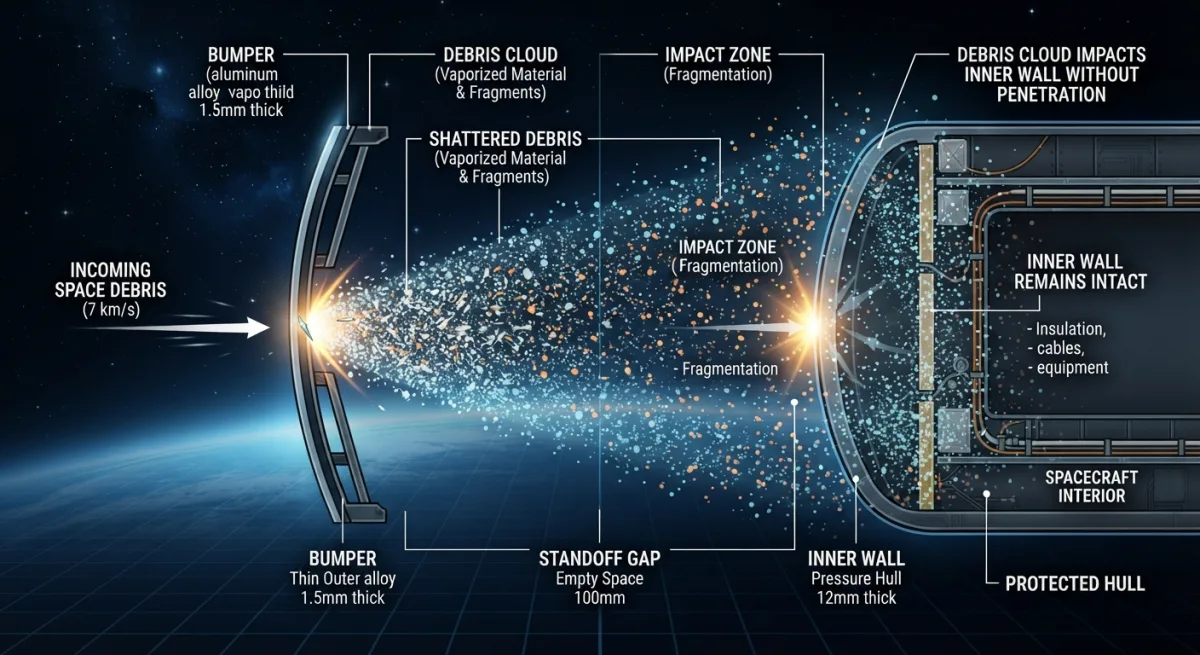
A Whipple shield is a type of protective structure installed around spacecraft to reduce damage from micrometeoroids and orbital debris (MMOD). It normally has two main walls: a thin outer plate called the bumper and a stronger inner wall called the rear wall or catcher.
The two walls are separated by a gap known as the standoff distance. This space is essential because it gives fragments from an impact room to spread out before reaching the spacecraft's main structure.
The outer bumper is commonly made from aluminium, while the rear wall provides the final barrier against fragments that survive the first impact.
Source: NASA – HyperVelocity Impact Technology: Basic Shielding Concepts.
How Does a Whipple Shield Work?

The working principle of a Whipple shield is based on breaking up an incoming object and spreading its impact energy across a larger area.
When a small piece of debris strikes the outer bumper at high speed, the collision produces intense shock forces. The incoming object may break apart, melt or partially vaporise. Material from the bumper can also become part of the resulting cloud of fragments.
Instead of one solid object continuing towards the spacecraft, a cloud of smaller particles travels across the gap between the two walls. As this cloud expands, its energy and momentum are distributed over a wider area.
When the remaining fragments reach the rear wall, they are generally less concentrated than the original projectile. This reduces the likelihood of penetration.
However, the shield does not guarantee complete protection. Its effectiveness depends on factors such as projectile size, speed, impact angle, material thickness and the distance between the protective layers.
Source: NASA – Orbital Debris Management and Risk Mitigation.
Why Is Space Debris Dangerous?
Space debris includes abandoned satellites, fragments from old rocket stages, pieces produced by collisions and other objects left behind by previous missions.
Natural micrometeoroids are another concern. These tiny particles originate from natural space materials, including comets and asteroids.
The danger comes from their speed. Objects travelling through orbit can reach several kilometres per second. At these speeds, even a very small particle can cause significant damage when it strikes a spacecraft.
Damage can include holes in external structures, damaged instruments, compromised equipment and problems with pressurised sections of crewed spacecraft.
NASA has documented impact marks on spacecraft, including the Hubble Space Telescope. These marks provide physical evidence of the continuing collision risk in Earth's orbital environment.
Source: NASA – Space Debris: Understanding the Risks to NASA Spacecraft.
Different Types of Whipple Shields
Engineers have developed several versions of the original Whipple shield. Different spacecraft require different levels of protection depending on their mission, weight limits and operating environment.
1. Standard Whipple Shield
The standard design uses a thin outer bumper and a stronger rear wall. It relies on the initial collision to fragment the incoming object before it reaches the spacecraft's main structure.
It is relatively simple and remains an important design for spacecraft protection.
Source: NASA – Shield Development and Basic Concepts.
2. Stuffed Whipple Shield
The stuffed Whipple shield improves on the standard design by adding intermediate materials between the outer bumper and rear wall.
Materials such as Nextel ceramic fabric and Kevlar are used to provide additional protection. These layers help break up and slow the fragments produced during the initial collision.
This design is particularly useful when engineers need stronger protection without relying entirely on thick metal walls.
Source: NASA – Alternative MMOD Shielding Concepts.
3. Multi-Shock Shield
A multi-shock shield uses several layers arranged at carefully selected distances. Each layer helps break up and reduce the impact of particles before they reach the rear wall.
The repeated interactions provide additional protection compared with a basic two-wall arrangement.
Source: NASA – HyperVelocity Impact Technology: Shield Development.
Materials Used in Whipple Shield Construction
The materials used in spacecraft shielding are selected according to their strength, weight and ability to withstand high-speed impacts.
Aluminium is commonly used for the outer bumper and rear wall because it provides useful protection without adding excessive weight.
Kevlar is a strong synthetic fibre used in intermediate protective layers. Nextel ceramic fabric is another material used to help manage the energy and fragments produced during an impact.
Researchers have also investigated metallic foam, ceramic foam, aluminium honeycomb and carbon-composite materials as alternatives or improvements to traditional shield designs.
The challenge is to develop protection that is strong enough to defend the spacecraft while remaining light enough for launch and long-term operation.
Source: NASA – Alternative MMOD Shielding Concepts.
Advantages and Limitations of Whipple Shields
Whipple shields offer several advantages for spacecraft engineering.
Their layered design can provide substantial protection without requiring one extremely thick metal wall. They also allow engineers to select different materials and layer arrangements depending on the spacecraft's needs.
However, they have limitations. A shield designed for small particles may not stop a much larger object. Some slower impacts may also allow a projectile to pass through the outer bumper without breaking apart sufficiently.
Shield performance also depends on available space, impact direction and the spacecraft's weight restrictions.
For these reasons, spacecraft designers use computer simulations and physical impact tests to determine whether a particular shield can provide sufficient protection.
Source: NASA – Improved Micrometeoroid and Orbital Debris Damage Prediction.
The Future of Whipple Shield Technology
Research into spacecraft protection continues as space agencies and engineers look for lighter and more effective materials.
NASA's Johnson Space Center continues to investigate alternative shielding designs, including metallic and ceramic foams, improved intermediate layers and self-sealing materials.
Self-sealing materials are particularly interesting because they could help reduce leakage when a spacecraft's protective wall is damaged.
NASA also uses specialised computer models to estimate the size of debris that could penetrate different shield configurations. Its Bumper 3 software is used to assess micrometeoroid and orbital debris penetration risks.
These developments show that Whipple shielding is not an outdated idea. Instead, its original principle continues to influence newer spacecraft protection systems.
Sources: NASA – Alternative MMOD Shielding Concepts | NASA – Broad Application Whipple Equation.
Whipple shields are an important part of protecting spacecraft against the dangers of high-speed space debris. Their ability to break apart incoming particles and spread impact energy across a larger area makes them useful for satellites, space stations and other space vehicles.
Although no shield can prevent every possible collision, continued research into advanced materials and layered designs is improving the protection available to spacecraft.
As human activities in space continue to expand, technologies such as Whipple shields will remain important for protecting equipment, scientific missions and astronauts.
Source: NASA – HyperVelocity Impact Technology.
Frequently Asked Questions
1. Who invented the Whipple shield?
Astronomer Fred Whipple proposed the concept in 1947 as a way to protect spacecraft from micrometeoroid impacts.
Source: NASA – Orbital Debris Management and Risk Mitigation.
2. What is the main purpose of a Whipple shield?
Its main purpose is to reduce damage from high-speed micrometeoroids and orbital debris by breaking up incoming particles before they reach the spacecraft's main wall.
Source: NASA – Shield Development.
3. What materials are used in Whipple shields?
Common materials include aluminium, Kevlar and Nextel ceramic fabric. Researchers also investigate metallic foam, ceramic foam and carbon composites.
Source: NASA – Alternative MMOD Shielding Concepts.
4. Are Whipple shields used on the International Space Station?
Yes. Whipple and advanced variations of this shielding technology are among the protective concepts developed for International Space Station modules.
Source: NASA – Shield Development.
5. Can a Whipple shield stop every piece of space debris?
No. Its effectiveness depends on the object's size, speed, direction and the shield's design. Some impacts can still penetrate the protective structure.
Source: NASA – Improved Micrometeoroid and Orbital Debris Damage Prediction.
6. What is a stuffed Whipple shield?
It is an advanced version of the standard design that includes additional protective materials, such as Kevlar and Nextel, between the outer bumper and rear wall.
Source: NASA – Alternative MMOD Shielding Concepts.
7. Why is there a gap between the shield layers?
The gap allows the debris cloud created by the initial collision to expand before reaching the spacecraft's rear wall. This spreads the impact over a larger area.
Source: NASA – Orbital Debris Management and Risk Mitigation.
8. What is MMOD?
MMOD stands for Micrometeoroids and Orbital Debris. It describes the natural and human-made particles that can collide with spacecraft.
Source: NASA – Micrometeoroids and Orbital Debris.