
Water Extraction From Clay: Unlocking Dry Asteroid Volatiles
Water extraction from clay minerals on asteroids could help future space missions obtain water, produce rocket propellants, and support astronauts without transporting every supply from Earth. Research involving carbon-rich asteroids, including Bennu, has confirmed the presence of water-bearing minerals. NASA-supported technology projects have also demonstrated that water and other volatile materials can be released from meteorite samples through heating. Although many asteroids appear dry on the surface, some contain water chemically bound within their minerals, offering a potential resource for future space exploration.
Summary
-
Topic: Extracting water and other volatile compounds from clay-rich asteroid material.
-
Main resource: Water chemically bound within hydrated minerals, including phyllosilicates.
-
Scientific evidence: NASA's OSIRIS-REx mission found water-bearing minerals in samples from asteroid Bennu.
-
Extraction method: Heating mineral-rich material so water vapour can be released, collected, and condensed.
-
Potential uses: Life-support systems, drinking water after appropriate treatment, oxygen production, and rocket propellant manufacturing.
-
Main challenge: Developing equipment that operates reliably in the vacuum, low gravity, and extreme temperatures of space.
What Are Asteroid Clays and Why Do They Matter?
Asteroid clay is not exactly the same as the clay commonly used in pottery. In planetary science, the term often refers to hydrated silicate minerals, including serpentine and smectite. These minerals contain water-related components within their chemical structures.
Some asteroids formed from material that experienced chemical reactions with liquid water early in the solar system's history. Although the water may no longer exist as a liquid, evidence of it remains locked inside the minerals.
Asteroid Bennu provides a strong example. NASA's OSIRIS-REx mission found carbon-rich material and water-bearing minerals in samples collected from the asteroid and returned to Earth in September 2023. Subsequent research has helped scientists investigate the minerals and chemical processes that existed in the early solar system.
This discovery matters because water is essential for human space exploration. Transporting large quantities of water from Earth is expensive, so scientists are investigating whether future spacecraft could collect and process resources directly from asteroids.
How Water Can Be Extracted From Clay


One promising approach is thermal extraction. The basic idea is to heat water-bearing asteroid material under controlled conditions, release water vapour, and collect it for further processing.
The process would involve several stages.
First, identify suitable material. Spacecraft would use cameras, spectrometers, and other scientific instruments to identify asteroids with minerals likely to contain useful quantities of water.
Second, collect and prepare the material. A robotic system would gather small quantities of regolith, the loose material covering the asteroid's surface. Depending on the material, the system might separate, crush, or otherwise prepare it for processing.
Third, apply heat. The material would be heated in an enclosed processing chamber. As the temperature rises, water-bearing minerals release water vapour and other gases. The necessary temperature depends on the mineral composition and extraction method.
Fourth, capture the vapour. The released gases would pass through a collection system. Cooling surfaces or cold traps could capture water vapour by condensation or freezing, while other components separate unwanted gases.
Finally, purify and store the water. Collected water would need testing and treatment before use in drinking systems, life support, or industrial processes.
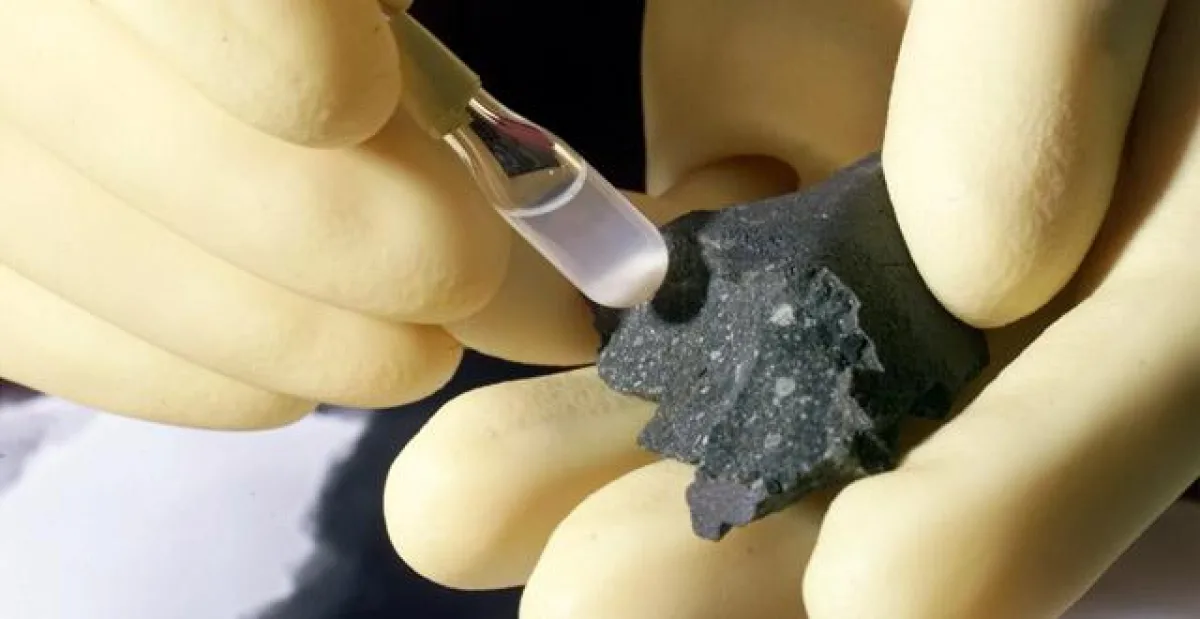
NASA-supported research has investigated these principles using meteorite samples and laboratory equipment. One technology project reported heating samples of olivine, serpentine, and carbonaceous meteorite material to approximately 650°C under vacuum conditions, then capturing released water and carbon dioxide using a liquid-nitrogen cold trap. These experiments demonstrate a possible extraction approach, not a complete operational asteroid-mining system.
The Role of Carbonaceous Asteroids
Carbonaceous asteroids are especially interesting because some contain hydrated minerals, carbon-bearing compounds, and other materials formed or altered during the early history of the solar system.
Bennu is an important research target because its returned samples allow scientists to study this material directly instead of relying only on observations from a distance.
Research published in 2026 on a recently recovered meteorite has also provided new evidence of ancient brines and chemical changes within primitive asteroid material. Such findings improve scientists' understanding of how water interacted with minerals billions of years ago.
However, not every asteroid contains the same amount of water. Mineral composition, previous heating, exposure to space, and the asteroid's history can all affect how much water remains available. Scientists must therefore determine both the quantity of water present and how difficult it would be to extract.
Potential Uses of Extracted Water
Water recovered from asteroids could support several future space activities.
-
Life support: Properly purified water could supply astronauts on extended missions.
-
Oxygen production: Water can be split into hydrogen and oxygen using electrolysis, provided sufficient power and suitable equipment are available.
-
Rocket propellant: Hydrogen and oxygen can serve as rocket propellants, although storing and handling them in space presents additional challenges.
-
Industrial applications: Water and other recovered compounds could support manufacturing and chemical processing beyond Earth.
-
Reduced resupply needs: Producing some supplies in space could reduce the amount of material that missions must launch from Earth.
NASA's Carbonaceous Asteroid Volatile Recovery project, known as CAVoR, investigated a system designed to recover water and produce hydrogen-rich synthesis gas from carbonaceous asteroid material. Its intended applications include propellant production, life-support supplies, and manufacturing. The project is listed as completed in NASA TechPort, but that status does not mean the technology has already been deployed on an asteroid.
Challenges Facing Asteroid Water Extraction
Despite its promise, extracting water from asteroid clay remains a difficult engineering task.
The first challenge is energy. Heating mineral-rich material can require substantial power, particularly when the water is chemically bound rather than present as easily accessible ice.
The second is the asteroid's low gravity. Conventional mining equipment relies on weight and friction to remain stable. On a small asteroid, drilling or digging could push equipment away from the surface unless the system is carefully designed.
Another challenge is material handling. Fine dust can interfere with moving parts, while different minerals release gases at different temperatures. Extraction equipment must also operate reliably in a vacuum and withstand large temperature changes.
Finally, economic feasibility remains uncertain. A successful mission would need to extract enough useful material to justify the cost of spacecraft development, transport, processing equipment, and operations.
Researchers are exploring alternatives, including solar-thermal systems and optical mining techniques that use concentrated sunlight to heat asteroid material. Studies of optical mining have highlighted the importance of mineral structure, heat distribution, and the behaviour of organic vapours in determining extraction performance.
The Future of Water Extraction From Asteroids
As sample-return missions and laboratory studies improve our understanding of asteroid composition, researchers are building a stronger scientific foundation for future resource-recovery systems.
The next major step is to demonstrate reliable extraction equipment under realistic space conditions. Such systems must prove that they can identify suitable material, release and collect water efficiently, control unwanted gases, and operate with limited human intervention.
If these challenges can be overcome, water-bearing asteroid minerals could become a useful resource for missions travelling farther into the solar system. Water extraction would not eliminate the need to transport equipment, food, and other supplies from Earth, but it could eventually reduce dependence on Earth-based resources.
The most important point is that water locked inside asteroid clay is a scientifically established phenomenon, while large-scale mining and commercial water production in space remain future possibilities. Continued research will determine which asteroids offer the best resources and whether extracting them can become practical.
References
-
Journal of Aerospace Engineering, Thermal Extraction of Volatiles from Lunar and Asteroid Regolith.