
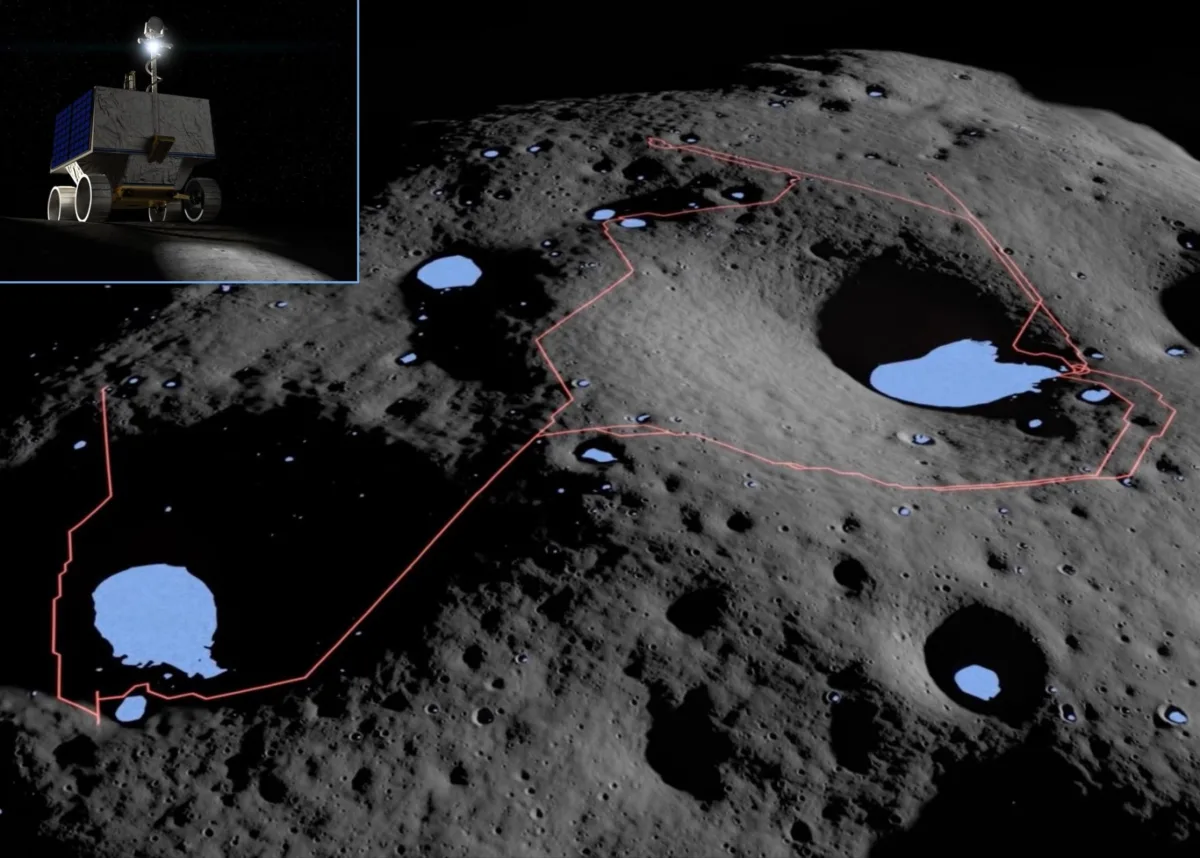
Volatiles Prospecting: How Rovers Sniff Out Hidden Space Water
Water is one of the most valuable resources scientists are searching for beyond Earth. On the Moon and Mars, robotic rovers use advanced sensors, spectrometers, drills and other scientific instruments to detect traces of water hidden beneath dusty surfaces and inside minerals. This process, known as volatiles prospecting, could help scientists understand the history of other worlds and prepare for future human exploration. By identifying where water exists, how much is present and whether it can be accessed, these robotic explorers are bringing space exploration closer to a future in which astronauts may be able to use resources found on other worlds.
What Is Volatiles Prospecting?
Volatiles prospecting is the scientific process of searching for substances that can easily evaporate or turn into gas under certain environmental conditions. These materials, known as volatiles, include water, carbon dioxide, methane, ammonia and other compounds.
Water receives particular attention because it is essential for life as we know it and could become an important resource for future space missions.
Scientists are especially interested in finding water ice around the Moon's south and north poles. Some permanently shadowed craters in these regions receive little or no direct sunlight. Their extremely low temperatures can allow frozen materials to remain trapped for very long periods.
However, finding water from orbit is not the same as understanding exactly where it is buried or how easily it can be collected. That is where robotic rovers become important.
How Rovers Search for Hidden Water

Rovers are robotic vehicles equipped with scientific instruments that allow them to investigate planetary surfaces without requiring astronauts to be present.
Rather than relying on ordinary cameras to identify water, scientists use several detection methods. Each instrument examines a different property of the soil, rocks or gases surrounding the rover.

Some instruments detect hydrogen, which is an important clue because water contains hydrogen. Others examine reflected light, identify minerals or analyse gases released from collected soil samples.
By combining these measurements, scientists can build a clearer picture of where water and other volatile materials may be hiding.
The Science Behind Water Detection

1. Neutron Spectrometers: Detecting Hydrogen Underground
One of the most interesting methods involves measuring neutrons released from a planetary surface.
Space radiation constantly interacts with the soil and rocks on the Moon and Mars, producing particles called neutrons. When these neutrons encounter hydrogen atoms, they lose energy.
Because hydrogen is a major component of water, changes in neutron energy can help scientists identify underground areas containing hydrogen-rich materials.
NASA's planned VIPER rover will carry an instrument called the Neutron Spectrometer System (NSS). It is designed to detect possible water deposits up to approximately three feet (one metre) below the lunar surface.
However, hydrogen does not automatically mean water ice is present. It can also occur in other hydrogen-bearing materials. Scientists therefore need additional measurements to establish what they have discovered.
2. Spectrometers: Identifying Water and Other Materials
Spectrometers help scientists identify substances by studying how they interact with different wavelengths of light.
NASA's VIPER mission is designed to use the Near-Infrared Volatiles Spectrometer System (NIRVSS) to investigate materials brought up from beneath the lunar surface.
The instrument examines the light reflected by soil and minerals, helping researchers distinguish between water, hydroxyl and other hydrogen-containing substances.
This distinction is important because water molecules and hydroxyl groups are chemically different, even though both contain hydrogen and oxygen.
NIRVSS will also help identify other potentially useful materials, including frozen carbon dioxide, methane and ammonia.
3. Drilling Beneath the Surface

A rover cannot always discover everything by examining the ground from above. Some potentially valuable materials may be buried beneath layers of dust and rock.
That is why NASA designed VIPER with a specialised drilling system called TRIDENT, short for Regolith and Ice Drill for Exploring New Terrains.
The drill is designed to reach approximately one metre beneath the lunar surface, collecting soil samples from different depths.
These samples can then be examined by other onboard instruments to determine their composition and whether they contain frozen water or other volatile materials.
This approach allows scientists to investigate not only whether water exists, but also how its concentration changes below the surface.
4. Mass Spectrometers: Analysing Released Gases
Another important instrument is the mass spectrometer.
When scientists collect lunar soil samples, some volatile materials can release gases. A mass spectrometer examines these gases and helps identify their chemical composition.
VIPER's Mass Spectrometer Observing Lunar Operations (MSolo) is designed to work alongside NIRVSS, analysing gases released from excavated material.
This gives researchers another way to investigate whether a sample contains water and other volatile compounds.
Together, the instruments provide a much stronger scientific picture than any single measurement could offer.
Real Examples: How Mars Rovers Have Searched for Water

Water prospecting is not limited to the Moon. Mars rovers have spent years investigating evidence of water in the planet's rocks and soil.
One important example is NASA's Curiosity rover, which landed on Mars in August 2012.
Curiosity carries an instrument called the Dynamic Albedo of Neutrons (DAN). It measures changes in neutron energy to detect hydrogen beneath the Martian surface.

In 2015, NASA reported that DAN had detected an unusually hydrogen-rich area near Marias Pass in Gale Crater. The findings suggested the presence of water molecules or hydroxyl associated with minerals or water absorbed by the soil.
The discovery demonstrated how a rover could identify hidden water-related materials without physically digging into every location.
Curiosity also carries two important laboratory instruments.
-
CheMin: Uses X-ray diffraction to identify minerals in collected rock and soil samples. Some minerals provide evidence of ancient water environments.
-
SAM: The Sample Analysis at Mars instrument examines gases and chemical compounds released from samples, helping scientists investigate the planet's chemical history.
These instruments help researchers understand how water influenced the Martian environment over billions of years.

NASA's VIPER Mission: A Major Step Towards Finding Lunar Water

One of the most ambitious projects in lunar water exploration is NASA's Volatiles Investigating Polar Exploration Rover, better known as VIPER.
Unlike earlier lunar missions that mainly studied the Moon from orbit or examined limited landing areas, VIPER is designed to travel across the lunar surface, investigating different environments and collecting information about potential water deposits.
The mission was originally discontinued in July 2024 because of rising costs and scheduling difficulties. However, NASA later announced a new arrangement with Blue Origin on September 19, 2025, to deliver the rover to the Moon using its Blue Moon Mark 1 lander.
As of November 2, 2026, NASA's published plans target a late-2027 arrival at the lunar south pole. The rover is expected to travel more than 18 miles (30 kilometres), examining different locations, temperatures and soil conditions during its exploration. It has not yet landed on the Moon.
Another important development is the Lunar Polar Exploration (LUPEX) mission, led by Japan's JAXA and India's ISRO, with NASA contributing a neutron-detection instrument.
The mission is planned to investigate possible water ice deposits near the lunar south pole, with arrival expected no earlier than 2028.

Why Finding Water in Space Matters
Finding water beyond Earth could transform how future space missions are planned.
Water is not simply something astronauts would need for drinking. If suitable deposits can be accessed and processed, they could support several important activities.
Human survival: Water could provide an essential resource for astronauts living and working on the Moon.
Oxygen production: Water molecules contain oxygen, which could potentially be separated and processed to support breathing systems.
Rocket fuel: Water can be separated into hydrogen and oxygen, two substances that can serve as rocket propellants when produced and handled using appropriate technology.
Scientific discoveries: Studying frozen water deposits could help scientists understand how water reached the Moon, how it has been preserved and what these materials reveal about the early solar system.
However, finding water does not automatically mean it can be harvested economically. Scientists must determine its concentration, depth, physical condition and accessibility before considering it a practical resource.
Challenges Facing Water-Hunting Rovers
Prospecting on other worlds is far from easy.
The lunar south pole contains extremely cold, permanently shadowed regions where sunlight never reaches the surface. These locations are scientifically valuable but present serious engineering challenges.
Rovers must operate in harsh temperatures, navigate uneven ground and manage limited power supplies.
Lunar dust is another problem because it can interfere with mechanical equipment and sensitive instruments.
Communication is also important. Although the Moon is relatively close to Earth, operators must carefully plan rover movements and scientific observations.
Scientists must also avoid confusing hydrogen-rich minerals with actual water ice. Multiple instruments and laboratory-style analysis are necessary to establish what a sample really contains.
The Future of Volatiles Prospecting
The next generation of robotic explorers will make it possible to investigate planetary resources in greater detail.
Missions such as VIPER and LUPEX represent an important step towards understanding the Moon's hidden water deposits. Their findings could help determine where future exploration bases should be established and whether lunar resources can support longer human missions.
Mars exploration will also benefit from improved chemical analysis, subsurface sensing and sample collection technologies.
Ultimately, volatiles prospecting is about more than discovering frozen water. It is about understanding what other worlds contain and whether humans can responsibly use resources found beyond Earth.
As robotic technology advances, the search for hidden water could become one of the most important parts of humanity's journey towards exploring the Moon, Mars and other destinations in the solar system.
Frequently Asked Questions
1. What is volatiles prospecting?
It is the process of searching for materials such as water, carbon dioxide, methane and ammonia on planetary surfaces and beneath the ground.
2. How do rovers detect water underground?
They use instruments such as neutron spectrometers, infrared spectrometers and drills to identify hydrogen-rich materials and analyse soil samples.
3. What is NASA's VIPER rover?
VIPER stands for Volatiles Investigating Polar Exploration Rover. It is a NASA robotic rover designed to investigate water ice and other resources around the Moon's south pole.
4. Can rovers detect water without digging?
Yes. Neutron spectrometers can detect hydrogen beneath the surface, providing clues about possible water deposits without initially excavating the soil.
5. Why are scientists searching for water on the Moon?
Water could support future astronauts, provide oxygen and potentially be processed into rocket fuel.
6. Has water been discovered on Mars?
Yes. Multiple spacecraft have identified evidence of water ice, hydrated minerals and geological features associated with ancient flowing water.
7. What is the TRIDENT drill?
It is VIPER's specialised drilling system, designed to collect lunar soil samples from depths of up to one metre.
8. When will NASA's VIPER rover reach the Moon?
NASA's published schedule targets a landing near the lunar south pole in late 2027.
9. What is the difference between water and other volatiles?
Water is a specific chemical compound made of hydrogen and oxygen. Volatiles are a broader category of substances that can readily evaporate under certain environmental conditions.
10. Could humans eventually use water found on the Moon?
Potentially, yes. However, scientists must first establish how much water exists, where it is located and whether it can be extracted and processed economically.