
Viking 1 Mars Orbiter: Looking Back at the Four-Year Mission
Viking 1 is remembered mainly because its lander became the first U.S. spacecraft to land successfully on Mars in 1976. But the Viking 1 Orbiter deserves equal attention. The orbiter spent more than four years circling Mars, photographing the planet, studying its atmosphere and surface temperature, mapping water vapor, examining the moons Phobos and Deimos, and helping scientists choose a safe landing site for its own lander.
Launched from Cape Canaveral on August 20, 1975, Viking 1 reached Mars on June 19, 1976. Its orbiter ultimately completed about 1,488 orbits before NASA ended its operations on August 7, 1980, when its attitude-control propellant was running out.
The mission was originally designed around a much shorter operational period. Instead, Viking 1 became one of the most productive Mars missions of its era. Its cameras provided an enormous amount of information about the planet, and imagery from the Viking orbiters eventually contributed to global maps covering about 97% of Mars at roughly 300-meter resolution.
Even today, Viking's data remains important. USGS says Viking imagery is still used to help verify and control data arriving from newer Mars missions.
Mission Summary
| Detail | Viking 1 Orbiter |
|---|---|
| Mission | NASA Viking 1 |
| Destination | Mars |
| Spacecraft type | Orbiter and lander combination |
| Launch date | August 20, 1975 |
| Launch vehicle | Titan IIIE-Centaur |
| Launch site | Cape Canaveral, Launch Complex 41 |
| Mars orbit insertion | June 19, 1976 |
| Lander landing | July 20, 1976 |
| Orbiter end of mission | August 7, 1980 |
| Planned mission life | Approximately 90 days after landing for the Viking mission |
| Actual orbiter life | More than four years in Mars orbit |
| Orbits completed | About 1,488 |
| Main instruments | Visual Imaging Subsystem, MAWD, IRTM |
| Primary role | Imaging, atmospheric water-vapor studies and thermal mapping |
| Operator/management | NASA, with Langley Research Center managing the project and JPL handling spacecraft operations |
| Target | Mars |
NASA identifies Viking 1 as an orbiter-and-lander mission, with the orbiter entering Mars orbit on June 19, 1976, and the lander reaching Chryse Planitia one month later.
What Was Viking 1?
Viking 1 was one of two nearly identical NASA Viking spacecraft sent to Mars in the mid-1970s. Each Viking spacecraft consisted of an orbiter and a lander.
The orbiter was essentially the spacecraft's Mars observation platform. It remained in space around the planet while the lander separated and descended to the surface.
NASA explains that the orbiters were based heavily on the design of the earlier Mariner 9 spacecraft. Their job was to obtain high-resolution images and study Mars' atmosphere and surface from orbit.
The Viking 1 spacecraft was also unusually important because the orbiter and lander worked together. Orbital observations were not only scientific. They had direct operational importance.
Before Viking 1 landed, engineers and scientists used images from the orbiter to inspect possible landing areas. Those pictures showed that the original target was more dangerous than expected.
That changed the landing plan.
Why NASA Sent Viking 1 to Mars
By the early 1970s, NASA had already gathered a significant amount of information about Mars through Mariner missions. But scientists still knew relatively little about what the planet was actually like on the ground.
NASA wanted Viking to go much further.
The broad goals included:
-
studying the Martian atmosphere
-
photographing and mapping the planet
-
examining surface temperatures
-
measuring atmospheric water vapor
-
investigating the geology and composition of Mars
-
landing instruments on the surface
-
looking for possible evidence of life
The mission was therefore much more ambitious than simply taking photographs.
The combination of orbiter and lander gave scientists two different perspectives: the orbiter provided the large-scale picture from above, while the lander carried out detailed experiments directly on Mars.
NASA describes Viking as a mission designed to investigate Mars and search for signs of life, while its orbital instruments focused on imaging, water-vapor mapping and thermal measurements.
The Launch of Viking 1
Viking 1 launched on August 20, 1975, aboard a Titan IIIE-Centaur rocket from Launch Complex 41 at Cape Canaveral.
At the time, the fully fueled Viking spacecraft was the heaviest planetary spacecraft the United States had launched, weighing about 7,776 pounds (3,527 kilograms). The Titan IIIE-Centaur was required because of the enormous energy needed to send it on its journey to Mars.
Viking 1 then spent roughly 304 days traveling through space.
It was not a simple straight-line trip. The spacecraft needed carefully planned navigation and later course corrections to reach the correct point in Mars' orbit.
NASA records three major course corrections during the journey: August 27, 1975, June 10, 1976, and June 15, 1976.
Arriving at Mars
On June 19, 1976, Viking 1 successfully entered orbit around Mars.
Its initial orbit was highly elliptical, approximately 1,500 by 50,300 kilometers. The following day, NASA adjusted the spacecraft into a more useful operational orbit of about 1,500 by 32,800 kilometers.
This was the point when Viking 1 truly began its work around Mars.
The orbiter immediately started returning images.
And those images created a problem.
The Landing Site Had to Be Changed
NASA managers had originally hoped to land Viking 1 on July 4, 1976, a date that would have coincided with the United States Bicentennial.
But orbital photographs raised concerns.
The planned area looked rougher than expected, with terrain that could threaten the lander's descent and landing. NASA therefore postponed the landing while teams searched for a safer location.
This is one of the clearest demonstrations of why the orbiter mattered.
Viking 1 was not simply taking pictures for scientists to study years later. Its observations were being used in real time to make decisions that could determine whether the lander survived.
A safer site was eventually selected in Chryse Planitia, an extensive plain associated with ancient channels and flood-related terrain.
On July 20, 1976, the lander separated from the orbiter and successfully descended to the surface.
The landing became historic.
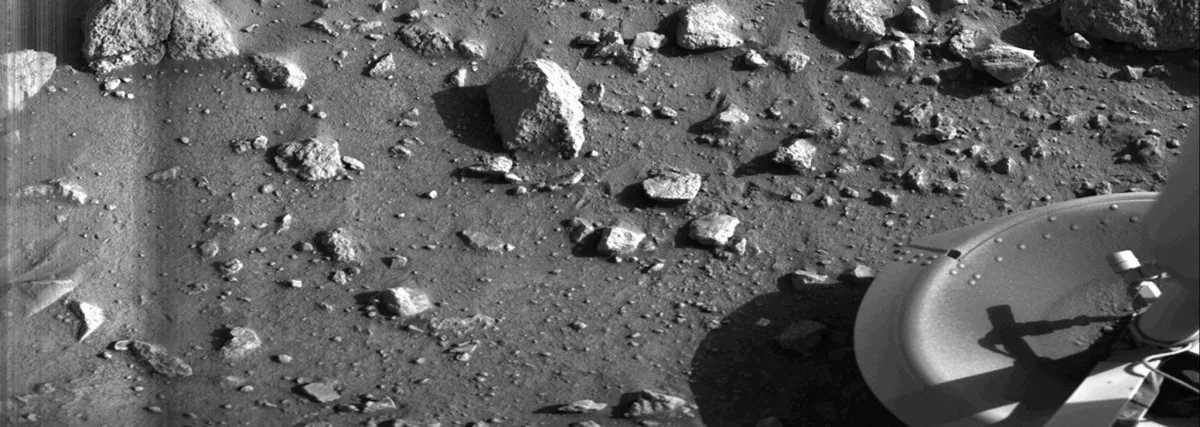
Within minutes, Viking 1 sent back the first photograph ever taken from the surface of another planet.
The lander became the headline-making part of the mission, but it could not have safely reached its selected landing area without information from the orbiter.

The Instruments That Made Viking 1 Powerful
The Viking 1 Orbiter carried three main scientific experiments.
Visual Imaging Subsystem
The Visual Imaging Subsystem, or VIS, consisted of two high-resolution slow-scan television cameras.
The cameras were mounted together on a scanning platform, with their optical axes separated by about 1.38 degrees.
These cameras produced the images that transformed scientists' understanding of Mars.
Instead of seeing Mars only as a distant reddish disk, scientists could examine mountains, volcanoes, canyons, plains, channels, craters, polar regions and other surface features in much greater detail.
The cameras also helped create enormous mosaics of the planet.
USGS later used thousands of Viking Orbiter images to construct global cartographic products. One major Viking-derived global mosaic incorporates approximately 4,600 Viking Orbiter images and provides gap-free coverage of Mars at about 232 meters per pixel at the equator.
Mars Atmospheric Water Detector
The Mars Atmospheric Water Detector (MAWD) was an infrared spectrometer designed to measure water vapor.
The instrument observed infrared radiation reflected from the Martian surface through the atmosphere back toward the spacecraft.
Water vapor was important because even though Mars is extremely dry today, water is central to understanding the planet's climate history.
Viking's atmospheric observations therefore became part of a much larger scientific effort to understand how water moved through the Martian environment and how the planet changed over time.
Infrared Thermal Mapper
The Infrared Thermal Mapper (IRTM) measured the temperatures of the atmosphere and surface.
NASA says the instrument could measure temperature differences of about 1 degree Celsius over a very large temperature range, extending from about −130°C to +57°C.
This allowed scientists to study how Mars' surface responded to sunlight and how different terrains behaved thermally.
Thermal data could also help researchers understand surface materials and atmospheric conditions.
What Viking 1 Orbiter Saw
The images from Viking 1 changed the visual understanding of Mars.
Scientists saw a planet with enormous geological variety.
The orbiter revealed extensive volcanic regions, gigantic canyon systems, cratered highlands, smooth plains, channels and other terrain shaped by processes that happened over immense spans of time. NASA summarizes the Viking results as showing volcanoes, lava plains, huge canyons, cratered terrain and evidence of surface water.
One of the most spectacular targets was Valles Marineris, the enormous canyon system near Mars' equator.
Viking imagery helped reveal its extraordinary scale and complexity.
NASA/JPL later produced mosaics using Viking 1 images showing the vast canyon system, as well as volcanic landscapes around the Tharsis region. (NASA Jet Propulsion Laboratory)
Olympus Mons From Viking 1
Viking 1 also produced important views of Olympus Mons, the enormous shield volcano on Mars.
A NASA/JPL color mosaic released from Viking 1 imagery used images from orbit 735 on June 22, 1978. The mosaic shows the volcano and its surrounding aureole terrain.
Viking was helping scientists move from a vague understanding of Mars toward something closer to a planetary geological survey.
Images of Mars' Moons
The Viking orbiters also photographed Phobos and Deimos, Mars' two small moons.
NASA notes that the orbiters produced striking images of both moons, adding useful observations of these irregular bodies to the mission's broader investigation of the Martian system. (NASA)
This expanded Viking's reach beyond Mars' surface itself.
Mapping Almost the Entire Planet
One of the greatest achievements of the Viking orbiters was the amount of Mars they mapped.
Together, Viking 1 and Viking 2 returned 52,663 images of Mars and mapped about 97% of the planet's surface at approximately 300-meter resolution. Selected locations were imaged at still higher resolution, down to about 8 meters. (NASA)
That is extraordinary considering the technology of the 1970s.
The images were not just stored as historical photographs. They became scientific and cartographic data.
USGS explains that Viking-derived products include global mosaics, polar maps, hemispheric views and other cartographic datasets, and that Viking imagery continues to be useful for checking and controlling observations from newer missions. (Astrogeology)
This is one reason Viking 1 still matters decades after it stopped transmitting.
The Four-Year Orbital Mission
When Viking 1 reached Mars, the spacecraft was not expected to keep operating for years and years.
The original Viking mission was designed for a much shorter period. NASA says the mission was planned around roughly 90 days of operation after landing, but both orbiters and landers far exceeded their expected lifetimes.
Viking 1's orbital mission went through several phases.
Primary Mission
The early period focused heavily on arriving at Mars, surveying the landing region, supporting the landing and beginning the spacecraft's main scientific program.
Extended Mission
After the primary mission ended in November 1976, Viking activities continued into an Extended Mission from November 1976 to May 1978.
Continuation Mission
The next phase ran from May 1978 to July 1979.
Survey Mission
After that, Viking 1 Orbiter entered a Survey Mission from July 1979 to July 1980.
The fact that NASA kept finding useful science to do says a lot about the quality of the spacecraft and its instruments.
Why the Orbiter Eventually Had to Stop
The Viking 1 Orbiter did not fail because scientists suddenly lost interest in Mars.
Its main problem was fuel for attitude control.
A spacecraft in orbit must constantly control its orientation. Viking 1 needed to keep its communications antenna pointed toward Earth and its solar panels correctly oriented toward the Sun.
That required attitude-control gas.
By late July 1980, engineers were closely watching the spacecraft because its supply was nearly exhausted.
On August 7, 1980, engineers at the Jet Propulsion Laboratory sent the command to turn off Viking 1 Orbiter.
NASA says the orbiter had completed about 1,488 Mars orbits.
The contemporary JPL announcement described the mission as a four-year mission and said the spacecraft was expected to lose its ability to maintain the correct orientation when its attitude-control gas ran out.
There is a small difference in the way NASA historical sources count the final orbit: the current NASA Science page gives 1,488 completed orbits, while the 1980 JPL announcement refers to the spacecraft approaching its next orbit. The safest description is therefore that Viking 1 completed roughly 1,488 orbits before shutdown.
Viking 1 Did Not Crash Into Mars
An interesting part of the shutdown story is what happened afterward.
NASA did not simply let the orbiter plunge onto Mars.
The JPL announcement explained that Viking 1 would remain in orbit long after the end of operations, helping avoid unnecessary contamination of the Martian surface from a spacecraft that had been operating around the planet.
That reflects another important feature of the Viking program: planetary protection.
NASA was searching for possible life on Mars. Introducing unnecessary material from Earth onto the surface could therefore complicate future investigations.
The Orbiter and the Search for Life
Viking is often remembered because its landers performed biological experiments designed to search for signs of life.
The orbiters themselves did not directly perform those biological experiments.
Their role was different.
They helped scientists understand the planet's environment and identify geological and atmospheric conditions.
The Viking landers carried several biology experiments, including gas-exchange, labeled-release and pyrolytic-release investigations, as well as a gas chromatograph-mass spectrometer designed to detect organic compounds.
The experiments produced intriguing chemical activity, but NASA says they did not provide definitive evidence of living microorganisms at the landing sites.
This distinction is important.
The Viking results did not prove that Mars had never contained life.
Instead, they showed that no convincing evidence of living organisms was detected at the places and under the conditions tested.
What Viking 1 Taught Scientists About Mars
The Viking program fundamentally improved scientists' understanding of Mars.
The planet appeared as a world with:
-
enormous volcanic regions
-
giant canyon systems
-
ancient channels
-
cratered highlands
-
lava plains
-
a thin carbon-dioxide-rich atmosphere
-
severe temperature variation
-
seasonal changes
-
wind-driven processes
-
evidence that water had played an important role in the past
NASA's modern summary of Viking science emphasizes ancient river channels and evidence of massive flooding as major discoveries from the mission.
The orbiter was especially important because geological features that were difficult to understand from one landing site became much easier to interpret when scientists could compare them across the planet.
A channel seen at one location could be understood in the context of a much larger landscape.
A volcanic structure could be compared with others.
The planet could begin to be studied as an interconnected geological system rather than as a collection of isolated photographs.
Major Viking 1 Orbiter Achievements
| Achievement | Why It Mattered |
|---|---|
| Entered Mars orbit on June 19, 1976 | Established long-term orbital observations of Mars |
| Helped evaluate landing sites | Orbital imagery revealed unsafe terrain and helped scientists choose a safer area |
| Returned extensive surface imagery | Greatly improved knowledge of Martian geology |
| Studied atmospheric water vapor | Helped investigate Mars' atmospheric water cycle |
| Mapped thermal conditions | Revealed how the planet's surface and atmosphere behave under changing temperatures |
| Imaged Phobos and Deimos | Expanded Viking's study to the Martian moons |
| Contributed to global Mars mapping | Viking data became the basis for major planetary maps |
| Operated for more than four years | Greatly exceeded its expected lifetime |
| Completed about 1,488 orbits | Demonstrated remarkable long-term spacecraft reliability |
| Supplied data still used today | Viking imagery remains valuable for modern cartography and mission analysis |
A Mission That Helped Define Modern Mars Exploration
It is difficult to overstate how important Viking 1 was to later Mars missions.
Before Viking, Mars had been photographed from space, but Viking pushed planetary exploration into a much more complete phase.
It combined:
orbital reconnaissance + landing + surface imaging + environmental measurements + soil analysis + life-detection experiments.
That combination became enormously influential.
Modern Mars missions use more advanced technology, higher-resolution cameras and more sophisticated analytical instruments, but many of the fundamental questions remain similar:
What happened to Mars' water?
Was the planet ever habitable?
What geological processes shaped it?
How does its atmosphere change?
Could environments beneath or within the surface have once supported life?
NASA's current Viking anniversary material explicitly notes that modern missions continue investigating whether Mars was once habitable and that today's life-detection strategies continue to be informed by lessons from Viking.
Viking 1 Compared With Today's Mars Orbiters
Technologically, Viking 1 now looks extremely old.
Its imaging system relied on vidicon television cameras, and the spacecraft had far less computing power and communications capability than modern Mars orbiters.
Today, spacecraft such as Mars Reconnaissance Orbiter can produce images at dramatically finer resolution and carry instruments designed for highly specialized geological and atmospheric measurements.
Yet Viking's importance is not measured by modern technical specifications alone.
Its achievement was that it worked.
It got to Mars.
It entered orbit.
It surveyed the planet.
It helped guide a successful landing.
It continued gathering scientific data for years.
And its datasets became foundational records of the Martian surface.
Viking 1 and the First Close Look at Mars
The cultural impact of Viking was also enormous.
The first photographs from the surface of Mars transformed the planet from an astronomical object into a place people could visually explore.
The first panorama showed a rocky Martian landscape stretching toward the horizon. The first color image revealed the reddish landscape that would become familiar to generations of Mars enthusiasts.
But the orbiter gave the public something else: a view of Mars as a whole world.
From orbit, people could see volcanoes, enormous canyons and vast plains.
This combination of orbital and surface views helped establish Mars as a real physical world rather than simply a distant point of light.
The Final Days of Viking 1 Orbiter
By July 1980, the end was approaching.
Engineers monitored the attitude-control system carefully, knowing that once the gas supply was exhausted, the spacecraft would no longer be able to maintain its orientation.
That would eventually mean losing its ability to communicate properly and keep its systems pointed where they needed to be.
Rather than waiting for the spacecraft to fail unpredictably, JPL engineers deliberately issued a shutdown command on August 7, 1980.
After more than four years around Mars, Viking 1 Orbiter became silent.
Its mission was over.
Its science was not.
The images, measurements and maps it produced continued to be analyzed long afterward.
Viking 1 Orbiter Timeline
| Date | Event |
|---|---|
| August 20, 1975 | Viking 1 launches from Cape Canaveral |
| August 27, 1975 | First major course correction |
| June 10, 1976 | Second major course correction |
| June 15, 1976 | Third major course correction |
| June 19, 1976 | Viking 1 enters Mars orbit |
| June 20, 1976 | Orbiter begins imaging the planned landing region |
| July 1976 | Orbital imagery leads to reconsideration of the landing area |
| July 20, 1976 | Viking 1 lander separates and lands at Chryse Planitia |
| July 1976 onward | Orbiter continues imaging and atmospheric/thermal science |
| November 1976 | Primary Viking mission ends; extended mission begins |
| May 1978 | Continuation Mission begins |
| July 1979 | Viking 1 Orbiter enters Survey Mission |
| July 1980 | Final operational phase |
| August 7, 1980 | Viking 1 Orbiter is shut down |
| After August 1980 | Orbiter remains in Mars orbit after operations end |
The chronology is based primarily on NASA's mission history and the JPL shutdown announcement. (NASA Science)
Why Viking 1 Still Matters in 2026
The year 2026 marks 50 years since Viking 1 landed on Mars, and NASA is using the anniversary to revisit the mission's history and influence on planetary exploration.
The orbiter's importance is especially clear when looking at modern Mars maps.
USGS still distributes Viking-derived global products, and some of these datasets incorporate thousands of original Viking images. The agency says Viking imagery remains useful for verifying and controlling data collected by later missions.
So Viking 1 is not simply an old mission sitting in history books.
Its observations remain part of the scientific record researchers use to understand Mars.5 Powerful SEO Title Options
References
NASA Science — Viking 1. Mission overview, dates, instruments, results and orbiter shutdown. (NASA Science)
NASA Science — Viking Project. Mission objectives, 1,488-orbit figure and overall scientific results. (NASA Science)
NASA Science — Viking Spacecraft and Science. Orbiter instruments, communications systems and scientific capabilities. (NASA Science)
NASA Science — Viking: 50 Years on Mars. Current 2026 anniversary information and mission legacy. (NASA Science)
NASA History — 45 Years Ago: Viking 1 and 2 Off to Mars. Launch, cruise, mission design and historical context. (NASA)
NASA History — 45 Years Ago: Viking 1 Touches Down on Mars. Landing-site change, landing and first images. (NASA)
NASA/JPL — Viking Orbiter 1 Mission Concluded. August 7, 1980 shutdown and attitude-control issue. (NASA Jet Propulsion Laboratory)
NASA/JPL — Viking 1 Mission. General mission background and scientific instruments. (NASA Jet Propulsion Laboratory)
USGS Astrogeology — Mars Viking Colorized Global Mosaic 232m. Viking-derived planetary mapping data and approximately 4,600-image mosaic. (Astrogeology)
USGS Astrogeology — Mars Viking Global Products. Continuing use of Viking imagery in modern Mars cartography. (Astrogeology)
NASA/JPL — Color Mosaic of Olympus Mons. Viking 1 Orbiter imagery from orbit 735. (NASA Jet Propulsion Laboratory)
NASA/JPL — Photomosaic of the Tharsis Region. Viking 1 Orbiter imagery of the Tharsis volcanic region. (NASA Jet Propulsion Laboratory)
NASA/NTRS — The First Viking Mission to Mars by Gerald A. Soffen and Conway W. Snyder, Science, 1976. Contemporary scientific account of the mission. (NASA Technical Reports Server)
NASA/NTRS — Viking 1: Early Results. Contemporary account of early orbital and surface science. (NASA Technical Reports Server)