
The Outer Space Treaty Challenges: Revising Outdated 1967 Laws
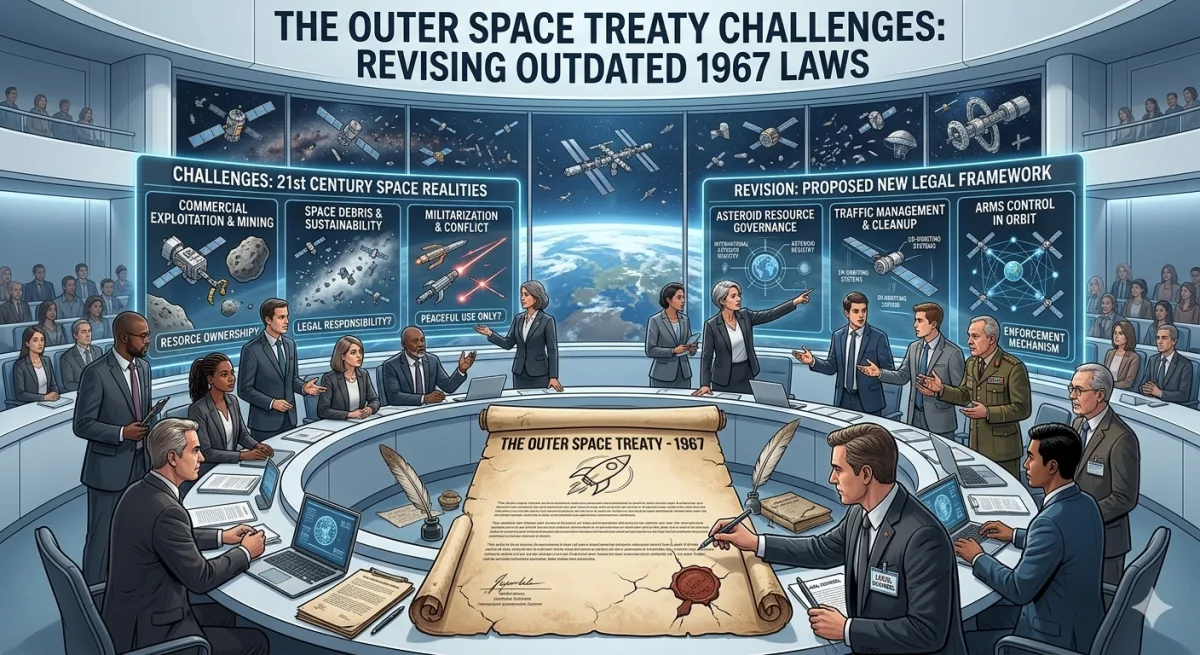
The 1967 Outer Space Treaty remains the foundation of international space law, but the space environment it governs has changed dramatically. When the treaty entered into force in October 1967, human spaceflight was still in its early years, commercial space companies were virtually nonexistent, satellite numbers were small, and concepts such as lunar resource extraction, large satellite constellations, commercial space stations, autonomous spacecraft and routine private missions were largely part of the future.
The treaty still provides important principles, including freedom of exploration, a ban on national appropriation of outer space, international responsibility for national activities and requirements to avoid harmful interference. The challenge is that many of these principles are broad rather than detailed rules for modern activities. In 2026, the United Nations is actively working on issues such as space resources, information sharing, space traffic and long-term sustainability, while newer frameworks such as the Artemis Accords are attempting to add practical guidance without replacing the 1967 treaty.
Summary
- Full name: Treaty on Principles Governing the Activities of States in the Exploration and Use of Outer Space, including the Moon and Other Celestial Bodies
- Common name: Outer Space Treaty
- Opened for signature: January 27, 1967
- Entered into force: October 10, 1967
- Main purpose: Establish basic international rules for the exploration and use of outer space
- Key principles: Freedom of exploration, non-appropriation, peaceful use, international responsibility, liability, cooperation and avoidance of harmful interference
- Major modern challenge: The treaty provides broad principles but limited detailed rules for today's commercial and congested space environment
- Key areas under discussion today: Space resources, lunar activities, orbital debris, space traffic coordination, transparency and private-sector activities
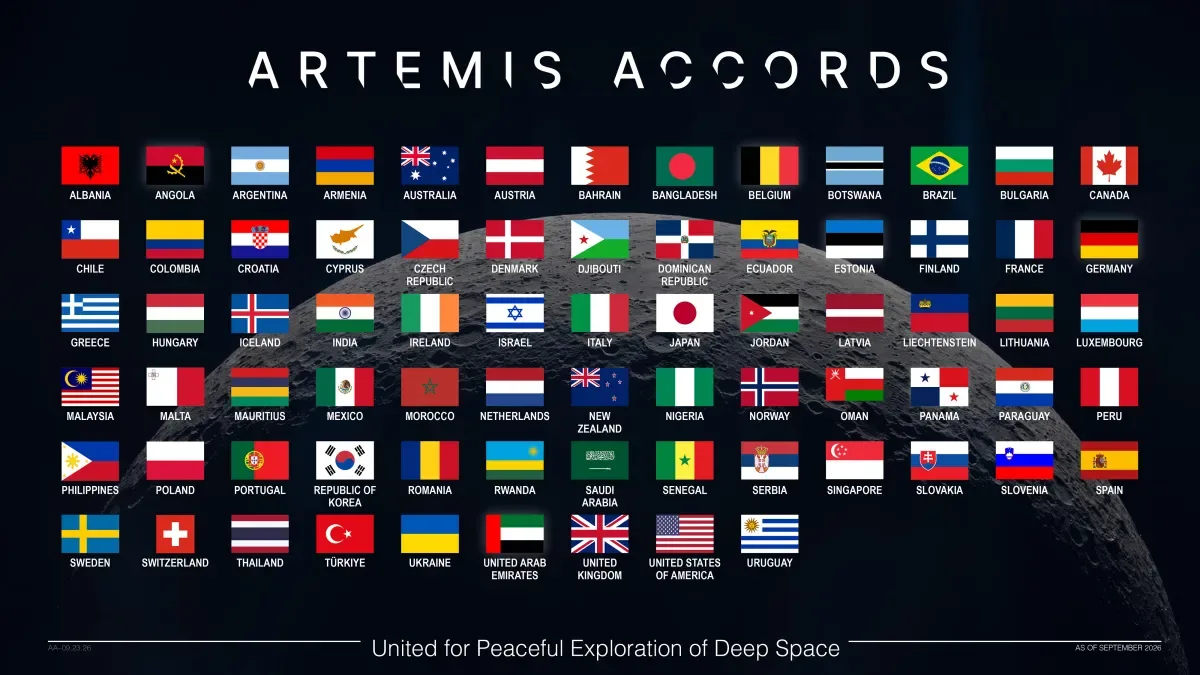
- Related modern framework: The Artemis Accords, established in 2020 and now signed by 73 countries as of September 21, 2026
- Current UN activity: COPUOS and its Legal Subcommittee are developing recommended principles for space-resource activities and new tools for information sharing under Article XI of the treaty.
What Is the Outer Space Treaty?
The Outer Space Treaty is the foundation of modern international space law.
It was negotiated during the Cold War, when the United States and Soviet Union were competing in space and governments were already thinking about the possibility of military confrontation beyond Earth. The treaty was signed in 1967 and entered into force later that year.
The agreement established several principles that continue to shape space activities today.
Article I states that the exploration and use of outer space should be carried out for the benefit and interests of all countries. It also establishes freedom of exploration and use and free access to celestial bodies.
Article II prohibits national appropriation of outer space and celestial bodies.
In simple terms, one country cannot claim the Moon, Mars or another celestial body as its territory.
Article VI is particularly important for the modern commercial space industry because it states that countries are internationally responsible for their national activities in space, including activities carried out by non-governmental entities. Private activities therefore have to be authorized and continuously supervised by the appropriate state.
Article IX requires countries to conduct their activities with "due regard" for the interests of other states and to undertake consultations where potentially harmful interference could occur.
These principles have survived for nearly six decades.
The debate is not really about whether the treaty has become useless. The larger question is whether broad principles written in the 1960s provide enough detail for an increasingly busy, commercial and technologically advanced space environment.
Why a 1967 Treaty Is Being Tested Today
In 1967, the world had only begun to experience the practical possibilities of spaceflight.
The treaty was created at a time when governments were the dominant space actors. Today, the situation is very different.
Private companies build and launch spacecraft. Companies operate large satellite constellations. Governments plan long-term lunar missions. Commercial organizations are developing spacecraft capable of servicing or moving other objects in orbit. Countries are considering the use of lunar resources, while scientific and commercial missions increasingly operate in the same areas.
The treaty was intentionally written around broad principles rather than highly detailed technical regulations.
That flexibility helped it survive technological change, but the same flexibility creates uncertainty when completely new activities appear.
A spacecraft operating near another spacecraft, for example, raises practical questions about notification, maneuvering, priority, interference and responsibility that the treaty does not answer in the same detailed way that modern aviation regulations answer comparable questions for aircraft.
This is one reason the international space-law debate in 2026 focuses increasingly on implementation and additional rules rather than simply abandoning the 1967 framework. At the 2026 UN Legal Subcommittee discussions, space traffic, space resources and debris were repeatedly identified as major legal and governance issues.
The Biggest Challenges Facing the Outer Space Treaty
| Outer Space Treaty Principle | Modern Challenge | Why More Rules May Be Needed |
|---|---|---|
| Freedom of exploration and use | Increasing congestion in popular orbits and lunar regions | Activities can interfere with one another even when every operator claims a lawful purpose |
| No national appropriation | Commercial extraction of lunar or asteroid resources | The treaty does not give detailed rules on ownership of extracted resources |
| State responsibility for private actors | Rapid growth of commercial space companies | Governments must supervise activities that may be technically and commercially complex |
| Due regard and harmful interference | Large constellations and increasingly crowded orbital environments | Operators need clearer international coordination procedures |
| Environmental protection | Orbital debris and long-term sustainability | Existing principles do not create a complete global debris-management system |
| Transparency and information sharing | Complex commercial and government missions | Article XI is broad, while modern operators need more consistent information practices |
| Peaceful use | Increasingly sophisticated military and dual-use space systems | The treaty does not resolve every question involving modern military capabilities |
| Jurisdiction and ownership | On-orbit servicing, abandoned spacecraft and debris removal | More detailed rules are needed concerning access to and control of other space objects |
1. Space Resource Mining and the Question of Ownership
One of the most important unresolved questions concerns natural resources in space.
The Outer Space Treaty prohibits national appropriation of outer space and celestial bodies. But it does not contain a detailed chapter explaining exactly what happens when a company extracts material from the Moon, an asteroid or another celestial body.
That creates an important legal distinction.
There is a difference between claiming the Moon itself as national territory and extracting a resource from the Moon. The difficult question is where international law draws the line between permitted use and prohibited appropriation.
The United States and some other countries have interpreted the Outer Space Treaty as allowing resource extraction provided that the activity does not amount to national appropriation of the celestial body itself. The Artemis Accords explicitly state that the extraction of space resources does not inherently constitute national appropriation under Article II.
Other legal scholars and states have taken different positions about how far the treaty permits resource ownership and commercial exploitation to go.
The disagreement is important because future lunar missions could make this question practical rather than theoretical.
A company could potentially extract water ice, minerals or other useful material. But who owns the material after extraction? What rights exist around a particular extraction site? How long could an operator have priority over an area? What happens if two companies want to work in the same location?
The 1967 treaty does not answer those questions in detail.
That is why the United Nations created a Working Group on Legal Aspects of Space Resource Activities. In 2026, the group had made further progress toward an initial set of recommended principles for space-resource activities.
This is one of the clearest examples of the international community trying to build modern rules around the foundation established by the Outer Space Treaty.
2. Commercial Space Companies and Article VI
Another major challenge comes from the transformation of the space industry.
In 1967, national governments were the main actors.
Today, private organizations can design spacecraft, launch satellites, operate communications constellations, develop commercial stations and participate in lunar missions.
Article VI already anticipated non-governmental activities. It says countries are responsible for national activities in space and that non-governmental activities require authorization and continuing supervision.
The problem is that the words "authorization" and "continuing supervision" are principles rather than a complete global regulatory system.
Each country develops its own national laws and licensing procedures.
That can create differences in how activities are regulated from one jurisdiction to another.
A company may therefore face one set of requirements in one country and another set somewhere else.
The international community has increasingly discussed whether national regulation alone is enough as companies become more important players in space.
The debate does not necessarily mean that the treaty must be replaced. It may mean that countries need clearer and more consistent implementation of Article VI.
3. Orbital Debris Is Becoming a Legal Problem
Space debris is another challenge that the original treaty was not designed to regulate in detail.
Dead satellites, discarded components, fragments from breakups and other human-made objects can remain in orbit for long periods.
The Outer Space Treaty contains principles concerning responsibility and harmful interference, but there is no comprehensive debris-management regime within the treaty itself.
The United Nations adopted 21 Guidelines for the Long-term Sustainability of Outer Space Activities in 2019. These guidelines are voluntary and were designed to help states and international organizations make space activities safer and more sustainable.
The continuing problem is enforcement and consistency.
A voluntary guideline is not the same thing as a universally binding requirement.
Research presented through the European Space Agency's Space Debris Conference has highlighted the lack of an internationally binding space-traffic-management framework and the difficulty of applying existing treaty provisions to debris mitigation in a precise and consistent way.
A particularly difficult issue concerns old spacecraft.
Suppose a satellite stops functioning completely. Is it abandoned property? Who is allowed to move it? Can another company remove it without permission? Who accepts responsibility if a debris-removal mission causes damage?
Existing international space law provides pieces of the answer, including continued ownership and jurisdiction over registered space objects, but it does not provide a simple, comprehensive debris-removal system.
4. Space Traffic Is Becoming More Complicated
Outer space does not have roads or traffic lights.
Yet more and more spacecraft must share the same orbital environment.
Space traffic management involves detecting objects, predicting their movements, exchanging information and reducing the risk of collision or harmful interference.
This raises questions that were not central when the treaty was drafted.
How close may one spacecraft operate to another?
Who should provide warning of a potential collision?
What information should operators be required to share?
What happens when two operators disagree about who should maneuver?
Which authority coordinates international traffic?
Article IX requires states to show due regard for the interests of other states and to consult when potentially harmful interference is expected. But the language is general.
The United Nations has recognized the need for more detailed work.
A 2025 UN conference paper noted the growth of space traffic and emphasized the importance of better space situational awareness and international information sharing. It also pointed to the 21 long-term sustainability guidelines adopted in 2019.
During the 2026 COPUOS discussions, states continued considering space traffic coordination, space situational awareness and the legal and policy aspects of traffic management.
5. The Meaning of "Harmful Interference" Needs More Detail
Article IX contains one of the treaty's most important concepts: harmful interference.
The idea makes sense.
One state's space activity should not unnecessarily interfere with another state's peaceful space activity.
But modern missions create situations that are much more complicated than anything considered in the 1960s.
Large satellite constellations can operate thousands of spacecraft. Lunar missions may eventually operate relatively close to one another. Scientific missions may require extremely sensitive observation conditions.
This creates questions about how interference should be measured.
Is interference only physical?
Can interference include radio-frequency effects?
What about interference with astronomical observations?
What about activities that create long-term environmental consequences?
The broad language of Article IX provides a foundation, but detailed technical standards can make the principle easier to apply.
That is why newer frameworks increasingly focus on notification, coordination and operational best practices.
6. The Artemis Accords Show How New Rules Are Developing
The Artemis Accords are one of the clearest examples of how countries have tried to add practical rules around the existing treaty.
NASA and the U.S. Department of State established the Accords in 2020.
They explicitly affirm continued compliance with the Outer Space Treaty and related space treaties while addressing practical questions involving lunar exploration, resource use, safety, transparency, scientific data, heritage and debris mitigation.
As of September 21, 2026, Albania became the 73rd signatory.
The Accords are particularly significant because they provide an example of countries developing additional principles without formally rewriting the 1967 treaty.
One controversial part concerns space resources.
The Accords state that extracting and using space resources can be consistent with the Outer Space Treaty and that extraction does not inherently constitute national appropriation.
Legal scholars continue to debate the wider implications of that interpretation. Some view the Accords as an important practical development, while others argue that the interpretation of Article II requires broader international agreement.
The growing number of Artemis Accords signatories also demonstrates how new space-governance frameworks are developing alongside the original treaty rather than replacing it.
7. Article XI and the Problem of Transparency
The Outer Space Treaty also contains transparency requirements.
Article XI says states should inform the UN Secretary-General, the public and the international scientific community, to the greatest extent feasible and practicable, about the nature, conduct, locations and results of their activities in outer space.
That was a meaningful idea in 1967.
But today's space sector is far more complicated.
There are commercial satellites, national-security programs, scientific spacecraft, private lunar missions, hosted payloads and other activities.
What exactly should be reported?
How frequently should information be updated?
How detailed should the information be?
What information should remain confidential for legitimate commercial or security reasons?
The UN is now working on this issue.
In February 2026, the Legal Subcommittee received a draft voluntary template for providing information on space activities under Article XI. The proposed template is intended to make information-sharing more consistent without replacing other reporting methods.
This is an important example of how an old treaty provision can be adapted through modern implementation rather than rewritten immediately.
8. The Treaty Was Not Designed for Commercial Lunar Bases
The Moon is becoming one of the most important areas of future space law.
Countries and commercial organizations are developing plans involving lunar landers, scientific instruments, communications systems and eventually more persistent infrastructure.
This creates questions the 1967 treaty does not answer in detail.
What happens when several operators need the same landing area?
How should temporary exclusion or coordination areas work?
Who protects historically important lunar sites?
How should scientific sites be protected?
What happens when commercial operations and scientific missions require access to the same location?
The Artemis Accords use the concept of temporary "safety zones" intended to prevent harmful interference. NASA describes these zones as temporary and says their use is intended to respect the Outer Space Treaty principles of free access and due regard.
The key legal issue is ensuring that a safety measure does not gradually become a territorial claim.
That is precisely where Article II and Article IX interact: there can be coordination around activities without creating national sovereignty over a celestial body.
9. Space Weapons and the Limits of the 1967 Rules
The Outer Space Treaty also deals with military issues.
Article IV prohibits placing nuclear weapons and other weapons of mass destruction in orbit or stationing them in outer space. It also requires the Moon and other celestial bodies to be used exclusively for peaceful purposes and prohibits military bases, fortifications, weapons testing and military maneuvers on celestial bodies.
However, Article IV does not provide a complete legal code covering every modern military or dual-use space capability.
This has contributed to a broader international debate over preventing an arms race in outer space.
The UN General Assembly adopted a resolution on prevention of an arms race in outer space in December 2025, with 177 votes in favour, two against and one abstention. A separate resolution on further practical measures received 121 votes in favour, 50 against and seven abstentions.
These votes show that space security remains an active area of international diplomacy.
For the Outer Space Treaty, the central challenge is that its foundational principles were written before many modern military and dual-use technologies existed.
10. What Does "Revising" the Treaty Actually Mean?
There is an important distinction between revising the treaty and developing new rules around the treaty.
The Outer Space Treaty itself contains an amendment procedure. Article XV allows a state party to propose an amendment. An amendment enters into force for states accepting it after acceptance by a majority of states parties, and then applies to other states as they accept it.
But formally changing a treaty used by a very large international community is difficult.
Countries have different interests.
Spacefaring countries may have different views from emerging space nations.
Commercial interests may differ from environmental concerns.
Some states support a stronger international resource regime, while others emphasize the freedom to explore and use space.
Because of these differences, much of the modern response has been gradual.
Instead of rewriting the entire treaty, countries have also used:
- UN resolutions
- COPUOS guidelines
- national space laws
- bilateral and multilateral agreements
- technical standards
- voluntary principles
- information-sharing systems
- operational best practices
This approach allows the legal system to evolve without reopening every part of the 1967 compromise.
What Could a Modern Space-Law Framework Address?
| Modern Issue | Possible Legal Question |
|---|---|
| Space resources | What rights exist over resources after lawful extraction? |
| Lunar operations | How can multiple operators safely work in the same region? |
| Orbital debris | Who must remove dangerous objects and who pays? |
| Space traffic | What international coordination system should operators follow? |
| Private companies | What should "continuing supervision" under Article VI require? |
| Transparency | What information must states and companies disclose? |
| Autonomous systems | How should responsibility be assigned when spacecraft operate with limited direct control? |
| Environmental protection | What standards should prevent long-term harm to the space environment? |
| Commercial stations | Which state has jurisdiction over people and property on private stations? |
| Servicing and repair | Under what circumstances may one operator interact with another operator's spacecraft? |
These questions demonstrate why the future of space law is unlikely to depend on a single document.
The treaty can remain the foundation while more detailed rules develop around it.
The 2026 Push for New International Principles
The international discussion has accelerated in 2026.
At the UN Legal Subcommittee's 65th session, the Working Group on Legal Aspects of Space Resource Activities made progress on an initial set of recommended principles.
The Legal Subcommittee also continued work on Article XI information sharing through the proposed voluntary reporting template.
During the 69th session of COPUOS in June 2026, delegates continued discussing space traffic, space resources, debris, space situational awareness and long-term sustainability.
The discussions also show that states are not necessarily looking at the Outer Space Treaty as a document that should simply be discarded.
Instead, many of the current conversations are about making its principles more practical for modern activities.
That distinction matters.
A treaty can remain legally important while requiring supplementary rules to address technologies and activities that its original authors could not have fully anticipated.
Should the Outer Space Treaty Be Rewritten?
There is no single internationally agreed answer.
A complete rewrite could create a modern framework specifically designed for commercial spaceflight, lunar activity, space resources and space traffic.
But reopening the treaty could also create disagreement over principles that have remained relatively stable for decades.
Another approach is to preserve the treaty's core provisions while developing additional agreements and detailed international standards around them.
This second approach is already visible in the Artemis Accords, the UN long-term sustainability guidelines, national space legislation and the ongoing COPUOS work on space resources and information sharing.
A third possibility is a mixture of both approaches: preserve the original treaty's principles, but gradually develop legally binding protocols or supplementary instruments dealing with particular issues.
The future may therefore involve an expanding network of space-law instruments rather than one massive replacement for the 1967 treaty.
Why the Original Treaty Still Matters
Despite all of these challenges, the Outer Space Treaty has several characteristics that remain extremely important.
It establishes that outer space cannot simply be divided among nations as ordinary territory.
It promotes freedom of exploration and use.
It establishes international responsibility for national space activities, including those carried out by private entities.
It protects the principle of international cooperation.
It provides a foundation for consultations when activities may cause harmful interference.
And it links space activities to the broader principles of international law and the UN Charter.
Those principles are not outdated simply because technology has advanced.
The challenge is that today's activities need more detailed rules beneath them.
A modern spacecraft operator needs more than a general statement about due regard. A lunar resource company needs clearer expectations regarding extraction and interference. A debris-removal company needs legal certainty about ownership and responsibility. A crowded orbital environment needs more consistent traffic coordination.
The foundation still matters.
The missing pieces are the detailed rules.
Latest Developments as of September 24, 2026
Several recent developments show how quickly this field is changing.
The Artemis Accords reached 73 signatories after Albania signed on September 21, 2026.
The UN continued its work on recommended principles for space-resource activities during 2026.
The UN also advanced a voluntary template intended to improve the sharing of information under Article XI of the Outer Space Treaty.
At the 2026 COPUOS discussions, space traffic, resources and debris remained central legal and policy questions.
The discussions demonstrate a broader shift in space governance.
The question is no longer simply how countries can reach space.
It is increasingly about how humanity can share an environment that is becoming more commercially valuable, more crowded and more technically complex.
Frequently Asked Questions
What is the Outer Space Treaty?
The Outer Space Treaty is the main international agreement establishing basic legal principles for activities in outer space, including the Moon and other celestial bodies. It was signed in 1967 and entered into force the same year.
Why is the Outer Space Treaty considered outdated by some experts?
The treaty is not outdated in the sense that it has stopped being important. Rather, many modern space activities were not technologically or commercially developed when the treaty was written. It therefore leaves several practical questions open, particularly concerning resources, commercial operations, orbital traffic and debris.
Does the Outer Space Treaty allow space mining?
The treaty does not provide a detailed space-mining regime. The legal question centers on whether extracting resources is compatible with the treaty's non-appropriation principle. The Artemis Accords state that resource extraction does not inherently constitute national appropriation, while the broader international debate continues through COPUOS.
Can a country own part of the Moon?
The Outer Space Treaty prohibits national appropriation of the Moon and other celestial bodies. A country cannot claim the Moon as sovereign territory or acquire it simply through occupation or use.
Are private companies covered by the Outer Space Treaty?
Yes. Article VI specifically addresses non-governmental entities and requires their activities to be authorized and continuously supervised by the appropriate state.
Does the treaty regulate space debris?
It contains broad principles relevant to harmful interference and international responsibility, but it does not establish a comprehensive debris-management regime. The UN has therefore developed additional long-term sustainability guidelines and continues discussing further measures.
What are the Artemis Accords?
The Artemis Accords are a set of principles for cooperation in civil exploration and use of outer space, created in 2020. They build on existing space treaties and address issues such as resource use, transparency, lunar heritage, deconfliction and debris mitigation.
How many countries have signed the Artemis Accords?
As of September 21, 2026, NASA lists 73 countries as signatories, following Albania's signing.
What is Article XI of the Outer Space Treaty?
Article XI asks states to provide information about their space activities to the UN Secretary-General, the public and the international scientific community to the greatest extent feasible and practicable. The UN is developing a voluntary template to make this information-sharing more consistent.
Will the Outer Space Treaty be replaced?
There is no current agreement to replace the treaty completely. Much of the international work is instead focused on developing complementary rules, principles, guidelines and national regulations around the treaty's existing foundation.
References
- United Nations Office for Outer Space Affairs — Outer Space Treaty: Read the official Outer Space Treaty text
- United Nations Treaty Collection — Outer Space Treaty: View the UN Treaty Collection record
- NASA — Artemis Accords: Read NASA's current Artemis Accords information
- United Nations — Draft Article XI information-sharing template, 2026: Read the 2026 UN document
- United Nations — 2026 COPUOS discussions on space resources and space governance: View the UN COPUOS record
- United Nations — 2025 space-traffic coordination paper: Read the UN conference paper
- UN Office for Outer Space Affairs — Space Treaty Implementation: Read UNOOSA's treaty implementation information
- OECD — Space Sustainability: Read the OECD overview of space sustainability
- European Space Agency — International Law of Space Traffic Management: Read the ESA conference paper
- Cambridge University Press — Artemis Accords and space resources: Read the Cambridge International Legal Materials article