
The Hubble Tension Debate: Why Universe Expansion Rates Disagree
The universe is expanding, but astronomers still cannot agree on exactly how fast it is happening. What appears to be a straightforward scientific measurement has developed into one of the biggest mysteries in modern cosmology, known as the Hubble Tension.
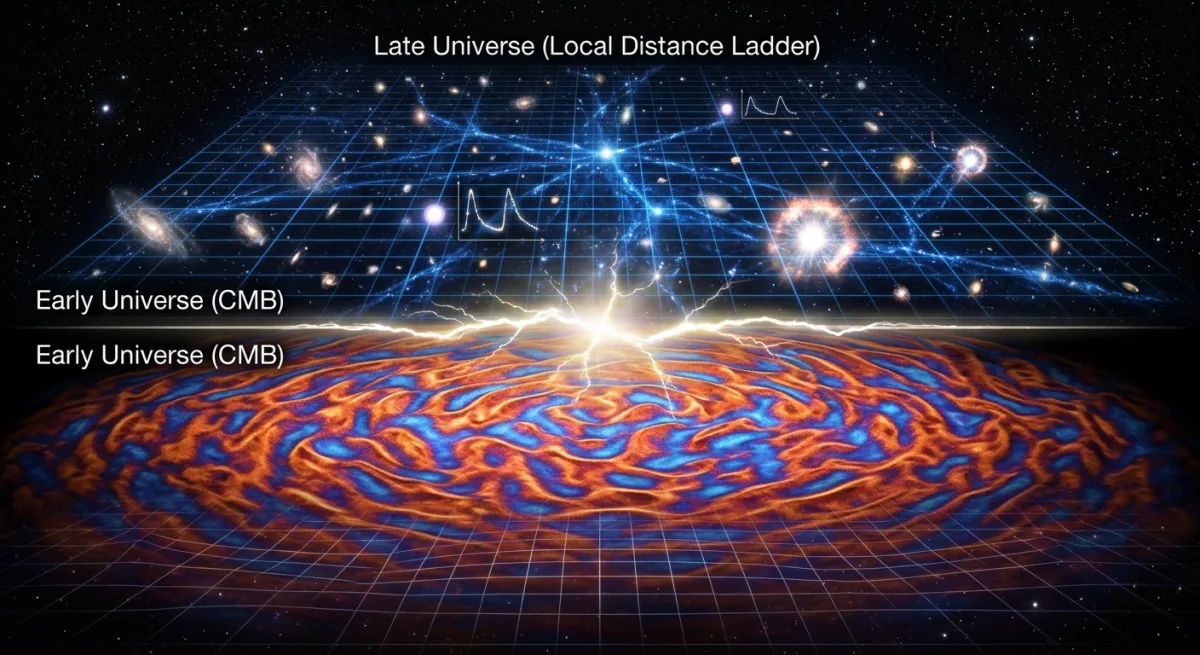
The disagreement involves two major approaches to measuring cosmic expansion. One examines the universe as it existed shortly after the Big Bang, while the other measures distances and movements of galaxies in the relatively nearby universe. Both approaches are supported by extensive scientific research, yet they continue to produce different answers.
Recent research published in 2026 has strengthened the debate, with an international collaboration reporting an exceptionally precise measurement that continues to disagree with predictions from the early universe.
Source: NASA – Understanding the Hubble Constant and Tension.

Deep-field observations reveal galaxies across enormous distances, helping astronomers investigate the expansion of the universe. Image: NASA/ESA.
What Is the Hubble Tension?
The Hubble Tension refers to the disagreement between measurements of the universe's current expansion rate. This rate is represented by a scientific value called the Hubble Constant, commonly written as H₀.
It describes how quickly distant galaxies appear to move away from us as the universe expands. The measurement is expressed in kilometres per second per megaparsec, meaning the recession speed increases with distance.
For example, a higher Hubble Constant suggests that distant galaxies are moving away faster than they would under a lower value. This measurement is important because it helps scientists understand the universe's expansion history, age and possible future evolution.
Source: NASA – Hubble Constant and Tension.
Why Are Scientists Getting Different Answers?
The disagreement mainly comes from two methods of measuring cosmic expansion.
1. Measuring the early universe
One approach uses observations of the cosmic microwave background (CMB), the faint radiation left behind from the early universe. This radiation provides information about the universe when it was approximately 380,000 years old.
The European Space Agency's Planck mission studied this radiation in extraordinary detail. When scientists interpret its observations using the standard cosmological model, known as Lambda-CDM, they obtain a Hubble Constant of approximately 67.4 kilometres per second per megaparsec.
Source: ESA – Planck Mission and Cosmological Observations.

The Planck satellite's map of the cosmic microwave background, showing tiny temperature variations in the early universe. Image: ESA/Planck Collaboration.
2. Measuring the nearby universe
The second approach measures distances to nearby galaxies using astronomical objects whose brightness can be estimated reliably.
One important method uses Cepheid variable stars, which change brightness in predictable ways. Astronomers use them to establish distances to galaxies and calibrate Type Ia supernovae, which can be observed much farther away.
The SH0ES collaboration, led by astronomer Adam Riess, has used this approach to obtain measurements around 73 kilometres per second per megaparsec.
The difference between the two approaches is substantial enough that scientists cannot simply dismiss it as an ordinary measurement variation.
Source: NASA – Webb and Hubble Telescopes Affirm the Universe's Expansion Rate.

NGC 5468, a galaxy observed using Hubble and Webb data, contains Cepheid variable stars used in cosmic distance measurements. Image: NASA/ESA/CSA.
Can the Hubble Space Telescope and James Webb Solve the Mystery?
The Hubble Space Telescope has played an important role in measuring cosmic distances, but scientists wanted to make sure that its observations were not affected by hidden errors.
One concern was stellar crowding. When stars appear close together in distant galaxies, their light can overlap, potentially making brightness measurements less accurate.
NASA's James Webb Space Telescope provided an important independent check. Its infrared instruments can distinguish individual stars more clearly in crowded regions.
In March 2024, NASA reported that observations from Webb supported the accuracy of Hubble's measurements. This made it increasingly difficult to explain the disagreement simply as an error caused by crowded stars.
However, confirming the measurements did not explain why the two methods produce different expansion rates.
Source: NASA – Webb and Hubble Confirm the Universe's Expansion Rate.
What Did Scientists Discover in 2026?
One of the most important developments came in April 2026, when the H₀ Distance Network Collaboration published a major study in Astronomy & Astrophysics.
Rather than depending on a single distance-measuring technique, researchers combined several independent methods, including Cepheid stars, red giant stars, supernovae, megamasers and other astronomical indicators.
Their analysis produced a Hubble Constant of:
73.50 ± 0.81
km/s/Mpc
Reported direct measurement, approximately 1.1% uncertainty.
The result remained significantly different from the early-universe estimate of approximately 67.24. The collaboration reported a difference of about 7.1 standard deviations under the stated cosmological assumptions.
This development is particularly important because the researchers combined multiple distance indicators rather than relying entirely on one measurement technique.

A visual representation of the astronomical distance measurements used to calculate the universe's expansion rate.
However, the debate is not completely settled. A September 2026 paper in Physical Review D examined 88 measurements that do not depend on the standard sound-horizon approach. Its analysis found a smaller, but still significant, disagreement between groups of measurement methods, illustrating how conclusions can depend on the datasets and assumptions being compared.
Source: Physical Review D – Dissecting the Hubble Tension: Insights from Sound-Horizon-Free Measurements.
Could New Physics Explain the Disagreement?
Scientists have proposed several explanations, although none has been universally accepted.
One possibility is early dark energy. This theory suggests that an additional form of energy may have briefly influenced the expansion of the universe during its early development.
Other proposals involve previously undiscovered particles, changes to gravity on cosmological scales, or more complicated behaviour of dark energy.
There is also the possibility that some systematic errors remain in astronomical measurements or in the assumptions used to interpret them.
These ideas are still being investigated. No new particle or alternative explanation has been confirmed as the solution to the Hubble Tension.

The James Webb Space Telescope continues to provide observations that help researchers investigate the history of the universe. Image: NASA/ESA/CSA.
Why Does the Hubble Tension Matter?
Understanding the Hubble Tension is about much more than determining a single number. The expansion rate is connected to the age, structure and evolution of the universe.
If the disagreement reflects an incomplete understanding of cosmology, scientists may need to revise important parts of the standard model.
That could change how researchers understand dark energy, the early universe and the physical processes that have shaped cosmic evolution.
For now, the disagreement remains an important scientific challenge rather than proof that the Big Bang theory is incorrect.
Source: NASA – Hubble Constant and Tension.
What Happens Next?
Future observations from advanced telescopes and astronomical surveys will help researchers test the competing explanations.
The Hubble and James Webb Space Telescopes will continue contributing to distance measurements, while projects such as the Dark Energy Spectroscopic Instrument (DESI) provide additional information about the expansion history of the universe.
The 2026 Local Distance Network study also provides researchers with openly available data and software, allowing independent scientists to examine its methods and incorporate future measurements.
The central question remains unanswered: is the universe expanding faster than our current cosmological model predicts, or are scientists still missing something important in their measurements?
Until stronger evidence provides an answer, the Hubble Tension will remain one of the most fascinating debates in modern astronomy.
Source: Astronomy & Astrophysics – The Local Distance Network: A Community Consensus Report (2026).