
The Economics of In-Orbit Servicing: Extending Satellite Lifespans
In-orbit satellite servicing is creating a new business opportunity in the space industry by allowing operators to repair, refuel, reposition and extend the operational lives of satellites without immediately replacing them. As the cost of launching and maintaining space infrastructure remains significant, companies are developing spacecraft capable of servicing existing satellites. Successful commercial missions, including Northrop Grumman's Mission Extension Vehicle, have demonstrated that extending a satellite's life can protect valuable investments and delay expensive replacement programmes. By November 2026, new developments from Northrop Grumman, Astroscale and the European Space Agency show that satellite servicing is gradually moving towards a commercial space economy.
What Is In-Orbit Satellite Servicing?
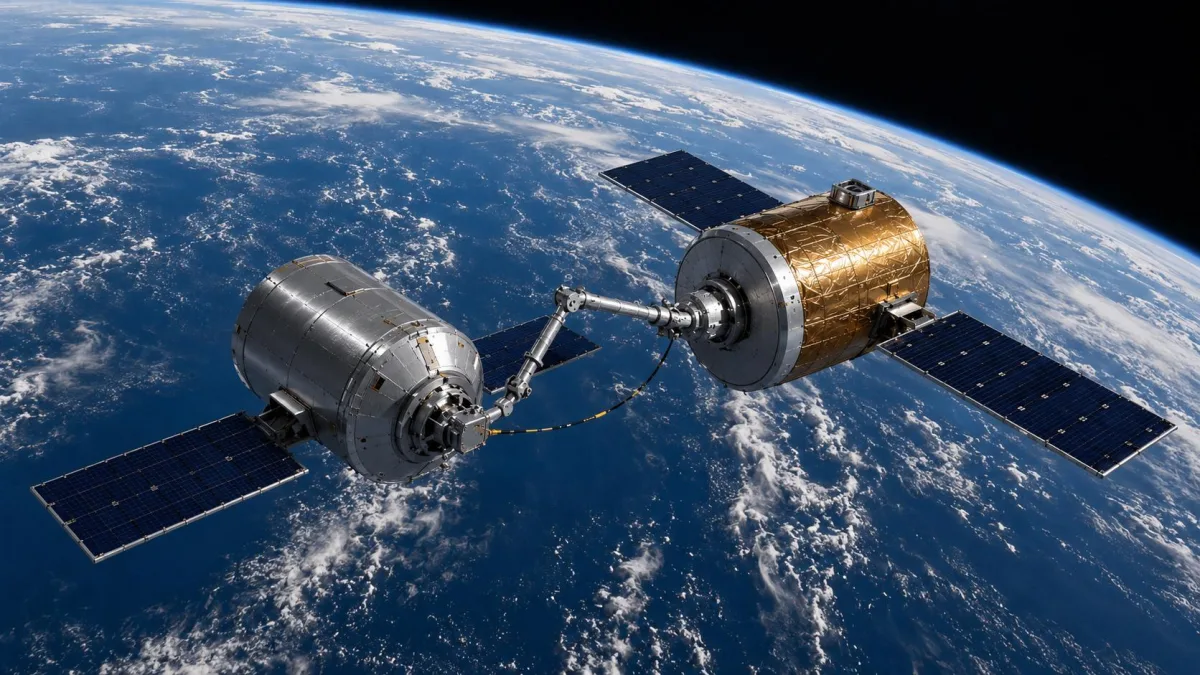
In-orbit servicing refers to activities performed by specialised spacecraft to maintain, repair, refuel, upgrade or extend the operational lives of satellites already in space. Instead of abandoning a satellite when its fuel runs low or a particular component needs attention, operators can potentially send another spacecraft to provide the required service.
These operations may involve robotic arms, docking systems, specialised fuel-transfer equipment and advanced navigation technology. Servicing spacecraft must approach their targets carefully, establish a safe connection and perform operations in an environment where even small movements require precise control.
The technology could change how satellite operators manage their investments, particularly in communications, broadcasting, navigation and Earth observation.
Source: NASA – On-orbit Servicing, Assembly, and Manufacturing 1.

Why Extending Satellite Lifespans Makes Economic Sense
Building and launching satellites requires substantial investment. Depending on their size, technology and purpose, some commercial communications satellites can represent investments worth hundreds of millions of dollars.
When a satellite reaches the end of its operational life because of limited fuel, replacing it can require another spacecraft, launch arrangements, insurance and additional operational planning. In-orbit servicing offers another financial option.
For example, if a satellite remains technically functional but has insufficient fuel to maintain its assigned position, a servicing vehicle could provide additional propulsion. This may allow the original operator to continue generating revenue without immediately purchasing a replacement.
The financial benefit depends on the servicing price, the remaining useful life of the satellite, its revenue potential and the cost of replacement. Extending a satellite's life is not automatically profitable, but it can become attractive when the asset remains valuable.
Source: Northrop Grumman – Satellite Services in Space: Extending Life in Orbit.

Northrop Grumman and the Commercial Business of Satellite Servicing
One of the strongest commercial examples is Northrop Grumman's Mission Extension Vehicle (MEV).
The company's MEV-1 made history on 25 February 2020 when it docked with Intelsat's IS-901 communications satellite. The servicing spacecraft used its own propulsion system to help maintain the satellite's position and extend its operational life.
MEV-2 subsequently docked with Intelsat's IS-10-02 satellite in April 2021.
An important milestone came on 9 April 2025, when MEV-1 successfully undocked from IS-901 after completing five years of life-extension services. It was then repositioned for another servicing mission.
This achievement demonstrated an important commercial advantage: a servicing spacecraft can potentially support more than one customer during its operational lifetime.
Source: Northrop Grumman – SpaceLogistics and Mission Extension Vehicle Services.
The Financial Benefits of In-Orbit Servicing
The economics of satellite servicing involve several potential benefits.
1. Reduced replacement costs: Operators can delay purchasing and launching replacement satellites when existing spacecraft remain useful.
2. Increased revenue opportunities: Additional operational years can allow satellite companies to continue providing communications, broadcasting and other services.
3. Better use of existing investments: Servicing can help operators obtain more value from spacecraft that have already required substantial development and launch expenditure.
4. Improved fleet management: Satellite operators may be able to reposition, inspect or upgrade their assets instead of immediately retiring them.
5. Reduced orbital waste: Responsible servicing and disposal can help reduce the number of inactive spacecraft and abandoned objects in orbit.
However, these benefits must be compared against the cost of developing servicing spacecraft, launching them, securing insurance and carrying out technically demanding operations.
Source: NASA – 2026 In-Space Servicing, Assembly, and Manufacturing State of Play.

Challenges Facing the Satellite Servicing Industry
Despite its potential, in-orbit servicing still faces financial and technical challenges.
One major difficulty is that many older satellites were never designed to receive maintenance. They may lack suitable docking connections, accessible fuel ports or equipment that allows another spacecraft to interact with them safely.
NASA's OSAM-1 programme demonstrated how expensive and complicated these capabilities can become. In March 2024, NASA announced that it would discontinue the project following significant technical, financial and scheduling challenges.
The programme had experienced substantial cost growth, and NASA's independent review identified an estimated total project cost of approximately $2.38 billion.
The cancellation showed that demonstrating technical possibilities is not enough. Servicing programmes must also demonstrate a realistic return on investment and attract customers willing to pay for the services.
Source: NASA – Update on Status of NASA's OSAM-1 Project.
New Developments in 2026
The satellite servicing industry has continued developing in 2026.
On 21 July 2026, Northrop Grumman's Mission Robotic Vehicle (MRV) and three Mission Extension Pods (MEPs) successfully launched. The system is designed to support satellite life extension, inspection, repairs, upgrades and other servicing activities.
The MEP technology provides an alternative to larger servicing vehicles by offering additional propulsion capabilities through modular units attached to compatible satellites.
Source: Northrop Grumman – SpaceLogistics Services.
Another important development involves Astroscale. On 16 March 2026, the company announced that it had selected Isar Aerospace to provide launch services for its ELSA-M demonstration mission. The spacecraft is designed to capture and remove an end-of-life Eutelsat OneWeb satellite.
Astroscale also completed its ADRAS-J inspection demonstration. On 25 March 2026, the company announced that the spacecraft had completed its operations after 293 days in orbit and had begun controlled orbital descent.
These developments demonstrate that the industry is expanding beyond extending satellite lifespans into inspection and responsible debris removal.
Sources: Astroscale – ELSA-M Launch Partnership Announcement | Astroscale – ADRAS-J Mission Completes Operations.
The European Space Agency also signed a new agreement with ClearSpace in September 2026 under its Phoenix Partnership Project. The initiative aims to develop a European spacecraft and commercial service for maintaining satellites in geostationary orbit.
The programme is particularly important because it seeks to establish the foundations for recurring commercial servicing rather than relying entirely on individual demonstration missions.
Source: European Space Agency – ClearSpace Phoenix Partnership Project.
The Future Economics of Satellite Servicing
The future of satellite servicing will depend on whether companies can turn successful demonstrations into affordable, repeatable commercial services.
Standardised docking systems, satellites designed for maintenance, reusable servicing vehicles and more affordable launches could make the industry more financially attractive.
A research perspective published in npj Space Exploration on 2 April 2026 also highlighted the potential for servicing to reduce replacement costs and improve the reliability of small-satellite constellations.
The opportunity extends beyond traditional communications satellites. Government agencies, scientific organisations, commercial operators and national security institutions could all become customers.
Source: Nature – On-orbit Servicing as a Future Accelerator for Small Satellites.
Ultimately, in-orbit servicing could change satellites from disposable pieces of expensive equipment into long-term infrastructure that can be maintained and improved. The commercial market is still developing, but successful missions and new international partnerships suggest that satellite maintenance will become an increasingly important part of the global space economy.
The biggest opportunity is not simply keeping satellites in orbit longer. It is finding economically sustainable ways to get more value from the infrastructure humanity has already placed in space.
Research cutoff: 21 November 2026.