
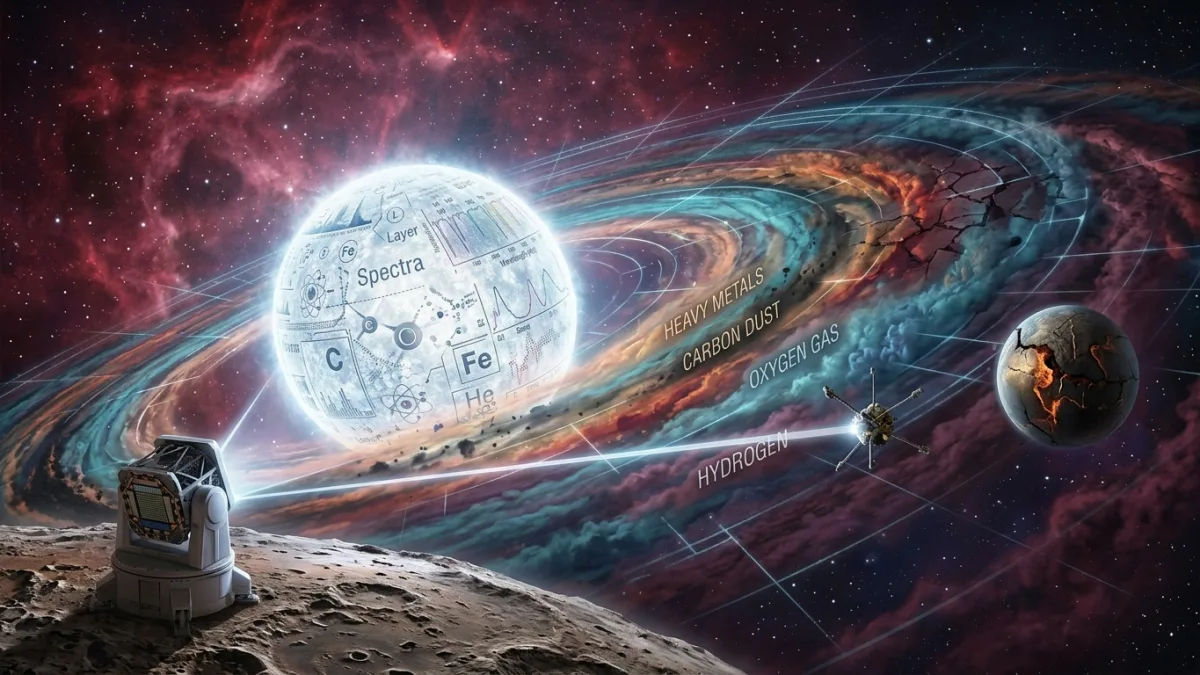
The Chemical Blueprint of White Dwarfs: Dying Star Mysteries
White dwarfs are the dense remains of stars that have reached the end of their normal lives. Although they no longer produce energy through the same nuclear reactions that powered them earlier, they preserve important clues about stellar evolution, planetary chemistry, and the fate of solar systems. By studying the light from these stars, astronomers can identify chemical elements in their atmospheres and sometimes discover material from destroyed asteroids, icy objects, and former planets. In October 2026, the discovery of an unusually green white dwarf added another surprising chapter to this research, showing how chemical composition can influence the appearance of a dying star.
Summary
-
Subject: White dwarfs and their chemical composition.
-
What they are: Dense stellar remnants left behind by many stars, including Sun-like stars.
-
Main ingredients: Their interiors are usually rich in carbon and oxygen, or sometimes oxygen and neon.
-
Common atmospheric elements: Hydrogen and helium, although other elements can also be detected.
-
How scientists study them: Spectroscopy, space telescopes, and computer models.
-
Major scientific importance: They reveal how stars age and what planetary systems are made of.
-
Recent discovery: In October 2026, astronomers reported an unusually green white dwarf, WD J1330+6435, whose appearance is linked to its unusual atmospheric chemistry.

Introduction: What Happens When a Star Dies?
Stars do not live forever. They spend much of their lives producing energy by converting hydrogen into helium in their cores. Eventually, they run low on the fuel needed to maintain that process, and their structure begins to change.
For a star with a mass similar to the Sun, the final stages involve an expansion into a red giant. The star releases its outer layers into space, while its central region remains behind as a white dwarf.
A white dwarf is remarkably small compared with the star that created it. It can contain a substantial fraction of the Sun's mass inside a body roughly the size of Earth. This makes it incredibly dense.
Despite the name, a white dwarf is not necessarily white in appearance. Its color depends on factors such as temperature and atmospheric composition. Most importantly, the elements found in and around these stellar remnants provide clues to events that occurred long before astronomers began observing them.
The Chemical Blueprint of White Dwarfs
The phrase chemical blueprint describes the information scientists can obtain by identifying the elements present in a white dwarf.
The interior and atmosphere must be considered separately. A typical white dwarf's interior contains mainly carbon and oxygen, while some more massive examples may have cores dominated by oxygen and neon. Its visible atmosphere, however, is often dominated by hydrogen or helium.
Why does this difference matter? Gravity is extremely strong on a white dwarf. Heavy elements can sink beneath the visible surface, leaving lighter elements at the top. As a result, the atmosphere may appear chemically simple even when the star's interior contains a different mixture.
However, astronomers sometimes detect elements such as calcium, magnesium, silicon, iron, carbon, and oxygen in white dwarf atmospheres. These findings can reveal processes taking place inside the star or indicate that material from a surrounding planetary system is falling onto it.

How Scientists Read a Star's Chemical Fingerprints
Astronomers cannot normally collect samples from a distant star. Instead, they study its light.
Every chemical element absorbs or emits light at particular wavelengths. When scientists spread starlight into a spectrum, they can search for these distinctive patterns, which act like fingerprints.
This technique is called spectroscopy.

Scientists then compare the observed spectrum with computer models. These models account for temperature, pressure, gravity, and other conditions that affect how elements behave in the star's atmosphere.
The result is not a direct photograph of the star's interior. It is a scientific estimate based on measurable evidence, physical laws, and models that can be tested against observations.
What the Main Chemical Elements Reveal
|
Element or material |
What it can tell scientists |
|---|---|
|
Hydrogen |
Often the main ingredient in a white dwarf's visible atmosphere. |
|
Helium |
Can dominate the atmosphere when hydrogen is scarce or absent. |
|
Carbon |
Provides clues about the star's interior and, in some cases, a possible merger between stars. |
|
Oxygen |
Helps researchers study stellar interiors and water-rich planetary debris. |
|
Silicon |
Can indicate rocky material from asteroids or planet-like bodies. |
|
Magnesium and iron |
Help reveal the mineral composition of planetary debris. |
|
Neon |
Can be important when investigating the cores of certain massive white dwarfs. |
These clues must be interpreted carefully. Detecting an element does not automatically establish where it came from. Scientists compare several elements, their relative abundances, and the physical conditions of the star before drawing conclusions.
The Mystery of Polluted White Dwarfs
One of the most surprising discoveries in white dwarf research is that these old stars can carry chemical evidence of planetary systems.
Normally, heavy elements settle beneath a white dwarf's visible atmosphere. When astronomers find elements such as silicon, calcium, or iron in that atmosphere, they may be seeing evidence of material that has recently fallen onto the star.
Scientists call this a polluted white dwarf. The term does not mean the star is dirty in the everyday sense. It describes an atmosphere containing elements that should otherwise have settled out of sight.
The leading explanation in many cases is that the star's gravity has disturbed its surrounding planetary system. Asteroids or other small bodies may be pulled into dangerous orbits, torn apart by tidal forces, and deposited onto the white dwarf.
In 2013, Hubble observations revealed silicon and other chemical clues in white dwarfs in the Hyades star cluster. The findings suggested that rocky material similar in some respects to the building blocks of Earth had survived the earlier stages of stellar evolution.
This discovery gave astronomers a valuable way to investigate planetary material around stars far beyond our solar system.
Can White Dwarfs Reveal the Remains of Water-Rich Worlds?
Yes, in some cases, the chemical evidence points to icy objects that once orbited a star.
In September 2025, NASA reported Hubble observations of a white dwarf accreting material from what researchers believe was a fragment of a Pluto-like object. The debris contained carbon, sulfur, nitrogen, and abundant oxygen. Analysis indicated that the material was approximately 64% water ice.

This finding matters because a star's transformation into a white dwarf can dramatically change the surrounding planetary system. Objects that survive may be pushed into new orbits by gravitational interactions. Some can eventually approach the stellar remnant closely enough to be destroyed.
By studying the chemical remains, researchers can investigate the materials that existed in these distant systems. They can look for evidence of rocky bodies, water-rich objects, and other ingredients that help explain how planets form.
However, finding water-rich debris does not mean scientists have discovered life. Water is an important ingredient for life as we know it, but it is not proof that life ever existed on the object.
When Two White Dwarfs Become One
Not every white dwarf follows the same path. Some form through the merger of two stars or their remnants.
A merger can leave behind a white dwarf with unusual properties. Its temperature, mass, and atmospheric chemistry may differ from those of a white dwarf formed through the evolution of a single star.
In August 2025, a study published in Nature Astronomy reported ultraviolet evidence of carbon in the atmosphere of WD 0525+526. The researchers identified it as a rare, massive white dwarf whose chemical characteristics provide evidence consistent with a merger origin. The discovery showed how sensitive ultraviolet observations can reveal clues that ordinary visible-light observations might miss.
This research is important because white dwarf mergers can help scientists understand the possible origins of certain stellar explosions, including thermonuclear supernovae. Not every merger produces such an explosion, and researchers continue to investigate which conditions lead to different outcomes.
Latest Discovery: The Unusually Green White Dwarf

On October 16, 2026, Reuters reported an unusual white dwarf designated WD J1330+6435, located approximately 280 light-years away in the constellation Draco. The object was described as the first identified green-colored star of its kind.
According to the report, astronomers identified the object during a study of 151 nearby white dwarfs. Its unusual appearance is associated with the way its dense atmosphere interacts with light. The reported chemical signatures included elements such as sodium, calcium, and lithium, linked to material from planetary debris.
The same study also highlighted a white dwarf with a salmon-pink appearance, illustrating how different chemical conditions can affect the colors seen by astronomers.
The discovery offers a useful reminder: a star's color is not simply a measure of its temperature. Atmospheric chemistry can also influence the light that reaches our telescopes.
The finding does not mean that all white dwarfs have unusual colors, nor does it overturn the established understanding of stellar evolution. Instead, it adds another example of how studying light and chemical composition can reveal unexpected details about old stars.
Because this is a newly reported discovery, the detailed interpretation should be judged against the original scientific publication and any follow-up observations as they become available.
Major Scientific Milestones
|
Year |
Discovery or development |
Why it matters |
|---|---|---|
|
2013 |
Hubble identified rocky planetary debris around white dwarfs. |
Showed how stellar remnants can reveal the chemistry of former planetary systems. |
|
2013 |
Observations of GD 61 provided evidence of water-rich planetary material. |
Demonstrated that the remains of icy bodies can be investigated through atmospheric chemistry. |
|
2025 |
Hubble observations identified debris rich in water ice around a white dwarf. |
Offered evidence for the survival of icy objects through stellar evolution. |
|
2025 |
Ultraviolet spectroscopy revealed carbon in a rare massive white dwarf. |
Helped researchers investigate the history of stellar mergers. |
|
2026 |
WD J1330+6435 was reported as an unusually green white dwarf. |
Highlighted the role of atmospheric chemistry in the appearance of stellar remnants. |
Why This Research Matters
White dwarf chemistry connects several important areas of astronomy.
First, it helps researchers understand how stars evolve. The composition of a white dwarf can reveal information about the star's earlier life, its internal processes, and whether it may have merged with another star.
Second, polluted white dwarfs offer a way to investigate planetary chemistry outside our solar system. When rocky or icy material falls onto a white dwarf, its elements can leave measurable signatures in the atmosphere.
Third, these stars provide a glimpse into the possible future of our own solar system. The Sun is expected to become a red giant and eventually leave behind a white dwarf. The details of that future are still billions of years away, but observations of other systems help scientists understand what might happen to planets, asteroids, and icy bodies as their stars age.
Finally, continued observations can test and improve computer models. If a model predicts a particular chemical mixture but the telescope detects something different, researchers must investigate what the model has missed.
White dwarfs may be remnants of dying stars, but their chemical fingerprints continue to provide new information about the universe.
Fun Facts About White Dwarfs
-
A typical white dwarf packs a large fraction of the Sun's mass into a body roughly the size of Earth.
-
A white dwarf no longer produces energy through sustained hydrogen fusion in its core like a normal main-sequence star.
-
Many white dwarfs cool gradually over extremely long periods.
-
Their atmospheres are often dominated by hydrogen or helium, even when their interiors contain mainly carbon and oxygen.
-
Some white dwarfs reveal the remains of asteroids and icy objects from their former planetary systems.
-
Spectroscopy allows scientists to study chemical elements across enormous distances without collecting physical samples.
-
An unusual white dwarf's color can provide clues about its atmospheric conditions and chemical makeup.
Frequently Asked Questions
What is a white dwarf?
A white dwarf is the dense remnant left behind when a star similar to the Sun reaches the end of its normal life and releases its outer layers.
What elements are white dwarfs made of?
Their interiors usually contain mainly carbon and oxygen. Some massive white dwarfs may contain large amounts of oxygen and neon. Their atmospheres are often dominated by hydrogen or helium.
Why are white dwarfs important to astronomers?
They help scientists understand stellar evolution, the behavior of matter under extreme pressure, and the chemical composition of planetary systems.
How do scientists identify chemicals in white dwarfs?
They use spectroscopy to study patterns in the star's light. Each element has characteristic spectral features that scientists can compare with computer models.
What is a polluted white dwarf?
It is a white dwarf whose atmosphere contains heavier elements that may have arrived through falling asteroids, planetary fragments, or other surrounding debris.
Can white dwarfs reveal the remains of planets?
Yes. By measuring elements such as silicon, magnesium, iron, and oxygen, researchers can investigate the composition of material left behind by planetary bodies.
What was the unusual green white dwarf discovered in 2026?
WD J1330+6435 is a white dwarf reported on October 16, 2026, as an unusually green-colored stellar remnant. Its appearance has been linked to chemical interactions in its dense atmosphere.
Can a white dwarf still shine?
Yes. Although it no longer generates energy through sustained core hydrogen fusion, it continues to release stored heat and gradually cools.
Will the Sun become a white dwarf?
Yes. According to current models of stellar evolution, the Sun is expected to expand into a red giant, shed its outer layers, and leave behind a white dwarf.
Can white dwarfs support life?
A white dwarf is not considered a likely home for life as we know it. However, studying the rocky and water-rich debris around these stars can reveal whether planetary systems contain some of the materials associated with potentially habitable environments.
References
The following sources support the scientific findings and recent developments discussed in this article.
1. NASA Science — Hubble Finds Dead Stars Polluted with Planet Debris https://science.nasa.gov/missions/hubble/hubble-finds-dead-stars-polluted-with-planet-debris/
2. NASA Science — Water-Rich Planetary Building Blocks Found Around White Dwarf https://science.nasa.gov/missions/hubble/water-rich-planetary-building-blocks-found-around-white-dwarf/
3. NASA Science — Hubble Sees White Dwarf Eating Piece of Pluto-Like Object, September 18, 2025 https://science.nasa.gov/missions/hubble/nasas-hubble-sees-white-dwarf-eating-piece-of-pluto-like-object/
4. Nature Astronomy — A Hot White Dwarf Merger Remnant Revealed by an Ultraviolet Detection of Carbon, August 6, 2025 https://www.nature.com/articles/s41550-025-02590-y
5. Royal Society Open Science / PubMed — The Spectral Evolution of White Dwarfs: Where Do We Stand? https://pubmed.ncbi.nlm.nih.gov/38681903/
6. Monthly Notices of the Royal Astronomical Society — Machine-Learning Study of Exoplanetary Material Accreted onto White Dwarfs, 2025 https://academic.oup.com/mnras/article/540/1/746/8128279
7. Reuters — Report on the Unusually Green White Dwarf, October 16, 2026 https://www.reuters.com/science/newly-identified-green-star-leaves-astronomers-amazed-2026-10-16/
8. NASA Science — Hubble Uncovers a Rare White Dwarf Merger Remnant https://science.nasa.gov/missions/hubble/nasas-hubble-uncovers-rare-white-dwarf-merger-remnant/