
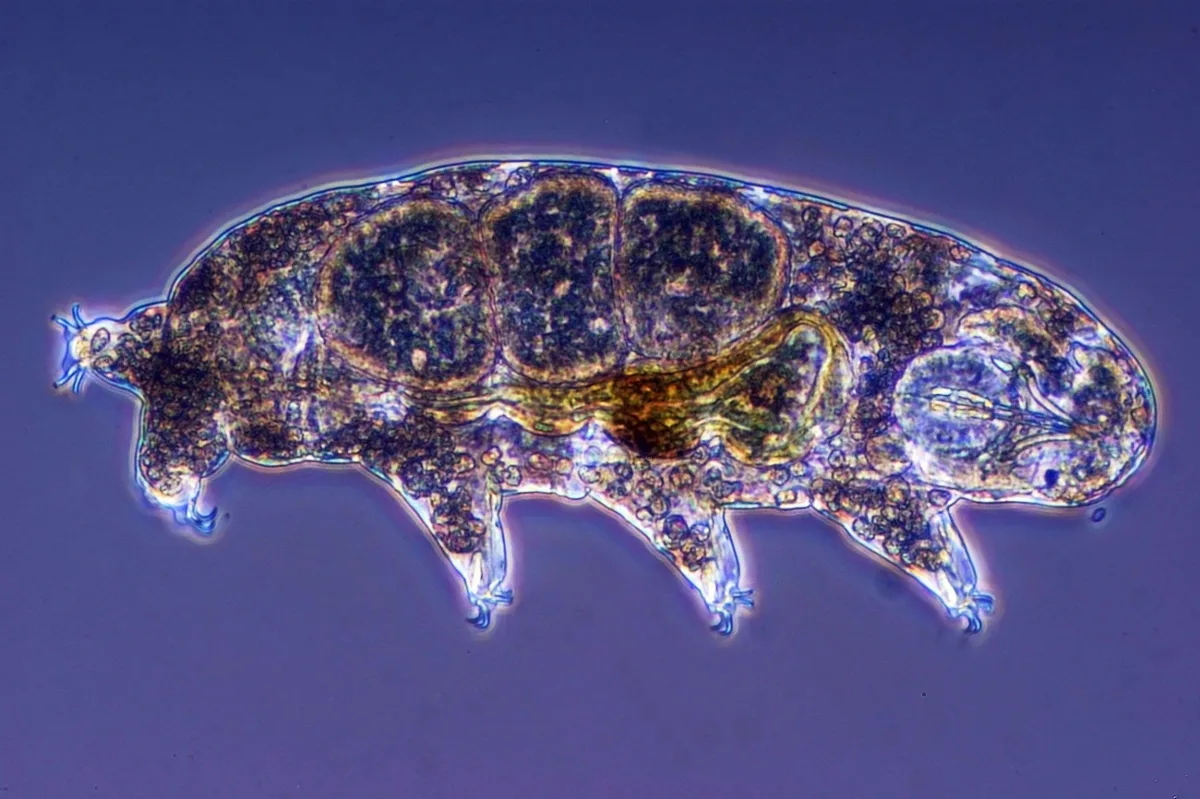
Tardigrade Radiation Resistance: Gene Editing for Space Crews
Tardigrades, often called water bears, are among the most remarkable animals on Earth because of their ability to survive extreme environmental conditions, including intense radiation. Scientists are studying their unusual biological protection systems to understand whether similar mechanisms could one day help protect human cells during long-duration space missions. One particularly interesting discovery is a tardigrade protein called Damage Suppressor (Dsup), which can help protect DNA against radiation-related damage. Research has already demonstrated promising results in laboratory-grown human cells, raising questions about whether gene-editing technologies could eventually help astronauts withstand some of the dangers of travelling beyond Earth's protective atmosphere. However, genetically modifying human space crews remains experimental, and much more research is needed before it could become a safe medical option.
Summary
-
Subject: Tardigrade radiation resistance and its possible application in human space exploration.
-
Organism: Tardigrades, commonly known as water bears.
-
Important protein: Damage Suppressor (Dsup).
-
Main discovery: Dsup can help protect DNA against certain forms of radiation-related damage.
-
Scientific significance: Laboratory experiments have demonstrated reduced DNA damage in human cells expressing the tardigrade protein.
-
Potential application: Developing biological approaches to reduce radiation-related health risks for astronauts.
-
Technology involved: Genetic engineering, gene editing and molecular biology.
-
Current status: Experimental research; no approved genetic modification of astronauts for radiation resistance exists.
-
Main challenge: Establishing long-term safety and effectiveness in living organisms and eventually humans.
What Are Tardigrades?

Tardigrades are microscopic animals found in environments ranging from freshwater and oceans to soil and moss. Despite their tiny size, they have developed unusual survival abilities that allow certain species to endure extreme temperatures, dehydration, pressure changes and radiation.
They are commonly called water bears because of their appearance under a microscope. Most are less than one millimetre long, but their biological survival systems have attracted considerable attention from scientists studying the limits of life.
One particularly interesting ability is their resistance to ionizing radiation. This type of radiation carries enough energy to damage molecules inside living cells, including DNA. In humans, extensive exposure can increase the risk of cancer and other serious health problems.

However, tardigrades have developed several biological mechanisms that help them survive conditions that would be dangerous to many other organisms. Scientists are investigating these mechanisms to understand whether their protective features could eventually be adapted for medical applications and human space exploration.
It is important to understand that not every tardigrade species has identical resistance. Their ability to withstand radiation also depends on their species, hydration state and environmental conditions.
The Dsup Protein: A Natural DNA Protection System
One of the most important discoveries in tardigrade research came in 2016, when scientists identified a protein called Damage Suppressor, commonly shortened to Dsup.
The protein was discovered in the tardigrade species Ramazzottius varieornatus. Researchers found that Dsup associates with chromatin, the material formed when DNA is packaged around proteins inside cells.
This association is important because DNA contains the genetic instructions that living organisms need to function. Radiation can damage this material, sometimes causing breaks in DNA strands.
Dsup appears to help protect DNA by reducing its exposure to harmful molecules called hydroxyl radicals. These highly reactive molecules can form when radiation interacts with water inside cells.
In laboratory experiments, researchers introduced the Dsup gene into human embryonic kidney cells. The modified cells experienced approximately 40% less DNA damage following certain X-ray exposures than the comparison cells.
This finding was significant because it demonstrated that a protective protein from a microscopic animal could function inside human cells.
However, the experiment did not make human beings radiation-proof. It demonstrated a promising cellular protection mechanism under controlled laboratory conditions.
Why Radiation Is a Major Problem for Space Crews

Earth provides natural protection against much of the radiation coming from space. Its atmosphere and magnetic field help shield living organisms from energetic particles.
Astronauts travelling beyond this protection face a different environment.
NASA identifies three important sources of space radiation:
-
Trapped radiation: Energetic particles held within Earth's magnetic field.
-
Solar energetic particles: High-energy particles released during solar events.
-
Galactic cosmic rays: Energetic particles originating beyond our solar system.
Galactic cosmic rays are particularly challenging because some contain heavy atomic nuclei capable of producing significant biological damage.
Extended exposure can increase the risks of cancer, cardiovascular problems, cataracts and other health effects. The full consequences of long-duration exposure remain an important research question.
This becomes especially relevant when considering future missions to Mars. Unlike astronauts aboard the International Space Station, who operate within Earth's protective magnetic environment, crews travelling to Mars would spend extended periods exposed to deep-space radiation.
NASA continues to investigate radiation monitoring, spacecraft protection and biological countermeasures to reduce these risks.
Could Gene Editing Give Astronauts Tardigrade-Like Protection?

The possibility of using tardigrade proteins to improve human radiation resistance has encouraged research into genetic engineering.
One proposed approach involves introducing genetic instructions for producing Dsup into selected human cells. Gene-editing technologies could potentially allow researchers to investigate how cells respond when this protective protein is produced.
A 2025 research paper titled Integrated Tardigrade-Based Biomimetic Strategy and Stem Cell Expansion and Differentiation for a Novel Radioprotection Approach explored an approach involving the DSUP gene and blood-forming stem cells.
The researchers investigated DSUP-modified mouse stem cells and human stem-cell-derived laboratory material. Their findings provided evidence of radiation-protection potential in laboratory tests.
This research is important because blood-forming stem cells help produce red blood cells, white blood cells and platelets. Protecting these cells could eventually become relevant to managing radiation-related damage.
Nevertheless, these experiments should not be confused with genetically modifying astronauts. They represent early research into possible protective treatments, not an established method of preparing humans for spaceflight.
The 2025 Breakthrough: Delivering Tardigrade Protection Without Permanent Gene Editing
An especially interesting development came from research published in Nature Biomedical Engineering on February 26, 2025.
Scientists investigated whether they could deliver instructions for producing Dsup into cells using messenger RNA (mRNA).
Instead of permanently changing a cell's DNA, this approach uses temporary genetic instructions that allow cells to produce the protective protein.
Researchers packaged the mRNA inside nanoparticles and tested the delivery system in human and mouse cells.
They also conducted experiments in mice. Following administration of the nanoparticles, Dsup production increased in the targeted tissues and later declined. The researchers found reduced DNA damage in treated animals exposed to radiation.
Importantly, the protective effects were largely limited to the treated areas in these experiments.
The study demonstrated an alternative to permanent genetic modification. Rather than permanently inserting a tardigrade gene into a person's genome, scientists could potentially deliver temporary instructions for producing its protective protein.
This distinction matters because temporary protein production could offer more control over how long the protective effect lasts.
The findings were initially investigated in the context of protecting healthy tissue during cancer radiation treatment, but they also provide useful ideas for future space-radiation research.
The researchers stressed that further work is necessary before clinical applications can be established.
Latest Research Developments in 2026
Research into tardigrade-inspired radiation protection has continued to develop in 2026.
A paper published in the Journal of Heredity on May 7, 2026, examined the possibility of using modified mRNA carrying instructions for Dsup to protect frozen animal cells.
The research discussed a proposed lunar biorepository, a facility that could store biological samples on the Moon for long periods. One of the major concerns surrounding such a facility is the possibility that radiation could damage stored genetic material.
The authors proposed investigating nanoparticle delivery of Dsup instructions as a way to reduce radiation damage without permanently modifying the cells' genomes.
The paper also discussed how this approach could provide a research foundation for studying radiation protection during long-duration crewed space missions.
It is important to distinguish this proposal from a completed lunar experiment. The publication discusses a possible strategy and its scientific foundation; it does not establish that a functioning lunar storage facility or radiation-resistant astronaut treatment already exists.
Current and Potential Applications
The research has several possible applications beyond protecting astronauts.
|
Application |
Potential benefit |
Current status |
|---|---|---|
|
Space exploration |
Reduce radiation-related cellular damage |
Experimental research |
|
Cancer treatment |
Protect healthy tissue during radiation therapy |
Preclinical research |
|
Stem-cell research |
Investigate protection of blood-forming cells |
Laboratory research |
|
Biological storage |
Protect frozen biological samples |
Proposed research strategy |
|
Human medicine |
Develop new radioprotection treatments |
Under investigation |
The most immediate medical interest is the possibility of protecting healthy tissues during radiation treatment. Space exploration presents a more demanding challenge because astronauts experience complex radiation environments over extended periods.
The Challenges of Genetically Protecting Astronauts
Although Dsup research is promising, several important questions remain unanswered.
Long-term safety: Scientists must determine whether continuous production of Dsup could interfere with normal cellular functions.
Cancer-related concerns: DNA protection is not automatically beneficial in every situation. Cancer cells also depend on DNA-related processes, so researchers must understand whether Dsup could unintentionally help harmful cells survive.
Different radiation types: Laboratory X-rays do not perfectly reproduce the complex radiation environment encountered during deep-space travel.
Whole-body protection: Protecting a particular group of cells does not mean every organ and tissue will receive adequate protection.
Ethical questions: Permanent genetic changes in humans would raise important questions about safety, consent and possible effects on future generations.
These challenges explain why scientists cannot yet recommend genetic modification as a radiation-protection strategy for astronauts.
What Could This Mean for Future Mars Missions?

Future missions to Mars could last many months, with crews facing radiation exposure during their journey and while operating on the planet's surface.
Traditional protection strategies include spacecraft shielding, radiation monitoring, mission planning and designated protected areas where astronauts can shelter during certain solar events.
Biological protection could eventually complement these approaches.
If scientists can establish a safe and effective way to use tardigrade-inspired proteins, future medical treatments might help reduce certain types of cellular damage during spaceflight.
However, no single protein is likely to solve every radiation-related problem. A combination of spacecraft engineering, medical monitoring, improved treatments and biological research will remain important.
The real value of tardigrade research is that it gives scientists a new way to investigate how living cells protect themselves under extreme conditions.
What Scientists Still Need to Discover
Despite encouraging results, scientists have not established that Dsup can safely protect an entire human body against the radiation found in deep space.
Future research needs to establish how the protein behaves in different human tissues, whether its protective effects remain consistent over time and whether it affects normal DNA repair processes.
Researchers must also determine whether temporary mRNA delivery offers a better balance of safety and effectiveness than permanent genetic modification.
The distinction is important: the goal is not necessarily to turn astronauts into genetically modified versions of tardigrades. It is to understand and potentially adapt specific biological mechanisms that could make space exploration safer.
Conclusion
Tardigrades demonstrate that life can develop extraordinary ways to survive challenging environments. Their ability to withstand radiation has provided scientists with valuable clues about protecting DNA and maintaining cellular health.
The discovery of Dsup opened an interesting direction in biotechnology, while research published in 2025 and 2026 has expanded the possibilities of delivering tardigrade-inspired protection through temporary genetic instructions and other biological approaches.
For future astronauts, particularly those preparing for missions to Mars, these discoveries could eventually contribute to better protection against the dangers of deep-space travel.
However, the science is still developing. Scientists must establish long-term safety, effectiveness and practical applications before such treatments can be considered for human space crews.
The possibility of borrowing a microscopic animal's natural defence system to help humans explore another planet is fascinating. What began as research into one of Earth's smallest animals could eventually contribute to some of humanity's most ambitious space exploration goals.
References
1. Hashimoto et al. (2016). Extremotolerant tardigrade genome and improved radiotolerance of human cultured cells by tardigrade-unique protein. Nature Communications. Read the original scientific study.
2. National Institutes of Health (March 25, 2025). Tiny tardigrades may hold clues to cancer care. Read NIH research report.
3. NASA (March 16, 2023; updated March 13, 2026). Space Radiation. Read NASA's space radiation research.
4. The tardigrade Hypsibius exemplaris dramatically upregulates DNA repair pathway genes in response to ionizing radiation. Current Biology (2024). Read the scientific paper.
5. Integrated tardigrade-based biomimetic strategy and stem cell expansion and differentiation for a novel radioprotection approach. (2025). Read the research paper.
6. Hagedorn et al. (2026). Inducing radiation resilience in frozen animal cells via mRNA coding for tardigrade damage-suppressor protein in support of space travel and Lunar storage. Journal of Heredity. Read the 2026 publication.
7. Molecular basis of radiation resistance in tardigrades and the medical implications. (2026). Read the scientific review.