
Synthetic Biomes: Building Artificial Ecosystems for Space
Synthetic biomes could change how humans survive in some of the most difficult environments imaginable. By combining plants, algae, microorganisms, advanced sensors and automated life-support technology, scientists are exploring ways to create artificial ecosystems inside sealed habitats. These systems could eventually help astronauts live on the Moon or Mars without depending entirely on supplies delivered from Earth. Although completely self-sustaining artificial ecosystems remain a major scientific challenge, research involving NASA, the European Space Agency and other institutions is bringing the concept closer to practical application.
Source: NASA – Space Crops and Bioregenerative Life Support Systems.

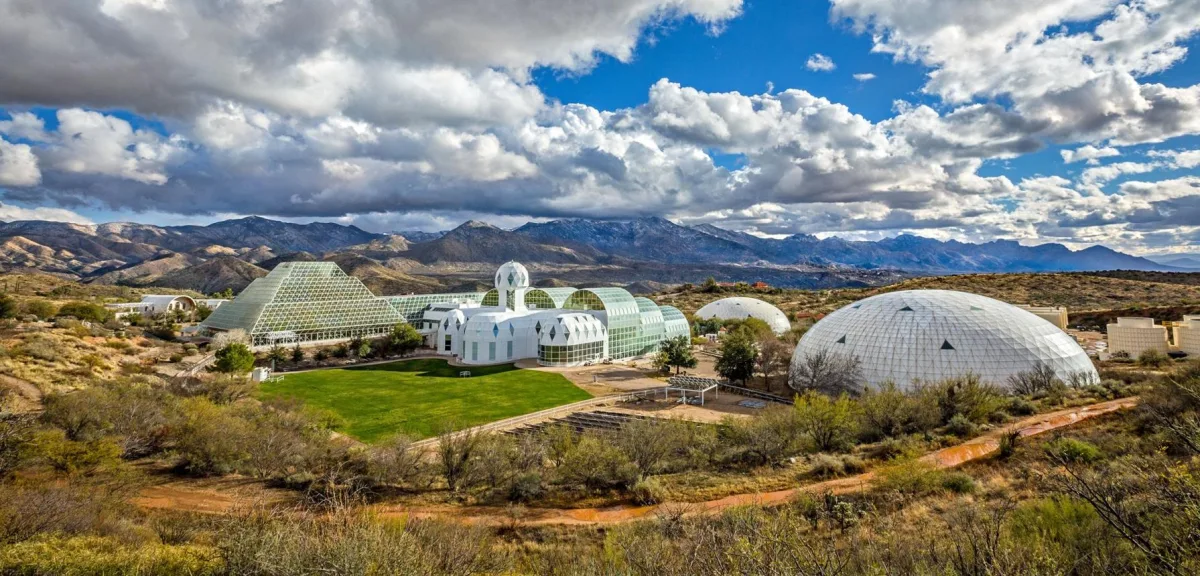
An enclosed ecosystem research facility illustrates how natural environments can be studied under controlled conditions. Image reference: University of Arizona Biosphere 2.
What Are Synthetic Biomes?
A synthetic biome is an artificially created ecosystem designed to reproduce some of the natural processes that support life. Instead of depending on an open environment, the ecosystem operates within a controlled space where temperature, humidity, lighting, air quality and water circulation can be carefully managed.
The idea is to bring different living organisms together so they perform useful functions. Plants can absorb carbon dioxide and release oxygen through photosynthesis. Algae can contribute to oxygen production and biomass generation, while bacteria and fungi can help break down organic waste and return nutrients to the growing environment.
Unlike an ordinary greenhouse, a properly designed synthetic biome aims to connect these biological processes into a coordinated life-support system.
Why Scientists Want Ecosystems Inside Sealed Bases
Establishing permanent human settlements away from Earth presents a serious problem: everything needed for survival must either be transported from Earth or produced locally.
On the Moon and Mars, transporting food, water and other essential supplies repeatedly would be expensive and technically difficult. A sealed ecological system could reduce that dependence by recycling resources and producing some of the materials humans need.
Such habitats could eventually support astronauts during long missions, particularly when regular deliveries are impossible. They could also provide useful technology for isolated research stations and other locations where access to fresh supplies is limited.
How a Synthetic Biome Would Work
A stable synthetic biome would need several connected biological and technological systems.
1. Plants for Food and Oxygen
Plants would form one of the most important parts of the ecosystem. Selected crops could provide fresh vegetables, contribute to oxygen production and absorb carbon dioxide.
NASA has already investigated plant growth in space through its Veggie system and Advanced Plant Habitat. These experiments help scientists understand how plants respond to controlled growing conditions and microgravity.
However, producing enough food and oxygen for an entire crew requires much larger and more complex systems than a small experimental plant chamber.
Source: NASA – Growing Plants in Space.
2. Microorganisms for Waste Recycling
A sealed ecosystem cannot function properly if organic waste continues accumulating. Bacteria and other microorganisms could help process biodegradable waste, break down organic materials and recover nutrients.
These nutrients could then be returned to agricultural systems, reducing the need to transport fresh fertilisers.
The challenge is controlling the microbial environment. Harmful organisms must be prevented from spreading, while useful biological communities must remain stable.
Source: npj Microgravity – Plant and Microbial Science and Technology.
3. Water Recovery and Circulation
Water is essential for human survival and plant growth. A synthetic biome would need systems that collect used water, remove contaminants and return suitable water to the habitat.
Plant transpiration, condensation collection, filtration and biological treatment could contribute to this process.
The objective would be to reduce water losses and keep as much of the available supply circulating within the habitat as possible.
Source: ESA-linked MELiSSA Foundation – The MELiSSA Programme.
4. Artificial Lighting and Environmental Control
Inside a sealed base, natural sunlight may be unavailable or unreliable. Artificial lighting, particularly energy-efficient LED systems, could provide the light plants require.
Sensors and automated controls would monitor temperature, humidity, carbon dioxide, oxygen, water levels and nutrient conditions.
These technologies would help maintain a suitable environment even when external conditions are extremely hostile.
Source: NASA – Advanced Plant Habitat.
Real-World Research: Biosphere 2

One of the most interesting examples of artificial ecosystem research is Biosphere 2 in the United States. Operated by the University of Arizona, this research facility contains five controlled ecosystems: a tropical rainforest, desert, savanna, mangrove and ocean.
The facility was originally developed to investigate whether complex natural environments could be recreated and studied inside an enclosed structure. It remains an important research centre for understanding ecosystem behaviour, environmental resilience and interactions between living systems.
Biosphere 2 demonstrates that large artificial ecosystems can be constructed and studied. However, it should not be confused with proof that a completely closed habitat can support people indefinitely without outside assistance.
Source: University of Arizona – Biosphere 2 Research Initiatives.
The European MELiSSA Project

Another important initiative is MELiSSA (Micro-Ecological Life Support System Alternative), a European research programme developed to investigate regenerative life-support technology.
Its objective is to connect different biological and technological processes to recycle air, water and waste while supporting food production.
The programme has involved universities, research organisations and industrial partners. Its work includes microbiology, bioreactor development, system modelling and experimental demonstrations.
MELiSSA is particularly important because it approaches the problem as an interconnected system rather than treating food production, water recovery and waste management as completely separate challenges.
Source: MELiSSA Foundation – The MELiSSA Programme.
The Biggest Challenges Facing Synthetic Biomes
Creating an artificial ecosystem is much more difficult than simply placing plants and microorganisms inside a building.
One major challenge is ecological stability. Different organisms depend on one another, and a disturbance in one part of the system could affect everything else. A shortage of nutrients, an unexpected microbial outbreak or a change in atmospheric conditions could threaten the entire habitat.
Energy consumption is another problem. Artificial lighting, pumps, filtration systems, environmental controls and monitoring equipment require dependable power. This is especially challenging on Mars, where solar energy availability can vary.
Another concern is food production. Growing enough crops to provide a balanced diet for an entire crew requires considerable space, water, nutrients and energy.
Researchers must also consider human health. A sealed habitat could allow certain pollutants or microorganisms to accumulate unless they are carefully monitored and controlled.
A 2025 research paper in npj Microgravity highlighted the remaining technological and organisational gaps in developing fully integrated bioregenerative life-support systems. It also emphasised the need for greater investment and more comprehensive testing.
Source: npj Microgravity – Critical Investments in Bioregenerative Life Support Systems.
Could Synthetic Biomes Make Mars Colonies Possible?

Mars is one of the most interesting potential destinations for synthetic biome technology. Its thin atmosphere, extreme temperatures and radiation exposure make ordinary outdoor agriculture unsuitable without extensive protection.
A future Mars settlement could use underground chambers or protected structures containing controlled agricultural environments. These facilities might combine crop production, water recycling, oxygen generation and biological waste treatment.
Different sections could perform different functions. One area might grow vegetables, another could contain algae-based production systems, while specialised reactors process organic waste.
Artificial intelligence could monitor the entire environment, detect changes and adjust lighting, temperature, water delivery and nutrient levels.
However, these are proposed applications rather than an established capability. No fully self-sustaining human settlement on Mars currently exists, and researchers still need to demonstrate that integrated biological life-support systems can remain reliable over long periods.
Source: NASA – Space Crops.
What the Future Could Look Like
Synthetic biomes could eventually become an important part of future space settlements. Instead of transporting every essential resource from Earth, astronauts might live inside habitats where biological and mechanical systems work together to produce food, recycle water and manage waste.
The technology could also benefit Earth. Similar principles could improve controlled agriculture, water treatment, resource recycling and food production in areas affected by environmental pressures.
The greatest achievement will not simply be building a sealed greenhouse. It will be developing a reliable ecosystem that can respond to unexpected changes, recover from disturbances and support human life over extended periods.
As research continues, synthetic biomes could help answer one of humanity's most important questions: can we recreate enough of Earth's life-supporting processes to survive beyond our home planet?
Source: MELiSSA Foundation – Terrestrial Applications and Regenerative Life Support.
Conclusion
Synthetic biomes represent an important direction in the future of space exploration and environmental engineering. By combining biology, microbiology, artificial intelligence and advanced environmental controls, scientists are working towards habitats that can recycle resources and reduce dependence on external supplies.
The technology is not yet capable of supporting a completely independent human settlement indefinitely. Nevertheless, research projects such as Biosphere 2, NASA's plant-growth experiments and Europe's MELiSSA programme are helping researchers understand what will be required.
One day, the ability to build stable artificial ecosystems could make long-term human settlements beyond Earth more realistic while also providing valuable solutions for environmental challenges at home.
Source: Nature – Critical Investments in Bioregenerative Life Support Systems.
Frequently Asked Questions
1. What is a synthetic biome?
A synthetic biome is an artificially created ecosystem designed to reproduce selected natural processes under controlled environmental conditions.
Source: University of Arizona – Biosphere 2 Research.
2. Can synthetic biomes produce oxygen?
Yes. Photosynthetic organisms, including plants and algae, can produce oxygen while absorbing carbon dioxide. The challenge is producing enough oxygen to meet the needs of an entire crew.
Source: NASA – Space Crops.
3. Can people live permanently inside a synthetic biome?
This remains an engineering and scientific goal. Current research has not demonstrated a completely self-sustaining artificial ecosystem capable of supporting people indefinitely without external assistance.
Source: npj Microgravity – Critical Investments in Bioregenerative Life Support Systems.
4. What is Biosphere 2?
Biosphere 2 is a large controlled-environment research facility in Arizona containing five artificial ecosystems.
Source: University of Arizona – Biosphere 2.
5. What is the MELiSSA project?
MELiSSA is a European regenerative life-support research programme investigating ways to recycle air, water and waste while producing food for future space missions.
Source: MELiSSA Foundation – The MELiSSA Programme.
6. How could artificial ecosystems help Mars astronauts?
They could potentially provide fresh food, recycle water, manage organic waste and contribute to oxygen production inside protected habitats.
Source: NASA – Space Crops.
7. What role would artificial intelligence play?
AI could help monitor environmental conditions, identify unusual changes and automatically adjust the habitat's lighting, temperature, water and nutrient systems.
Source: NASA Technical Research – Bioregenerative Life Support Systems.
8. Could synthetic biomes be useful on Earth?
Yes. The technology could support controlled agriculture, water treatment, resource recovery and more efficient environmental management.
Source: MELiSSA Foundation – Terrestrial Applications.