
Sifting Regolith: How Mechanical Vibrations Work in Vacuum
Mechanical vibrations offer a promising way to sort lunar soil, control the movement of fine particles, and prepare materials for future space missions. On the Moon, where there is virtually no atmosphere and gravity is much weaker than on Earth, ordinary soil-processing methods may not work as expected. By shaking screens, containers, or processing equipment at carefully selected frequencies and amplitudes, engineers can encourage particles to move, separate by size, and flow through machinery. Research published in 2025 and 2026 is improving our understanding of these processes, although more testing is needed before the technology can be relied upon for large-scale lunar operations.
Summary
-
Lunar regolith is a mixture of dust, fine grains, and larger rocky fragments covering much of the Moon's surface.
-
Mechanical vibration can help separate particles by size without requiring water or air.
-
Vacuum conditions change how particles interact because air resistance and fluid-based effects are greatly reduced.
-
Vibration frequency, amplitude, gravity, particle shape, and surface forces all affect separation.
-
Researchers are investigating vibrating screens, hoppers, sampling devices, and excavation tools for lunar missions.
-
Recent studies show that vibration can improve particle flow and reduce blockages in some equipment.
-
Efficient regolith processing could support future efforts to extract useful materials and manufacture products on the Moon.
What Is Lunar Regolith?

Regolith is the loose layer of dust, soil-like material, broken rock, and mineral fragments covering the Moon's surface. It forms over long periods as meteorite impacts break rocks apart and spread the resulting particles across the ground.
Unlike ordinary garden soil, lunar regolith does not contain the same mixture of organic matter, water, and biological material found in Earth's soil. Its particles also have distinctive shapes because they have not experienced the same weathering processes that smooth many terrestrial grains.

The material is not uniform. A sample may contain extremely fine dust alongside sand-sized grains and much larger fragments. This variation matters when scientists want to extract specific minerals, prepare material for construction, or feed lunar manufacturing equipment.
Before regolith can be used for many industrial purposes, it may need to be sorted according to particle size, mineral composition, or other properties. This process is known as beneficiation when it improves the concentration or usefulness of a material.
On Earth, processing plants often use air, water, gravity, and mechanical screens to separate particles. On the Moon, water and air are limited resources, making dry processing techniques especially attractive.

How Mechanical Vibrations Separate Particles
Mechanical vibration is repeated movement produced by a motor, actuator, or another mechanism. When this movement is transferred to a screen or container holding granular material, the particles experience repeated changes in acceleration and contact forces.
Imagine a container filled with grains of different sizes. When the container remains still, friction and contact between particles can hold them in a stable arrangement. When it begins to vibrate, some grains lift slightly, slide, roll, or shift into new positions.
Smaller particles may work their way through spaces between larger grains, while bigger particles can rise toward the upper layers under suitable vibration conditions. This process is commonly described as vibration-induced size segregation.
The result depends on the material and the vibration pattern. Stronger shaking does not always produce better separation. If the vibration is poorly matched to the particle mixture, the material may compact, move unpredictably, or fail to separate effectively.
In a vibrating sieve, a mesh provides a physical size boundary. Particles smaller than the openings can pass through, while larger particles remain above. Vibration helps keep the material moving and reduces the chance that particles will settle into a stationary arrangement.
A 2025 study examined vibration-induced segregation using an Apollo lunar sample and three lunar soil simulants. The researchers observed differences in how the materials compacted and formed layers, showing that a substitute soil that looks similar to lunar material does not necessarily behave the same way.
Why Vacuum Conditions Change the Process

A vacuum is an environment with extremely little gas. The Moon has an almost nonexistent atmosphere, so machines operating on its surface cannot depend on ordinary atmospheric airflow to move or separate soil.
On Earth, air trapped between particles can influence their movement. In a vacuum, this effect becomes much smaller, allowing direct contact forces, friction, electrostatic attraction, and particle collisions to play more important roles.
However, a vacuum does not remove gravity or friction. The Moon still has gravity, although its surface gravity is about one-sixth of Earth's. This means particles behave differently from how they behave in a terrestrial laboratory.
Another challenge is electrostatic charging. Lunar dust can acquire electrical charges through interactions with surfaces and other particles. These charges can affect how grains stick together or move through processing equipment.
Research published in Space and Planetary Resources in October 2025 examined vibration-induced separation using lunar material and simulants. The experiments were conducted under Earth's gravity, so the findings provide useful evidence about particle behavior but do not, by themselves, prove that the same results will occur under lunar vacuum and gravity.
The Importance of Frequency and Amplitude
Two important measurements help engineers control a vibrating separator.
Frequency describes how many vibration cycles occur each second. It is measured in hertz (Hz). A machine operating at 50 Hz completes 50 vibration cycles every second.
Amplitude describes the size of the vibration's displacement from its central position. A larger amplitude generally produces greater movement, although its effect depends on the frequency and the machine's design.
These two factors influence how particles rearrange themselves. Slow or weak vibration may fail to release grains trapped in a compact arrangement. Stronger vibration may help particles move, but excessive or poorly selected settings can create unwanted movement or reduce separation quality.
A 2026 study in the Journal of Rheology investigated the flow of lunar soil simulant through a vibrating hopper. The researchers found that vibration could reduce blockages and make material flow more regular, but the outcome depended on the operating conditions. Higher vibration levels did not guarantee better performance in every situation.
Engineers must therefore identify a suitable combination of frequency, amplitude, screen opening, and processing time for each material.
Applications in Future Space Exploration
 Mechanical vibration could support several important activities during future lunar missions.
One application is particle-size classification. Separating fine grains from larger fragments could help prepare material for construction, laboratory analysis, or other processing steps.
Another application is material handling. Lunar soil may clog hoppers and feed systems, preventing equipment from receiving a steady supply of material. Research into vibration-assisted flow aims to make these systems more reliable.

Vibration can also help excavation tools move through compact granular material. NASA-supported research into ultrasonic penetrators has investigated how rapid, small-amplitude vibrations can reduce the force needed to push tools into simulated lunar soil under vacuum conditions.
These technologies could eventually work alongside magnetic or electrostatic separation. NASA has also supported research into systems that use electrostatic sieving and magnetic separation to concentrate useful minerals from lunar soil. Such approaches show that lunar resource processing will probably require several complementary technologies rather than a single universal machine.

Challenges Engineers Still Need to Solve
Despite its promise, vibration-based regolith processing faces several technical challenges.
First, lunar soil is highly variable. Grain size, particle shape, mineral composition, and cohesion can change how a sample responds to vibration.
Second, reduced gravity changes the forces holding particles against a screen. A design that works well on Earth may require different settings on the Moon.
Third, equipment must operate reliably in a harsh environment. Dust can enter moving parts, while extreme temperature changes and limited electrical power place additional demands on machinery.
Finally, researchers must distinguish between laboratory demonstrations and proven operational systems. Tests using simulants are valuable, but simulants cannot reproduce every property of real lunar regolith.
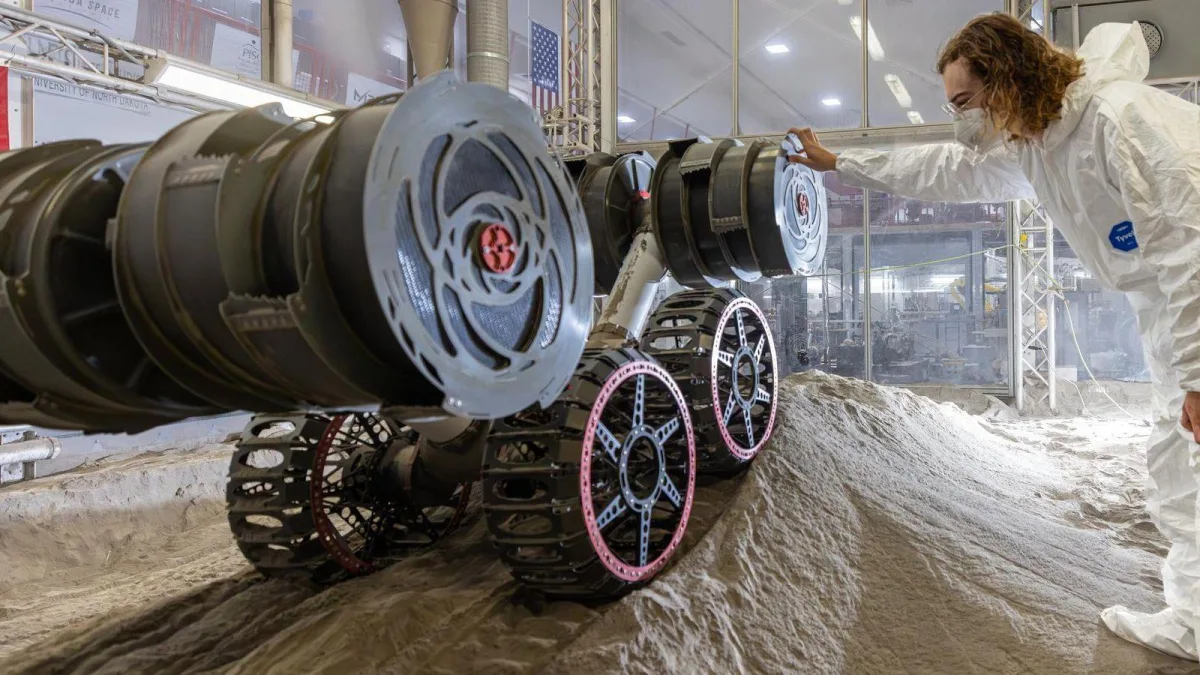
NASA's Granular Mechanics and Regolith Operations Laboratory studies soil behavior, excavation, particle sizing, and other processes needed to develop reliable equipment for lunar and Martian surface operations. This work helps engineers understand the problems that future machines must overcome.
Mechanical vibrations provide a practical approach to separating and moving lunar regolith without depending on air or water. By controlling vibration frequency and amplitude, engineers can influence particle rearrangement, improve material flow, and potentially reduce blockages in lunar processing equipment.
Research published in 2025 and 2026 has strengthened scientific understanding of vibrational segregation and granular flow. However, successful operation will depend on careful testing under realistic combinations of vacuum, reduced gravity, temperature, and material conditions.
As lunar exploration advances, vibration-based systems could become an important part of the equipment used to prepare soil, recover useful materials, and support longer missions. Their greatest value may come from combining mechanical vibration with other separation and processing technologies to make better use of resources already available on the Moon.

References
-
Rasera, J. N., and colleagues. (2025). Vibration-induced size segregation of lunar regolith and simulants for in situ resource utilisation. Space and Planetary Resources.
-
Lappa, M., Watson, P., and Bonnieu, S. V. (2026). Vibrationally aided flow of lunar regolith simulants in a hopper-based conveying device. Journal of Rheology.
-
NASA Technical Reports Server. Effect of Vacuum on Force Response of an Ultrasonic Penetrator.