
Satellite Light Pollution Lawsuits: The New Legal Battles
Satellite light pollution is becoming a growing concern for astronomers, environmental researchers, and people who depend on dark skies to study the universe. As companies launch thousands of satellites into orbit to provide internet access and other services, questions are emerging about who should be responsible when these satellites interfere with astronomical observations. The resulting legal debate raises important questions about space regulation, scientific research, environmental protection, corporate responsibility, and whether existing laws are strong enough to manage the rapidly growing satellite industry.
What Is Satellite Light Pollution?
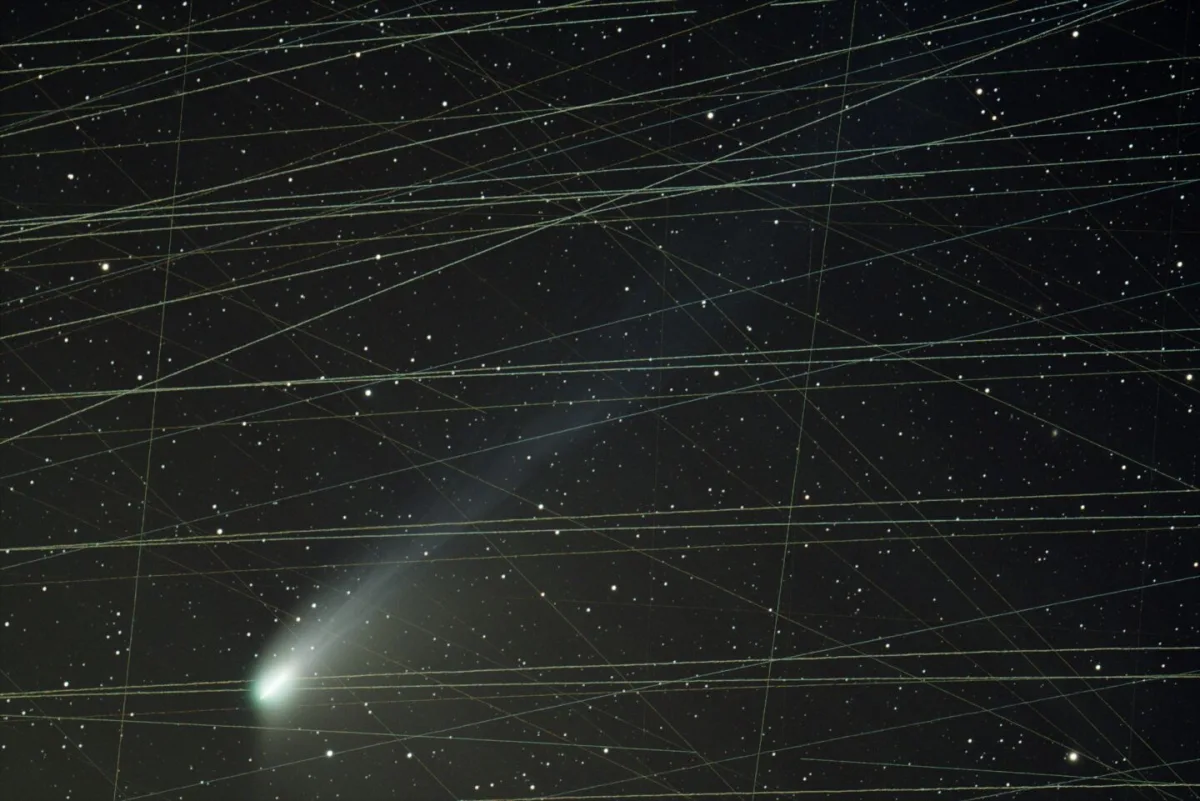
Satellite light pollution happens when artificial satellites reflect sunlight toward observers on Earth, making them visible in the night sky. Unlike streetlights, which shine from the ground, these satellites move across the sky while reflecting sunlight from orbit.
The problem has grown alongside satellite networks designed to provide internet access across cities, rural communities, ships, aircraft, and remote locations. These networks can deliver important services, but their growing numbers have raised concerns among astronomers.
When a satellite passes through a telescope's field of view, it can leave a bright streak across an image. This may affect observations of distant galaxies, asteroids, and other faint objects. Researchers have also raised concerns about radio interference, although radio-frequency interference is a different problem from visible light pollution.
Why Are Satellite Light Pollution Lawsuits Becoming a Legal Issue?
The debate is not simply about whether satellites should be allowed in space. It is about whether commercial operators should be required to consider the wider effects of their activities.
In a 2024 legal study, Georgetown Law professor David A. Koplow examined the conflict between large satellite networks and astronomy. His research discussed existing legal rules, possible ways to protect scientific observations, and the need to balance commercial space activities with other legitimate uses of space.
Three main legal questions stand out.
First, environmental review. Should regulators assess the combined effects of thousands of satellites before approving a network? Critics argue that examining each satellite or licence separately may fail to capture the total impact of a large constellation.
Second, responsibility for harm. If satellite trails damage valuable astronomical observations, can a research institution prove that an operator's actions caused a legally recognizable loss? Even when interference is scientifically documented, establishing the legal basis for compensation may be difficult.
Third, government oversight. Regulators must decide whether existing licensing requirements are sufficient or whether stronger rules are needed to limit satellite brightness, require cooperation with observatories, and improve tracking information.
These questions could shape future lawsuits, regulatory challenges, and negotiations between governments, researchers, and satellite companies.
What Does the Law Say About Satellite Light Pollution?
The 1967 Outer Space Treaty is one of the central agreements governing activities in outer space. Its provisions include obligations concerning the peaceful exploration and use of space, international cooperation, and the need for states to act with due regard to the interests of other states.
Legal scholars have examined whether these principles can support stronger protection for astronomy. However, the treaty does not provide a simple, specific rule setting a universal maximum brightness for commercial satellites. The application of its broader obligations to visible satellite light pollution remains a subject of legal discussion.
In the United States, the Federal Communications Commission (FCC) plays an important role in licensing satellite communications systems. Its January 2026 authorization concerning SpaceX's next-generation Starlink constellation discussed the effects of reflected sunlight on optical astronomy and the company's cooperation with NASA, the National Science Foundation, and the astronomy community. The FCC concluded that the mitigation commitments described in the proceeding were sufficient for its authorization decision.
That decision illustrates how the dispute can move through regulatory proceedings without necessarily becoming a lawsuit. Regulators can impose or assess licence conditions, while affected parties may raise concerns through formal comments and other available legal procedures.
|
Legal issue |
Main question |
|---|---|
|
Outer Space Treaty |
How should states balance competing uses of outer space? |
|
Environmental review |
Should cumulative effects be assessed before approval? |
|
Satellite licensing |
Are brightness controls and mitigation commitments sufficient? |
|
Civil liability |
Can a claimant prove a legally recognized loss and establish responsibility? |
|
International cooperation |
How can countries agree on consistent standards? |
The Role of SpaceX and Starlink
SpaceX's Starlink network has become a major example in the discussion because its large number of low-Earth-orbit satellites has raised concerns among astronomers.
These satellites reflect sunlight, and their visibility can affect long-exposure telescope images. SpaceX has worked on measures intended to reduce their brightness, including satellite darkening and changes to how surfaces reflect sunlight. The FCC's 2026 authorization records these mitigation efforts and continued coordination with astronomy stakeholders.
The debate should not be reduced to a claim that satellite operators have already been found guilty in court. Internet satellite networks also provide connectivity in areas where traditional infrastructure is limited. The legal challenge is finding rules that preserve those benefits while reducing avoidable harm to scientific research.
Other satellite operators may face similar questions as large constellations expand. Consistent standards could help prevent the same dispute from recurring with every new network.
Latest Legal Developments as of October 20, 2026
International discussions are moving forward, although a single worldwide legal standard for satellite brightness has not been established by the sources reviewed.
On January 19, 2026, Cambridge University Press published a paper examining the International Institute of Space Law's work on protecting the night sky. The paper explained that satellite-related optical light pollution remains a relatively new and insufficiently regulated issue. It also examined how existing international and domestic legal principles might support stronger protection.
The United Nations Office for Outer Space Affairs has also been working with the scientific community and the Square Kilometre Array Observatory on dark and quiet skies. Its programme included a December 2025 workshop addressing satellite interference, mitigation methods, legal issues, and possible regulatory improvements. In 2024, the UN space committee agreed to include dark and quiet skies and large satellite constellations on its agenda for sessions from 2025 to 2029.
|
Development |
Status |
|---|---|
|
FCC review of Starlink's effects on optical astronomy |
Addressed in its January 2026 authorization |
|
International legal research |
Published and ongoing |
|
UN discussions on satellite constellations |
Included in the 2025–2029 agenda |
|
Universal satellite brightness limits |
No universal binding standard established by the sources reviewed |
|
Landmark lawsuit awarding damages specifically for satellite light pollution |
Not verified in the research conducted for this article |
These developments show that the issue is receiving legal and regulatory attention. They do not establish that a specific satellite light pollution lawsuit has succeeded.
What Could Happen in Future Lawsuits?
Future legal cases could focus on whether a regulator properly considered scientific evidence before approving a satellite network. A separate dispute could concern whether an operator violated a licence condition or another applicable legal duty.
A claim for financial compensation would face additional challenges. A claimant would need to establish the relevant legal basis, demonstrate the harm, and connect it to the conduct of the party being sued. The precise requirements would depend on the country, the applicable law, and the facts.
Legal action could also encourage satellite companies to share more information with astronomers, improve brightness-reduction technology, and coordinate satellite movements with major observatories. Governments could respond by strengthening licence conditions or supporting international standards.
The most likely path forward is a combination of scientific cooperation, regulatory reform, and, where appropriate, court proceedings.
Why Satellite Light Pollution Matters
The night sky is important for more than its beauty. Astronomers use it to investigate distant galaxies, identify potentially hazardous asteroids, and study the history of the universe.
Satellite interference can make some observations harder and may require researchers to identify affected images, change observation schedules, or develop new processing methods. The effects vary depending on the telescope, satellite brightness, orbital position, and type of observation.
Protecting astronomical research also matters for education, scientific discovery, and communities whose cultural traditions are connected to the stars.
Fun Facts
-
Satellites can appear bright because they reflect sunlight, even when the ground below them is dark.
-
A satellite crossing a telescope's field of view can create a streak in a photograph.
-
Visible light pollution and radio-frequency interference are different problems and may require different solutions.
-
Satellite brightness can be reduced through engineering and operational changes, although no single measure eliminates every effect.
Frequently Asked Questions
1. What is satellite light pollution?
It is the unwanted visibility of artificial satellites reflecting sunlight, which can interfere with views of the night sky and astronomical observations.
2. Are satellite light pollution lawsuits already happening?
The research for this article did not verify a landmark lawsuit specifically seeking damages for satellite-reflected light pollution. Regulatory proceedings and legal research on the issue are documented.
3. Why is Starlink involved in the debate?
Starlink operates a large satellite network, and astronomers have raised concerns about reflected sunlight and interference with telescope observations.
4. Can satellite companies be sued for light pollution?
Potentially, depending on the applicable law, the evidence, the claimant's legal standing, and whether a recognized legal duty or actionable harm can be established. Liability is not automatic.
5. Does the Outer Space Treaty prohibit bright satellites?
It does not set a specific universal brightness limit. Its broader principles are being examined as possible foundations for stronger international protections.
6. What is the FCC's role?
The FCC licenses relevant satellite communications systems in the United States and can consider astronomy-related concerns and mitigation commitments in its regulatory decisions.
7. How can satellite operators reduce light pollution?
Possible measures include darker satellite surfaces, changes to reflective designs, operational adjustments, and better coordination with astronomers.
8. Will satellite light pollution become a bigger legal issue?
It could, as satellite networks expand and scientific evidence develops. The scale of future legal action will depend on regulation, documented harm, and the availability of effective legal remedies.
9. Are there international rules protecting dark skies?
Existing international space-law principles and national laws may offer some protection, but a universal binding standard specifically limiting satellite brightness has not been established by the sources reviewed.
10. What is the main legal challenge?
The central challenge is balancing the benefits of satellite services with the protection of astronomy and other legitimate interests, while establishing clear and enforceable responsibilities.
References
1. Cambridge University Press — Report of the International Institute of Space Law on Light Pollution of the Night Sky from a Space Law Perspective (2026) https://www.cambridge.org/core/journals/proceedings-of-the-international-astronomical-union/article/report-of-the-international-institute-of-space-law-on-light-pollution-of-the-night-sky-from-a-space-law-perspective/EF5FE3F8ED7358B55FB7CB2F08CEABD5
2. Federal Communications Commission — DA 26-36, Starlink Authorization (2026) https://docs.fcc.gov/public/attachments/DA-26-36A1.pdf
3. Georgetown Law — Blinded by the Light: Resolving the Conflict Between Satellite Megaconstellations and Astronomy (2024) https://nationalsecurity.law.georgetown.edu/publication/blinded-by-the-light-resolving-the-conflict-between-satellite-megaconstellations-and-astronomy/
4. United Nations Office for Outer Space Affairs — UN/SKAO Workshop on Dark and Quiet Skies for Science and Society (2025) https://www.unoosa.org/oosa/en/ourwork/psa/schedule/2025/UN-SKAO-dark-and-quiet-skies-2025.html
5. Vanderbilt Law Review — Blinded by the Light: Resolving the Conflict Between Satellite Megaconstellations and Astronomy (2024) https://scholarship.law.vanderbilt.edu/vjtl/vol57/iss1/4/
6. United Nations Office for Outer Space Affairs — Dark and Quiet Skies for Science and Society https://www.unoosa.org/oosa/en/ourwork/psa/schedule/2021/2021_dark_skies.html