Remembering Voyager 2: Lessons From the 1977 Launch Baseline
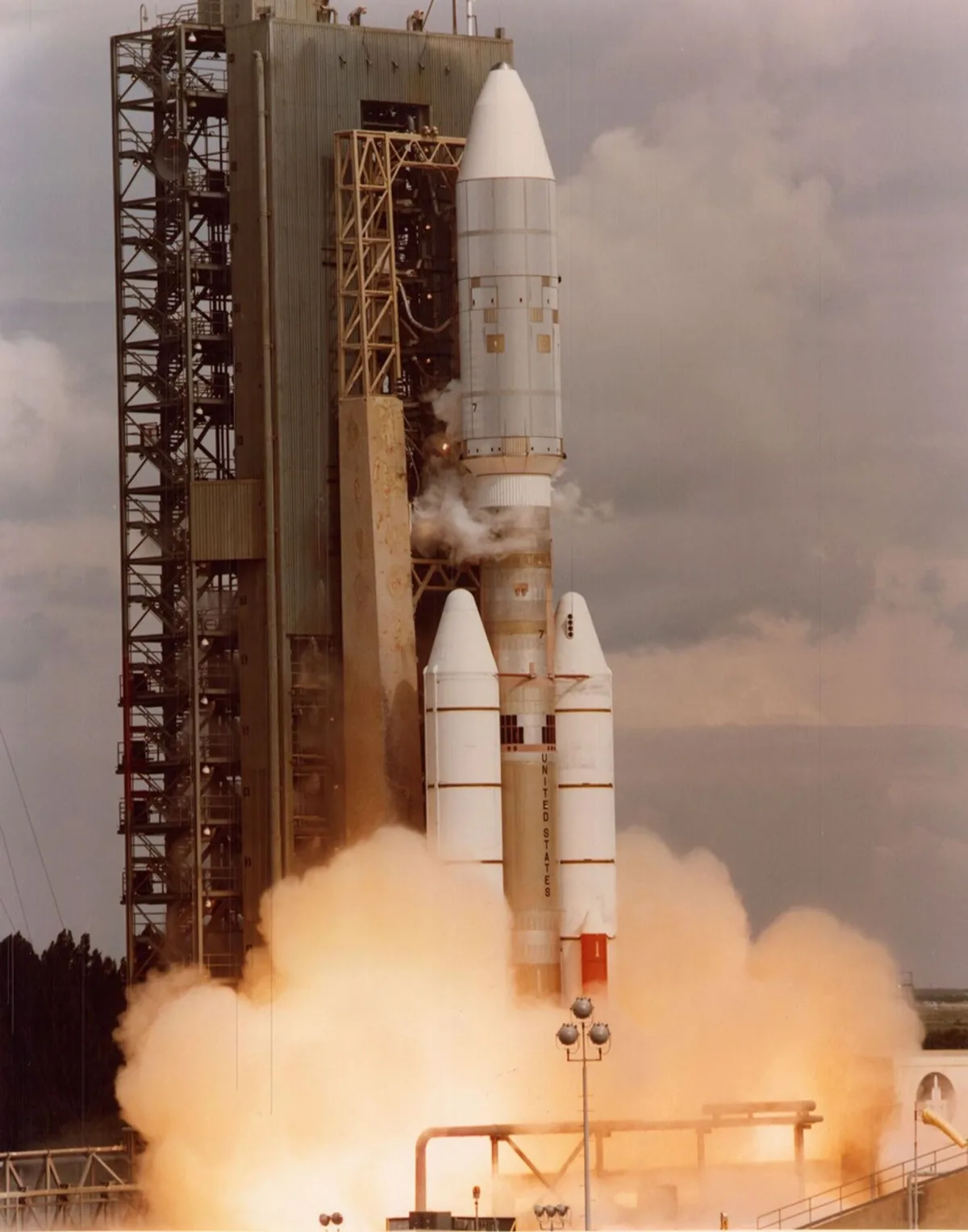
Voyager 2 began its journey on August 20, 1977, as a spacecraft designed primarily to study Jupiter and Saturn. Almost half a century later, it has become one of the most successful and longest-running planetary missions in history. Voyager 2 went on to become the first spacecraft to fly past Uranus and Neptune, crossed into interstellar space in 2018, and continues to return scientific data in 2026. Its story is not only about distant planets. It is also a remarkable lesson in careful mission planning, engineering simplicity, scientific flexibility, power management and the value of designing hardware to survive far beyond its original expectations.
Summary
-
Full name: Voyager 2
-
Mission: NASA deep-space robotic spacecraft
-
Launch date: August 20, 1977
-
Launch site: Cape Canaveral, Florida, Launch Complex 41
-
Launch vehicle: Titan IIIE-Centaur
-
Operator: NASA, with mission management and control by the Jet Propulsion Laboratory
-
Original mission: Close study of Jupiter and Saturn
-
Extended mission: Uranus, Neptune and the interstellar environment
-
Firsts: First spacecraft to visit Uranus and Neptune; second human-made spacecraft to enter interstellar space
-
Uranus encounter: January 24, 1986
-
Neptune encounter: August 25, 1989
-
Interstellar-space crossing: November 5, 2018
-
Current status: Extended mission; still operating with a limited set of scientific instruments as NASA manages its declining power supply
-
Important remaining instruments in 2026: Cosmic Ray Subsystem, Magnetometer and Plasma Wave Subsystem
-
Main lesson: Long-lived missions depend not only on advanced technology, but also on conservative engineering, adaptability and disciplined resource management.

The 1977 Launch Baseline
Voyager 2 was launched into a world very different from today's space age. Personal computers were in their infancy, global satellite navigation did not exist, and most of the spacecraft's hardware was designed around technologies that now look remarkably old.
Yet the mission planners were dealing with a problem that remains familiar to spacecraft designers today: how to accomplish ambitious scientific goals while working within strict limits on money, mass, power, communications and launch opportunities.
In the 1960s, NASA's Jet Propulsion Laboratory had recognized that the outer planets would line up in a configuration that occurs only roughly every 175 years. That geometry meant a spacecraft could use the gravity of one planet to alter its trajectory and reach another, potentially allowing a single spacecraft to visit several worlds.
The original concept was an ambitious Grand Tour involving multiple spacecraft and visits to the outer planets. The plan proved too expensive and was cancelled. NASA subsequently approved a scaled-down mission using two spacecraft intended initially to investigate Jupiter and Saturn.
That reduction in scope turned out to be one of the most important decisions in the entire Voyager story.
Rather than building a fleet of highly specialized spacecraft for every possible target, NASA built two largely identical spacecraft capable of performing their initial missions and potentially taking advantage of opportunities that emerged later.
The spacecraft were originally associated with the Mariner Jupiter/Saturn 1977 program. On March 7, 1977, NASA Administrator James C. Fletcher announced the names Voyager 1 and Voyager 2.
Voyager 2 actually left Earth first.
On August 20, 1977, it launched from Cape Canaveral aboard a Titan IIIE-Centaur rocket. NASA records place liftoff at 14:29:44 Universal Time, or 10:29:44 a.m. local time in Florida.
Voyager 2 at a Glance
| Feature | Details |
|---|---|
| Launch | August 20, 1977 |
| Launch vehicle | Titan IIIE-Centaur |
| Launch location | Cape Canaveral, Florida |
| Mission type | Deep-space flyby |
| Original targets | Jupiter and Saturn |
| Extended targets | Uranus, Neptune and interstellar space |
| Spacecraft mass | About 1,592 lb (721.9 kg) |
| Interstellar-space crossing | November 5, 2018 |
| Current mission | Extended mission |
| Mission management | NASA/JPL |
Why Voyager 2 Was Able to Go So Far
The most important feature of Voyager 2's journey was not simply the spacecraft itself. It was the trajectory.
NASA engineers studied thousands of possible trajectories before selecting flight paths that would make the Jupiter and Saturn encounters scientifically valuable while preserving future opportunities. More than 10,000 trajectories were studied before the final choices were made.
Gravity assists were central to this strategy.
Instead of carrying enough fuel to accelerate itself directly toward every distant planet, Voyager could pass near a planet and use that planet's gravitational field to change its trajectory and velocity relative to the Sun.
This meant the spacecraft's initial route could become the foundation for an even longer mission.
Voyager 2's Saturn encounter was particularly important. Its trajectory was designed so that the Saturn flyby could naturally send it toward Uranus. The geometry around Uranus was then planned with the possibility of a future Neptune encounter in mind.
That is a powerful lesson from the 1977 baseline: a good mission plan can preserve options instead of locking the spacecraft into one outcome.
The Journey to Jupiter
Voyager 2 reached Jupiter on July 9, 1979, nearly two years after launch. Its mission was to examine the giant planet and its moons, while also collecting information that would help guide the spacecraft toward Saturn and potentially farther.
Voyager's Jupiter observations contributed to a much richer understanding of the planet and its complicated system of moons, rings, magnetic fields and radiation.
The mission also showed why the spacecraft's design needed to be more than a simple flyby camera. Voyager carried instruments capable of studying magnetic fields, particles, plasma, radiation and other properties of the planetary environment.
The result was a mission capable of moving from planetary photography to space physics without changing its fundamental hardware.

Saturn and the Opportunity Beyond
Voyager 2 reached Saturn on August 25, 1981. By then, the mission had already demonstrated that a spacecraft launched for a limited planetary program could continue performing useful science on a much larger scale.
The Saturn encounter was also the key decision point for Voyager 2's next chapter.
Instead of ending after Saturn, the spacecraft was directed toward Uranus.
The journey would take another several years, but the opportunity was too valuable to ignore.
NASA's later account of the mission describes how Voyager 2's Jupiter and Saturn trajectories were deliberately selected to preserve the possibility of visiting the outer planets.
Voyager 2 and Uranus: A Historic First
On January 24, 1986, Voyager 2 became the first human-made spacecraft to fly past Uranus.
This was an extraordinary achievement because, before Voyager 2 arrived, Uranus had never been examined from close range by a spacecraft. The encounter therefore transformed the planet from a distant telescopic object into a world with a complex physical environment.
The spacecraft discovered 10 previously unknown moons and two previously unknown rings during the encounter. It also found that Uranus possessed a magnetic field with an unusual orientation, tilted roughly 55 degrees relative to its rotational axis and offset from the planet's center.
Voyager 2 also photographed Miranda, Ariel, Umbriel, Titania and Oberon.
Miranda became one of the most memorable discoveries because its surface looked extraordinarily complex, with enormous cliffs, valleys and contrasting geological features. Voyager's close approach to Miranda brought the spacecraft within about 17,560 miles (28,260 kilometers) of the moon.
The Uranus encounter also showed the scientific value of going somewhere that spacecraft had never visited before.
There was no substitute for direct observation.
Neptune: The Final Planetary Encounter
Voyager 2 reached Neptune on August 25, 1989, becoming the first spacecraft ever to visit the planet.
This encounter completed Voyager 2's unprecedented tour of the four giant planets: Jupiter, Saturn, Uranus and Neptune.
Neptune turned out to be a dynamic world.
Voyager 2 observed powerful winds, cloud structures and the large storm system known as the Great Dark Spot. It also studied Neptune's rings and moons and photographed its largest moon, Triton.
Triton was especially fascinating. Voyager 2 photographed roughly two-thirds of the moon's surface and provided evidence of active processes, including nitrogen geysers. The observations revealed an unexpectedly complicated world at the edge of the known planetary system.
With Neptune behind it, Voyager 2's original planetary mission had effectively reached its greatest possible achievement.
But the spacecraft itself was not finished.
From Planetary Explorer to Interstellar Mission
After the Neptune encounter, Voyager 2 was placed into a lower-power operating mode to conserve resources.
NASA subsequently formalized the spacecraft's next phase as the Voyager Interstellar Mission.
The spacecraft continued traveling outward, using its instruments to study the increasingly distant environment surrounding the Sun.
On November 5, 2018, Voyager 2 crossed the heliopause and entered interstellar space.
This made it only the second human-made spacecraft, after Voyager 1, to reach the interstellar environment. NASA defines interstellar space here as the region beyond the heliopause, outside the heliosphere—the bubble of particles and magnetic fields generated by the Sun.
This was particularly remarkable because Voyager 2 had already exceeded its original mission lifetime by decades.
The Golden Record
Voyager 2 carries something that has little to do with conventional spacecraft science: the Voyager Golden Record.
Both Voyager spacecraft carry a 12-inch gold-plated copper phonograph record containing selected images, sounds, music and greetings intended as a message from Earth to any technologically capable civilization that might someday encounter the spacecraft.
The record includes 115 images, natural sounds, music from different cultures and eras, and greetings in 55 languages. Its cover contains symbolic instructions intended to explain how the record can be played and how the spacecraft's origin can be determined.
The Golden Record is therefore more than a technological object.
It reflects a particular idea about exploration: that humanity can send scientific instruments into the unknown while also carrying a small representation of life and culture from the world that built them.
A Mission Built for Five Years That Reached Nearly Half a Century
One of Voyager 2's most important engineering lessons is found in its original design expectations.
The Voyager spacecraft were built for a primary mission lasting about five years. Their success at Jupiter and Saturn made an extended mission possible, and the engineering team continued adapting the spacecraft as it moved farther away.
A spacecraft designed in the 1970s has now operated for almost five decades.
That longevity was not the result of unlimited resources.
It has required increasingly careful decisions about which systems should remain active and which should be switched off.
Every watt has become important.

The Power Problem in 2026
Voyager 2 gets electricity from radioisotope thermoelectric generators, or RTGs. These devices produce electricity from the heat released by decaying plutonium.
But the power output decreases over time.
NASA says the Voyager spacecraft lose roughly 4 watts of electrical power each year as their plutonium supply decays. That gradual reduction has forced engineers to turn off heaters, equipment and scientific instruments to keep the spacecraft alive.
Several Voyager 2 instruments have already been shut down.
For example, NASA turned off its Plasma Science instrument in September 2024 to conserve power, and its Low-Energy Charged Particles experiment was turned off in March 2025.
By 2026, Voyager 2 had reached a new stage in which power conservation had become one of the central challenges of the mission.
Voyager 2 Instrument Status
| Instrument | Status in 2026 | Reason/Notes |
|---|---|---|
| Cosmic Ray Subsystem | On | Continuing interstellar science |
| Magnetometer | On | Continuing measurements of magnetic fields |
| Plasma Wave Subsystem | On | Continuing measurements of plasma-wave activity |
| Low-Energy Charged Particles | Off | Shut down to save power in March 2025 |
| Plasma Science | Off | Shut down to save power in September 2024 |
| Imaging Science System | Off | Planetary imaging ended after the planetary encounters |
| Infrared Interferometer Spectrometer/Radiometer | Off | Power conservation |
| Photopolarimeter | Off | Degraded performance |
| Planetary Radio Astronomy | Off | Power conservation |
| Ultraviolet Spectrometer | Off | Power conservation |
NASA's 2026 "Big Bang" Power-Saving Effort
One of the biggest Voyager developments of 2026 came in August.
NASA engineers successfully carried out an energy-saving modification on Voyager 2 known informally as the "Big Bang."
The strategy involved turning off certain powered devices and replacing their functions with lower-power alternatives while ensuring the spacecraft remained warm enough for its systems to operate.
According to NASA, the work should allow Voyager 2 to continue operating its three remaining science instruments for at least another year longer than originally expected.
This is an important moment in the spacecraft's history because the latest Voyager achievement is no longer a planetary flyby.
It is engineering survival.
The team is effectively finding new ways to make a 1970s spacecraft function under conditions its original designers could never have expected to last this long.
What Voyager 2 Teaches Us About Mission Design
The Voyager 2 story offers several lessons that remain highly relevant to modern space exploration.
1. Design for the mission you know, but preserve room for the mission you do not know
Voyager 2 was originally intended for Jupiter and Saturn.
The mission nevertheless preserved the possibility of reaching Uranus and Neptune.
That flexibility proved invaluable.
2. Simplicity can become a strength
Voyager 2 does not have the computing power of a modern smartphone.
Yet the spacecraft's relatively conservative engineering, redundancy and carefully managed systems have allowed it to continue operating for decades.
Its survival is a reminder that more modern technology is not automatically more durable technology.
3. Build around scarce resources
Voyager's power system was always finite.
Mission engineers have therefore had to treat energy as a resource that must be carefully budgeted.
In 2026, that principle has become especially clear.
NASA is not simply asking which instruments are scientifically useful. Engineers must also ask whether the spacecraft can afford to operate them.
4. A mission can become more valuable with age
Voyager 2's original planetary objectives were completed decades ago.
Yet the spacecraft entered an environment that earlier generations had never directly sampled.
The extended mission consequently created an entirely new scientific opportunity: studying the region beyond the heliosphere.
5. Distance changes everything
Commands and data cannot travel instantly between Earth and Voyager 2.
As the spacecraft moves farther away, communications become slower and engineering decisions become increasingly demanding.
That makes autonomy, careful testing and extremely conservative procedures essential to deep-space mission operations.
Major Discoveries and Milestones
| Year | Milestone | Why It Matters |
|---|---|---|
| 1977 | Voyager 2 launches | Begins one of the longest-running planetary missions |
| 1979 | Jupiter flyby | First major planetary encounter |
| 1981 | Saturn flyby | Preserves route toward Uranus |
| 1986 | Uranus flyby | First spacecraft to visit Uranus |
| 1986 | New Uranian moons and rings identified | Reveals a much more complex Uranian system |
| 1989 | Neptune flyby | First spacecraft to visit Neptune |
| 1989 | Triton observations | Reveals active geological processes |
| 1990s onward | Interstellar mission operations | Spacecraft continues beyond planetary exploration |
| 2018 | Enters interstellar space | Becomes second human-made object to cross the heliopause |
| 2024 | Plasma Science instrument shut down | Power conservation becomes increasingly important |
| 2025 | LECP shut down | Further power-saving measure |
| 2026 | "Big Bang" power-saving modification | Extends the ability to operate remaining science instruments |
Voyager 2's Current Status
As of August 29, 2026, Voyager 2 remains an active extended mission.
NASA's current instrument information shows that three science instruments remain operating: the Cosmic Ray Subsystem, Magnetometer and Plasma Wave Subsystem. Other instruments have been shut down because of power limitations, previous degradation or because their planetary-science missions ended long ago.
NASA's August 4, 2026 update says the latest power-saving work gives the spacecraft enough electrical margin to keep all three remaining science instruments operating for at least an additional year beyond the previous expectation.
That does not mean Voyager 2 will operate indefinitely.
The RTG power supply will continue declining, and eventually the spacecraft will no longer have enough electrical power to sustain its scientific and engineering systems.
But the 2026 intervention demonstrates something remarkable: nearly 50 years after launch, engineers are still finding ways to extract useful scientific life from the spacecraft.
Current Projects
| Project/Activity | Status | Current Situation |
|---|---|---|
| Interstellar science | Active | Voyager 2 continues collecting data with surviving fields-and-particles instruments |
| Magnetometer observations | Active | Instrument remains operational |
| Plasma Wave observations | Active | Instrument remains operational |
| Cosmic-ray measurements | Active | Still operating after the 2026 power-saving work |
| Power conservation | Active | Engineers continue reducing electrical demand |
| "Big Bang" modification | Completed | Implemented on Voyager 2 in 2026 |
| Future instrument shutdowns | Expected eventually | Continued power loss will require additional decisions |
The Golden Record and the Human Side of Voyager
It is easy to remember Voyager as a machine.
But the spacecraft also represents a very human idea.
Someone had to decide what humanity should say.
The Golden Record committee, chaired by Carl Sagan, selected a collection intended to represent Earth through images, natural sounds, music and spoken greetings. NASA says the record contains material from numerous cultures and languages rather than presenting a single narrow picture of human civilization.
That makes Voyager 2 unusual among scientific spacecraft.
It carries measurements of cosmic rays and magnetic fields, but it also carries a symbolic portrait of the planet that produced those instruments.
Highlights
| Year | Career Milestone |
|---|---|
| 1977 | Launches from Cape Canaveral |
| 1979 | Reaches Jupiter |
| 1981 | Reaches Saturn |
| 1986 | Becomes the first spacecraft to visit Uranus |
| 1989 | Becomes the first spacecraft to visit Neptune |
| 1989 | Begins its formal interstellar mission phase |
| 1998 onward | Increasing power conservation begins reshaping operations |
| 2018 | Crosses the heliopause into interstellar space |
| 2024 | Plasma Science instrument switched off to conserve power |
| 2025 | Low-Energy Charged Particles experiment switched off |
| 2026 | Major power-saving modification extends science operations |
Legacy and Career Impact
Voyager 2's scientific legacy is already enormous.
It remains the only spacecraft ever to visit both Uranus and Neptune, and its observations remain essential to our understanding of those distant worlds. (NASA Science)
Its images changed public perceptions of the outer solar system.
Instead of seeing Uranus and Neptune as distant points of light, humanity received close-up views of atmospheric structures, moons, rings and magnetic environments.
The mission also expanded the definition of a planetary spacecraft.
Voyager began as an outer-planet mission but became an interstellar scientific platform.
Its continuing measurements have helped scientists study the transition between the Sun's environment and the wider interstellar medium.
That makes Voyager 2 not simply an artifact of the space race era.
It remains a working scientific experiment.
Lessons From the 1977 Launch Baseline
Looking back from 2026, perhaps the most impressive part of Voyager 2 is how modest its original baseline appears compared with what it ultimately achieved.
NASA did not launch the spacecraft in 1977 knowing with certainty that it would still be returning scientific information nearly five decades later.
The mission succeeded because its designers created a spacecraft capable of surviving uncertainty.
The trajectory preserved future destinations.
The instruments served multiple scientific purposes.
The spacecraft carried redundancy and conservative engineering.
And generations of engineers continued finding ways to work with aging hardware rather than simply abandoning it.
That is the deeper lesson of Voyager 2.
The best long-duration missions are not necessarily those that begin with the most ambitious promises. They are the ones designed with enough resilience and flexibility to take advantage of opportunities that nobody can fully predict at launch.
References
-
NASA Science — Voyager 2: mission history, launch details, planetary encounters and current mission status. (NASA Science)
-
NASA Science — Mission Overview: history of the Voyager program and its exploration of the giant planets. (NASA Science)
-
NASA Science — Planetary Voyage: trajectories, gravity assists and Voyager 2's planetary itinerary. (NASA Science)
-
NASA/JPL — 45 Years Ago: Voyager 2 Begins Its Epic Journey: background on the Grand Tour concept and the 1977 program. (NASA Jet Propulsion Laboratory)
-
NASA Science — NASA Engineers Help Prolong Voyager 2's Science Mission, August 4, 2026: latest power-saving work and remaining science capability. (NASA Science)
-
NASA Science — Where Are Voyager 1 and 2 Now?: current 2026 instrument-status information. (NASA Science)
-
NASA Science — Instruments: descriptions and current status of Voyager instruments. (NASA Science)
-
NASA Science — Golden Record Contents: photographs, sounds, music and greetings carried aboard Voyager. (NASA Science)
-
NASA Science — Golden Record Overview: history and purpose of the Voyager message. (NASA Science)
-
NASA Science — Uranus Facts and Uranus Moons: current information about discoveries connected with Voyager 2. (NASA Science)
-
NASA Science — Neptune Facts: Voyager 2's observations and later scientific understanding of Neptune. (NASA Science)