

Predicting Solar Flares: New AI Models Are Giving Scientists More Time to Prepare
Solar flare forecasting is entering a new phase as artificial intelligence moves beyond simply recognizing already-visible sunspots and starts searching for subtle patterns that appear before major solar activity becomes obvious. In 2026, researchers published several promising approaches, including transformer-based models that forecast M-class flares up to 24 hours ahead, convolutional neural networks that predict major flares within 12 hours, deep-learning systems for solar energetic particle events, and a NASA-backed AI model that can identify emerging solar active regions up to 12 hours before they become visible. These systems are not yet a replacement for human forecasters, and some remain research prototypes, but together they show how AI could eventually give astronauts, satellite operators, airlines and communications systems more warning before dangerous space-weather events.
Summary
-
Subject: Artificial intelligence and solar-flare forecasting
-
Research area: Space weather, heliophysics and machine learning
-
Main challenge: Predicting rare, powerful solar flares before they occur
-
Important data sources: NASA's Solar Dynamics Observatory, particularly HMI and AIA observations, together with GOES X-ray measurements and other space-weather datasets
-
Major 2026 development: NASA's COFFIES team demonstrated a machine-learning approach that can predict the emergence of solar active regions up to 12 hours before they appear
-
New forecasting approach: Transformer architectures are being used to analyze short sequences of multi-wavelength solar observations and identify changes over time
-
Forecast horizons: Current research examples include 12-hour and 24-hour forecasts
-
Operational models: NASA's Community Coordinated Modeling Center already hosts several automated and probabilistic flare and particle-forecasting models
-
Biggest limitation: Extreme solar flares are rare, which makes false alarms, class imbalance and differences between datasets major problems
-
Current status: AI forecasting is advancing quickly, but the newest research models still require additional validation before they can be trusted as universal real-time forecasting systems
What Is a Solar Flare?
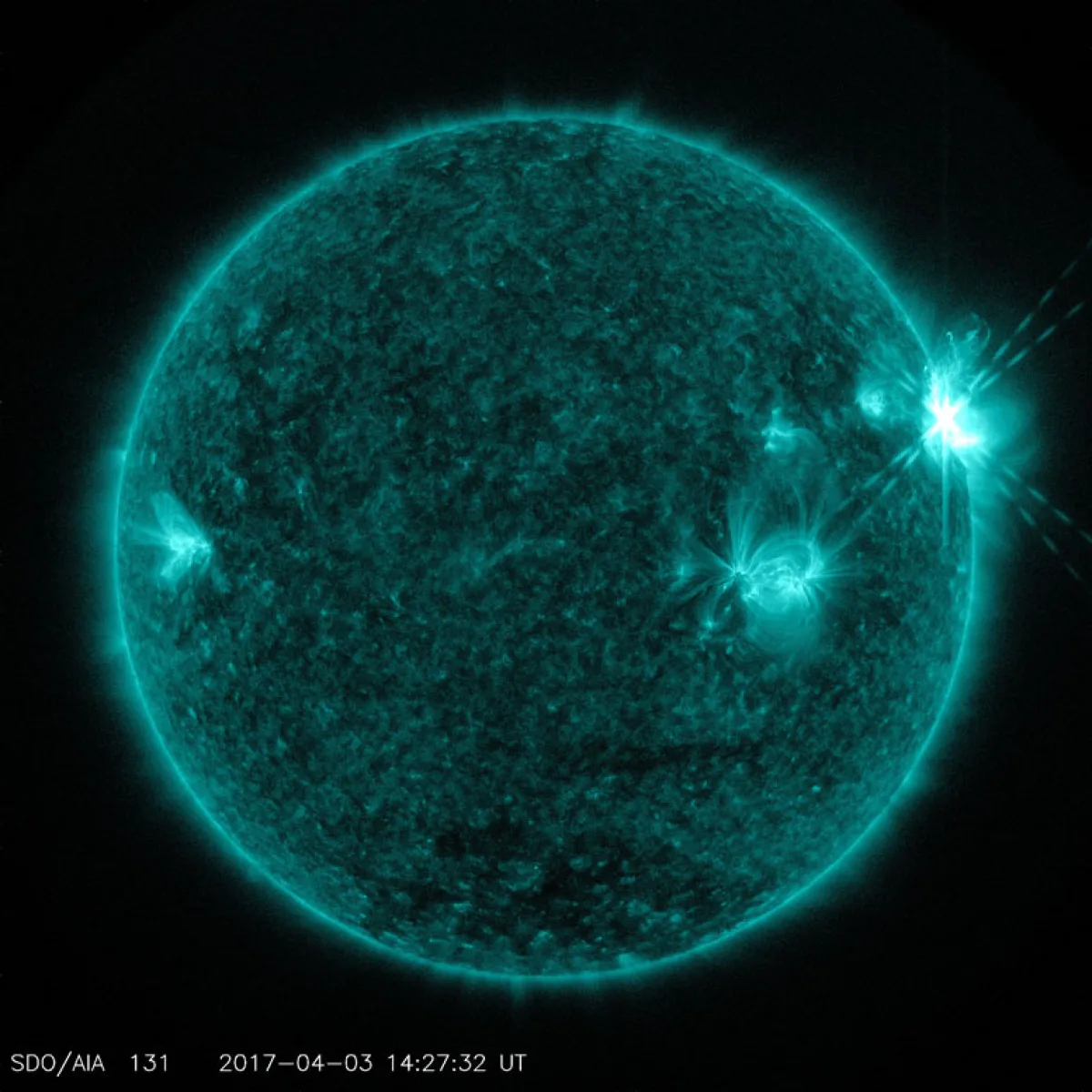
A solar flare is a sudden burst of energy released from the Sun, usually associated with magnetic activity in regions known as solar active regions. These eruptions produce intense electromagnetic radiation and can also be associated with coronal mass ejections and energetic particles.
Solar flares are commonly classified as A, B, C, M and X according to their peak soft X-ray output. X-class events are the strongest category. Stronger flares can disturb Earth's ionosphere and interfere with high-frequency radio communication and navigation systems, while associated energetic particles and coronal mass ejections can create additional hazards for spacecraft and other technologies.
The reason scientists care so much about prediction is simple: once a major flare has erupted, part of its electromagnetic impact reaches Earth very quickly. NASA explains that harmful radiation from flares does not normally physically affect people on the ground because Earth's atmosphere and magnetic field provide protection, but strong flares can disturb radio communications and affect satellites and spacecraft.
For modern society, even a relatively short warning can be useful. Operators can prepare spacecraft, monitor vulnerable systems, adjust mission plans and warn users who depend on sensitive radio or navigation services.
Why Solar Flare Prediction Is So Difficult
Predicting a solar flare is much harder than simply identifying a large sunspot.
The Sun is a constantly changing magnetic environment. Active regions can evolve quickly, and the most important information may not be obvious from a single image.
Researchers therefore study several kinds of data. Solar magnetic-field observations can reveal the complexity and energy stored in active regions. Extreme-ultraviolet and other observations show changes in the solar atmosphere. X-ray measurements can record flare activity. Time series are especially valuable because a developing region may look ordinary at one moment and highly unstable several hours later.
Another major problem is class imbalance.
Most observed periods do not contain major M- or X-class flares. A model could therefore achieve a high ordinary accuracy score by predicting "no major flare" most of the time, while still performing poorly at the thing scientists actually care about: detecting the rare event.
That is why solar-flare researchers often use measures such as the True Skill Statistic (TSS), which is designed to be less distorted by severe imbalance between event and non-event samples. A 2026 study on major flare prediction specifically emphasized TSS for this reason.
How AI Is Changing Solar Flare Forecasting
Traditional flare forecasting relies heavily on physical knowledge, observed active-region properties, statistical relationships and the experience of solar forecasters.
AI adds another approach.
Instead of scientists manually choosing every relationship to investigate, machine-learning systems can examine large historical datasets and learn patterns associated with later flaring activity.
Modern models can work with:
-
Solar magnetic-field maps
-
Extreme-ultraviolet images
-
X-ray measurements
-
Time-series observations
-
Active-region parameters
-
Previous flare history
-
Multiple wavelengths at once
The biggest change in recent research is the move toward spatiotemporal models. Rather than asking what one image looks like, these systems ask how the Sun's magnetic and atmospheric structures are changing across a sequence of observations.
That makes transformer architectures particularly interesting.
Transformers were originally developed for sequence-based problems, but they are increasingly being adapted to astronomy and heliophysics, where scientists need to understand relationships between observations separated in time and space.
NASA's COFFIES AI Model: Looking Beneath the Visible Surface
One of the most notable developments of 2026 came from NASA's COFFIES team.
In August 2026, NASA reported that researchers had developed a machine-learning system capable of predicting the emergence of solar active regions up to 12 hours before they appear at the surface. The project brought together scientists from the New Jersey Institute of Technology, Princeton University and NASA's Ames Research Center.
This is important because existing forecasting methods generally depend on active regions that are already visible.
The COFFIES approach attempts to look earlier.
Researchers use observations from NASA's Solar Dynamics Observatory and search for subtle changes in acoustic waves and magnetic fields associated with magnetic structures rising through the solar interior.
The system uses a sliding-window transformer architecture. Rather than treating the entire history as one enormous sequence, it moves a fixed-size window across the data, focusing on recent information while retaining broader temporal context.
NASA says the approach can estimate the approximate locations of emerging sunspots instead of waiting for those regions to become clearly visible.
That could eventually become valuable for space-weather forecasting because emerging active regions are potential sources of future solar flares and coronal mass ejections.
However, an important qualification is necessary: NASA says this model is not yet ready for operational real-time forecasting. Researchers plan to test it against many more known solar events before it can be considered ready for routine operational use.
So the achievement is not that NASA has solved solar-flare prediction. The achievement is that AI has demonstrated a promising way of detecting information that appears before an active region becomes visible.
The 2026 Multi-Wavelength Transformer Model
Another major step came from a June 2026 study published in Space Weather.
Dunia Alatoom and Nikos Nikolaou developed a transformer-based system for forecasting M-class and stronger flares at the active-region level over a 24-hour period. The model combines multiple wavelengths from NASA's Solar Dynamics Observatory with image representations, convolutional processing and attention-based temporal modeling.
The results were strong within the study's evaluation framework.
The model reported:
| Metric | Reported result |
|---|---|
| TSS | 0.806 ± 0.041 |
| HSS | 0.731 ± 0.055 |
| Probability of Detection | 0.931 ± 0.058 |
| False Positive Rate | 0.125 ± 0.047 |
| F1-score | 0.807 ± 0.036 |
| AUROC | 0.959 ± 0.014 |
| AUPRC | 0.894 ± 0.030 |
| Accuracy | 0.889 ± 0.027 |
The authors reported that the results were averaged across six random seeds, which provides a better indication of model stability than presenting a single lucky training run. They also stressed that comparisons between different flare-forecasting papers must be treated carefully because datasets, input wavelengths, spatial coverage and evaluation methods can vary considerably.
That warning matters.
A model achieving an impressive score on one benchmark does not automatically mean it will perform equally well during every future phase of the solar cycle or on completely different observations.
CNNs Are Still Important
Transformers are receiving considerable attention, but convolutional neural networks remain powerful tools for solar prediction.
A February 2026 study in Solar Physics examined a convolutional neural-network approach using multivariate magnetic-field time series to predict whether an M- or X-class flare would occur within the next 12 hours. The researchers tested multiple preprocessing approaches and compared their model with several baselines.
The proposed model achieved an average TSS of 0.8601 ± 0.0044 across five independent runs and outperformed the tested baselines by at least 0.02 in TSS.
The study also highlights an important lesson for AI research: more features do not automatically mean a better model. The researchers found that carefully selected subsets of features could reach performance close to the full feature set, while the complete feature collection remained best for maximizing average performance.
AI Is Moving Beyond Flare Detection
Another important change is that researchers are no longer looking only at whether a flare will happen.
They are increasingly trying to predict what happens after an eruption.
Solar energetic particles, or SEPs, can pose risks to spacecraft, astronauts and high-altitude or polar aviation operations. A 2026 study introduced SEPNET, a multi-task deep-learning system that combines information about flares, coronal mass ejections and magnetic-field properties to forecast SEP events. The system uses both LSTM and transformer components.
NASA's CCMC describes SEPNET as a model for predicting the probability of a solar energetic particle event exceeding 10 pfu for protons above 10 MeV at Earth within the next 24 hours.
This is a sign of a broader change in the field:
The goal is becoming an integrated space-weather forecasting chain rather than a single "Will there be a flare?" prediction.
Explainable AI and Solar Forecasting
Another difficult question is trust.
Suppose an AI says an active region has a high probability of producing an M-class flare. Scientists and mission operators need to know more than just the probability.
They may want to know:
Why did the model make that prediction?
A 2026 study presented an operational solar-flare forecasting system based on a large-language-model-inspired architecture called LLMFlareNet. The system focuses on major, or M-class and above, flares and uses SHAP-based explainability methods to investigate the factors behind its forecasts.
Explainability is especially important for high-consequence forecasting.
An opaque model might be statistically impressive, but forecasters still need to determine whether it is reacting to meaningful physical signals or to an accidental pattern in the training data.
FlareCast and Machine-Learning Operations
Another 2026 development is FlareCast, described by its researchers as a solar-flare forecasting system built with machine-learning operations, or MLOps, principles.
The system was published in March 2026 and made available as an online service to the research community. Its importance is less about one particular neural-network architecture and more about the move toward maintaining forecasting systems as real, evolving services rather than isolated experiments.
Operational forecasting requires more than a good research paper.
A practical system needs reliable data delivery, repeatable processing, monitoring, version management, uncertainty estimates and safeguards against changes in data quality.
That is where MLOps becomes increasingly important.
Current AI and Automated Solar-Flare Models
By August 2026, NASA's Community Coordinated Modeling Center was hosting several approaches covering different parts of the space-weather prediction problem.
| Model/system | Main approach | Forecast focus | Forecast horizon/status |
|---|---|---|---|
| CLEARflare-LSTM | Deep LSTM framework using SHARP parameters | M-class and above flares | 24 hours |
| A-EFFort | Bayesian analysis of magnetic-field-derived parameter | M1+, M5+, X1+, X5+ flares | 24 hours |
| DAFFS | Probabilistic statistical/discriminant analysis | Solar-flare probabilities | Near real time |
| SEPNET | Multi-task deep learning using LSTM and transformers | Solar energetic particle events | 24 hours |
| SIDC operator v2 | Human forecaster aided by statistical flare probabilities | M-class and above | 24 hours |
| COFFIES research model | Sliding-window transformer | Emerging active regions | Up to 12 hours before visible emergence |
NASA's CCMC says CLEARflare-LSTM produces M-and-above flare probabilities for each active region and the full solar disk using the previous 24 hours of SDO/HMI magnetic-field observations. Its outputs include uncertainty estimates derived from 30 bootstrapped model runs.
A-EFFort takes a different approach. It converts a magnetic-field parameter called Beff into probabilities for four flare thresholds and refreshes those forecasts every three hours.
DAFFS also demonstrates that AI is not the only path forward. It combines magnetic-field information, flare history and statistical discriminant analysis while providing fallback options when particular data sources are unavailable.
This growing collection of models suggests that the future will probably involve ensembles of complementary forecasting systems rather than one universal AI.
Why Early Prediction Matters
The practical value of prediction becomes clearer when the consequences of space weather are considered.
Solar flares can disturb high-frequency radio communications and affect the ionosphere. Strong events can interfere with navigation signals. Other solar eruptions can create radiation environments that are hazardous to spacecraft and astronauts. NOAA notes that space weather can affect radio communications, GPS accuracy, satellites and aviation operations.
Earlier warnings could therefore help operators:
| Area | Potential benefit of better forecasting |
|---|---|
| Satellites | Prepare for radiation and communication disturbances |
| Human spaceflight | Adjust mission procedures and radiation planning |
| Aviation | Improve awareness of high-latitude communication and navigation risks |
| GPS and navigation | Prepare for possible signal degradation |
| Radio communications | Anticipate periods of severe interference |
| Scientific missions | Protect instruments and schedule sensitive observations |
| Deep-space exploration | Improve planning for radiation hazards far from Earth |
NASA has specifically highlighted the importance of space-weather forecasting for future lunar and Mars exploration. The agency says improved prediction of emerging regions, including regions on the Sun's far side, could supplement existing operational models.
The Far Side of the Sun Could Become a Major AI Target
One particularly interesting direction is forecasting activity that is not yet directly visible from Earth.
A solar active region can rotate onto the visible side of the Sun after spending time on the far side. If scientists could identify clues that an emerging region is forming before it becomes visible, forecasters could receive more advance information.
NASA says COFFIES' emerging-region prediction capability could eventually provide additional information, especially about far-side activity, to existing space-weather models.
That would represent an important conceptual change.
Rather than merely forecasting the behavior of something scientists can already see, AI could help reveal what is likely to become important before it enters the normal observational workflow.
The Biggest Problem: A Good Model Can Still Make Mistakes
It would be a mistake to interpret impressive benchmark scores as proof that AI can accurately predict every major solar flare.
The Sun is not a laboratory experiment with perfectly repeatable conditions.
Models learn from historical observations, and unusual solar conditions can challenge systems trained on older distributions. NASA's current CCMC model documentation explicitly warns that model performance can vary during unusual solar activity.
There are also problems involving missing observations, changing instruments, class imbalance, projection effects and differences between datasets.
The 2026 transformer study itself warns that direct comparison between research models should be treated cautiously because studies can use different datasets, wavelengths, spatial restrictions and evaluation procedures.
This is why the strongest future systems will probably combine AI with:
physics + observations + statistics + human expertise.
What Comes Next?
The next stage of research is likely to focus on several connected goals.
First, models need to be tested against larger and more diverse collections of solar events. A system that works well on a carefully prepared benchmark must also survive real-world data conditions.
Second, researchers need better uncertainty estimates. A forecast saying "80% probability" is much more useful when the probability is well calibrated and consistent with real outcomes.
Third, scientists are increasingly combining different kinds of information. Images tell us what structures look like. Magnetic measurements describe the field. Time series reveal evolution. Particle and X-ray observations provide information about eruptions and their consequences.
Putting those streams together may produce more useful forecasts than relying on any single data type.
Fourth, explainability will matter increasingly as AI becomes part of operational decision-making.
Finally, researchers need systems that continuously update as the Sun changes across its approximately 11-year activity cycle.
Latest Scientific Developments in 2026
As of August 25, 2026, the most important recent developments in AI-driven solar forecasting include:
| Date | Development | Why it matters |
|---|---|---|
| February 3, 2026 | CNN-based major-flare study published in Solar Physics | Demonstrated strong 12-hour M/X flare prediction using magnetic-field time series |
| February 19, 2026 | LLMFlareNet study published | Added explainable AI concepts to operational-style flare prediction |
| March 11, 2026 | FlareCast published | Demonstrated an MLOps-oriented solar forecasting service |
| April 2026 | Foundational transformer study published in Astronomy and Computing | Compared transformer models across images, video and time-series solar data |
| June 19, 2026 | Multi-wavelength transformer study published | Reported 24-hour M-class active-region forecasting with strong benchmark performance |
| August 14, 2026 | NASA announced COFFIES AI development | Demonstrated up to 12-hour early prediction of emerging solar active regions |
| August 15, 2026 | NASA CCMC model pages updated | Showed an expanding ecosystem of real-time and near-real-time forecast models |
These developments show that the field is moving quickly, but they should not be confused with a single operational breakthrough that solves solar forecasting.
Current Projects and Status
| Project | Focus | Status as of Aug. 25, 2026 | Expected/confirmed timing |
|---|---|---|---|
| COFFIES AI | Predict emerging active regions | Research/validation | Up to 12 hours before visible emergence |
| Multi-wavelength transformer | M-class flare forecasting | Peer-reviewed research | 24-hour forecast horizon |
| CNN magnetic-field model | M/X flare prediction | Peer-reviewed research | 12-hour forecast horizon |
| LLMFlareNet | Explainable major-flare forecasting | Published research | Operational-style system described |
| FlareCast | AI forecasting with MLOps | Published research/service | Current research use |
| SEPNET | SEP event prediction | Available through NASA CCMC | 24-hour probability forecast |
| CLEARflare-LSTM | M+ flare probabilities | NASA CCMC-hosted model | 24-hour forecast |
The COFFIES project is the clearest example of a system that is scientifically exciting but not yet operational. NASA explicitly says additional validation is required before real-time operational use.
Final Assessment
The newest AI solar-flare models do not mean scientists have finally "solved" the Sun.
They do show something more realistic and potentially more useful: AI is becoming a serious tool for finding the early signs of solar instability.
The most promising 2026 research combines temporal modeling, magnetic-field information, multi-wavelength observations and increasingly sophisticated neural architectures. NASA's COFFIES work goes a step further by attempting to identify emerging active regions before they are visible, while other models are already producing 12-hour and 24-hour probabilistic forecasts for flares and solar energetic particle events.
The next breakthrough may therefore not be a single spectacular prediction.
It may be the creation of a reliable forecasting ecosystem in which AI, solar physics, satellite observations and human experts work together to provide earlier and more trustworthy warnings.
As reliance on satellites, navigation, communications and human spaceflight continues to grow, knowing what the Sun is likely to do next is becoming less of an academic question and more of an infrastructure challenge.
References
- NASA Science Data Portal — Inside Surya: The Team and Technology Behind NASA's Solar AI Model. Updated August 12, 2026. NASA Science Data Portal
- NASA Science — NASA's COFFIES Uses AI to Predict Storm-Causing Active Regions. August 14, 2026. NASA Science
- NASA CCMC — CLEARflare-LSTM. Updated August 15, 2026. NASA CCMC CLEARflare-LSTM
- NASA CCMC — SEPNET. Updated August 24, 2026. NASA CCMC SEPNET
- NASA CCMC — MagPy v3. Updated August 15, 2026. NASA CCMC MagPy v3
- Alatoom et al., Space Weather (2026) — Multi-Wavelength Transformer-Based 24-Hour Solar Flare Forecasting at the Active-Region Level. AGU / Space Weather paper
- Yu et al., Journal of Geophysical Research: Machine Learning and Computation (2026) — Solar Energetic Particle Forecasting With Multi-Task Deep Learning: SEPNET. AGU / JGR paper
- Li et al., Space Weather (2026) — Operational Solar Flare Forecasting System Using an Explainable Large Language Model. AGU / Space Weather paper
- NASA — Solar Storms and Flares. NASA Science
- NASA — Solar Flares FAQs. NASA Science