
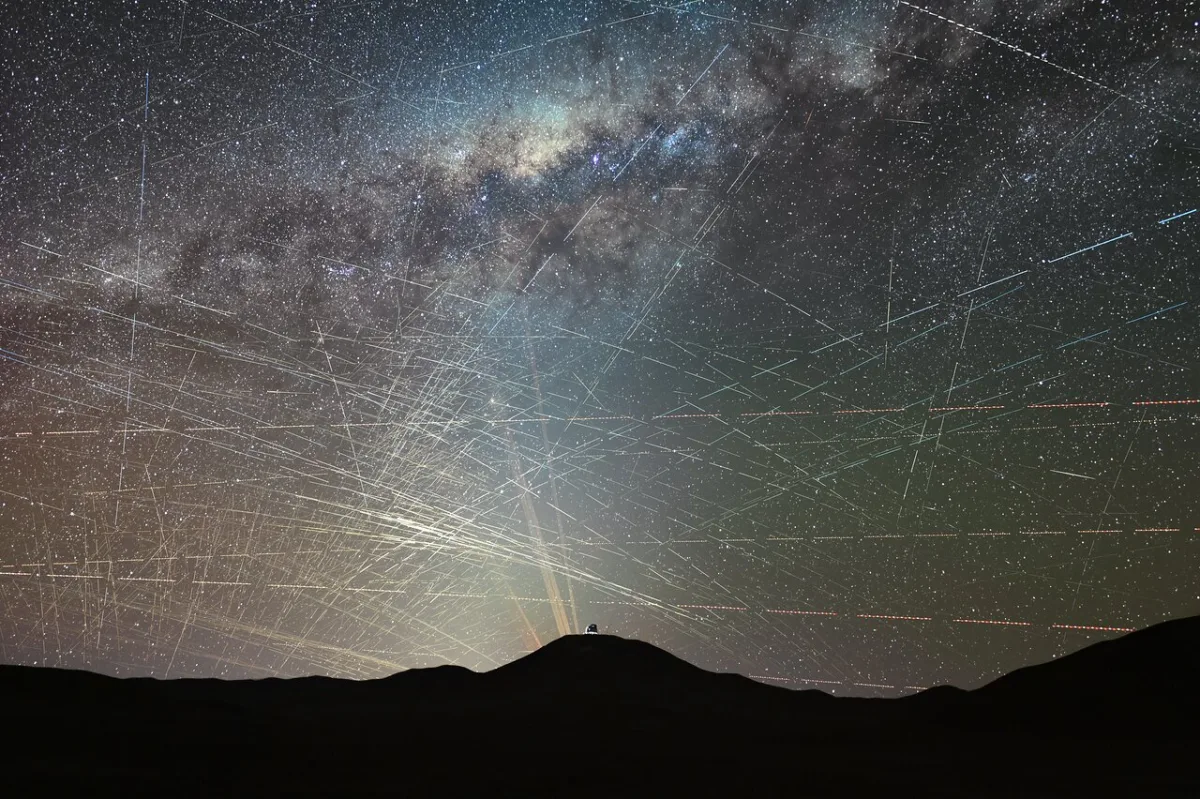
Orbital Light Encroachment: The Death of Pristine Night Skies
The rapid growth of satellite constellations is changing humanity’s relationship with the night sky. Satellites provide valuable services, including internet connectivity, navigation, and communications, but their reflected light and the growing amount of space debris are creating new challenges for astronomy. Research published in 2025 and 2026 has raised serious concerns about the effects on ground-based observatories, space telescopes, and our ability to observe a naturally dark sky. Protecting the stars does not mean abandoning technological progress. It means ensuring that the expansion of human activity in orbit does not permanently diminish one of the world's most remarkable natural sights.
Summary
-
Topic: Orbital light encroachment and the loss of pristine night skies.
-
Main cause: Reflected sunlight from artificial satellites, expanding satellite constellations, and light scattered by space debris.
-
Major concern: Satellite trails can interfere with astronomical observations and make the night sky less natural.
-
Recent research: A July 2026 study announcement from the European Southern Observatory warned that proposals for more than 1.7 million satellites could have severe consequences for astronomy.
-
Scientific impact: Satellite trails can contaminate images captured by both ground-based and space-based telescopes.
-
Environmental and cultural concern: Dark skies support scientific research, wildlife rhythms, cultural traditions, and people's connection with the natural world.
-
Possible solutions: Reduce satellite brightness, improve orbital tracking, manage constellation sizes, and strengthen international standards for responsible space activity.
-
Central message: The future of space technology should include protecting the darkness that allows us to see the universe.
Introduction: When the Stars Begin to Disappear
For generations, the night sky has served as a natural window into the universe. Away from cities and artificial lighting, people could look upward and see thousands of stars, trace the Milky Way, and observe planets without specialist equipment. These experiences helped shape ancient calendars, navigation methods, cultural stories, and humanity's earliest attempts to understand its place in the cosmos.
Today, that experience faces a growing challenge. Artificial satellites are moving across the sky in increasing numbers, reflecting sunlight long after sunset and before sunrise. Some appear as bright points, while others leave visible trails in astronomical photographs.
This problem is part of what can be called orbital light encroachment: the increasing intrusion of artificial light reflected from objects in space into our view of the natural night sky.
Unlike traditional light pollution, which largely originates from streetlights, buildings, billboards, and vehicles, orbital light pollution comes from human-made objects above Earth. It is a growing concern because satellites can affect observations across large geographical areas, including places far from major cities.
The issue is no longer simply a prediction about the distant future. Astronomers are already recording interference, while recent research warns that the problem could become much more serious as satellite networks expand.
What Is Orbital Light Pollution?
Orbital light pollution occurs when artificial objects in space reflect sunlight or scatter light in ways that interfere with observations of the natural sky. The problem is closely connected to the rapid expansion of satellite megaconstellations, which are large networks of satellites designed to provide services such as global internet access.
Satellites are useful for communications, weather monitoring, navigation, disaster response, and scientific research. However, their reflective surfaces can make them visible from Earth, particularly during twilight, when the Sun has set for observers on the ground but still illuminates objects high above them.
A study published in Nature on December 3, 2025, examined how planned satellite networks could affect space-based observatories. The researchers projected that approximately one-third of Hubble Space Telescope images could contain satellite trails if the proposed networks were deployed. Several other space telescopes could face even higher levels of interference. These are projections based on proposed deployments, not measurements of current contamination in every image.
The Growing Threat to Astronomy
Astronomers depend on dark skies to study faint objects, including distant galaxies, asteroids, and planets beyond our solar system. Satellite trails can obscure objects, introduce unwanted light into images, and force researchers to repeat observations or remove contaminated data.
The concern extends beyond individual streaks. A July 2026 report from the European Southern Observatory described a study examining proposals for more than 1.7 million additional satellites. Its modelling warned that large numbers of satellites, particularly bright ones, could significantly increase overall sky brightness and interfere with ground-based astronomy. The report also considered proposed mirror-equipped satellites intended to reflect sunlight toward Earth at night.
|
Issue |
Potential consequence |
|---|---|
|
Reflected sunlight |
Visible moving points and streaks |
|
Satellite trails |
Contaminated telescope images |
|
Scattered light |
Brighter backgrounds that hide faint objects |
|
Space debris |
Additional artificial light in the night sky |
|
Expanding constellations |
More frequent interference with observations |
The figures in these studies depend on the number, brightness, altitude, and orientation of satellites. Nevertheless, the findings show why astronomers are calling for stronger protection before proposed networks reach their full size.
The Loss of a Natural Night Sky
The value of a dark sky extends beyond professional astronomy. For many people, seeing the Milky Way or recognising familiar constellations is a powerful reminder of the scale of the universe.
As artificial objects become more common overhead, the natural appearance of the sky may change. Even satellites too faint to notice individually can contribute to the overall brightness recorded by sensitive instruments. Large numbers of visible satellites could also make it harder to distinguish natural celestial objects from artificial ones.
Dark skies have cultural importance, too. Across generations, communities have used stars to tell stories, mark seasons, navigate journeys, and pass traditional knowledge to younger people. Preserving access to the night sky helps protect this shared human heritage.
Can the Problem Be Solved?
Reducing orbital light pollution does not require ending satellite technology. Instead, it requires better planning, responsible engineering, and cooperation between satellite operators, governments, and astronomers.
The International Astronomical Union's Centre for the Protection of the Dark and Quiet Sky published recommendations in March 2024 calling for action to reduce satellite interference. Its work highlights the need for cooperation between the space industry and the scientific community.
Possible measures include:
-
Reducing satellite brightness: Designing spacecraft and controlling their orientation to minimise unwanted reflections.
-
Improving orbital information: Providing astronomers with accurate, regularly updated satellite positions so they can anticipate interference.
-
Setting responsible limits: Assessing the cumulative impact of proposed constellations before authorising large deployments.
-
Improving telescope software: Developing better methods to identify and remove satellite trails without destroying valuable scientific information.
-
Strengthening international cooperation: Establishing consistent standards because orbital light pollution can affect observers across national borders.
A 2026 study published in The Astronomical Journal also used observations from NASA's SPHEREx mission to examine satellite-trail contamination, providing further evidence that this issue affects telescopes operating in space as well as observatories on Earth.
The Future of Pristine Night Skies
The future will depend on decisions being made now. Satellite networks can improve access to communication services and support important scientific and commercial activities. Yet these benefits must be weighed against the long-term consequences of filling Earth's orbital environment with increasingly reflective objects.
The challenge is not simply to make individual satellites less visible. It is to consider how millions of objects, operating together, could change the appearance of the sky and the quality of astronomical observations.
Protecting dark skies requires satellite operators to take scientific concerns seriously and regulators to consider the combined effects of proposed launches. Researchers also need continued support to measure the problem and develop effective solutions.
Orbital light encroachment is becoming an important environmental and scientific concern of the space age. Research published through 2026 indicates that expanding satellite constellations could interfere with telescope observations and make natural darkness harder to preserve.
The night sky belongs to no single country, company, or generation. Its scientific value and cultural importance make it worth protecting. Humanity can continue to develop space technology while working to preserve the stars, planets, and distant galaxies that have inspired curiosity for thousands of years.
The goal should be progress without unnecessary loss: a future in which satellite technology serves humanity without taking away our ability to experience and study the universe.
References
-
European Southern Observatory. (2026, July 1). Beyond the limit: One million satellites and mirrors in space pose grave threat to the night sky. Read the ESO report.
-
Borlaff, A. S., Marcum, P. M., & Howell, S. B. (2025). Satellite megaconstellations will threaten space-based astronomy. Nature, 648, 51–57. Read the research.
-
International Astronomical Union. (2024, March 14). CPS urges action in first recommendations paper. Read the recommendations.
-
Borlaff, A. S., et al. (2026, June 23). SPHEREx confirms predictions for artificial satellite trail pollution in low Earth orbit. The Astronomical Journal. Read the study.
-
Monthly Notices of the Royal Astronomical Society: Letters. (2025). Low Earth Orbit satellite fragmentation rates are critically disrupting the natural night sky background. Read the research.