
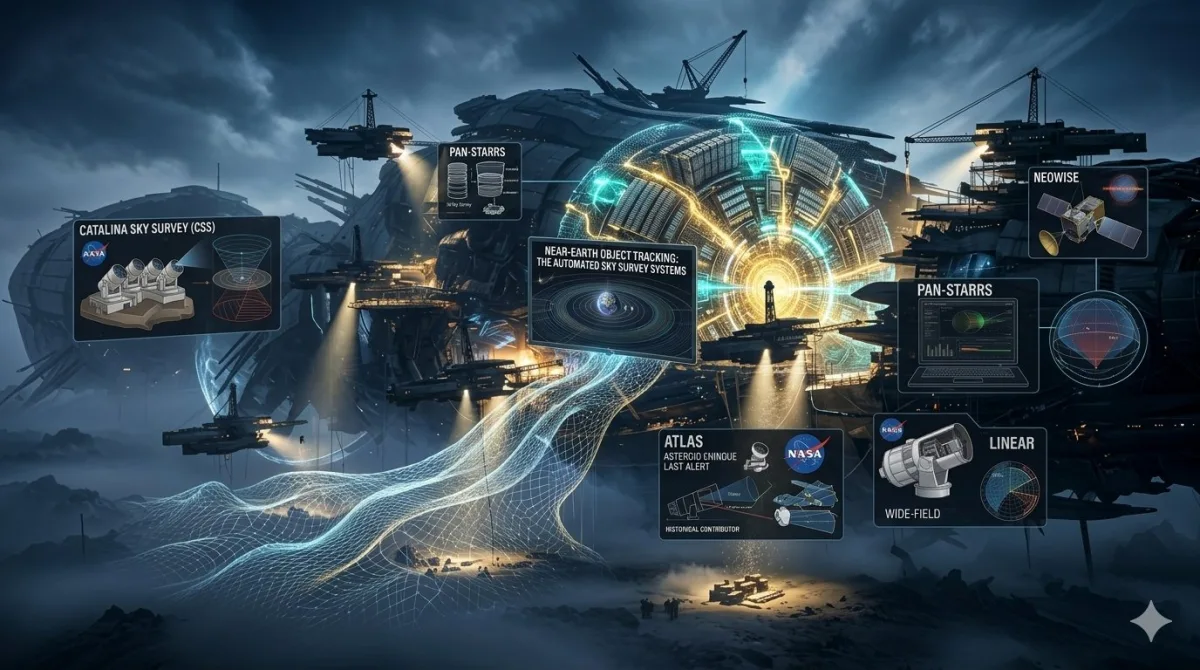
Near-Earth Object Tracking: The Automated Sky Survey Systems Watching the Solar System
Near-Earth object tracking is no longer based on astronomers simply looking through telescopes and waiting to spot an asteroid. Modern planetary-defense surveys use wide-field digital cameras, robotic telescope controls, rapid image processing and automated software to scan huge areas of sky, identify objects that move against background stars, calculate their positions, and send measurements to the Minor Planet Center for confirmation and orbit analysis. Systems such as the Catalina Sky Survey, Pan-STARRS and ATLAS are already doing this work every night, while the Vera C. Rubin Observatory's 10-year Legacy Survey of Space and Time has now begun and is adding a much larger source of moving-object data. NASA's future NEO Surveyor is expected to add an infrared space-based capability specifically designed to find difficult-to-see asteroids and comets. Together, these systems form an increasingly connected early-warning network for discovering, tracking and studying objects that come close to Earth's neighborhood.
What Is a Near-Earth Object?
The term Near-Earth Object, or NEO, refers to an asteroid or comet whose orbit brings it into the broad neighborhood of Earth.
NASA describes NEOs as asteroids and comets that have been moved by gravitational interactions into orbits that can bring them into Earth's neighborhood. In orbital terms, the standard definition used by NASA and other planetary-defense organizations is based on a perihelion distance of less than 1.3 astronomical units from the Sun. An astronomical unit is the average distance between Earth and the Sun.
The word "near" can sound alarming, but a NEO does not automatically mean an object is going to hit Earth.
Some NEOs remain millions of kilometres from Earth. Others can pass relatively close to our planet without posing any danger. A smaller subset is classified as Potentially Hazardous Asteroids, based on both size and how closely their orbits can approach Earth's orbit.
This distinction is important because planetary defense is not about assuming that every new asteroid is dangerous. It is about finding objects early enough that scientists can determine what they are doing and where they are likely to go.
Why Astronomers Need Automated Sky Surveys
The night sky contains an enormous number of stars and distant objects. An asteroid can look like nothing more than a tiny point of light in a single image.
The difference becomes visible when the same part of the sky is photographed again.
A star that is extremely far away appears almost fixed against the celestial background. A nearby asteroid moves noticeably from one exposure to another. Software can compare images, identify the changing point and estimate its direction and rate of motion.
This is the basic idea behind automated asteroid surveys.
The challenge is scale.
A modern survey telescope can capture huge areas of sky in a relatively short time. Doing that manually would be too slow and would make it difficult to react quickly to newly discovered objects. Automated systems therefore handle much of the repetitive work, including telescope scheduling, image processing, candidate detection and data organization.
Rubin Observatory provides a good illustration of the scale involved. Its alert system automatically compares new images with older reference images, searching for changes in position or brightness. Its alert stream can produce millions of alerts during a night, which are then processed by specialized software systems known as alert brokers.
That is why modern NEO tracking is really a combination of astronomy, automation, computing and continuous follow-up.

How Automated NEO Tracking Works
Although individual projects use different hardware and software, the basic process can be understood as a chain of connected steps.
1. The telescope surveys the sky
The telescope is given an observing plan.
Instead of pointing at only one interesting object, a survey telescope repeatedly scans large portions of the sky. The objective is to find objects that were not previously known.
Survey systems are designed around a balance between sky coverage, image depth, exposure time and how frequently each area is revisited.
For example, the Catalina Sky Survey's 1.5-meter telescope covers about 1,000 square degrees per night, while its 0.7-meter Schmidt telescope covers about 4,000 square degrees per night.
2. Digital cameras record the images
Modern surveys use sensitive digital detectors rather than old photographic plates.
The cameras record positions and brightnesses of countless astronomical sources in every exposure.
The quality of those cameras matters enormously. Catalina's large-format 10,560 × 10,560-pixel cameras, for example, helped increase the amount of sky that its telescopes could survey. The survey attributes major increases in discovery rates to improved cameras, software, data pipelines and moving-object detection.
3. Software searches for movement
The computer pipeline processes the images and looks for sources that behave differently from ordinary stars.
One common strategy in modern astronomical imaging is difference-image analysis: a new image is compared with a reference image, and changing sources stand out. Rubin's processing system uses difference-image analysis, source detection and measurement as part of its rapid alert pipeline.
Other survey systems use specialized moving-object detection methods designed around the speed and direction of objects crossing the field.
4. Multiple detections become a tracklet
A single point in one image is not enough.
The system needs several observations separated by time. When those observations are connected into a short sequence, they provide information about how the object is moving.
The Minor Planet Center's tools work with these observation groups, known as tracklets, when evaluating newly reported moving objects. Its current documentation describes automated classification of tracklets to determine which candidates should appear on the Near-Earth Object Confirmation Page.
5. The data goes to the Minor Planet Center
The Minor Planet Center, or MPC, is a central international hub for observations of minor planets, comets and related objects.
New observations can be submitted electronically using modern formats such as ADES. Newly detected potential NEOs may be placed on the MPC's Near-Earth Object Confirmation Page, or NEOCP, where astronomers can see candidates that require additional observations.
6. Other telescopes perform follow-up observations
This step is critical.
The discovery telescope may only have a short series of images. Additional telescopes observe the object later, sometimes from completely different locations.
Those extra measurements help answer an important question:
Where exactly is this object going?
Catalina, for example, operates a separate 1-meter telescope primarily for NEO follow-up. It can recover dozens of targeted NEOs during a typical night.
7. Orbit calculation begins
The more accurate the measurements become, the better scientists can determine the object's orbit.
NASA's Center for Near-Earth Object Studies uses reported observations to compute high-precision orbital paths and study possible future positions. The orbit calculations account for gravitational forces from the Sun, planets, Moon and major asteroids.
8. Impact monitoring systems analyze the orbit
Once an object has enough information associated with it, automated systems can examine whether its future orbit could bring it dangerously close to Earth.
NASA's Sentry continuously examines the current asteroid catalogue for possible Earth impacts over the next 100 years. For new, still-unconfirmed candidates, NASA's Scout system performs preliminary short-term hazard assessments using NEOCP observations.
This is a good example of why finding an asteroid is only the beginning.
The Major Automated NEO Survey Systems
| Survey System | Main Location | Main Capability | Role in NEO Tracking |
|---|---|---|---|
| Catalina Sky Survey | Arizona, United States | Two survey telescopes plus a follow-up telescope | Dedicated NEO discovery and follow-up |
| Pan-STARRS | Haleakalā, Hawaii | Two 1.8-meter survey telescopes | Major NEO discovery survey |
| ATLAS | Hawaii, Chile and South Africa | Four robotic survey telescopes | Rapid, wide-area asteroid warning and discovery |
| Vera C. Rubin Observatory / LSST | Chile | 8.4-meter telescope and enormous digital camera | Broad sky survey producing huge numbers of moving-object observations |
| NEO Surveyor | Space-based, planned | 50-cm infrared telescope | Future dedicated search for difficult-to-see NEOs |
Sources: NASA, Catalina Sky Survey, Pan-STARRS, ATLAS, Rubin Observatory and NASA/JPL. (NASA)
Catalina Sky Survey
The Catalina Sky Survey (CSS) is one of the most important dedicated NEO discovery programs.
Based at the University of Arizona's Lunar and Planetary Laboratory, CSS operates three telescopes. Its 1.5-meter and 0.7-meter telescopes are primarily used for surveying, while a 1-meter telescope is used for follow-up observations.
The project was established in the late 1990s and began developing specialized hardware and software for NEO searches in 1999. Over time, increasingly capable cameras and detection pipelines dramatically increased its productivity.
CSS also demonstrates something important about "automation."
The telescopes and data pipelines can carry out much of the repetitive work, but human observers still validate candidates and report them to the MPC. The system therefore works as a partnership between software and astronomers. (Catalina Sky Survey)
Pan-STARRS
The Panoramic Survey Telescope and Rapid Response System, better known as Pan-STARRS, operates two 1.8-meter telescopes on Haleakalā in Hawaii.
A large share of Pan-STARRS observing time is dedicated to searching for potentially hazardous asteroids under NASA's NEO Observations Program. The system is also used for other astronomical research, including transient events and wider surveys of the sky. (Pan-STARRS)
Pan-STARRS became one of the leading sources of NEO discoveries because it combines large-aperture telescopes, wide-area imaging and repeated observations.
ATLAS
ATLAS stands for Asteroid Terrestrial-impact Last Alert System.
Operated by the University of Hawaii with NASA funding, ATLAS uses four telescopes located in Hawaii, Chile and South Africa. Its network automatically surveys the whole sky several times during a night, searching for moving objects. (Atlas)
The geographic distribution matters.
A telescope in one location can lose observing time because of clouds, daylight or local conditions. A network spread over different parts of the planet increases the chance that another station can observe the same object.
ATLAS has also demonstrated the scientific value of this type of automated survey beyond planetary defense. In July 2025, its Chile telescope reported the first observations of interstellar comet 3I/ATLAS, showing that the same systems built to find moving objects near Earth can also identify unusual visitors from outside our Solar System.
Vera C. Rubin Observatory
The Vera C. Rubin Observatory represents a major change in astronomical survey scale.
Located in Chile, Rubin uses an 8.4-meter telescope and an enormous digital camera to repeatedly image the southern sky.
Its Legacy Survey of Space and Time (LSST) officially began in late June 2026 and is planned to continue for 10 years. One of its major scientific goals is taking an inventory of the Solar System.
Rubin is not a telescope built exclusively for planetary defense. It is intended to study dark matter, dark energy, the Milky Way, transient objects and the Solar System as a whole.
Nevertheless, its ability to repeatedly image huge portions of the sky makes it highly valuable for asteroid discovery.
During early survey work, Rubin data resulted in more than 11,000 new asteroid discoveries, including 33 previously unknown near-Earth asteroids. (Rubin Observatory)
Rubin expects its full 10-year survey to catalogue more than 100,000 NEOs, although those objects will form only part of its much larger Solar System catalogue.

What Happens When a New Asteroid Is Detected?
A newly detected moving point of light does not immediately become a confirmed asteroid.
First, astronomers need to establish that the source is real.
False detections can come from many causes, including image artifacts, detector problems, satellites or other transient effects. Rubin notes that artificial satellites can create bright streaks in astronomical images and interfere with observations.
For an unconfirmed candidate, the MPC can place it on the NEO Confirmation Page.
Astronomers around the world can then use the available position and timing information to obtain additional observations. NASA's Scout system simultaneously analyzes possible short-term trajectories for these unconfirmed objects.
When enough evidence is collected, the candidate can be confirmed and assigned an official designation.
The process can then move from a preliminary discovery to a much more accurate orbital solution.
This is why a headline saying an asteroid has been "detected" should not automatically be interpreted as meaning an impact is expected.
Early observations can produce a broad range of possible orbits. Additional observations normally reduce that uncertainty.
NASA explains that objects can appear temporarily on its Sentry risk page because their early orbits are poorly constrained. As more observations arrive, the possible paths can narrow and a potential impact scenario can disappear.
Why Repeated Observations Matter So Much
Imagine seeing a car through a window for only one second.
You know where it was, but you do not know exactly where it is going.
Now imagine taking photographs of it every few seconds.
The pattern becomes much easier to understand.
Asteroid tracking works in a similar way.
A few observations establish a rough direction. More observations establish a stronger estimate of velocity and orbital motion. Observations made weeks, months or years later can make the long-term orbit much more precise.
NASA's Sentry documentation describes orbit determination as finding the orbital path that best fits the available observations. As new measurements are incorporated, uncertainty can decrease significantly.
This is also why astronomers continue to observe already-known asteroids.
A known object is not necessarily a perfectly known object.
Better measurements can improve its orbit, size estimate and physical characterization.
The Role of Artificial Intelligence and Software
Modern asteroid discovery produces far more data than a human team could inspect manually.
That is where software becomes essential.
Automated pipelines can:
-
Process incoming images
-
Calibrate data
-
Compare new and reference images
-
Identify possible moving sources
-
Measure positions and brightness
-
Link observations into tracklets
-
Compare candidates with known objects
-
Prioritize objects for follow-up
-
Help classify the orbital behavior of candidates
The Minor Planet Center's current documentation describes Digest2 as a rapid orbit classifier that assigns scores across several orbit classes and is used in determining which tracklets should be posted to the NEO Confirmation Page. (MPC Public Documentation Hub)
Rubin Observatory uses another layer of automation through its alert brokers. These systems ingest the enormous alert stream, add contextual information and can use machine-learning methods to classify or prioritize sources. (Rubin Observatory)
However, automation does not remove uncertainty.
Software is only as good as the observations and models available to it. A computer can process millions of measurements rapidly, but astronomers still need to determine whether observations are valid, obtain follow-up data and interpret the results.
The Problem of Finding Asteroids Near the Sun
One of the biggest challenges in asteroid detection is something surprisingly simple:
Earth-based optical telescopes generally observe the night sky.
An asteroid appearing close to the Sun's apparent position in the sky can be extremely difficult or impossible to observe safely with ordinary ground-based nighttime surveys.
This creates a blind region.
Some potentially hazardous objects can approach from directions close to the Sun and may therefore be discovered later than an object approaching from a more favorable part of the sky.
NASA designed NEO Surveyor partly to address this problem.
NASA NEO Surveyor: The Next Major Step
NASA's Near-Earth Object Surveyor, or NEO Surveyor, is a space telescope specifically designed for planetary defense.
It is currently a future mission, with launch planned no earlier than September 2027.
Instead of depending on visible reflected sunlight alone, NEO Surveyor will use infrared observations.
That matters because asteroids that are very dark or difficult to see in reflected light can still emit detectable infrared radiation because they are warmed by the Sun.
NASA says the spacecraft will carry a 50-centimeter telescope operating in two heat-sensitive infrared wavelengths. The mission's five-year baseline survey is designed to find at least two-thirds of NEOs larger than 140 meters, helping NASA advance toward the long-standing goal of discovering more than 90% of that population.
In May 2026, NASA reported that NEO Surveyor was undergoing integration and testing, with engineers continuing spacecraft and instrument development ahead of its planned launch window.
The mission is important because it is not simply another ground telescope.
It is intended to observe portions of the Solar System from space and use infrared sensing to search for objects that conventional visible-light surveys can miss or find relatively late.
ESA's Flyeye Telescope
NASA is not the only organization developing new automated asteroid-search technology.
The European Space Agency's Flyeye telescope uses a design inspired by the compound eye of an insect.
Instead of having one conventional field of view, Flyeye uses multiple optical channels to capture a very large region of sky.
ESA says the telescope can capture an area more than 200 times the apparent area of the full Moon in a single exposure and is designed to automatically survey the sky for new near-Earth asteroids and comets.
Flyeye's first-light campaign in May 2025 included observations of asteroid 2025 KQ. ESA reported that the telescope captured 67 images over roughly 15 minutes and used synthetic tracking to keep the moving asteroid distinct while stars appeared trailed.
ESA envisions a future network of as many as four Flyeye telescopes distributed between the northern and southern hemispheres.
This shows another direction in planetary defense: instead of building only larger telescopes, engineers are also experimenting with wider fields of view, automation and networks of telescopes.
Why Global Coverage Matters
No individual telescope can watch the entire sky continuously.
There are practical limits.
The sky moves.
The Earth rotates.
Telescopes need darkness.
Clouds can interrupt observations.
The Moon can affect certain observations.
Some objects become too faint.
Others can pass close to the Sun's apparent position.
For this reason, a network is much stronger than a single facility.
ATLAS provides a good example. Its four telescopes are spread between Hawaii, Chile and South Africa, giving it coverage across widely separated geographic locations.
Different surveys also have different strengths.
A wide-field survey may cover enormous areas quickly.
A larger telescope may see fainter objects.
A follow-up telescope may spend time precisely measuring a specific target.
An infrared space telescope may detect objects that visible-light telescopes struggle to see.
The planetary-defense system works because these capabilities complement each other.
NASA, ESA and the Minor Planet Center: Turning Observations Into Warnings
The telescope networks are only one part of the system.
Once observations are collected, they must be organized, compared and interpreted.
The Minor Planet Center acts as a central international repository for observations of minor planets, comets and related objects. It receives astrometric observations from observatories and provides services for newly detected objects and follow-up work.
NASA's Center for Near-Earth Object Studies then uses these observations for high-precision orbit calculations and impact analysis.
NASA's Scout system focuses on newly detected, unconfirmed candidates.
NASA's Sentry system focuses on confirmed near-Earth asteroids and checks possible future impacts over a 100-year horizon. (CNEOS)
Europe has a parallel capability through the ESA Near-Earth Object Coordination Centre, or NEOCC, which observes objects, calculates asteroid orbits and assesses impact risk. Its database is updated continuously as new information arrives. (NEO)
This international structure is one of the most important parts of modern asteroid tracking.
A telescope may make the discovery, but the resulting information becomes much more useful when the observation is shared and other scientists can independently measure the same object.
What Makes an Asteroid Hard to Detect?
Not every asteroid is equally easy to find.
Several factors can make detection difficult.
Size
A large asteroid generally reflects or emits more detectable energy than a tiny one. Small objects can remain invisible until they are relatively close.
Reflectivity
Two asteroids of similar size can look very different in visible light because their surfaces can have different reflectivities.
A very dark asteroid can be particularly difficult for visible-light surveys.
Distance
The farther away an object is, the fainter it becomes.
Direction
An asteroid positioned near the Sun in the sky can be difficult for ground-based nighttime surveys.
Speed
Fast-moving objects can cross a detector quickly, producing streaks rather than obvious point sources. Specialized processing is needed to find these objects.
Weather
Clouds and atmospheric conditions can prevent observations at a ground-based site.
Crowded star fields
Objects moving in front of dense regions of stars can be more difficult to isolate.
Human-made objects
Satellites can leave streaks across images and create sources that software must distinguish from natural Solar System bodies. (Rubin Observatory)
Current Projects and Their Status
| Project | Status in September 2026 | Current Role or Expected Contribution |
|---|---|---|
| Catalina Sky Survey | Operational | Dedicated NEO discovery, validation and follow-up |
| Pan-STARRS | Operational | Major wide-field NEO discovery survey |
| ATLAS | Operational | Automated all-sky scanning several times per night |
| Vera C. Rubin Observatory / LSST | Survey underway | 10-year wide survey with major Solar System and NEO discovery capability |
| ESA Flyeye | Early operational development / follow-up capability | Wide-field automated asteroid observations; future network planned |
| NASA NEO Surveyor | In development | Dedicated infrared space-based NEO search; launch no earlier than September 2027 |
Sources: NASA, University of Arizona, University of Hawaii, ESA and Rubin Observatory. (Catalina Sky Survey)
The Growing Importance of Vera Rubin Observatory
One of the biggest changes in asteroid surveillance during 2026 is that Rubin's Legacy Survey of Space and Time has started.
Rubin officially began LSST on June 29, 2026. The 10-year programme will repeatedly photograph the southern sky, creating a detailed record of objects that move or change.
The observatory had already demonstrated its Solar System capability before the full survey began.
Early Rubin observations produced more than 11,000 newly discovered asteroids, including 33 NEOs.
Its enormous data stream is equally important.
Rubin reports that the observatory can produce around seven million alerts in a night, while its data-processing systems use automated analysis to sort changing and moving sources. (Rubin Observatory)
For NEO tracking, this means more observations, more opportunities for discovery and more measurements that can eventually contribute to improved orbital knowledge.
A Discovery Is Not the Same as a Threat
This is one of the most important facts to understand when reading asteroid news.
A newly detected asteroid can initially have a poorly known orbit.
With only a few observations, there may be many possible paths that fit the data.
One of those mathematical possibilities might pass close to Earth.
That does not mean the asteroid is actually going to hit Earth.
As NASA explains, objects often appear temporarily on impact-risk lists because their initial orbital uncertainty is large. New observations can narrow the range until the potential impact disappears from consideration.
This is why the first orbital estimate of a newly discovered asteroid should not necessarily be treated as its final trajectory.
More data usually means greater confidence.
How the Future of NEO Tracking Is Changing
The future of asteroid surveillance is not likely to depend on one giant telescope.
Instead, the system is becoming a network of complementary technologies.
Ground-based surveys will continue scanning large areas of sky.
Rubin will contribute an enormous stream of repeated observations.
ATLAS will continue providing rapid wide-area monitoring.
Catalina and Pan-STARRS will continue supplying high-value discovery and follow-up measurements.
ESA's Flyeye network could provide additional wide-field automated observations.
NASA's NEO Surveyor will add an important infrared perspective from space.
The result will be a system in which an object can be discovered by one telescope, observed by another, processed by automated software, confirmed through the MPC and then evaluated independently by planetary-defense systems.
That is much more powerful than simply building a catalogue of asteroid names.
The real goal is to know where these objects are, how they move, how their orbits could evolve and how much uncertainty remains in those predictions.
Frequently Asked Questions
What is a Near-Earth Object?
A Near-Earth Object, or NEO, is an asteroid or comet whose orbit brings it into Earth's broader orbital neighborhood. The standard definition uses a perihelion distance of less than 1.3 AU from the Sun.
How are Near-Earth Objects discovered?
Large survey telescopes repeatedly photograph broad regions of the sky. Computer software then searches the images for objects that move relative to the background stars.
Are asteroid searches completely automatic?
No. Large parts of the process can be automated, but humans still play an important role in validating candidates, organizing follow-up observations and interpreting results. Catalina, for example, uses automated acquisition and data-reduction pipelines while observers validate and report NEO candidates.
What is the Minor Planet Center?
The Minor Planet Center is an international center for collecting and organizing observations of minor planets, comets and related objects. It also operates services such as the Near-Earth Object Confirmation Page for newly reported candidates.
What is NASA's Sentry system?
Sentry is NASA/JPL's automated impact-monitoring system for confirmed near-Earth asteroids. It searches for possible future Earth impacts over the next 100 years using available observations and orbital calculations.
What is NASA's Scout system?
Scout provides preliminary hazard analysis for newly detected but unconfirmed potential NEOs listed on the MPC's NEO Confirmation Page.
Why can a newly discovered asteroid suddenly appear on a risk list?
Early observations may not be sufficient to determine an exact orbit. Several mathematically possible paths can fit a short set of observations, including some that approach Earth. Additional observations can eliminate those possibilities and greatly reduce the uncertainty.
What is the Vera C. Rubin Observatory's role in asteroid tracking?
Rubin's LSST is a broad astronomical survey rather than a dedicated planetary-defense telescope, but its repeated wide-field observations are expected to discover and track huge numbers of Solar System objects, including NEOs.
What is NASA NEO Surveyor?
NEO Surveyor is a future space telescope specifically designed to search for potentially hazardous asteroids and comets. It will observe in infrared and is planned for launch no earlier than September 2027.
How many near-Earth asteroids are known today?
ESA's NEO Coordination Centre listed 42,437 known near-Earth asteroids in a September 17, 2026 database update. The number changes over time as new objects are discovered, confirmed and linked.
References
NASA — Near-Earth Object Observations Program
NASA NEO Observations Program
NASA/JPL — Near-Earth Object Surveyor
NASA/JPL NEO Surveyor Mission
NASA/JPL CNEOS — Sentry Earth Impact Monitoring
NASA Sentry Impact Monitoring
NASA/JPL CNEOS — Scout Hazard Assessment
NASA Scout Hazard Assessment
NASA/JPL CNEOS — Discovery Statistics
NASA NEO Discovery Statistics
Minor Planet Center — Public Documentation
Minor Planet Center Documentation
Minor Planet Center — NEOCP Observations API
MPC NEO Confirmation Page Tools
Catalina Sky Survey — Telescopes
Catalina Sky Survey Telescopes
Catalina Sky Survey — Discovery Statistics
Catalina Sky Survey Discovery Statistics
Pan-STARRS — University of Hawaii
Pan-STARRS Project
ATLAS — University of Hawaii
ATLAS Asteroid Survey
Vera C. Rubin Observatory — LSST
Rubin Observatory LSST
Vera C. Rubin Observatory — Alert Stream
Rubin Observatory Alert System
ESA — Near-Earth Object Coordination Centre
ESA NEO Coordination Centre
ESA — Flyeye Asteroid Survey Telescope
ESA Flyeye Asteroid Hunter