
National Space Transportation Policy Updates: Managing Mega Launches
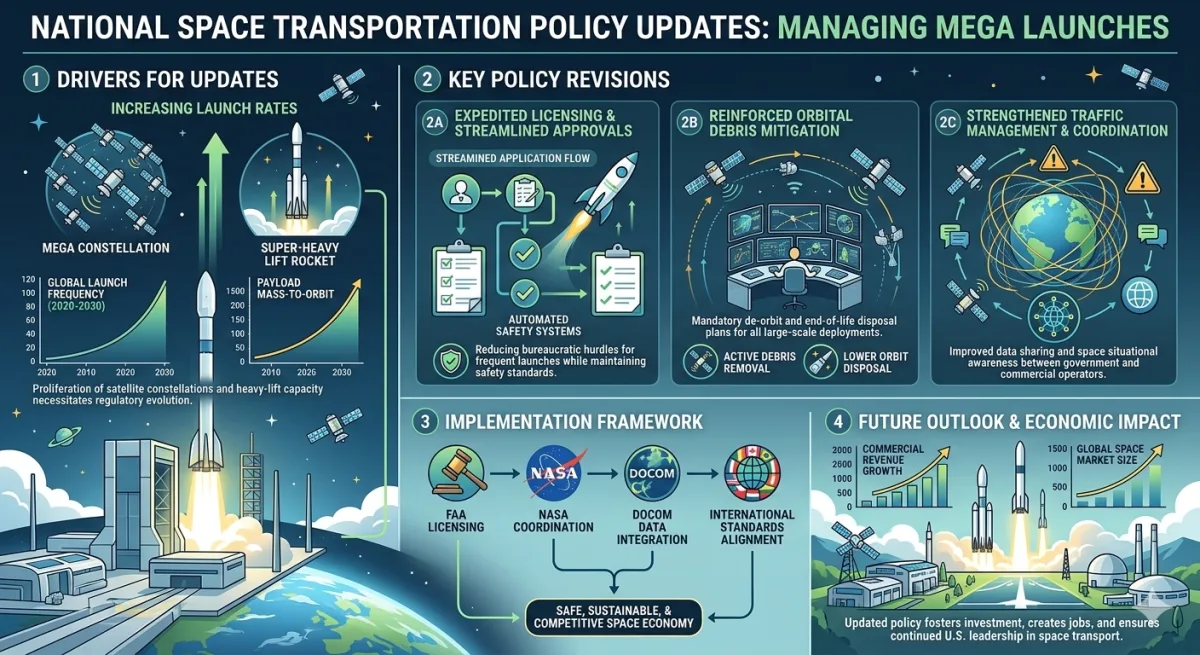
The United States significantly changed its space transportation policy on August 20, 2026, when the White House issued a new National Space Transportation Policy, National Security Presidential Memorandum 17 (NSPM-17). The policy replaced the previous 2013 National Space Transportation Policy and set a major new target: U.S. space transportation ranges should be able to support more than 1,000 launches and reentries each year by 2030.
The new approach focuses on increasing launch capacity, expanding and modernizing launch and reentry infrastructure, improving range scheduling, integrating rocket operations with airspace management, encouraging private investment, strengthening the domestic space transportation industry, and making it easier for commercial companies to obtain launch approvals. At the same time, 2026 has brought important regulatory changes, including the full transition to FAA Part 450 commercial launch licensing and a new FAA proposal aimed at reducing environmental and regulatory requirements for some commercial space licenses.
Summary
- Policy: National Space Transportation Policy, NSPM-17
- Issued: August 20, 2026
- Previous policy: Presidential Policy Directive 26 from November 21, 2013
- Main target: More than 1,000 launches and reentries annually by 2030
- Main agencies involved: FAA, NASA, Department of Transportation, Department of Commerce, Department of Defense/War, FCC, Department of Homeland Security and other federal agencies
- Main focus: Launch and reentry infrastructure, licensing, range capacity, airspace, spectrum, industrial-base development and national security
- Commercial licensing update: FAA Part 450 became the exclusive mandatory framework for U.S. commercial spaceflight after the transition period ended in March 2026
- FAA FY2025 commercial operations: 204 licensed launches and reentries
- FAA FY2026 forecast: 209–214 commercial space operations
- FAA high-case FY2036 forecast: 507 commercial space operations
- Major mega-launch example: SpaceX Starship/Super Heavy
- Starship Boca Chica environmental review: FAA completed a final tiered environmental assessment and issued a mitigated finding of no significant impact/record of decision for an increased-cadence proposal covering up to 25 annual orbital launches
- Important 2026 licensing proposal: FAA proposed waiving requirements under 13 federal laws for certain commercial space licenses when the requirements are determined unnecessary for public health and safety, property, national security or foreign-policy interests
- Research cutoff: September 26, 2026

What Is the National Space Transportation Policy?
The National Space Transportation Policy is a U.S. government policy framework covering how the country approaches access to space, commercial launch and reentry services, government space transportation, launch infrastructure and the wider space transportation industry.
The newest policy was issued by President Donald Trump on August 20, 2026 through National Security Presidential Memorandum 17. It supersedes and revokes the National Space Transportation Policy issued in 2013 under Presidential Policy Directive 26.
The change comes at a time when rockets are becoming more reusable, spacecraft are becoming larger and more numerous, and commercial launch companies are trying to increase the number of missions they can fly each year.
The new policy therefore deals with something that was much less urgent when the previous policy was written: how to manage a space transportation system that could operate at a much higher frequency.
The memorandum states that U.S. space transportation should cover missions ranging from suborbital flights and very-low Earth orbit through the lunar surface, Lagrange points and deep space. It also establishes the goal of having U.S. ranges support more than 1,000 launches and reentries per year by 2030.
That number is important, but it should not be confused with the FAA's separate commercial-operations forecast. The FAA reported 204 licensed commercial space operations in fiscal year 2025, while its current forecast projects 209–214 operations in FY2026 and potentially 507 by FY2036. The FAA figures cover its commercial launch and reentry regulatory scope and are not the same measurement as the national policy's broader launch-and-reentry capacity target.
Why the Policy Was Updated
The 2013 policy was created during an earlier stage of the commercial space industry. It supported commercial transportation, partnerships between government and industry, new launch technologies, hosted payloads and improved access to space.
Since then, reusable rockets and commercial satellite systems have changed the launch market.
The FAA recorded a record 204 licensed commercial space operations in FY2025, describing that total as a nearly 38% increase over the previous fiscal year and more than a 500% increase compared with 2020.
The newer generation of rockets is also designed around much greater payload capability. The FAA identifies Starship/Super Heavy as having a potential low-Earth-orbit payload capability of roughly 100,000 to 150,000 kilograms, although actual performance depends on vehicle configuration and mission requirements. Blue Origin's New Glenn is listed at up to about 35,000 kilograms to low Earth orbit, while Falcon 9 Heavy is listed at approximately 63,800 kilograms.
This creates a different management problem.
The challenge is no longer simply building a rocket that can reach orbit. Government agencies and commercial operators also need enough launch pads, fuel systems, tracking infrastructure, range personnel, airspace coordination, reentry locations, communications capacity, environmental approvals and scheduling systems to operate those rockets repeatedly.
That is the basic reason the 2026 policy places so much attention on infrastructure and launch cadence.
From Bigger Rockets to Mega Launches
The phrase "mega launch" is not a formal category in the National Space Transportation Policy. In practical terms, however, it can be used to describe a combination of very large launch vehicles and increasingly high launch cadence.
A mega-launch environment involves two separate developments.
The first is larger rockets capable of transporting substantially more mass in a single mission.
The second is more launches. A very large rocket can create a different operational burden from a smaller rocket if it requires extensive airspace closures, large exclusion zones, specialized ground infrastructure and complex recovery or reentry operations.
SpaceX's Starship/Super Heavy system is one of the clearest examples of the type of vehicle that helps explain the policy discussion. The FAA identifies Starship/Super Heavy as having an estimated reusable payload capability of up to about 150 metric tons to low Earth orbit.
The FAA has also been working through environmental and licensing issues connected with increasing Starship activity.
At the Boca Chica, Texas, launch site, the FAA completed a final tiered environmental assessment and a mitigated finding of no significant impact/record of decision for a proposal involving increased Starship/Super Heavy cadence. The proposed action covered up to 25 annual orbital launches, together with up to 25 Starship landings and 25 Super Heavy landings. This environmental decision is part of the approval process and should not be interpreted as an automatic authorization for an unlimited number of launches.
The FAA has also completed a final environmental impact statement and record of decision for the proposed Starship/Super Heavy operation at Launch Complex 39A at Kennedy Space Center. Completion of an environmental review does not by itself guarantee that a vehicle operator license will be issued or modified; safety, risk and indemnification requirements still apply.
The Biggest Changes in the 2026 Policy
| Policy area | 2026 direction | Why it matters |
|---|---|---|
| Launch capacity | More than 1,000 launches and reentries annually by 2030 | Requires a much larger national launch system |
| Federal ranges | Improve access for government and commercial users | Reduces the chance that limited range capacity becomes a bottleneck |
| Infrastructure | Encourage leases, private investment and public-private partnerships | Allows commercial companies to participate more directly in infrastructure development |
| Range scheduling | Develop federal scheduling criteria and publish schedules regularly | Creates a more predictable launch environment |
| Airspace | Integrate launch and reentry management with air traffic modernization | Important as launch frequency increases |
| Launch sites | Identify potential additional facilities | Creates more geographic and operational capacity |
| Spectrum | Improve reliable access to spectrum | Supports launch, recovery, reentry and related operations |
| Reentry | Develop another designated federal land reentry site | Supports reusable vehicles and higher flight frequency |
| Industrial base | Create a space transportation industrial-base strategy | Focuses on supply chains, workers and resilience |
| Government payloads | Generally use U.S.-manufactured launch vehicles, subject to exceptions | Links government demand to the domestic launch industry |
| Commercial transportation | Favor commercial transportation for government needs where practical | Expands the role of private providers |
| Lunar transportation | Develop commercial lunar logistics architecture | Connects launch policy with future Moon missions |
These provisions are contained in the August 20, 2026 memorandum and include deadlines ranging from 60 to 240 days for various implementation actions.
Building More Launch Infrastructure
A high launch rate cannot be achieved simply by manufacturing more rockets.
Launch facilities themselves have to keep up.
The policy directs federal agencies to improve infrastructure and access to federal launch and reentry facilities. It encourages leases, commercial investment and public-private partnerships for capital improvements on federal property. It also calls for transparent cost-recovery policies for common services and infrastructure.
This matters because launch facilities contain highly specialized systems.
A modern launch site may require vehicle integration areas, propellant storage, communications systems, tracking equipment, safety systems, water-deluge infrastructure, roads, power systems, landing or recovery areas and connections to wider range networks.
When launch frequency increases, those facilities have less time between missions for maintenance, inspections and configuration changes.
The policy therefore asks agencies to focus on capacity, flexibility, resilience and economies of scale rather than treating each launch as an isolated event.
Another important provision calls for the identification of potential locations for additional launch facilities or targeted infrastructure improvements.
That could eventually mean more spaceports, additional pads at existing locations, improvements to federal facilities or greater use of commercial facilities.
Range Scheduling Becomes a Bigger Issue
Rockets do not launch into an empty environment.
A launch range must coordinate tracking, safety zones, ships, aircraft, ground personnel and other activities. As commercial launch frequency increases, the number of scheduling conflicts can also increase.
The new policy specifically directs the federal government to develop range scheduling criteria within 180 days and to regularly publish range schedules. The purpose is to make better use of limited range resources while continuing to meet government requirements.
This is particularly important for mega-launch vehicles because a larger rocket can affect a wider geographic area.
The range must be ready not only for launch but also for possible stages of recovery and reentry.
A schedule that works for a handful of launches may not work for hundreds.
Airspace Management and Mega Launches
Commercial rockets routinely interact with the aviation system because launch and reentry corridors can cross areas used by civilian aircraft.
As launch numbers increase, regulators need a system that can coordinate both activities efficiently.
The 2026 National Space Transportation Policy therefore calls for space launch and reentry management to be integrated into airspace and traffic-control modernization efforts. It also calls for priority airspace for critical space-launch corridors.
This does not mean aircraft will simply be removed from an area whenever a company wants to launch.
The practical objective is to make the process more predictable and coordinated as the number of spaceflight operations rises.
This becomes particularly important when companies seek launch windows that are close together.
Reentry Is Now Just as Important as Launch
Reusable rockets change the transportation equation.
A traditional expendable rocket launches a payload and much of the launch vehicle is not recovered for another flight. A reusable system can bring hardware back, inspect it, refurbish it and use it again.
That can reduce the amount of hardware required for a high flight rate, but it creates another infrastructure requirement: safe reentry and recovery locations.
The 2026 policy directs the federal government to identify an additional designated federal land reentry site. The Department of Transportation is also instructed to evaluate reentry safety criteria for that location.
The policy also tells NASA to ensure commercial crew and cargo services are available to support government needs and directs attention toward lunar logistics and future deep-space transportation.
That means space transportation policy is increasingly about a complete transportation chain rather than a launchpad alone.
FAA Part 450 Is Now the Main Commercial Launch Framework
Another major change in 2026 is the completion of the FAA's transition to Part 450.
On March 17, 2026, the FAA announced that commercial launch and reentry licensing would proceed under Part 450, which consolidated four older regulatory frameworks into one.
The rule is performance-based rather than relying only on highly prescriptive requirements. It allows a license to cover a portfolio of operations, vehicle configurations, mission profiles and even multiple launch and reentry sites.
The transition period lasted five years.
The FAA said operators that transitioned legacy licenses by the March 9, 2026 deadline included Blue Origin's New Shepard, Firefly Aerospace's Alpha, SpaceX's Falcon 9/Falcon Heavy and Dragon, Rocket Lab's Electron, and United Launch Alliance's Atlas and Vulcan.
This is especially relevant to a high-cadence launch market because requiring a completely separate approval structure for every variation of a recurring operation can create unnecessary administrative work.
The FAA's own forecast notes that Part 450 is intended to help the agency keep pace with increasing commercial launch cadence and complexity.
The 2026 FAA Environmental-Regulation Proposal
The biggest regulatory debate surrounding commercial space transportation in 2026 concerns environmental reviews.
On July 30, 2026, the FAA published a proposed rule titled Waiver of Specified Statutory Requirements for Commercial Space Launch and Reentry Actions.
The proposal would allow the Department of Transportation to waive specified requirements of certain federal laws for commercial space licenses and permits when those requirements are determined not to be necessary to protect public health and safety, property, national security or U.S. foreign-policy interests.
The proposal covers requirements under 13 federal laws, including the National Environmental Policy Act, Endangered Species Act, Clean Water Act, Clean Air Act, Coastal Zone Management Act, National Historic Preservation Act, Marine Mammal Protection Act and others.
The important point is that this was a proposed rule, not a completed final rule, as of September 26, 2026.
The Federal Register notice set August 31, 2026 as the deadline for public comments.
Therefore, it would be inaccurate to describe the 13-law waiver proposal as already being the final commercial launch licensing system.
The proposal is part of a wider effort that began with the August 2025 executive order on commercial space competition, which directed the Transportation Department to examine ways to eliminate or expedite environmental reviews and other regulatory barriers to commercial launches and reentries.
What This Means for Environmental Reviews
Large launch systems can require environmental analysis because launches and reentries may involve impacts involving wildlife, air quality, water, noise, coastal areas, historical resources and other environmental factors.
The FAA's 2026 proposal reflects the administration's position that some of these requirements may be unnecessary for certain commercial space licenses when they do not relate to public safety, property safety, national security or foreign-policy interests.
At the same time, environmental reviews are still relevant to specific projects.
For example, the FAA and NASA determined that a full environmental impact statement was appropriate for the revised Starship/Super Heavy proposal at Kennedy Space Center's Launch Complex 39A. The FAA subsequently announced the availability of the final EIS and record of decision.
This shows that environmental review and launch licensing remain separate parts of the overall system, even while federal policy is moving toward faster approvals.
Starship as a Test Case for Higher Launch Cadence
Starship/Super Heavy demonstrates why the U.S. is trying to redesign the way launch operations are managed.
The system is significantly larger than many existing commercial rockets, and the FAA has had to consider launch trajectories, reentry paths, airspace closures, environmental impacts and increased launch frequency.
In July 2026, the FAA also closed its investigation into the SpaceX Starship Flight 12 mishap. The FAA said the investigation found no reports of public injury or damage to public property and identified the probable causes and corrective actions before allowing Flight 13 operations to proceed subject to applicable requirements.
The episode illustrates an important part of mega-launch policy: higher launch frequency cannot be separated from mishap response.
A system intended to operate frequently needs a regulatory structure that can handle both routine flights and investigations following failures.
The policy therefore places emphasis on resilience, rapid restoration and access to safety data and lessons learned.
The Role of Other Heavy-Lift Rockets
Starship is not the only system shaping the future launch environment.
Blue Origin's New Glenn is another large reusable launch vehicle. The FAA lists its payload capability at up to 35,000 kilograms to low Earth orbit.
Blue Origin's third New Glenn mission launched on April 19, 2026, from Launch Complex 36 at Cape Canaveral Space Force Station.
However, the company experienced a significant anomaly during an integrated-vehicle hotfire test on May 28, 2026. In a June 30 update, Blue Origin said repairs and recovery work were underway and that it intended to return New Glenn to flight by the end of 2026.
Other next-generation launchers are also entering the market. The FAA's 2026–2046 aerospace forecast identifies New Glenn, Starship and Relativity Space's Terran R as next-generation systems designed to increase payload capability to low Earth orbit.
This variety is important because the National Space Transportation Policy emphasizes multiple avenues for reliably transporting U.S. government payloads rather than relying on a single launch system.
Current Launch-System and Policy Picture
| System or policy | 2026 status | Importance to space transportation |
|---|---|---|
| National Space Transportation Policy | Issued August 20, 2026 | Sets the national direction and 2030 capacity goal |
| FAA Part 450 | Exclusive commercial framework after March 2026 transition | Provides one performance-based licensing structure |
| FAA environmental waiver proposal | Proposed July 30, 2026 | Could reduce environmental/regulatory requirements for qualifying licenses |
| Starship/Super Heavy at Boca Chica | Environmental review for increased cadence completed | Example of high-frequency heavy-lift operations |
| Starship/Super Heavy at LC-39A | Final EIS and ROD available | Expands the regulatory and infrastructure case for Starship |
| New Glenn | Operating in 2026, with later return-to-flight work following May anomaly | Adds another heavy reusable commercial vehicle |
| Terran R | Development continues; FAA forecast expected launch in late 2026 | Represents another next-generation heavy-lift entrant |
The status descriptions above reflect information available by September 26, 2026 and should not be treated as predictions of whether a vehicle will meet a future schedule.
The Space Transportation Industrial Base
The new policy does not focus only on rockets.
It also calls for a space transportation industrial-base strategy within 180 days. The strategy is supposed to address industrial capability, affordability, security, resilience and the workforce needed to support the sector.
This is significant because increasing launch numbers requires a large supply chain.
Rocket companies need engines, valves, avionics, batteries, sensors, software, composite materials, metals, electronics and other specialized components.
A launch system may also depend on smaller companies that manufacture individual components or provide testing, logistics, software or engineering services.
The policy therefore asks the federal government to support workforce development, retention programs, military-to-industry pathways, government-industry exchanges and other talent pipelines.
For the U.S. to reach a much higher launch rate, the workforce has to grow alongside the vehicles and facilities.
Government Payloads and Commercial Launch Providers
The 2026 policy also establishes a stronger connection between government demand and U.S. commercial launch providers.
It directs agencies generally to use vehicles manufactured in the United States for U.S. government payloads, while providing specific exceptions for certain international programs, secondary payloads where no comparable U.S. service exists and hosted payload arrangements involving non-U.S.-owned spacecraft.
The policy also directs NASA and the national-security launch organizations to favor commercial transportation services when meeting government requirements.
This does not mean every government mission will automatically use a private company. Government agencies still have mission-specific requirements, security needs and responsibilities.
Instead, the policy places commercial space transportation more clearly inside the government's long-term transportation architecture.
Multiple Ways to Reach Space
One of the most important ideas in the new policy is diversification.
The memorandum calls for multiple reliable ways of deploying U.S. government payloads across relevant orbital regimes and payload classes. It also calls for ridesharing, hosted payload opportunities and standardized interfaces that can make it easier to move payloads between launch vehicles when necessary.
This approach can reduce dependence on one vehicle or one launch provider.
It also matters during periods when a rocket is grounded after a failure.
A diversified launch market can provide alternative ways to transport spacecraft while an affected system undergoes investigation and corrective work.
Space Transportation Beyond Earth Orbit
The new policy extends beyond getting satellites into low Earth orbit.
NASA is directed to develop a lunar logistics architecture that facilitates commercial transportation to and from the lunar surface. The policy also asks NASA to explore commercial robotic access to Mars and commercial architectures for future crewed Mars missions.
This means the U.S. government is increasingly treating space transportation as a continuous system.
The future transportation network could include:
- Earth-to-orbit launch services
- Reusable first-stage recovery
- Orbital transfer vehicles
- Space stations
- Lunar cargo transportation
- Lunar landing systems
- In-space servicing
- Debris-removal services
- Deep-space transportation
- Future Mars transportation
The 2026 policy specifically directs attention to in-space transportation services, including on-orbit servicing and in-space logistics.
International Space Transportation
The policy also addresses foreign participation.
Requests involving foreign space vehicles launching or reentering in the United States for commercial purposes are to be reviewed on a case-by-case basis. The policy says that this assessment should consider national security, foreign policy, nonproliferation, effects on the U.S. space industrial base, foreign investment, liability and effects on federal launch infrastructure.
Separately, the policy directs the State and Commerce Departments to review export policies, market access, international regulatory alignment and export controls relating to U.S. space transportation capabilities.
This creates a balance between expanding the U.S. launch market and controlling sensitive space technologies.
What Happens Next?
The policy is new, so many of its most important implementation requirements have not yet been completed as of September 26, 2026.
The memorandum contains several deadlines.
| Deadline from August 20, 2026 | Approximate date | Required action |
|---|---|---|
| 60 days | October 19, 2026 | Recommendations relating to certain foreign space-vehicle launch/reentry requests |
| 90 days | November 18, 2026 | Identify federal land for an additional designated reentry site |
| 120 days | December 18, 2026 | Update space transportation market-access and export policies |
| 180 days | February 16, 2027 | Range scheduling criteria, infrastructure actions, airspace integration and industrial-base work |
| 240 days | April 17, 2027 | Development plan for the additional federal land reentry site |
These dates are calculated from the deadlines specified in the August 20 memorandum. The actual completion and publication of agency actions may depend on interagency processes and other legal or administrative requirements.
The policy also says that implementation must remain consistent with applicable law and the availability of appropriations. This is important because a presidential memorandum can direct executive-branch action, but it does not eliminate statutory requirements or automatically provide funding for every infrastructure project.
The Main Challenge: Capacity Versus Safety
The central challenge for the new policy is simple to describe.
The U.S. wants substantially more launches, but rockets still have to operate safely.
A high-cadence launch system needs to coordinate:
Vehicles + launchpads + fuel + range safety + airspace + tracking + environmental requirements + recovery sites + communications + personnel + emergency response.
Increasing only one part of this chain will not automatically increase overall capacity.
For example, manufacturing more rockets will have limited value if there are not enough launch windows. More launch windows may not help if airspace procedures cannot support the schedule. A new launch site will not solve every problem if reentry infrastructure remains limited.
This is why the 2026 policy is broader than a rocket-development program.
It treats space transportation as national infrastructure.
Is the 1,000-Launch Goal Easy to Reach?
The 1,000-per-year target is ambitious by comparison with today's FAA-regulated commercial activity.
The FAA's current forecast places commercial space operations at between 209 and 214 in FY2026, with a high case of 507 by 2036. Again, these numbers are not directly comparable with the policy's broader 1,000 launch-and-reentry capacity goal, but they show the scale of growth that is already being anticipated within commercial space transportation.
Reaching the national target would therefore require much more than today's launch infrastructure.
It would likely require higher vehicle reliability, greater reuse, more launch locations, faster licensing, larger support workforces, expanded range capacity, improved airspace coordination and continued growth in commercial demand.
The policy itself recognizes this by calling for infrastructure investment, industrial-base development, workforce support and more flexible launch scheduling.
What the Policy Could Mean for Commercial Space Companies
For commercial operators, the 2026 policy creates a clearer federal direction toward higher launch cadence and greater reliance on private transportation services.
The FAA's move to a single Part 450 licensing framework is particularly relevant because one license can cover multiple launches, configurations, mission profiles and sites.
The administration's 2025 executive order and the 2026 FAA proposal also show an effort to reduce regulatory barriers surrounding commercial space licenses and permits.
However, faster licensing does not eliminate technical requirements.
Launch providers still have to demonstrate that their operations meet applicable safety, risk, financial responsibility and other requirements.
For very large rockets, the environmental and infrastructure issues can also be significant, as demonstrated by the separate environmental processes involving Starship at Boca Chica and Kennedy Space Center.
References
The White House — The National Space Transportation Policy, August 20, 2026
Read the current National Space Transportation Policy
U.S. Department of Commerce, Office of Space Commerce — National Space Transportation Policy
Read the Office of Space Commerce policy summary
Federal Aviation Administration — FAA Streamlines Commercial Space License Approvals, March 17, 2026
Read the FAA Part 450 update
Federal Aviation Administration — Waiver of Specified Statutory Requirements for Commercial Space Launch and Reentry Actions
Read the July 30, 2026 Federal Register proposal
Federal Aviation Administration — FAA Aerospace Forecast Fiscal Years 2026–2046
Read the FAA aerospace forecast
Federal Aviation Administration — SpaceX Starship/Super Heavy at Boca Chica
Read the FAA Starship environmental and licensing information
Federal Aviation Administration — SpaceX Starship/Super Heavy at Kennedy Space Center LC-39A
Read the FAA Kennedy Space Center Starship information
The White House — Enabling Competition in the Commercial Space Industry, August 13, 2025
Read Executive Order 14335
2013 National Space Transportation Policy — Historical reference
Read the 2013 National Space Transportation Policy