

NASA’s Chandra X-Ray Survey Discovers 84 Hidden Cosmic Objects
NASA’s Chandra X-ray Observatory has helped astronomers uncover a previously unrecognized population of cosmic objects that are extremely faint in normal X-ray observations but appear unusually powerful at the boundary between X-rays and ultraviolet light. By examining archival Chandra observations at the telescope’s lowest accessible X-ray energies, researchers identified 84 objects in six nearby galaxies and called them hypersoft X-ray sources, or HSSs. The objects are likely connected to compact binary systems involving accreting white dwarfs, black holes or neutron stars, although their exact nature is still unknown. The discovery could be important for understanding how galaxies become ionized and may also provide clues about the long-standing mystery of which stellar systems produce Type Ia supernovae.
Summary
-
Discovery: 84 hypersoft X-ray sources
-
Observatory: NASA’s Chandra X-ray Observatory
-
Announcement: September 9, 2026
-
Scientific publication: Nature Astronomy
-
Study: “Hypersoft X-ray sources as a low-energy class of luminous cosmic emitter”
-
Lead author: Mustafa Muhibullah, University of Alabama
-
Other authors: Jimmy A. Irwin and Rosanne Di Stefano
-
Galaxies studied: M31 (Andromeda), M101 (Pinwheel Galaxy), NGC 3115, NGC 3379, NGC 4697 and NGC 4472
-
Main characteristic: Extremely low-energy X-ray emission, mostly below 0.3 keV
-
Likely nature: X-ray binary systems involving white dwarfs, black holes and/or neutron stars
-
Main mystery: Why do these objects produce such unusually strong extreme-ultraviolet emission?
-
Possible importance: Understanding galaxy ionization and potential Type Ia supernova progenitors
-
Current status: Newly identified class; the physical nature of individual sources remains under investigation. (Chandra X-ray Observatory)
What Did NASA’s Chandra Observatory Discover?
The discovery came from a new look at old data.
Astronomers searched archival observations collected by NASA’s Chandra X-ray Observatory and looked specifically for objects that were visible at the lowest X-ray energies but almost disappeared when higher-energy X-rays were examined.
That unusual pattern turned out to be a clue.
The research team found 84 objects across six nearby galaxies. They were different from the typical X-ray sources astronomers are accustomed to finding, so the researchers gave them a new name: hypersoft X-ray sources.
The six galaxies include the spiral galaxies M31, better known as the Andromeda Galaxy, and M101, also known as the Pinwheel Galaxy. The other four—NGC 3115, NGC 3379, NGC 4697 and NGC 4472—are elliptical or early-type galaxies.
The researchers also found these objects in very different stellar environments. Some occur in areas associated with younger, actively forming stars, while others are present in older stellar populations. That makes the discovery particularly interesting because it suggests that hypersoft sources may not belong to one narrow stage of stellar evolution.
Why Are They Called “Hypersoft” X-Ray Sources?
The name comes from the unusual energy of their X-rays.
Most familiar X-ray binaries produce much of their detectable X-ray emission at energies above about 0.3 keV. The newly discovered sources are much softer, with their detectable X-ray emission concentrated primarily or exclusively below that energy.
The scientific study used the 0.15–0.3 keV range to identify the sources and required them to show a much stronger signal in that range than in the 0.3–1.0 keV band. The authors describe them as some of the softest X-ray sources known. (Nature)
But there is an important twist.
Although their X-rays are unusually soft, models indicate that much of their total energy may be released as extreme-ultraviolet (EUV) radiation. That is the part of the electromagnetic spectrum that has made these objects so difficult to find.
The “Missing” Part of the Electromagnetic Spectrum
Astronomers observe the universe at many wavelengths, including radio waves, visible light, infrared, ultraviolet, X-rays and gamma rays.
Extreme ultraviolet sits in a difficult observational region between ultraviolet radiation and X-rays. For distant astronomical objects, EUV radiation is strongly absorbed by hydrogen and helium gas along the path between the source and Earth.
That means an object could potentially be producing enormous amounts of EUV radiation without appearing obvious to astronomers.
The Chandra team describes the EUV region as an important observational blind spot. Rather than detecting the EUV light directly, the researchers searched for the faint low-energy X-ray signal that could act as evidence that strong EUV emission was present.
This approach allowed researchers to identify objects that previous surveys had effectively overlooked.
How Did Chandra Find the Hidden Objects?
The discovery did not come from a brand-new space telescope observation.
Instead, researchers went back through observations already stored in the Chandra archive.
They selected nearby galaxies with extensive Chandra observations and examined the data for sources that appeared at the lowest X-ray energies while disappearing at higher energies. This was important because ordinary detection methods can overlook extremely soft sources.
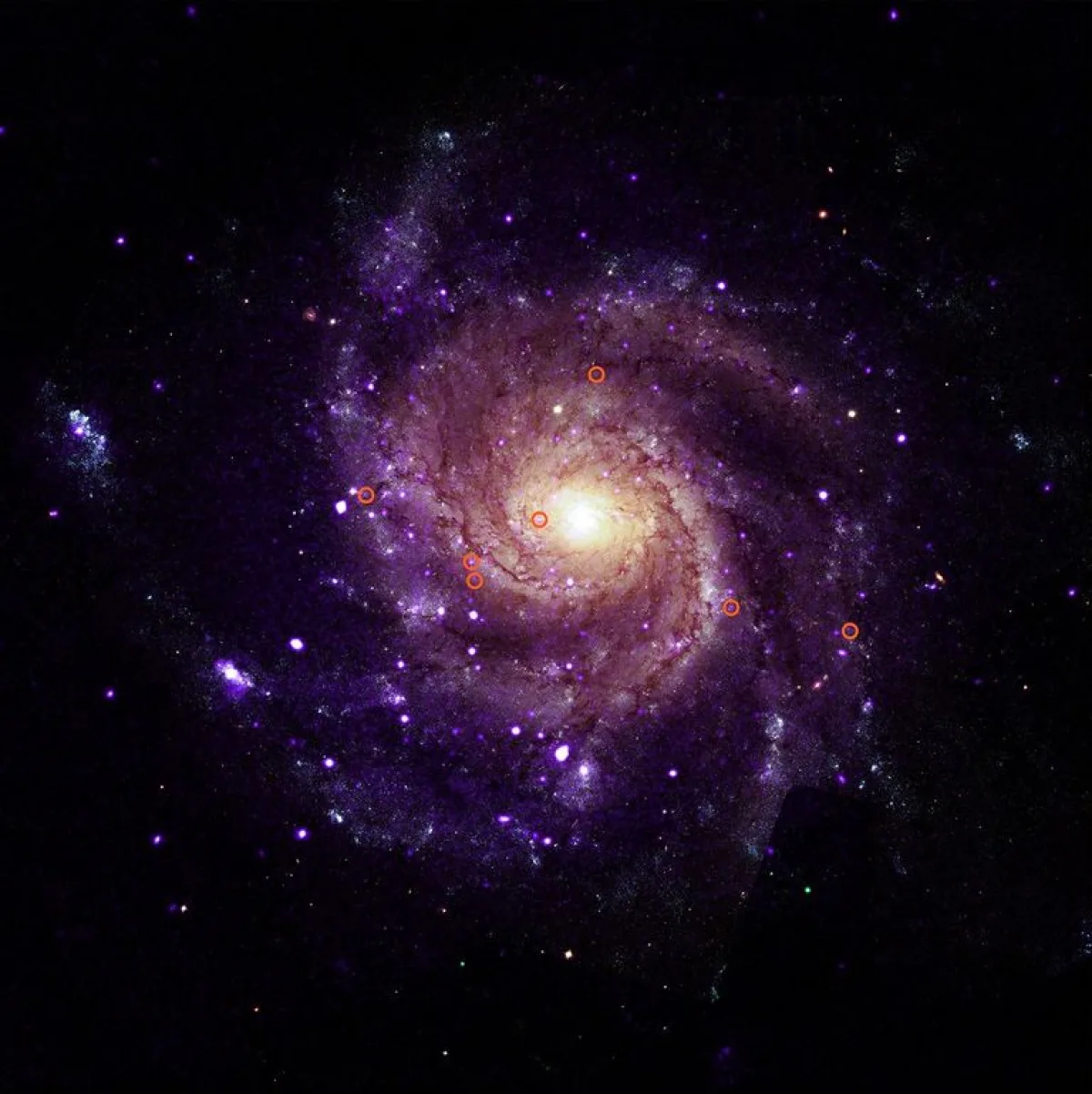
For example, NASA's newly released composite image of M101 highlights seven of the hypersoft sources found in that galaxy. They look like tiny points of light among the many other sources in the galaxy, and there is nothing visually obvious that would tell a casual observer that they are unusual.
The difference becomes clear only when scientists examine their X-ray energy distribution.
Where Were the 84 Objects Found?
The 84 sources were identified in six galaxies:
| Galaxy | Type | HSS Sources |
|---|---|---|
| M31 / Andromeda | Spiral | 18 |
| M101 / Pinwheel Galaxy | Spiral | 7 |
| NGC 3115 | Early-type | 18 |
| NGC 3379 | Elliptical | 12 |
| NGC 4697 | Elliptical | 8 |
| NGC 4472 | Elliptical | 21 |
| Total | Six galaxies | 84 |
The per-galaxy figures come from the study's source table. The official Chandra release independently confirms the overall total of 84 and the six-galaxy sample. (ResearchGate)
This distribution is also scientifically useful. The sources are found in both star-forming regions and galaxies dominated by older stars, suggesting that hypersoft X-ray sources may involve more than one type of stellar system. (NASA Science)
What Could These Objects Actually Be?
Scientists do not yet have a single confirmed answer.
The leading idea is that many of them are X-ray binary systems.
An X-ray binary consists of a compact object and a companion star. The compact object can pull material away from the companion. As that material falls toward the compact object, it becomes extremely hot and can produce powerful radiation.
In the case of the hypersoft sources, the compact object could be a white dwarf, neutron star or black hole.
The different possibilities are important because each points toward different stages of stellar evolution.
A white dwarf receiving material from a companion could form a system that is connected to a future Type Ia supernova. A black-hole binary would represent another pathway for producing an energetic compact source, while neutron-star systems would introduce yet another physical explanation.
The Nature Astronomy paper therefore does not present the HSS population as one proven type of object. Instead, the researchers propose that hypersoft sources may represent several physical classes of X-ray binaries sharing unusual observable characteristics.
Why Type Ia Supernovae Matter
One of the most exciting possibilities involves white dwarfs.
Type Ia supernovae are powerful stellar explosions that have played a major role in measuring cosmic distances. Observations of these explosions were central to the discovery that the expansion of the universe is accelerating.
Yet astronomers still have unanswered questions about exactly which stellar systems become Type Ia supernovae.
Some white dwarf binary systems are possible candidates. If a hypersoft source turns out to be an accreting white dwarf in the right evolutionary state, studying these objects could help researchers understand what happens before some Type Ia explosions occur.
Jimmy Irwin of the University of Alabama, a co-author of the study, emphasized that finding the systems that eventually produce these explosions would be especially valuable because researchers currently study Type Ia supernovae primarily after the explosions have occurred.
The discovery therefore does not prove that the 84 sources are Type Ia progenitors. Instead, it provides a new population of objects that could contain some of the systems astronomers have been searching for.
Could These Objects Affect Entire Galaxies?
Possibly.
The hypersoft sources may be much more important than their tiny appearance suggests because of the amount of energetic ultraviolet radiation they could produce.
The researchers are interested in a second major astrophysical problem: the ionization of gas between stars.
Some galaxies contain gas where atoms have been stripped of electrons. Hot, massive stars contribute to this process, but scientists have not been able to account for every observation using those stars alone.
The strong EUV output from hypersoft X-ray sources could provide another source of ionizing radiation. If large populations of these objects exist, they might influence the state of interstellar gas and therefore affect processes such as star formation and the evolution of galaxies.
That possibility is still being tested, but it gives the discovery significance beyond simply identifying a new category of X-ray source.
Why Were They Hidden for So Long?
The strange sources were hiding in plain sight partly because astronomers were looking in the wrong part of the X-ray spectrum.
The sources are strongest at extremely low X-ray energies, where detection is difficult. At the same time, much of the radiation they produce may lie in the EUV range, which is heavily absorbed by hydrogen and helium.
So the universe effectively places two barriers in front of these objects.
First, the lowest-energy X-rays are difficult for telescopes to detect. Second, the EUV radiation that could reveal how energetically the objects are really shining is absorbed before it can reach observers.
This combination helped create what the researchers describe as an observational blind spot.
The significance of the work is therefore not simply that Chandra saw something that no telescope had ever seen.
Chandra found a way to use a faint signal in an accessible part of the spectrum to identify objects whose strongest radiation may exist in a much harder-to-observe region.
How Powerful Are the Hypersoft Sources?
Despite being “soft” in X-rays, these objects can be extremely luminous.
The Nature Astronomy study reports that the most luminous examples can radiate around 10³⁸ erg per second in the narrow X-ray band being studied, while spectral models suggest substantially larger total luminosities because much of the energy may emerge outside the observed X-ray range.
This is an important distinction.
“Soft” does not mean “weak.”
In this case, it refers to the energy of the photons, not necessarily the total amount of energy being released.
The sources can therefore be enormously energetic while appearing unusually cool or faint to conventional X-ray observations.
Chandra’s Role in the Discovery
NASA's Chandra X-ray Observatory was designed to study some of the universe's most energetic phenomena, including black holes, neutron stars, supernova remnants and hot gas in galaxies and galaxy clusters.
Its ability to produce high-resolution X-ray observations has made it a major tool for identifying faint sources and separating them from other emissions.
For this discovery, however, one of the most valuable resources was not simply Chandra's telescope but the enormous archive of observations accumulated over many years.
The team used publicly available archival data to search for the unusual low-energy signatures. NASA and Chandra officials have highlighted the work as an example of how older observations can produce new discoveries when scientists ask new questions of existing datasets.
The M101 Image Shows What the Discovery Looks Like
One of the most striking examples comes from M101, the Pinwheel Galaxy.
Chandra observations taken over numerous observing sessions were combined with optical observations from the Hubble Space Telescope. The resulting image shows the galaxy's spiral structure, with seven hypersoft X-ray sources marked in the annotated version.
Chandra's observations of M101 total about 274 hours, collected across 25 observations between March 2000 and January 2005. The image covers about 86,000 light-years across.
To human eyes, the seven highlighted sources do not look extraordinary. Their unusual nature becomes apparent only after astronomers divide the X-ray observations according to photon energy.
That is one reason the discovery is so interesting: these objects were not necessarily hiding behind some dramatic visual feature. Their secret was in the physics of their radiation.
What Do Scientists Still Not Know?
The biggest unanswered question is simple: what exactly are hypersoft X-ray sources?
The researchers have proposed several possibilities, but the evidence does not yet allow every object to be assigned a definitive physical identity.
Some could be accreting white dwarfs. Others could involve black holes. Neutron stars are also possible.
The population may ultimately prove to contain several different kinds of systems rather than one single object type.
Researchers will need additional observations and detailed comparisons across different wavelengths to determine how these systems behave, how long they remain in the hypersoft state and whether they evolve into other recognizable types of X-ray source.
Latest Developments as of September 14, 2026
The discovery is extremely recent.
The peer-reviewed paper, “Hypersoft X-ray sources as a low-energy class of luminous cosmic emitter,” was published in Nature Astronomy on September 9, 2026. The paper was authored by Mustafa Muhibullah, Jimmy A. Irwin and Rosanne Di Stefano.
NASA and the Chandra X-ray Center issued their public announcement on the same date. The Chandra team currently describes the objects as a newly discovered class whose exact physical nature remains uncertain.
The research is therefore in an early stage. The 84 sources are not being presented as 84 confirmed black holes, neutron stars or white dwarfs. They are a newly identified population selected because of a shared and unusual pattern in their X-ray emission.
Current Project Status
| Research Item | Status | Date | Notes |
|---|---|---|---|
| Chandra archival search | Completed | 2026 | Revealed the HSS population |
| Identification of 84 HSS sources | Completed | September 2026 | Sources found in six galaxies |
| Nature Astronomy study | Published | September 9, 2026 | Peer-reviewed research paper |
| Physical identification of all HSSs | Ongoing | 2026 onward | Exact nature remains uncertain |
| Investigation of Type Ia connection | Ongoing | 2026 onward | White-dwarf systems are one possibility |
| Investigation of galaxy ionization | Ongoing | 2026 onward | EUV output may contribute to ionization |
| Follow-up research | Expected | Future | More observations are needed |
References
-
NASA Science — NASA’s Chandra Unveils Mysterious X-Ray Objects. Official NASA explanation of the 84 hypersoft X-ray sources, the six galaxies involved and the possible Type Ia supernova and galaxy-ionization connections. Read the NASA Science report
-
Chandra X-ray Observatory — NASA’s Chandra Unveils Mysterious X-Ray Objects. Official Chandra press release issued September 9, 2026. Read the official Chandra release
-
Nature Astronomy — Hypersoft X-ray sources as a low-energy class of luminous cosmic emitter. Peer-reviewed study by Mustafa Muhibullah, Jimmy A. Irwin and Rosanne Di Stefano, published September 9, 2026. Read the Nature Astronomy paper
-
Chandra Blog — A Hidden Population of Cosmic Beacons: Discovering Hypersoft X-ray Sources with Chandra. First-person account from lead author Mustafa Muhibullah explaining the search strategy and the EUV observational blind spot. Read the Chandra research blog
-
Chandra Photo Album — M101, the Pinwheel Galaxy. Official NASA/Chandra image information, including the seven highlighted hypersoft sources and M101 observation details. View the M101 Chandra image and details
-
arXiv — Hypersoft X-ray Sources: A New Class of Luminous Cosmic Emitters. Research preprint containing methodological and source-catalog details underlying the discovery. View the research preprint