
Microbial Mining in Space: How Bacteria Could Extract Valuable Metals from Asteroids
Scientists are exploring an unusual way to mine valuable resources in space: using microscopic organisms to extract metals from rocks and asteroids. Known as microbial biomining, the process uses bacteria and fungi to release useful elements from minerals through natural chemical reactions. Experiments aboard the International Space Station (ISS) have already demonstrated that microorganisms can extract valuable materials under microgravity conditions. In January 2026, researchers published new findings from the BioAsteroid experiment, which investigated how microorganisms could extract 44 different elements from actual asteroid-like material. The research could eventually help astronauts obtain essential resources without transporting everything from Earth, bringing sustainable space exploration a step closer.
Summary
-
Research topic: Microbial mining and asteroid resource extraction.
-
Technology: Microbial biomining, also called bioleaching.
-
Main organisms: Bacteria and fungi.
-
Research locations: International Space Station and Earth-based laboratories.
-
Important experiment: ESA's BioRock and BioAsteroid investigations.
-
Major discovery: Microorganisms can help release valuable elements from extraterrestrial rock material.
-
Elements of interest: Platinum, palladium, rare earth elements and other industrial metals.
-
Latest major research: BioAsteroid study published on January 30, 2026.
-
Potential applications: Space manufacturing, construction, resource recovery and future human settlements.
What Is Microbial Mining in Space?
Mining in space sounds like something that would require enormous machines, specialised equipment and advanced robotic systems. However, scientists are investigating whether tiny living organisms could perform part of this work.
Microbial mining involves using microorganisms to extract metals and other useful elements from rocks. On Earth, this process is already used in certain mining operations. Instead of relying entirely on traditional chemical treatments, microorganisms help break down minerals and release metals into surrounding liquids.
The process is known as bioleaching.
Some microorganisms produce acids and other chemical compounds that interact with minerals. These reactions help release elements that can later be collected and processed.
Scientists believe the same principle could work on asteroids, the Moon and Mars. If successful, it could reduce the need to transport large quantities of mining materials from Earth.
According to NASA, microbial mining could become an important technology for obtaining resources during future space missions.
How Bacteria Could Extract Metals from Asteroids
 The process begins when microorganisms come into contact with mineral-rich rocks.
Certain bacteria attach themselves to rock surfaces and form structures called biofilms. These communities allow microorganisms to interact with minerals and release substances that help dissolve or separate specific elements.
The resulting liquid contains dissolved materials that scientists can study and potentially recover.

Different microorganisms work with different minerals, meaning researchers must identify the most suitable organisms for each mining target.
One important example is Sphingomonas desiccabilis, a bacterium investigated during the European Space Agency's BioRock experiment. Researchers found that it could improve the extraction of rare earth elements from basalt, a volcanic rock similar to materials found on the Moon and Mars.
Major Experiments: BioRock and BioAsteroid
Two important research programmes have helped scientists understand whether microbial mining can work beyond Earth.
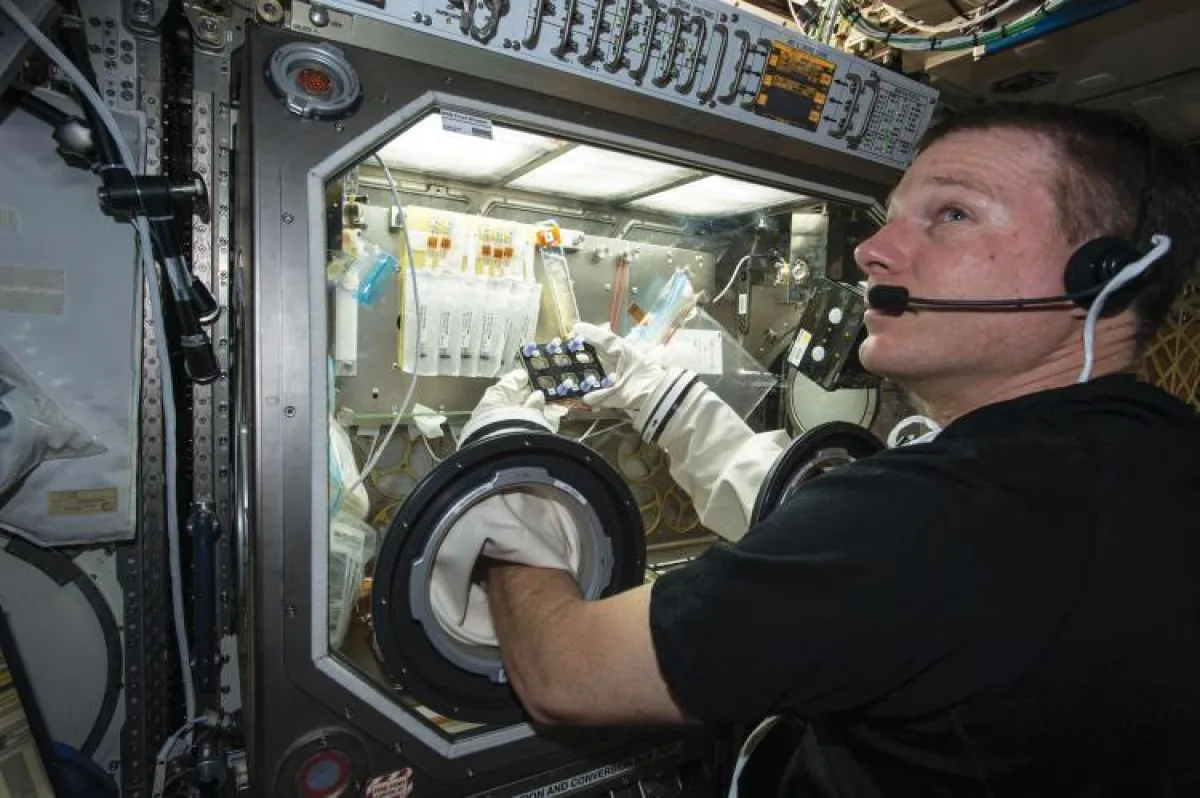
The first was BioRock, an ESA experiment conducted aboard the International Space Station in 2019. Researchers investigated how three microorganisms interacted with basalt under different gravity conditions.
The results showed that Sphingomonas desiccabilis enhanced the release of rare earth elements compared with non-biological controls.
The next major investigation was BioAsteroid, which examined actual meteorite material rather than relying only on Earth-based rock samples.
In research published in npj Microgravity on January 30, 2026, scientists investigated the extraction of 44 elements from L-chondrite meteorite material aboard the ISS.
The experiment tested the bacterium Sphingomonas desiccabilis, the fungus Penicillium simplicissimum, and a combination of both organisms.
One particularly interesting finding was that the fungus improved the release of palladium, platinum and other elements under microgravity compared with non-biological extraction.
The researchers also discovered changes in microbial metabolism under space conditions, including increased production of certain organic acids.
These findings demonstrate that microorganisms can interact with asteroid material in space and help release useful elements.
|
Research experiment |
Main findings |
|---|---|
|
BioRock (2019) |
Bacteria extracted rare earth elements from basalt. |
|
BioAsteroid (published 2026) |
Microorganisms helped release metals from meteorite material. |
|
ISS microgravity research |
Demonstrated that microbial extraction can function under spaceflight conditions. |
Why Asteroids Are Important for Future Mining

Asteroids contain different minerals and elements that could become valuable resources for future space industries.
Some contain iron, nickel and other metals, while certain asteroid materials contain platinum-group elements such as platinum and palladium.
These materials have important applications in electronics, manufacturing and industrial production.
However, transporting large quantities of resources from Earth into space is expensive. Establishing a way to obtain useful materials directly from asteroids could help reduce that dependence.
Microbial mining could also support future settlements by helping astronauts process locally available materials for construction and manufacturing.
Scientists are not suggesting that bacteria will replace all traditional mining equipment. Instead, microorganisms could become part of a larger resource-processing system.
Challenges Facing Microbial Mining in Space
Despite the promising findings, microbial mining is still an experimental technology.
One major challenge is microgravity. On Earth, gravity helps liquids circulate and allows particles to settle. In space, these natural processes behave differently, potentially affecting how microorganisms interact with rocks.
Another challenge is finding the right combination of microorganisms and minerals. Not every bacterium can extract every element effectively.
Researchers must also develop reliable systems that can operate for extended periods without creating risks for astronauts or contaminating spacecraft environments.
The BioAsteroid experiment used relatively small samples and controlled conditions. Large-scale mining operations on asteroids have not yet been demonstrated.
Charles Cockell, a researcher involved in this field, explained the attraction of the technology in a NASA article:
"It is low energy demand: you give the microbes some food, and they go about their business of mining."
NASA
The next challenge is determining whether this process can be expanded beyond small laboratory experiments.
Fun Facts About Microbial Mining in Space
-
Some bacteria can attach themselves to rocks and form biofilms.
-
The BioAsteroid investigation examined 44 elements in meteorite material.
-
Scientists have tested microbial mining under microgravity conditions aboard the ISS.
-
The fungus Penicillium simplicissimum showed promising results for extracting platinum-group elements.
-
Rare earth elements are important in many modern electronic and industrial technologies.
-
Microbial mining could eventually support manufacturing beyond Earth.
The Future of Space Mining
Microbial mining could become an important part of humanity's long-term plans for exploring and settling beyond Earth.
Rather than transporting every resource from our planet, future astronauts may be able to use local materials and biological systems to obtain some of the elements they need.
The January 2026 BioAsteroid findings represent an important step because they demonstrate microbial interactions with actual meteorite material under spaceflight conditions.
However, commercial asteroid mining remains a distant possibility. Scientists still need to develop larger systems, improve extraction efficiency and establish whether the technology is economically practical.
For now, the research offers an exciting possibility: some of the smallest organisms on Earth could eventually help humanity obtain resources from some of the largest objects in space.