
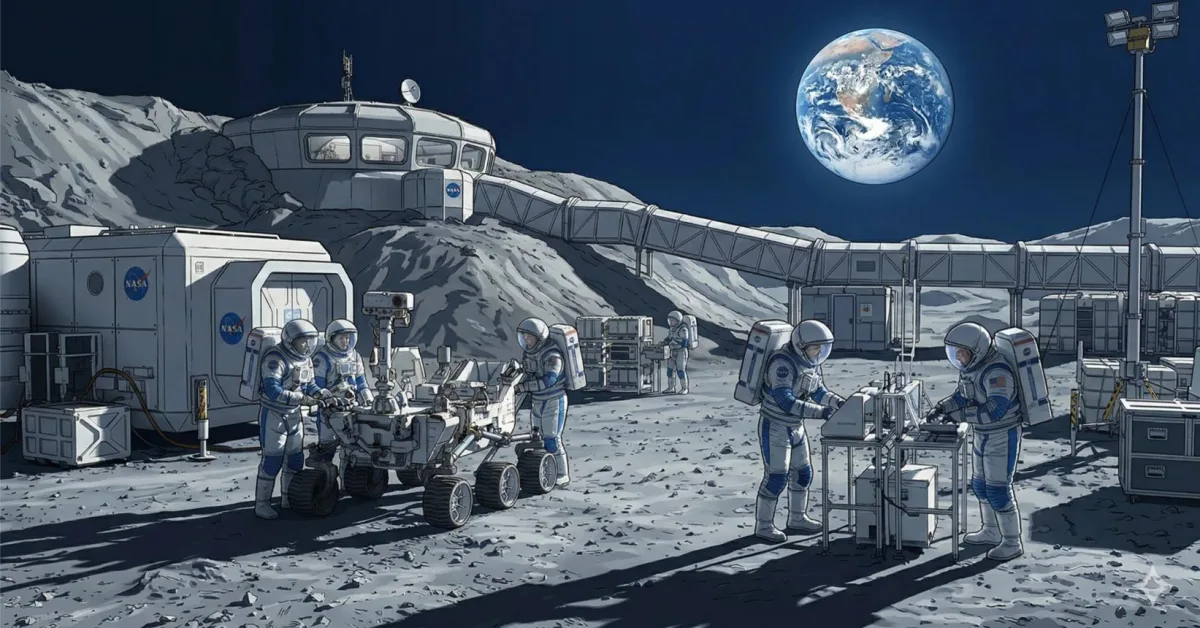
Lunar Carbon Harvesting: Finding the Ingredients for Plastics
The Moon may hold some of the raw materials needed to produce plastics and other useful manufactured products during future space missions. Although lunar soil contains small quantities of carbon, scientists are investigating how this element, along with other resources found on the lunar surface, could support manufacturing beyond Earth. The idea of lunar carbon harvesting could eventually help astronauts produce essential materials locally instead of transporting every supply from Earth. However, extracting enough carbon to manufacture plastics on a useful scale remains a significant scientific and engineering challenge.
Imagine a future in which astronauts living on the Moon can manufacture plastic equipment, protective components, containers and other everyday materials without depending entirely on deliveries from Earth. This possibility is attracting scientific interest as space agencies and researchers explore ways to use resources available beyond our planet.
One important part of this research is carbon harvesting. Carbon is a basic ingredient in many plastics, synthetic materials and organic compounds. On Earth, industries obtain carbon from sources such as petroleum, natural gas and biological materials. On the Moon, however, these resources are not readily available in the same quantities or forms.
Scientists are therefore investigating whether lunar soil, known as regolith, could provide useful amounts of carbon and other chemical elements for future manufacturing.
The research connects with a broader scientific goal called in-situ resource utilization (ISRU), which involves collecting and processing materials found on the Moon or other celestial bodies to support exploration and human activities.
Where Does Carbon Come From on the Moon?
Unlike Earth, the Moon has no large forests, living ecosystems or established petroleum deposits that could supply conventional plastic manufacturing. Nevertheless, scientific investigations have confirmed that carbon exists in lunar materials.
Some of this carbon comes from the solar wind, a continuous stream of charged particles released by the Sun. Over extremely long periods, solar wind particles have interacted with lunar soil, depositing elements such as hydrogen, carbon and nitrogen onto exposed grains.
Another important source is material delivered by asteroids, comets and micrometeoroids. These objects can carry carbon-containing compounds and organic materials that become incorporated into lunar soil following impacts.
There is also evidence of carbon-bearing materials associated with the Moon's geological history.
Research published in Science Advances on April 8, 2026, examined organic materials found in samples returned by China's Chang'e-5 and Chang'e-6 missions. The researchers identified different forms of carbon-rich organic material containing nitrogen- and oxygen-bearing chemical groups. Their findings provide further evidence that impacts from space objects and subsequent surface processes have contributed to the Moon's organic chemistry.
These discoveries are important because they improve scientists' understanding of where lunar carbon comes from and how it is preserved.
How Lunar Carbon Harvesting Could Work
 Harvesting carbon from lunar soil would require specialised equipment capable of collecting, separating and processing lunar materials.
The first stage would involve identifying areas containing useful concentrations of carbon-bearing compounds. Researchers would need to examine soil samples and determine which locations offer the best opportunities for extraction.
Once suitable material is identified, robotic equipment could collect and transport lunar regolith to a processing facility.
Scientists could then investigate heating and other chemical processing methods to release certain trapped gases and volatile compounds. These materials would need to be collected, separated and purified before they could become useful industrial feedstocks.
NASA's work on in-situ resource utilization already includes technologies for excavating and processing lunar resources. Its Carbothermal Reduction Demonstration (CaRD), for example, investigates using concentrated solar energy to heat lunar soil simulants and extract carbon monoxide while producing oxygen through a chemical reaction. Integrated prototype testing in 2026 demonstrated progress towards using locally available lunar materials.
However, producing carbon monoxide during oxygen extraction is not the same as establishing a complete carbon-harvesting industry. Additional processing would be necessary to turn available carbon compounds into suitable ingredients for plastic production.
Turning Lunar Carbon into Plastic

Carbon is particularly valuable because it forms the chemical backbone of many polymers. Polymers are large molecules made from repeating chemical units, and they are the foundation of materials used in packaging, electronics, construction and countless manufactured products.
On Earth, common plastics include polyethylene, polypropylene and polyethylene terephthalate (PET). Their production depends on suitable carbon-containing chemical feedstocks and carefully controlled industrial processes.
If scientists can obtain and process carbon-bearing materials on the Moon, they could potentially use them to manufacture certain polymers. However, harvesting carbon alone would not be enough. Plastic production also requires other chemical elements, suitable processing equipment, energy and reliable manufacturing systems.
For example, nitrogen, oxygen and hydrogen can play important roles in producing different types of polymers. Researchers would need to establish how these elements could be obtained, recycled or supplied through other lunar resources.
One promising area is biological manufacturing. Certain microorganisms can use carbon-containing feedstocks to produce useful chemicals and polymer materials. This could eventually provide an alternative to conventional manufacturing processes during long-duration space missions.
A NASA technical presentation published in August 2026 explored the development of biosynthesized thermoplastic materials combined with lunar and Martian regolith. The research considered poly(3-hydroxybutyrate), commonly known as PHB, a biodegradable thermoplastic that can be produced biologically. The material could potentially be manufactured using resources such as organic waste or carbon dioxide as feedstock.
This approach is particularly interesting because it connects resource recycling, biological production and the manufacturing of useful materials in space.
Why Plastics Matter for Future Lunar Missions

Plastic materials could become extremely useful as human activities on the Moon expand.
Astronauts and lunar research facilities would require equipment for scientific experiments, electrical systems, storage, communication and everyday operations. Some of these components could be manufactured using polymers.
Local plastic production could offer several advantages:
-
Reduced dependence on Earth: Astronauts could eventually manufacture selected components without waiting for supplies transported from Earth.
-
Equipment replacement: Certain plastic parts could be produced locally when existing components need replacement.
-
Material recycling: Used plastic products could potentially be processed and reused, reducing waste.
-
Flexible manufacturing: Different polymer materials could support the production of containers, fittings, protective components and specialised equipment.
-
Long-term sustainability: Combining local resources with recycling could make future lunar settlements more independent.
These advantages are important because transporting materials into space is expensive and requires careful planning. Every kilogram of equipment sent from Earth adds to mission costs and logistical demands.
The Scientific Challenges of Finding Carbon
Despite its potential, lunar carbon harvesting faces major difficulties.
The first challenge is scarcity. Carbon is present in lunar regolith at relatively low concentrations. Research reviewing lunar material resources has discussed average concentrations of approximately 100–120 parts per million by weight. This means that obtaining useful quantities would require processing substantial amounts of soil.
The second challenge is extraction. Lunar carbon is not necessarily available in convenient deposits that can be collected like ordinary minerals. Some is implanted in soil grains, while other carbon exists in organic compounds or impact-related materials. Different forms may require different extraction techniques.
The third challenge is the lunar environment. Equipment must operate in extreme temperature conditions, abrasive dust and low gravity. Permanently shadowed regions may contain valuable volatile materials, but their extremely cold conditions create additional engineering difficulties.
There is also the question of energy. Heating and processing large quantities of soil would require reliable power systems. Solar energy could support some operations, but lunar nights and the location of mining facilities would influence how equipment operates.
Finally, scientists must develop efficient methods for separating, purifying and converting extracted materials into usable chemical ingredients.
Recent Research and Developments in Lunar Manufacturing
Research conducted in 2026 demonstrates that scientists are moving beyond the idea of simply collecting lunar resources. They are increasingly investigating how locally available materials could become part of practical manufacturing systems.
NASA's Carbothermal Reduction Demonstration is one example. Its 2026 prototype testing used concentrated solar energy to extract carbon monoxide from simulated lunar regolith while demonstrating oxygen production. Although the primary objective is oxygen extraction, the work also illustrates how chemical processing could recover useful compounds from lunar soil.
Another development involves combining regolith with recycled high-performance plastics.
A study published on July 25, 2026, investigated recycled poly(ether ketone ketone), or PEKK, combined with lunar regolith simulant. The researchers explored how the composite could be used in additive manufacturing, including the production of sacrificial structures for future lunar operations.
The work demonstrated the potential of combining recycled polymers with locally sourced mineral materials. It also highlighted technical limitations, including porosity and brittleness that require further improvement.
These developments show that lunar manufacturing does not necessarily depend on producing every ingredient directly from lunar soil. A combination of Earth-supplied materials, recycled plastics and locally obtained resources could support earlier manufacturing efforts.
The Future of Carbon Harvesting on the Moon

The future of lunar carbon harvesting will depend on improvements in resource detection, extraction technology, chemical engineering and space-based manufacturing.
Scientists may eventually develop automated facilities capable of collecting lunar soil, extracting useful compounds and supplying them to manufacturing systems. Such facilities could operate with limited human intervention, allowing astronauts to focus on exploration and scientific research.
Biological manufacturing may also become an important part of this future. Microorganisms could potentially transform available carbon sources into useful chemicals, including materials needed for certain plastics.
However, these possibilities remain under development. There is currently no established industrial operation producing plastics from harvested lunar carbon on the Moon.
The most realistic approach in the near future may involve combining materials transported from Earth with lunar minerals, recycled polymers and whatever useful chemical resources can be recovered locally.
Conclusion
Lunar carbon harvesting represents an interesting possibility for the future of space exploration. Although the Moon contains relatively small quantities of carbon, scientific discoveries have confirmed that carbon-bearing compounds exist in its soil and that different processes have contributed to their presence.
Research into carbon extraction, oxygen production, biological manufacturing and polymer-regolith composites is gradually expanding the possibilities for manufacturing beyond Earth.
The biggest challenge will be developing affordable and efficient methods of obtaining enough usable material. If scientists overcome these limitations, future lunar missions could manufacture selected plastic products and other essential components using resources available beyond our planet.
What begins as research into tiny amounts of carbon trapped in lunar soil could eventually contribute to a much larger ambition: building sustainable human settlements beyond Earth.
References
-
Science Advances – Impact-processed nitrogen-bearing organics in Chang’e-5 and Chang’e-6 lunar regolith (April 8, 2026).
-
NASA Technical Reports Server – Biosynthesized Thermoplastic/Regolith Composites for Closed-Loop In-Space Manufacturing (August 2026).
-
Composites Part B – Circular additive manufacturing of recycled PEKK–regolith composites for sacrificial structures in lunar in-situ resource utilization (July 25, 2026).