
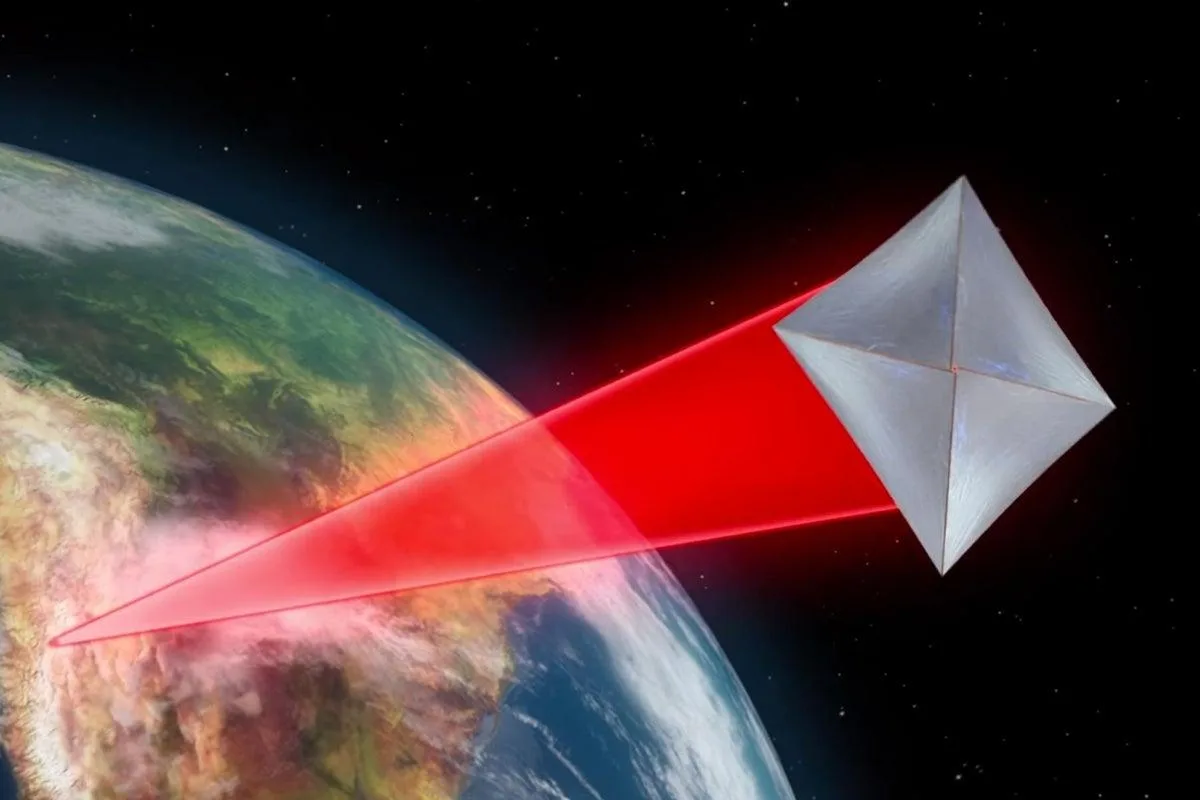
Laser-Powered Propulsion: Can Sails Push Probes to Alpha Centauri?
Laser-powered propulsion could one day send tiny spacecraft to Alpha Centauri, the nearest star system to our own. Instead of carrying large amounts of fuel, these probes would use powerful lasers to push extremely lightweight sails through space. Research projects such as Breakthrough Starshot have explored this idea, while engineering studies have examined how a laser-driven spacecraft might reach its destination. However, major challenges remain, including building powerful laser arrays, protecting sails from intense heat, guiding probes across enormous distances, and communicating with them after arrival. As of October 12, 2026, laser-powered interstellar travel remains an ambitious research concept rather than a demonstrated way to reach another star.
Summary
-
Laser-powered propulsion uses light pressure to accelerate a spacecraft.
-
A lightsail is an extremely thin, lightweight surface designed to receive momentum from a laser beam.
-
Alpha Centauri is approximately 4.3 light-years from Earth, making it one of our closest stellar neighbours.
-
Breakthrough Starshot has investigated tiny spacecraft that could theoretically travel at a significant fraction of the speed of light.
-
A separate engineering study, Project Dragonfly, examined a heavier spacecraft travelling at about 5% of light speed, with a journey lasting roughly a century.
-
Major obstacles include laser power, sail materials, beam accuracy, navigation, and slowing down near the destination.
-
No laser-powered probe has yet completed an interstellar journey.

What Is Laser-Powered Propulsion?
Conventional spacecraft use engines that expel propellant to generate thrust. Rockets must carry the fuel or other reaction mass needed for their propulsion systems, adding weight and limiting how much scientific equipment they can transport.
Laser-powered propulsion offers a different approach. A powerful laser on Earth or in space sends concentrated light toward a spacecraft equipped with a specially designed sail. When photons strike and reflect from the sail, they transfer momentum, producing a small pushing force.
Although this force is tiny under ordinary conditions, a sufficiently powerful laser can apply it continuously to a very lightweight spacecraft. Over time, the probe could accelerate to speeds far beyond those achieved by many conventional deep-space missions.
NASA's Jet Propulsion Laboratory reported laboratory demonstrations of laser-driven sail movement as far back as 2000. These experiments demonstrated aspects of the underlying physics, not a complete interstellar propulsion system.
How Could a Lightsail Reach Alpha Centauri?

A potential mission would begin by launching a tiny spacecraft attached to an ultralight sail. A large laser array would then direct energy toward the sail, accelerating the probe while the beam remained accurately aligned.
One well-known proposal is Breakthrough Starshot. Its concept involves gram-scale spacecraft, often called StarChips, attached to sails measuring metres across. The proposed laser system could accelerate these miniature vehicles to approximately 20% of the speed of light. That is a target for a future system, not a speed demonstrated by an operational interstellar probe.
At that speed, the journey to the Alpha Centauri region could take a little over 20 years, depending on the precise target and trajectory. The spacecraft would also need time for acceleration and other mission phases. After reaching its destination, the probe's observations would take more than four years to send back to Earth at light speed.
This delay matters because the spacecraft would have to operate largely autonomously. It could not depend on quick instructions from mission controllers.

How Long Would the Journey Take?
The answer depends on the spacecraft's speed, mass, and mission design.
|
Proposed approach |
Estimated journey time |
Status |
|---|---|---|
|
Breakthrough Starshot concept at about 20% of light speed |
A little over 20 years of cruise time |
Proposed concept |
|
Project Dragonfly study at about 5% of light speed |
Around 100 years |
Engineering study |
|
Conventional spacecraft at much lower speeds |
Thousands of years or longer, depending on speed |
Not suitable for a fast crewed-style interstellar journey |
The estimates above are not promises of actual travel times. Acceleration, trajectory, target selection, and the need to slow down can all affect the final mission duration.
The Biggest Technical Challenges

1. Building a powerful laser system
A laser array capable of accelerating a spacecraft to interstellar speeds would require enormous power, precise control, and advanced optical equipment. The beam must remain focused on a tiny, rapidly moving sail as the spacecraft accelerates away.
Even small alignment errors could reduce the force delivered to the sail. Engineers must also manage heat, energy supply, and the stability of the laser system.
2. Designing a sail that can survive
The sail must be extremely light while remaining strong enough to withstand intense laser illumination. It must reflect enough light to gain momentum without absorbing too much energy and overheating.
Researchers are studying materials and structures that might satisfy these competing requirements. However, a material that works well in a laboratory is not automatically suitable for a full-scale interstellar mission.
3. Navigating through interstellar space
A probe travelling at a significant fraction of light speed would face another problem: tiny particles become important hazards at such high velocities. Dust impacts could damage the sail, electronics, or scientific instruments.
The spacecraft would also need accurate navigation and enough onboard computing power to carry out observations without constant instructions from Earth.
4. Slowing down at the destination
Reaching Alpha Centauri is only part of the challenge. A fast flyby might provide a short window for photographs and scientific measurements, but it would not automatically allow a probe to enter orbit around a planet.
Project Dragonfly researchers examined possible braking methods, including magnetic and electric sails that could interact with charged particles in space. Such approaches remain challenging and would need further development.

What Is the Latest Research Telling Us?
Laser-powered propulsion is supported by established physics, but turning it into a practical interstellar transportation system requires substantial technological progress.
Breakthrough Starshot's published research programme describes its goal as developing and demonstrating the feasibility of light-driven miniature spacecraft. Its concept remains different from an operational mission already travelling toward Alpha Centauri.
Another NASA-supported concept, PROCSIMA, explored combining a laser beam with a neutral particle beam to reduce beam spreading. NASA's technology project record, updated on December 18, 2025, lists the study as completed. Its proposed architecture included a theoretical journey to Proxima Centauri lasting about 42 years at 10% of light speed. This was a projected performance, not a completed demonstration or confirmed launch plan.
These studies show that researchers are investigating different ways to overcome the same central problem: delivering enough energy to a tiny spacecraft over a distance measured in light-years.

Why Alpha Centauri Matters
Alpha Centauri is more than a convenient destination. It is a nearby stellar system containing three stars: Alpha Centauri A, Alpha Centauri B, and Proxima Centauri. Proxima is the closest individual star to the Sun.
A successful probe could help scientists study nearby stars, investigate their surrounding environments, and search for clues about planets beyond our Solar System. Even a brief flyby might collect valuable measurements that telescopes cannot obtain as easily from Earth.
However, discovering a planet does not mean it supports life. Any future mission would need to collect reliable evidence before scientists could draw conclusions about its atmosphere, surface, or potential habitability.
Current and Proposed Projects
|
Project or programme |
Purpose |
Status supported by available sources |
|---|---|---|
|
Breakthrough Starshot |
Develop tiny laser-driven interstellar spacecraft |
Research and development concept |
|
Project Dragonfly |
Study feasible lightsail missions to Alpha Centauri |
Published engineering studies |
|
PROCSIMA |
Explore a combined-beam propulsion architecture |
NASA technology study listed as completed |
References
-
NASA Jet Propulsion Laboratory — Sail Technology Beamed to Future Space Exploration
-
Breakthrough Initiatives — Breakthrough Starshot Research Programme
-
Breakthrough Starshot — Photon Engine Research Proposal
-
NASA TechPort — PROCSIMA Technology Project Record
-
Acta Astronautica — Project Dragonfly: Sail to the Stars