
Kilonova Explosions: How Neutron Star Collisions Forge Gold
Gold is one of the most valuable metals on Earth. It is used in jewellery, electronics, medical equipment and several important industrial applications. However, gold did not originate on our planet. Its atoms were formed through powerful nuclear processes that took place in space, long before Earth existed.
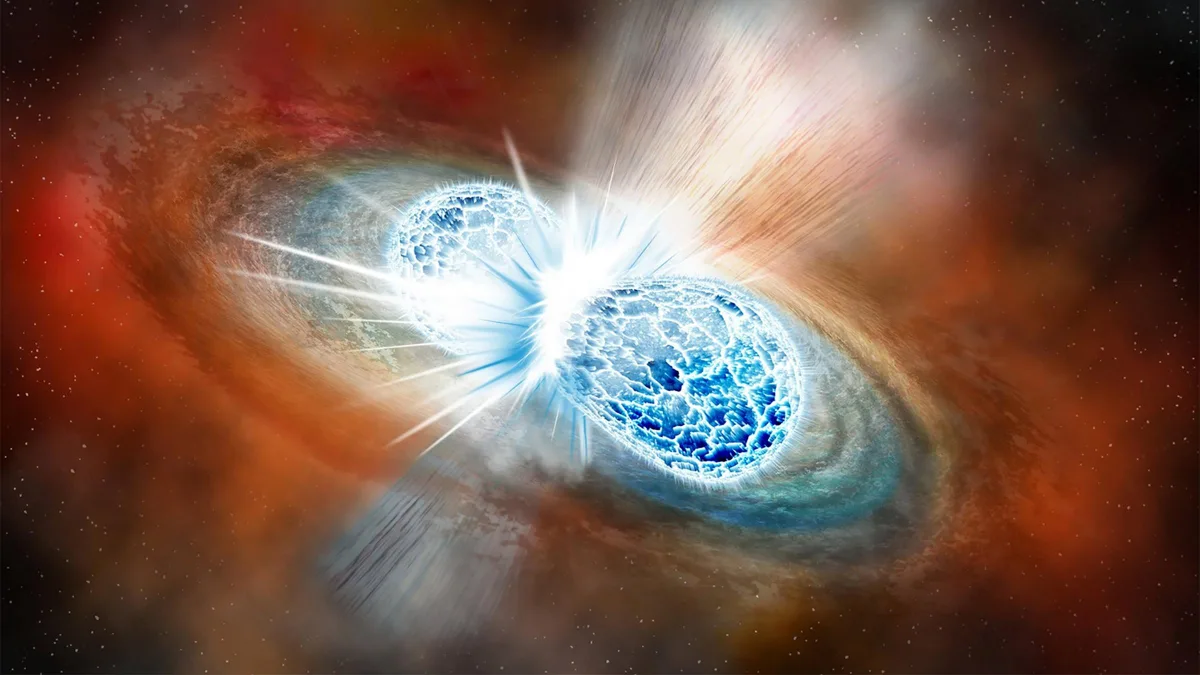
One of the most fascinating places where gold can be created is during a kilonova explosion. This happens when two neutron stars, the extremely dense remains of massive stars, collide and merge. The collision releases enormous energy and throws neutron-rich material into space, where nuclear reactions can produce heavy elements.
What Is a Neutron Star?

A neutron star is the collapsed core of a massive star that has exploded as a supernova. After the explosion, the remaining core can become so compressed that protons and electrons combine to form neutrons.
These objects are incredibly dense. A neutron star can contain more mass than our Sun while measuring only around 20 kilometres across. This means an enormous amount of matter is squeezed into a remarkably small space.
Their extreme density and powerful gravity make neutron stars some of the most unusual objects in the universe. When two of them orbit one another, they gradually lose energy through gravitational waves and move closer together until they eventually collide.
What Happens During a Kilonova Explosion?

A kilonova occurs when two neutron stars merge, producing an explosion and ejecting material into surrounding space. The collision is so energetic that it releases large amounts of matter moving at significant fractions of the speed of light.
The material thrown out during the merger contains enormous numbers of neutrons. As this debris expands and cools, nuclear reactions begin producing heavier atomic nuclei.
The newly created radioactive elements gradually decay, releasing energy that heats the expanding debris. This produces a bright flash of light across different wavelengths, including ultraviolet, visible and infrared radiation. Astronomers call this glowing aftermath a kilonova.
Unlike an ordinary supernova, which involves the explosion of a star, a kilonova is specifically associated with the merger of compact objects involving at least one neutron star.
How Do Neutron Star Collisions Produce Gold?

The secret behind gold production is a process known as rapid neutron capture, commonly called the r-process.
During a neutron star collision, the ejected material is extremely rich in free neutrons. Atomic nuclei in this environment can capture neutrons rapidly, sometimes faster than the nuclei can undergo radioactive decay.
These reactions build increasingly heavy atomic nuclei. Some of the unstable nuclei subsequently undergo beta decay, changing neutrons into protons and producing different chemical elements.
Through this process, the universe can create heavy elements including gold, platinum and other valuable metals.
Gold has 79 protons in its nucleus. Creating it therefore requires a chain of nuclear reactions capable of building nuclei with the correct number of protons and neutrons. The extreme neutron-rich environment of a neutron star merger provides conditions in which these reactions can happen.
Scientists studying the aftermath of neutron star collisions have found evidence supporting this explanation. However, neutron star mergers are not necessarily the only places where heavy elements are produced. Certain rare types of stellar explosions may also contribute.
The Historic GW170817 Discovery

One of the most important discoveries in modern astronomy happened on August 17, 2017.
On that day, scientists working with the Laser Interferometer Gravitational-Wave Observatory (LIGO) and the Virgo detector observed gravitational waves produced by two merging neutron stars. The event was named GW170817.
For the first time, astronomers detected gravitational waves from a neutron star collision and also observed the light produced by the same cosmic event.
The discovery triggered an international observation campaign involving space telescopes and ground-based observatories. NASA's Fermi Gamma-ray Space Telescope detected a short burst of gamma rays, while other observatories captured the fading light from the explosion.
The event was located in the galaxy NGC 4993, approximately 130 million light-years from Earth. Its aftermath provided some of the strongest observational evidence that neutron star mergers produce heavy elements through the r-process.
This discovery changed how scientists study the origins of precious elements and demonstrated the power of combining gravitational-wave astronomy with traditional observations of light.
Why Does the Kilonova Change Colour?

A kilonova does not maintain the same colour throughout its explosion. Its appearance changes as the radioactive debris expands and cools.
Initially, some of the ejected material produces a bright blue glow. This component is associated with material containing relatively lighter r-process elements and having lower opacity.
As time passes, the expanding debris becomes cooler, and material containing heavier elements, particularly lanthanides, absorbs and blocks more visible light. The emission becomes increasingly red and infrared.
This changing colour provides scientists with important clues about the composition of the explosion and the types of elements created inside it.
Observations of GW170817 revealed both blue and red components, helping researchers understand how different heavy elements are produced during neutron star mergers.
Are All the Gold on Earth Created by Kilonova Explosions?

Not necessarily. Although neutron star mergers are confirmed sources of heavy elements, scientists are still investigating how much of the universe's gold comes from these events compared with other possible cosmic sources.
The gold found on Earth was already present in the material from which our planet formed. Geological processes later concentrated some of it into deposits that humans can mine.
In other words, the gold in a wedding ring or electronic device has a much older history than the Earth itself. Its atoms were formed through nuclear reactions in earlier cosmic environments and eventually became part of the material that formed our solar system.
The exact contribution of different astrophysical events to Earth's gold supply remains an active area of scientific research.

What Scientists Are Still Trying to Understand
The discovery of GW170817 answered important questions, but several mysteries remain.
Researchers are investigating how much gold and other heavy elements individual neutron star mergers can produce, how frequently these collisions occur, and whether other stellar explosions contribute significantly to the universe's supply of precious metals.
Research published in 2026 continues to explore how neutron star spins, merger conditions and the behaviour of matter influence the amount of heavy material produced and the brightness of kilonovae.
These studies show that scientists are still improving their understanding of the connection between cosmic explosions and the chemical elements around us.
Conclusion
Kilonova explosions reveal an extraordinary connection between the most violent events in space and everyday life on Earth. When two neutron stars collide, their neutron-rich debris can undergo nuclear reactions that create some of the universe's heaviest elements, including gold and platinum.
The discovery of GW170817 gave astronomers an unprecedented opportunity to observe this process and investigate how precious elements are formed.
The next time you see a gold ring, remember that its story may begin in the collision of two dead stars, in an event that happened billions of years before human beings existed.
