
James Webb Traces Chariklo Asteroid Rings Changing Shape: What the New 2026 Study Reveals
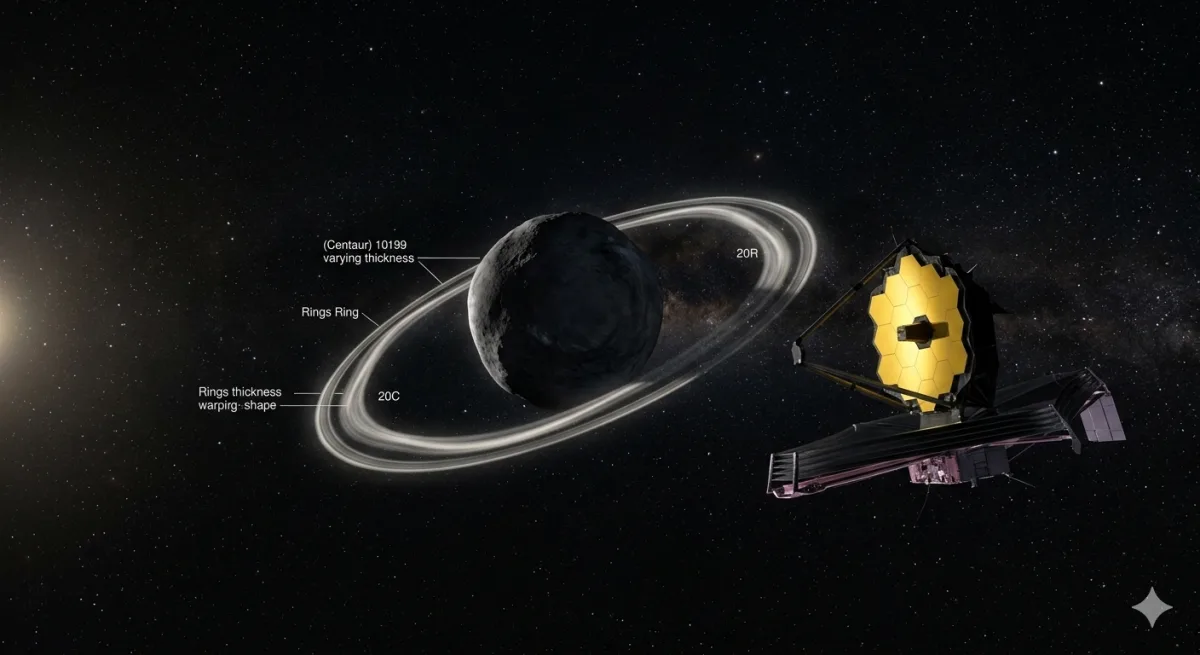
NASA’s James Webb Space Telescope has provided new evidence that the two narrow rings around Chariklo, a small icy body orbiting between Saturn and Uranus, have changed in their measured properties over only a few years. In observations made on October 18, 2022, Webb found that Chariklo’s inner ring, known as C1R, was much more opaque than in earlier observations, while the outer ring, C2R, produced a much weaker signal. The two rings have not simply moved to new locations, so scientists are cautious about calling this a literal change in shape. Instead, the evidence points to changes in the amount, structure, particle size or light-scattering behavior of ring material. The new study, published in Science Advances on September 9, 2026, suggests that small-body ring systems may be much more active and changeable than astronomers once thought.
Summary
-
Object: 10199 Chariklo
-
Type: Centaur, a small Solar System body orbiting between the giant planets
-
Location: Between the orbits of Saturn and Uranus
-
Size: About 125 km in equivalent radius, or roughly 250 km in equivalent diameter
-
Rings: Two narrow rings called C1R and C2R
-
Ring locations: About 390 km and 405 km from Chariklo’s center
-
Ring discovery: 2013
-
Discovery method: Stellar occultation
-
James Webb observation: October 18, 2022
-
JWST instruments used: NIRCam
-
Observation wavelengths: About 1.5 and 3.2 micrometres
-
Major new finding: The inner ring became more opaque while the outer ring became much weaker in the observations
-
Research published: September 9, 2026, in Science Advances
-
Main mystery: Scientists still do not know whether the changes represent real movement or loss and replenishment of material, or whether different particle sizes caused the rings to look different at infrared wavelengths.

What Is Chariklo?
Chariklo is one of the most unusual small bodies in our Solar System.
It belongs to a population known as Centaurs, objects whose orbits lie in the outer Solar System between the giant planets. NASA describes Chariklo as the largest member of the known Centaur population. It travels around the Sun in the region between Saturn and Uranus, at roughly 17 times the Earth-Sun distance.
Although Chariklo is much smaller than a planet, it has something that immediately made astronomers pay attention: rings.
When its rings were discovered in 2013, they became the first ring system known around a small Solar System body rather than one of the four giant planets. Before that discovery, rings had been confirmed around Jupiter, Saturn, Uranus and Neptune.
Chariklo is sometimes described in popular articles as a ringed asteroid, but its more precise classification is a Centaur or minor Solar System body.
Its two rings are extremely narrow compared with the giant planetary ring systems. They are called C1R, the inner and denser ring, and C2R, the outer ring. Their average orbital distances are about 390 and 405 kilometres from Chariklo's center.
That makes the system remarkable for another reason: Chariklo itself is small, but its rings are organized into sharply confined structures.
How Were Chariklo's Rings Discovered?
The discovery did not come from an ordinary photograph.
Astronomers discovered the rings through a method called a stellar occultation.
This sounds complicated, but the basic idea is simple. Astronomers watch a distant star. When an object in the Solar System passes in front of that star, the object's presence causes the star's light to become temporarily weaker.
If the object has material surrounding it, that material can produce additional dips in the star's brightness.
That is exactly what happened with Chariklo.
In 2013, astronomers observed a star as Chariklo passed in front of it. The star did not simply disappear once. It showed additional brief drops in brightness before and after the main occultation. Those unexpected signals revealed that material was orbiting Chariklo. Further analysis showed that the material formed two narrow rings.
The original discovery study found rings with widths of roughly 7 kilometres and 3 kilometres and orbital radii of about 391 and 405 kilometres. The research also suggested that the rings contain water ice, helping explain why ice-related spectral features around Chariklo changed as the viewing angle changed.
The discovery changed what astronomers thought small bodies could look like.
As the Institute of Astrophysics of Andalusia later explained, Chariklo's rings may contain small water-ice particles mixed with darker material, possibly connected to an ancient collision or other disruptive event. However, the exact origin of the rings remains uncertain.
What Did James Webb See?
The latest result comes from an observation made on October 18, 2022, when astronomers successfully used the James Webb Space Telescope to observe a stellar occultation involving Chariklo's rings. The new scientific paper was published in Science Advances on September 9, 2026.
This observation was particularly special because it was the first stellar occultation specifically planned and successfully observed with JWST.
Webb's Near-Infrared Camera, or NIRCam, observed the background star through two infrared filters centered around 1.5 micrometres and 3.2 micrometres.
The telescope did not produce a normal picture showing two bright rings around Chariklo.
Instead, astronomers measured changes in the star's brightness.
Chariklo was moving relative to Webb at only about 2.5 kilometres per second during the event. That relatively slow motion allowed the researchers to obtain unusually detailed information about the material crossing the star's light. The Webb viewing path came within about 7.4 kilometres of Chariklo's center, although the body itself did not block the star from Webb's viewpoint.
This is an important point: JWST still cannot directly resolve Chariklo's tiny rings as a normal image.
The telescope's strength here was its ability to measure the extremely small changes in starlight produced when the rings passed across the background star.
The Inner Ring Became More Opaque
The most striking result came from the inner ring, C1R.
Earlier observations produced an average normalized opacity of about 0.303 ± 0.028.
In the 2022 JWST measurements, the value was about 0.431 ± 0.012.
The researchers calculated that the difference is statistically significant, with a z-score of about 4.2. The paper describes this as a significant increase in the ring's opacity. The Paris Observatory summarized the result as the inner ring appearing about 50% more opaque than before.
In simple terms, the inner ring blocked more of the background starlight than it had in earlier observations.
That does not automatically mean the ring gained 50% more mass.
Opacity tells astronomers how strongly the material blocks or scatters light. A ring could become more opaque because it contains more particles, because existing particles were broken into smaller pieces, because the particles became more effective at blocking the particular wavelength being observed, or through another structural change.
The study therefore does not claim that scientists have already solved the mystery.
Instead, the new data show that something about the inner ring's optical behavior has changed.
The Outer Ring Went the Other Way
The outer ring, C2R, produced almost the opposite result.
Instead of becoming stronger, its infrared signal was surprisingly weak.
The paper reports that C2R had only a marginal detection in the 1.5-micrometre JWST data and was not detected in the 3.2-micrometre filter. Compared with previous ground-based observations, the ring appeared much less opaque.
The Paris Observatory reports that the outer ring's apparent opacity decreased by about 60% compared with 2017.
This is what makes the discovery especially interesting.
The two rings sit next to each other around the same small body, yet the new observations indicate that their optical properties changed in opposite directions.
The inner ring became stronger in the measurements.
The outer ring became weaker.
That contrast is difficult to explain with a single simple process.
Is Chariklo's Ring Actually Changing Shape?
This is where the headline needs some care.
The new research does not show that Chariklo suddenly stretched its rings into a different shape in the way a rubber band might change shape.
The researchers found that the radial positions of the rings remain consistent with earlier measurements. In other words, the rings have not simply moved outward or inward to completely different locations.
What has changed is their measured opacity, equivalent width and apparent structure.
So "changing rings" is scientifically safer than saying "the rings changed shape."
Still, the phrase "changing shape" captures part of the larger story because earlier studies had already found that the inner ring could vary in radial width around its orbit. A 2021 analysis of multiple occultations found that C1R's observed width ranged from about 4.8 to 9.1 kilometres, with a mean of about 6.5 kilometres, and identified W-shaped structures within the ring.
The 2026 JWST result now adds another layer: the ring system appears to be changing in how its material interacts with light.
Three Possible Explanations
The research team considered several possible explanations instead of choosing one as proven.
1. Different Parts of the Rings Were Observed
One possibility is that the rings are not equally dense all the way around Chariklo.
If some sections contain more material than others, JWST could have crossed a particularly dense part of C1R and a particularly sparse part of C2R.
However, the researchers tested an azimuthal-density explanation and found that the probability of the JWST observation simply catching extreme portions of both rings was low. They therefore do not consider a random difference in the sampled sections a complete explanation. (arXiv)
2. The Rings Really Are Changing
Another possibility is that material has actually moved around.
For C2R, the weaker signal could mean that the outer ring is losing material.
The research discusses the possibility that collisions between particles could produce smaller dust grains. Some of those tiny particles could then be affected more strongly by sunlight and radiation pressure, making it easier for them to leave the original ring structure.
For C1R, the process could work differently.
Collisions inside the denser inner ring might break larger particles into many smaller grains. That could increase the total effective cross-section of the material and make the ring appear more opaque. Another possibility is that material from elsewhere is being added to C1R.
3. The Particles May Look Different at Infrared Wavelengths
There is another major complication.
Earlier observations of Chariklo's rings were largely made in visible or shorter near-infrared wavelengths. JWST can examine the rings at longer infrared wavelengths that are difficult or impossible to observe from the ground.
Different particle sizes and materials do not necessarily interact with every wavelength of light in the same way.
The researchers modeled the possibility that C2R contains very small particles whose optical behavior changes strongly between visible and infrared light. Their models found that silicate-rich material with particle sizes around 0.2 to 0.5 micrometres can reproduce some of the observed differences.
But the authors clearly warn that these composition estimates depend on assumptions about the grain-size distribution. They are not a unique identification of what the outer ring is made of.
What Makes the JWST Observation So Important?
The significance of the discovery goes beyond Chariklo itself.
For years, astronomers had evidence that some small bodies could have rings. But there were still major questions about how those rings form, how long they survive and what keeps them narrow.
The new results suggest that these systems can change on relatively short astronomical timescales.
The 2026 paper says the origin, lifetime, composition and evolutionary history of small-body rings remain poorly understood. The new observations provide evidence that their behavior can be much more complicated than previously assumed.
Pablo Santos-Sanz, who led the study, said the results force scientists to reconsider how these rings form, evolve and remain stable. He also described the ability to detect such changes as a new opportunity to study ring systems.
That matters because rings are not simply pretty structures.
They are enormous natural laboratories.
The way particles collide, spread, gather, break apart and respond to gravity can tell scientists something about the history of the object around which they orbit.
Chariklo's Rings Compared With Planetary Rings
Chariklo's rings are tiny compared with Saturn's famous rings, but the basic physics is related.
Saturn's ring system contains countless particles ranging from dust to much larger pieces of ice and rock. Its rings also show changes in brightness, structure and particle distribution over time.
Other planetary rings are dynamic too. The 2026 Chariklo research points to changes seen in dusty structures such as Saturn's D and E rings, Neptune's arcs and Uranus's dusty ring structures as examples showing that ring material can evolve rather than remaining perfectly fixed.
What makes Chariklo unusual is that the central body is so small.
The discovery of its rings already forced astronomers to expand their ideas about where ring systems can exist.
Now, the new JWST observations suggest that these small rings may also be active environments.
Chariklo and the Water-Ice Mystery
Chariklo had already given Webb another important clue.
In 2022, JWST observations also examined reflected sunlight from Chariklo and detected a clear signature of crystalline water ice. NASA's records note that Webb's NIRSpec captured the spectrum on October 31, 2022.
Previous observations had suggested that water ice was present, but the quality of Webb's infrared data provided a clearer detection.
Researchers have suggested that continued tiny impacts or micro-collisions could expose fresh material or help maintain crystalline ice, because high-energy particles tend to alter ice over time.
This is interesting when considered alongside the new ring study.
If the rings really are experiencing collisions and changes in particle size, then Chariklo may be an active small world rather than a completely quiet frozen body.
The evidence is not enough to tell the whole story yet, but it gives scientists more pieces of the puzzle.
A Very Difficult Observation
Getting the 2022 JWST occultation right was not easy.
Astronomers needed accurate predictions for three things at once:
Chariklo's position, the position of the background star and JWST's own position in space.
JWST operates around the Sun-Earth L2 region, about 1.5 million kilometres beyond Earth. Its orbit requires periodic station-keeping corrections.
ESA's Gaia mission helped astronomers determine the position of the background star with the precision needed for the observation.
The result was a carefully predicted encounter that allowed Webb to record the tiny changes in starlight.
That precision is one reason stellar occultations remain so useful.
A direct image might show Chariklo as a tiny point.
An occultation can turn that tiny point into a detailed measurement of structures that cannot otherwise be resolved.
What Scientists Still Do Not Know
Despite the new discovery, many questions remain open.
Scientists do not yet know exactly what caused C1R to become more opaque.
They also do not know whether C2R is genuinely losing material or whether its weak infrared signal mostly comes from the way tiny particles scatter longer-wavelength light.
The two explanations could even be happening together.
The current study also does not provide a final answer about the rings' origin. Possible ideas include collisions that produced debris, followed by processes that keep the particles confined. Earlier research also proposed that small, unseen shepherding bodies could help maintain the narrow rings.
More observations are needed.
In particular, future occultations at different wavelengths could help separate a real change in ring material from a wavelength-dependent optical effect.
That is one of the most important next steps suggested by the research.
Major Chariklo Ring Findings
| Year | Observation or discovery | What scientists learned |
|---|---|---|
| 2013 | First stellar occultation revealing extra dips in starlight | Two rings were discovered around Chariklo |
| 2014 | Nature study published | C1R and C2R were characterized as narrow, dense rings |
| 2017–2020 | Multiple ground-based occultations | Ring widths, structure, geometry and Chariklo's shape were refined |
| 2022 | JWST stellar occultation | Rings detected in near-infrared light at 1.5 and 3.2 μm |
| 2022 | JWST spectroscopy | Clear crystalline water-ice signature detected |
| 2026 | New Science Advances analysis | C1R appeared more opaque while C2R showed a much weaker signal |
The historical measurements show why the 2022 JWST observation is so useful: astronomers can now compare observations made over nearly a decade and ask whether the rings themselves are changing. (Nature)
Current Status of the Chariklo Ring Mystery in 2026
| Question | Current scientific understanding |
|---|---|
| Does Chariklo have rings? | Yes, two narrow rings are well established |
| Are the rings still in roughly the same orbital locations? | Yes |
| Did the inner ring change? | Its measured opacity increased significantly |
| Did the outer ring change? | Its measured infrared signal became much weaker |
| Is material definitely moving or disappearing? | Not yet proven |
| Are the rings made partly of ice? | Water ice has strong evidence in the Chariklo system |
| Are tiny dust grains involved? | Models suggest they may contribute, especially in C2R |
| Is the exact origin of the rings known? | No |
| Can JWST directly photograph the rings? | No; occultation measurements are used instead |
| Could future observations settle the question? | Yes, especially observations at different wavelengths and future occultations |
Fun Facts About Chariklo
1. Chariklo was the first small Solar System body found with rings.
Before its discovery, confirmed Solar System rings were known around Jupiter, Saturn, Uranus and Neptune.
2. Chariklo's rings are only a few kilometres wide.
That is tiny compared with the enormous planetary ring systems of Saturn and Uranus.
3. Webb cannot simply photograph the rings.
The system is too small and distant for the rings to be directly resolved, so astronomers measure the shadows they create on background starlight.
4. JWST observed Chariklo at wavelengths longer than those normally accessible from the ground.
The new study used 1.5- and 3.2-micrometre filters, including an observation beyond 3 micrometres that is not possible through Earth's atmosphere in the same way.
5. The outer ring may contain extremely tiny particles.
The researchers found models involving roughly 0.2–0.5 micrometre silicate grains could reproduce some of the observed wavelength behavior, although this remains model-dependent.
6. The rings were discovered because a star appeared to blink.
Those brief changes in brightness became the clue that revealed material orbiting the otherwise tiny and distant object. (archive.iaa.csic.es)
References
arXiv — JWST occultation reveals unforeseen complexity in Chariklo's ring system
NASA Webb — Webb Spies Chariklo Ring System With High-Precision Technique
NASA Science — Chariklo JWST occultation light curve
Nature — A ring system detected around the Centaur (10199) Chariklo
Institute of Astrophysics of Andalusia — JWST discovers Chariklo's invisible rings are changing
Paris Observatory — The “pocket rings” of the small body Chariklo are evolving