
How Do Galaxy Spiral Arms Form? Astronomers Reveal New Insights
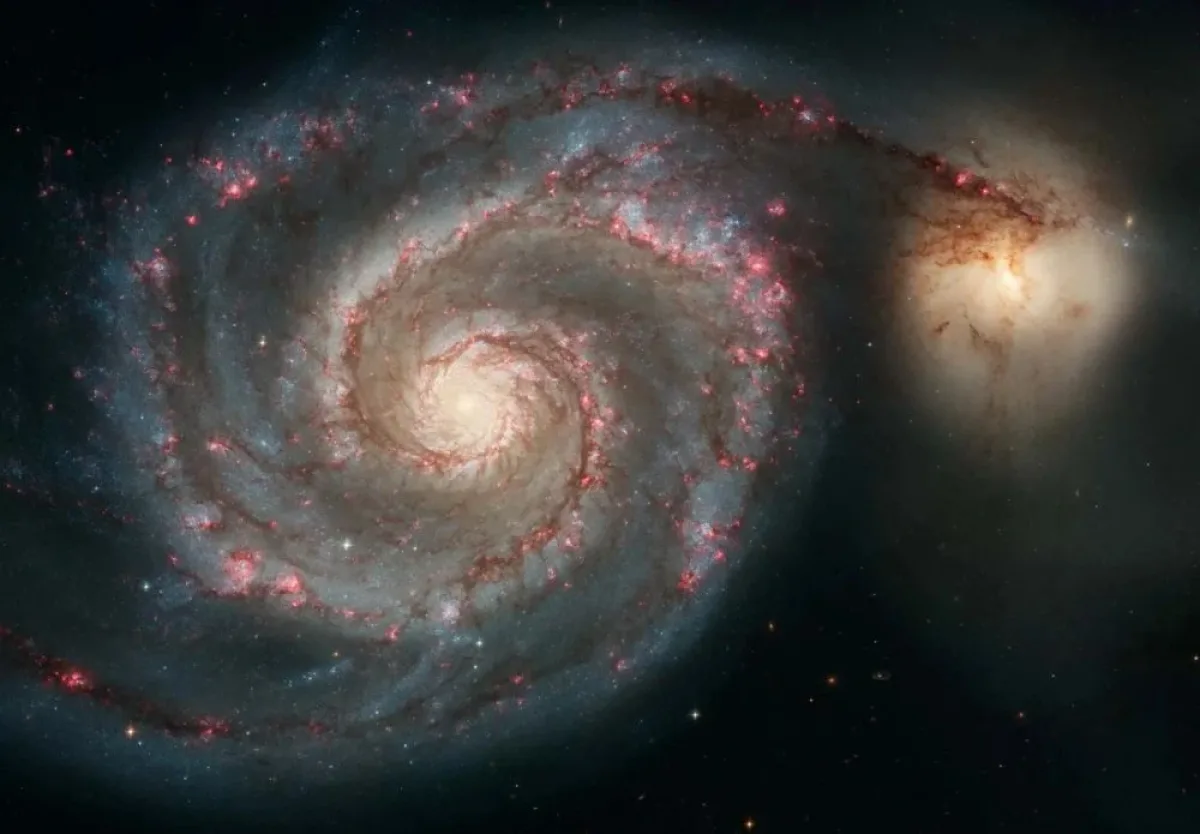
If you look at a spiral galaxy, you might assume the stars and gas are simply rotating like a solid fan but the physics tells a much stranger story. Astronomers have watched these beautiful shapes for over a century but they still struggle to explain why the arms don't just wind up and disappear. Recent data from the Euclid space telescope is finally helping us understand why some galaxies have two arms while others look like a messy collection of fragments.
Unwinding the Mystery of Spiral Arms
When Edwin Hubble proved that other galaxies existed in the 1920s, he opened up a massive puzzle. The inner parts of a galaxy disk spin much faster than the outer edges. If the spiral arms were permanent structures made of the same stars, they would wrap tighter and tighter until the spiral shape vanished in just a few hundred million years.
Since we see thousands of these galaxies looking perfectly intact, we know they are not "winding up" Scientists classify the shapes into three main types
- Grand Design
These have two long, clear and continuous arms. - Multi-armed
These feature three or more long arms. - Flocculent
These look fluffy with many short, broken arm segments.

The Traffic Jam in Space
One popular way to think about this is the density wave theory. Imagine a traffic jam on a highway - the jam stays in one spot even though individual cars move through it and leave. In a galaxy, stars and gas move into a high density area, slow down and then move out the other side.
While this explains some of what we see, it is not a perfect answer. Physical forces should eventually dampen these waves - this is why researchers are looking at the specific number of arms to see if the "weight" of the galaxy's center changes how these patterns behave.
New Clues from the Euclid Telescope
Professor Beverly Smith and her team recently used the Euclid space telescope to study over 380 000 galaxies. Because Euclid can see very far away, it allows us to look back billions of years to see how galaxies looked when the universe was younger. The team found that most spiral galaxies - about 60 % to 70 % - have two arms.
The research shows that the size of the central bulge is a major factor. If a galaxy has a large, heavy center, it usually has two dominant arms. The way the gravity works in the heavy centers favors a two arm layout. In contrast, galaxies with less mass in the middle often have three or more arms.
Why Do Arm Counts Matter?
You might think the number of arms is just a visual detail but it actually reveals what is happening deep inside the galaxy. Two armed spirals usually have lower rates of new star formation and tend to be more massive. Three armed galaxies are rarer and often produce new stars more quickly.
The count of arms also helps us track things we cannot see, like dark matter. Because the shape of the arms depends on how matter is spread out, counting them gives us a tool to estimate the dark matter hiding in the galactic center.
Looking into the Galactic Future
We are learning that spiral arms are more complex than just three simple categories. Many galaxies have branches or spurs that make them hard to label. Some two armed patterns might be permanent, while others might appear and disappear over time.
By looking at these subtle variations, you can start to see the history of a galaxy. As telescopes like Euclid continue to map the sky, we will get a better sense of how these massive systems evolve over billions of years.
FAQ
Why don't spiral arms wind up and disappear?
They don't disappear because they are likely density waves rather than solid structures. Stars move in and out of the arms, similar to how cars move through a slow moving patch of traffic.
How many arms does our Milky Way have?
The Milky Way is considered a galaxy with a large central bulge, which means it likely follows the pattern of having two dominant spiral arms, though it has multiple smaller branches as well.
What is a flocculent galaxy?
A flocculent galaxy is a type of spiral that does not have long, well defined arms. It looks patchy or "fluffy" with many small segments of arms scattered throughout the disk.
References
-
Universe Today - "Astronomers Are Still Trying to Understand How a Galaxy's Spiral Arms Form" - https://www.universetoday.com/articles/astronomers-are-still-trying-to-understand-how-a-galaxys-spiral-arms-form
-
Swinburne University - "Density Wave Model" - https://astronomy.swin.edu.au/cosmos/D/density+wave+model
-
Center for Astrophysics | Harvard & Smithsonian - "New Insights on How Spiral Galaxies Get Their Arms" - https://www.cfa.harvard.edu/news/new-insights-how-spiral-galaxies-get-their-arms
-
The Astrophysical Journal - "Galaxy Spiral Arm Count versus Concentration and Mass: A First Look with Euclid" - https://iopscience.iop.org/article/10.3847/1538-4357/ae7d22
-
NASA - "Galaxy Evolution" - https://science.nasa.gov/universe/galaxies/evolution
-
Wikipedia - "Spiral arm" - https://en.wikipedia.org/wiki/Spiral_arm
-
Astronomy.com - "Why do galaxies have spiral arms?" - https://www.astronomy.com/science/ask-astro-why-do-galaxies-have-spiral-arms-do-smaller-objects-have-them-too