
How Atmospheric Loss Shaped Venus: The Toxic Planet History of Earth’s Near-Twin
Venus is often described as Earth’s “evil twin,” but the comparison is more than just a dramatic nickname. The two planets are close in size, mass, rocky composition and distance from the Sun, yet their present climates could hardly be more different. Venus now has a dense carbon-dioxide atmosphere, clouds of sulfuric acid, surface temperatures around 467°C, and atmospheric pressure roughly 93 times that of Earth at sea level. NASA says the planet’s thick atmosphere traps heat in a runaway greenhouse effect.
The deeper story, however, is not simply that Venus “got hot.” Over billions of years, sunlight, atmospheric chemistry, volcanic activity, surface-atmosphere reactions and the escape of gases into space worked together to transform the planet. One of the most important losses was water. Ultraviolet radiation can split water molecules high in Venus’ atmosphere, while hydrogen, being extremely light, can escape into space much more easily than heavier elements. Spacecraft observations have directly detected hydrogen and oxygen escaping from Venus, with the proportions strongly pointing toward water loss.
Recent research has made the story even more interesting. A 2024 Nature study found that a chemical process involving HCO⁺ ions and dissociative recombination may be a major present-day pathway for hydrogen escape, nearly doubling previous estimates of Venus’ current hydrogen loss in the model used by the researchers.
At the same time, scientists still do not agree completely on whether Venus once had long-lived oceans like Earth. Some climate models support the possibility of an ancient wet Venus, while other models and newer atmospheric-composition studies suggest that Venus may have remained hot and dry much earlier than once thought.
Venus’ present hellish was shaped by a long planetary feedback involving water loss, ultraviolet radiation, atmospheric escape, greenhouse warming, volcanic outgassing and surface chemistry. The loss of hydrogen was especially important because hydrogen is one of water’s two essential elements. Once water became scarce, Venus lost one of the major mechanisms that could have helped regulate carbon dioxide. At the same time, volcanic processes continued supplying gases to the atmosphere while Venus lacked Earth’s global magnetic field. Today, Venus retains a massive carbon-dioxide atmosphere and only a tiny amount of water. Scientists now know that atmospheric escape is still happening, but the exact sequence that took Venus from its early state to the world we see today remains an active research question.
Summary
-
Planet: Venus
-
Location: Second planet from the Sun
-
Distance from Sun: About 108 million km on average
-
Current surface temperature: About 467°C
-
Surface pressure: About 93 times Earth’s sea-level pressure
-
Main atmospheric gas: Carbon dioxide
-
Cloud composition: Mainly sulfuric acid droplets
-
Major atmospheric-loss process: Escape of hydrogen, oxygen and other ions from the upper atmosphere
-
Key water-loss process: Ultraviolet radiation splits water high in the atmosphere, followed by escape of hydrogen and oxygen
-
Magnetic field: Venus has no internally generated global magnetic field; it instead develops an induced magnetic field through interaction with the solar wind
-
Major scientific question: Whether Venus once had surface oceans, a short-lived wet climate, or remained mostly dry after formation
-
Important recent result: A 2024 Nature study identified HCO⁺ dissociative recombination as a potentially dominant present-day hydrogen-loss pathway
-
Major future missions: NASA’s DAVINCI and VERITAS, plus ESA’s EnVision, are being developed to investigate Venus’ atmosphere, surface and evolution.
What Venus Is Like Today
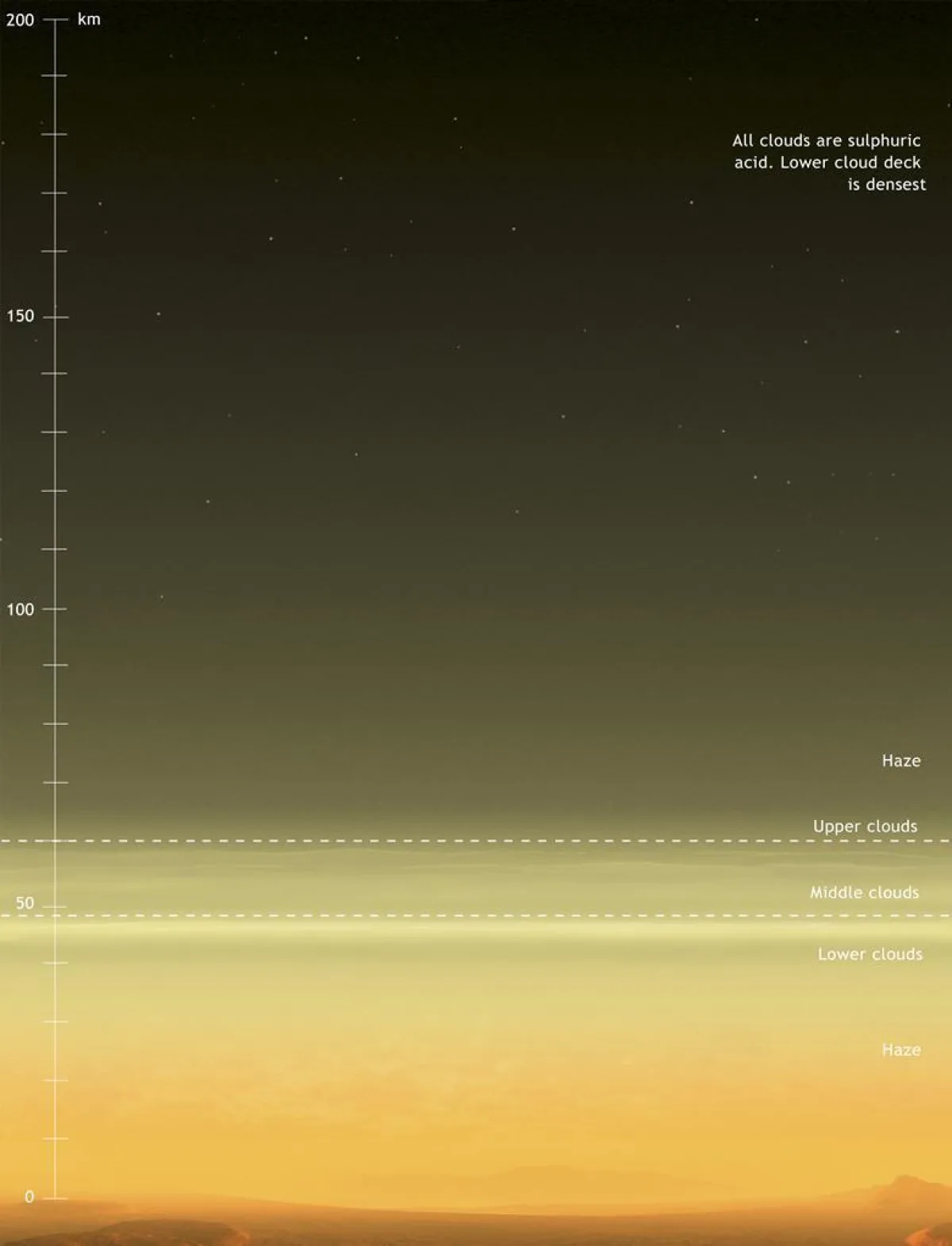
Venus looks deceptively calm from space. Its bright cloud tops hide a world where the surface is hot enough to melt lead and where the atmospheric pressure is comparable to being deep beneath an ocean on Earth. NASA currently gives a surface temperature of about 467°C and pressure of about 93 Earth atmospheres. Its atmosphere is dominated by carbon dioxide, while sulfuric-acid clouds form the planet’s bright global shroud.
The atmosphere is not simply a thick blanket. It is part of a complex planetary system connecting the upper atmosphere, lower atmosphere, clouds, volcanic gases and surface rocks.
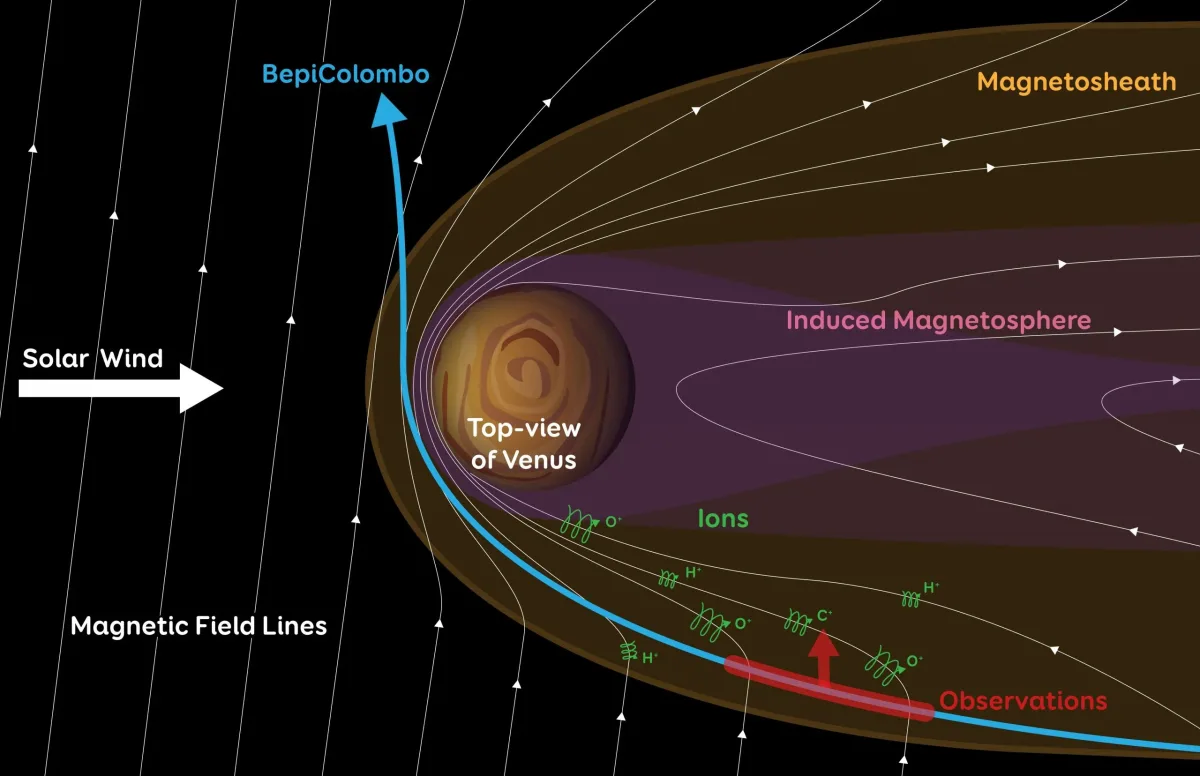
Venus also lacks an internally generated magnetic field like Earth’s. Instead, solar-wind interaction with its ionosphere creates an induced magnetic field around the planet. This does not mean the solar wind simply blows directly through the entire atmosphere, but it does create an environment in which atmospheric ions can be accelerated and lost to space.
That distinction is important because “Venus has no magnetic field” is often presented as though it automatically caused the planet to lose its atmosphere. The reality is more complicated. Venus still has an enormous atmosphere today. Atmospheric escape has been a long-term loss process, but the planet’s current atmosphere was also shaped by volcanism, chemical reactions and the persistence of heavy gases such as carbon dioxide.
Early Venus: A Planet That May Have Started Very Differently
Venus formed about 4.5 billion years ago from the same general population of rocky material that built Earth and the other terrestrial planets.
Because Venus and Earth are similar in size and composition, researchers have long asked why one became a relatively mild, water-rich world while the other became a hot, dry planet.
One longstanding possibility is that early Venus contained much more water than it does now. ESA’s Venus Express research found strong evidence that Venus has lost a large quantity of water over geological time. Water vapor in the upper atmosphere can be broken apart by solar ultraviolet radiation into hydrogen and oxygen. The lighter hydrogen escapes especially efficiently.
The ratio of escaping hydrogen to oxygen has been particularly useful. Venus Express measured an escaping hydrogen-to-oxygen ratio of roughly 2:1, consistent with the chemical composition of water. The spacecraft also observed enrichment of deuterium, a heavy form of hydrogen, because the lighter hydrogen isotope is more easily lost to space.
That evidence is one of the strongest clues that Venus once contained significantly more water.
But there is an important scientific warning: water loss does not by itself prove that Venus once had Earth-like oceans.
That question remains open.
The Great Debate: Did Venus Ever Have Oceans?
For years, a popular scenario suggested that Venus might once have enjoyed oceans and a more temperate climate. Climate models have shown that under some conditions, ancient Venus could have supported surface liquid water for a substantial period. A NASA-led 2016 study, for example, produced climate scenarios in which ancient Venus had a shallow ocean and relatively moderate surface conditions for potentially billions of years.
But another line of research has challenged that picture.
A 2021 Nature study using three-dimensional climate modelling concluded that water clouds on early Venus could have produced a strong warming effect that prevented water from condensing at the surface. In that model, Venus may have remained in a hot steam-dominated state rather than developing oceans.
A later study published in Nature Astronomy went further. Researchers argued that the chemistry of Venus’ present atmosphere and its likely volcanic gases is consistent with a very dry interior, which would make a long-lasting wet surface less likely. Their interpretation suggests that Venus may have lost much of its original hydrogen while still undergoing an early magma-ocean phase.
So there are two broad possibilities:
| Scenario | Basic idea | Current scientific position |
|---|---|---|
| Wet Venus | Venus once had substantial surface water and later lost it | Still scientifically plausible |
| Early dry Venus | Much of the original water was lost before long-lived oceans formed | Increasingly important in modern research |
The best answer today is not “scientists know Venus definitely had oceans.” They do not.
What scientists know with much greater confidence is that Venus has lost a great deal of water and continues to lose hydrogen from its upper atmosphere. (European Space Agency)
How Atmospheric Escape Works on Venus
Atmospheric escape is the gradual loss of particles from a planet into space.
There are many kinds of escape, but Venus is especially interesting because several processes can operate together.
Ultraviolet Radiation Breaks Apart Water
High-energy sunlight reaches the upper atmosphere and can split water molecules.
In simplified form:
H₂O → 2H + O
The hydrogen is extremely light. Once it reaches the upper atmosphere, it is much easier for hydrogen atoms or ions to escape Venus’ gravity than heavier particles.
The oxygen is heavier and more difficult to remove. Some oxygen escapes too, while some can participate in chemical reactions involving the atmosphere and surface.
ESA’s Venus Express observations provided direct evidence for hydrogen and oxygen escaping from Venus, reinforcing the connection between atmospheric escape and the planet’s lost water.
The Solar Wind Adds Another Layer
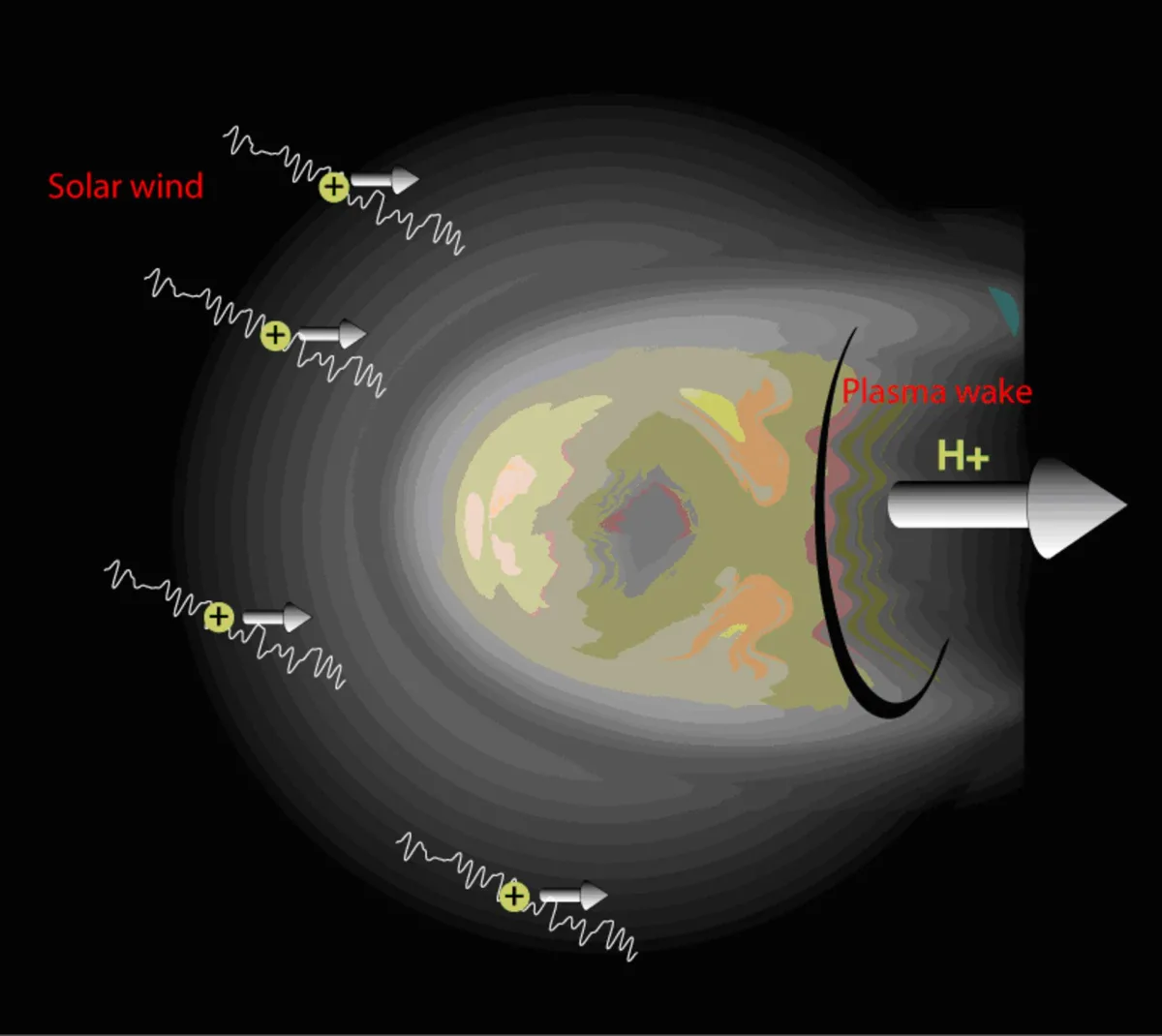
The Sun continuously releases a stream of charged particles called the solar wind.
Earth’s strong global magnetic field plays an important role in shaping how the solar wind interacts with our atmosphere. Venus does not possess the same kind of intrinsic magnetic shield. Instead, its upper atmosphere creates an induced magnetic environment as the solar wind encounters its ionosphere.
This interaction can accelerate ions and contribute to atmospheric escape.
Scientists have observed hydrogen, oxygen and other planetary ions being carried away from Venus. The escaping material can form an extended plasma tail downstream from the planet.
ESA’s Venus Express mission was especially important because it directly identified the composition of escaping particles rather than merely assuming that atmospheric loss was happening.
The New Piece of the Puzzle: HCO⁺
One of the most important recent developments came from a 2024 Nature study of Venus’ hydrogen escape.
The researchers examined a chemical pathway involving HCO⁺, a molecular ion found in the upper atmosphere. When HCO⁺ undergoes dissociative recombination, it can generate hydrogen in a form that contributes to escape.
According to the study, this mechanism may nearly double the present-day hydrogen escape rate compared with earlier estimates. The authors argue that this has consequences not only for the amount of water Venus loses today, but also for calculations of how much volcanic water or material from impacts would be needed to maintain the small amount of water presently observed in the atmosphere.
This matters because scientists are not simply asking, “Did Venus lose water?”
They are now asking:
Exactly how did it lose that water, at what rate, and over what periods of its history?
Those questions allow researchers to test competing climate histories.
Venus Is Still Losing Atmospheric Material Today
The loss of atmospheric material is not only an ancient story.
BepiColombo, a spacecraft designed primarily to study Mercury, flew past Venus in 2021 and produced valuable measurements of Venus’ space environment.
A study published in Nature Astronomy in 2024 reported observations of cold oxygen and carbon ions in Venus’ induced magnetosphere. The measurements provided new evidence that planetary material is escaping from Venus beyond regions previously explored in detail. The researchers estimated an average flux of about 4 ± 1 × 10⁴ cm⁻² s⁻¹ for the measured cold heavy ions in the observed region.
This is significant because it expands the list of atmospheric components known to participate in Venus’ ongoing interaction with space.
The study also found evidence for escaping C⁺ and O⁺, helping scientists better understand the loss of heavier material rather than focusing only on hydrogen.
Venus is therefore not a completely sealed atmospheric system. It is continuously exchanging material with space.
That exchange is slow compared with the total mass of the atmosphere, but over geological timescales, even slow processes matter.
Why Losing Water Changed Venus So Dramatically
Water is more than something that makes a planet wet.
On Earth, water participates in a huge number of processes that influence climate and the carbon cycle. Rain carries carbon dioxide into rocks. Oceans absorb gases. Rocks undergo weathering. Carbon can eventually be stored in minerals and sediments.
Venus appears to have followed a very different path.
As water disappeared, the planet became increasingly unable to sustain an Earth-like surface carbon cycle. Meanwhile, volcanic activity supplied gases to the atmosphere.
Carbon dioxide is difficult to remove through atmospheric escape because it is far heavier than hydrogen.
That created a major imbalance:
hydrogen escaped easily, while carbon dioxide remained.
The result was an atmosphere increasingly dominated by a gas that strongly absorbs infrared radiation.
NASA identifies this thick carbon-dioxide atmosphere as the basis of Venus’ runaway greenhouse conditions.
The Runaway Greenhouse Effect
A greenhouse effect is not inherently bad. Earth has one, and without it our planet would be much colder.
A runaway greenhouse effect is different.
In a simplified planetary feedback:
-
The planet warms.
-
More water evaporates.
-
Water vapor increases atmospheric heat trapping.
-
More warming causes more evaporation.
-
Eventually, water can move into the upper atmosphere where sunlight can break it apart.
-
Hydrogen escapes into space.
-
Water becomes harder to replenish.
-
Other greenhouse gases, especially carbon dioxide, become increasingly important.
The process can push a planet into a very different climate state.
NASA describes Venus as an example of a world where runaway greenhouse conditions produced its extreme modern surface environment. (NASA Science)
But scientists still debate exactly when Venus entered this state and whether a classical runaway greenhouse was the main driver of the transition.
That timing is one of the biggest unanswered questions in Venus science.
Volcanoes Also Helped Shape the Atmosphere
Atmospheric loss tells only half the story.
Venus has a huge volcanic record. Its surface contains thousands of volcanoes and widespread volcanic structures, while spacecraft observations have produced evidence consistent with relatively recent and possibly ongoing volcanic activity. NASA notes that Venus’ surface contains extensive volcanic features, and ESA has highlighted atmospheric sulfur-dioxide variability as one of the clues to volcanic activity.
Volcanoes can release gases such as carbon dioxide, sulfur dioxide and water vapor.
This means Venus has had two competing processes:
The atmosphere can lose material to space.
The planet can also add new gases from its interior.
The balance between those processes has changed over time.
Sulfur dioxide is especially interesting because it participates in the chemistry that forms Venus’ sulfuric-acid clouds. Variations in sulfur dioxide measured above the clouds have been interpreted as evidence of changes in atmospheric circulation and possible volcanic contributions.
Why Venus’ Clouds Are Made of Acid
The bright clouds covering Venus are not made primarily of water like Earth’s clouds.
They contain sulfuric acid droplets.
Sunlight drives chemical reactions involving sulfur-bearing gases and water in the atmosphere, helping produce sulfuric acid at cloud levels. The cloud system then becomes part of a larger sulfur cycle involving the atmosphere and the planet’s surface.
NASA identifies Venus’ global clouds as sulfuric acid clouds, while studies of Venusian atmospheric chemistry have shown how deeply the sulfur cycle is tied to the planet’s climate and volcanic history.
The clouds may reflect a significant amount of incoming sunlight, but they do not cancel the powerful greenhouse effect underneath them.
Venus therefore demonstrates something important in planetary climate science:
A planet can reflect a lot of sunlight and still become extremely hot when its atmosphere traps enough outgoing infrared energy.
What Happened to the Oxygen Left Behind?
If sunlight splits water into hydrogen and oxygen, it is natural to ask why Venus did not simply build up a huge oxygen atmosphere after losing its hydrogen.
The reason is that atmospheric chemistry is complicated.
Oxygen can escape as ions, but it can also react with minerals and other atmospheric components. On a rocky planet, oxygen does not necessarily remain floating freely in the atmosphere.
Some oxygen can become chemically bound to the surface.
This is one reason researchers study the interaction between Venus’ atmosphere, crust and mantle rather than treating atmospheric escape as a simple one-way pipe into space.
The 2024 BepiColombo study is especially useful here because it provided new evidence of escaping carbon and oxygen ions, showing that heavier elements are also involved in atmospheric evolution.
Venus Versus Earth: Two Different Climate Histories
| Feature | Earth | Venus |
|---|---|---|
| Size | Earth-sized | Nearly Earth-sized |
| Surface temperature | Moderate | About 467°C |
| Surface pressure | About 1 bar | About 93 bars |
| Main atmosphere | Nitrogen and oxygen | Mostly carbon dioxide |
| Surface liquid water | Abundant | Essentially absent |
| Global intrinsic magnetic field | Yes | No |
| Cloud composition | Mostly water | Sulfuric acid |
| Strong greenhouse effect | Important but moderated | Extreme |
| Current atmospheric escape | Ongoing | Ongoing |
The important lesson is that similar starting materials do not guarantee similar planetary outcomes.
Earth retained enormous quantities of surface water and developed long-term interactions among oceans, rocks, atmosphere and life.
Venus ended up dominated by a thick carbon dioxide atmosphere, with its surface water almost entirely gone.
A 2024 Finding Suggests Venus May Have Had a Dry Interior
One of the most interesting developments in Venus research came from the 2024 Nature Astronomy study “A dry Venusian interior constrained by atmospheric chemistry.”
The researchers examined what Venus’ present atmospheric chemistry suggests about gases released by volcanism. Their modelling indicated that Venus’ volcanic gases are relatively water-poor, pointing toward a potentially dry mantle.
That result is difficult to reconcile with a scenario in which Venus maintained vast surface oceans for a very long time.
The study therefore supports a different possibility: Venus may have lost much of its hydrogen while still very young, potentially during or after an early steam-rich, magma-ocean stage.
This does not completely rule out ancient surface water.
It does mean that the once-popular image of Venus as “Earth with oceans that later boiled away” is too simple.
Major Atmospheric-Loss Milestones
| Time / Era | Scientific significance |
|---|---|
| ~4.5 billion years ago | Venus forms as a rocky terrestrial planet |
| Early history | Hot atmosphere and interior strongly influence volatile retention and loss |
| Ancient era | Water loss begins through atmospheric chemistry and escape |
| Billions of years | Hydrogen continues escaping more readily than heavier gases |
| Later geological history | Volcanic outgassing replenishes atmospheric gases |
| Modern era | Venus retains an enormous CO₂ atmosphere and sulfuric-acid cloud system |
| 2006–2014 | Venus Express studies atmospheric escape and water-loss signatures |
| 2021 | BepiColombo performs a Venus flyby and samples its space environment |
| 2024 | Studies identify new heavy-ion escape observations and an important HCO⁺ pathway for hydrogen loss |
| 2026 | New preparation work continues for the next generation of Venus missions |
Major Scientific Missions That Changed Our Understanding
Venus has been visited by many spacecraft, but several missions stand out in the atmospheric-loss story.
Pioneer Venus helped establish key facts about Venus’ atmosphere and magnetic environment.
Venus Express, operated by ESA from 2006 to 2014, played a central role in showing that hydrogen and oxygen were escaping from Venus and linking that loss to the planet’s water history. (European Space Agency)
BepiColombo added new information about escaping carbon and oxygen ions during its 2021 Venus flyby.
The next generation of missions could transform the picture again.
Latest Venus Research and Missions as of August 2026
Venus research is entering a new phase.
NASA DAVINCI
NASA’s DAVINCI mission is currently in development. It is designed to study Venus from above the clouds down to the surface, including atmospheric chemistry, temperature, pressure, winds and the geology of the Alpha Regio highlands. NASA says the mission will help investigate the origin and evolution of Venus and determine whether the planet may once have been wet and habitable.
In July 2026, NASA reported that DAVINCI scientists had been testing its descent-imaging system using helicopter flights in Utah. The tests were designed to improve confidence that the probe will be able to reconstruct Venusian terrain and rock characteristics during its descent.
NASA VERITAS
NASA’s VERITAS is a future Venus orbiter intended to investigate the planet’s surface and interior and help scientists understand how Venus and Earth diverged.
NASA currently lists no earlier than 2031 for launch in its mission overview.
ESA EnVision
ESA’s EnVision mission is planned for launch in November 2031. It is designed to study Venus from its core to its upper atmosphere, combining observations of geology, surface processes and the atmosphere. ESA says the mission will investigate why Earth and Venus evolved so differently.
Together, these missions could address one of the biggest unresolved questions in planetary science:
Was Venus once Earth-like, or was it never truly Earth-like at all?
Current Projects
| Project | Role | Status | Expected date | Notes |
|---|---|---|---|---|
| DAVINCI | Atmospheric probe and flyby spacecraft | In development | Future mission | Will sample Venus’ atmosphere and image Alpha Regio |
| VERITAS | Venus orbiter | In development | No earlier than 2031 | Will map surface and investigate interior |
| EnVision | ESA Venus orbiter | In development | November 2031 target | Will study atmosphere, surface and interior |
Career Highlights of Venus Exploration
| Year | Milestone |
|---|---|
| 1962 | Mariner 2 becomes the first successful spacecraft to visit another planet |
| 1978 | Pioneer Venus missions begin a major new era of Venus atmospheric investigation |
| 1990s | Magellan dramatically improves knowledge of Venus’ surface through radar mapping |
| 2006 | ESA’s Venus Express arrives at Venus |
| 2007 | Venus Express identifies the composition of escaping atmospheric ions |
| 2008 | Venus Express observes hydrogen loss associated with atmospheric escape |
| 2014 | Venus Express mission concludes |
| 2021 | BepiColombo performs a Venus flyby |
| 2024 | New studies deepen understanding of hydrogen, oxygen and carbon escape |
| 2026 | NASA reports new DAVINCI testing as future Venus missions move forward |
| 2031 | DAVINCI/VERITAS/EnVision era expected to begin around the early 2030s, subject to mission schedules |
The Biggest Unanswered Questions
Several mysteries remain.
Did Venus ever have oceans?
The evidence for major ancient water loss is strong, but whether that water existed mainly as oceans or as atmospheric steam remains debated. (European Space Agency)
When did Venus become permanently dry?
Scientists know that desiccation happened, but the exact timing depends strongly on which climate model and geological history are correct.
How much atmospheric material does Venus lose today?
Spacecraft have measured several escape pathways, but estimating a total planetary loss rate remains difficult because escape changes with solar activity, location and atmospheric conditions.
How important is volcanism today?
Venus shows multiple signs of geological and possibly volcanic activity, but the exact present-day rate remains uncertain.
Did Venus ever have a climate that could support life?
That remains one of the most debated questions in Venus science. Different climate models produce different histories. Why Venus Stands Out
Venus stands out because its story is a warning about how interconnected planetary systems are.
The planet was not transformed by one single event.
Its history appears to involve the interaction of:
Sunlight + water + atmospheric chemistry + atmospheric escape + volcanism + surface chemistry + greenhouse warming.
Remove or change one part of that system, and the result could be dramatically different.
That is why Venus is such an important scientific target. It shows that a planet can remain roughly Earth-sized while becoming almost completely unlike Earth at the surface.
References
-
NASA Science — Venus Facts. Current NASA overview of Venus’ temperature, atmospheric pressure, greenhouse effect and induced magnetic field. NASA Science: Venus Facts
-
ESA — Caught in the Wind from the Sun. Venus Express observations of solar-wind interaction and escaping hydrogen, oxygen and helium ions. ESA: Caught in the Wind from the Sun
-
ESA — Was Venus Once a Habitable Planet? Evidence related to ancient water, deuterium enrichment and atmospheric escape. ESA: Was Venus Once a Habitable Planet?
-
Hadid et al., Nature Astronomy (2024) — BepiColombo observations of cold oxygen and carbon ions in the flank of the induced magnetosphere of Venus. Nature Astronomy research paper
-
Nature (2024) — Venus water loss is dominated by HCO⁺ dissociative recombination. Nature research paper
-
Nature Astronomy (2024) — A dry Venusian interior constrained by atmospheric chemistry. Nature Astronomy research paper
-
Turbet et al., Nature (2021) — Day–night cloud asymmetry prevents early oceans on Venus but not on Earth. Nature research paper
-
NASA — NASA Climate Modeling Suggests Venus May Have Been Habitable. NASA climate modeling study
-
NASA — NASA’s DAVINCI Mission. Current mission information and scientific goals. NASA DAVINCI mission
-
NASA — VERITAS Mission Overview. Current mission status and planned timeline. NASA VERITAS overview
-
ESA — EnVision. Current mission status and November 2031 launch target. ESA EnVision mission