How Artifact InSPECtor Software Fixes Space Telescope Data
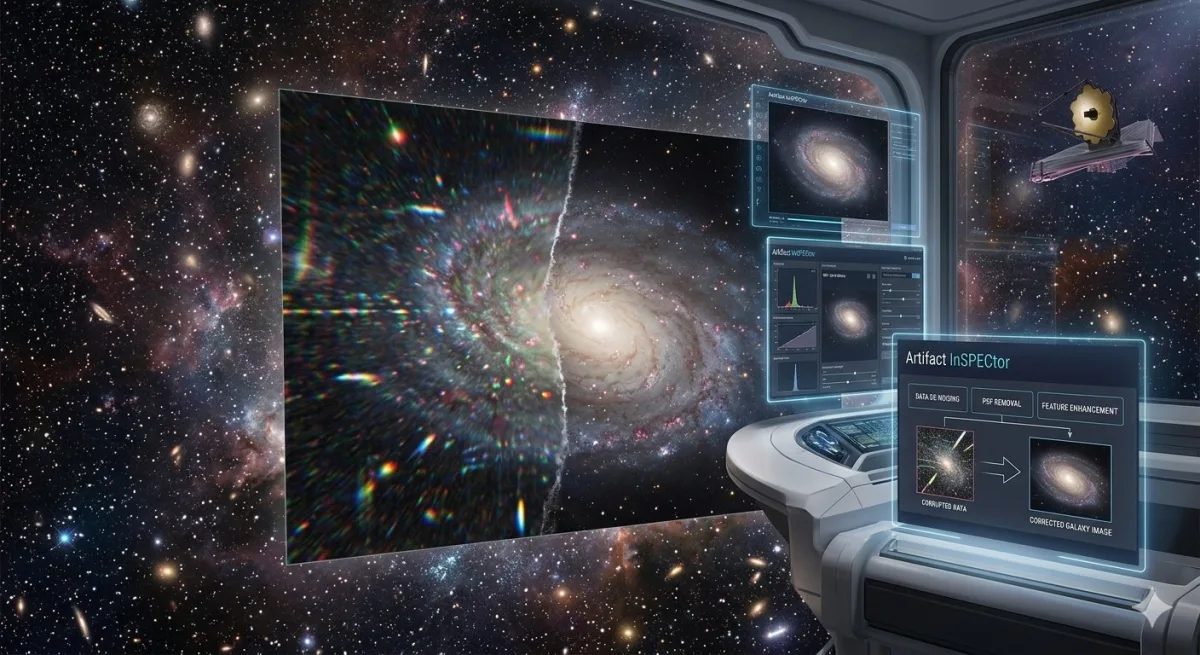
Artifact InSPECtor is a new NASA-supported citizen-science project designed to help scientists identify unwanted features, known as artifacts, in space telescope data. The project uses machine learning to find possible artifacts in spectroscopy data from the European Space Agency's Euclid mission, while human volunteers check whether the computer got those decisions right. Those human classifications will then be used to improve the machine-learning model and prepare it for data from NASA's Nancy Grace Roman Space Telescope. As of September 19, 2026, Roman has already launched and is undergoing commissioning on its way to its final orbit, making the work of Artifact InSPECtor especially timely.
Summary
-
Project name: Artifact InSPECtor
-
Type: NASA-supported citizen-science and machine-learning project
-
Platform: Zooniverse
-
Launch date: September 1, 2026
-
Main data source: ESA's Euclid Q1 data
-
Main focus: Spectroscopy data and the identification of unwanted artifacts
-
Machine-learning model: Meta's Segment Anything Model, or SAM
-
Human role: Check whether the AI correctly identified and masked artifacts
-
Main goal: Improve artifact detection for future Roman Space Telescope data
-
Roman status: Launched August 30, 2026; currently undergoing commissioning
-
Expected Roman first images: Early 2027, according to NASA's current schedule
-
Research institutions involved: University of Minnesota, University of Oxford, Adler Planetarium and other collaborators
-
Long-term plan: Publicly deploy the improved artifact-masking model through the Roman Research Nexus
What Is Artifact InSPECtor?
Artifact InSPECtor is not a traditional software package that a person downloads and installs to repair a damaged telescope photograph.
It is a NASA-funded research project on Zooniverse that combines machine learning with human observations to improve the way unwanted features are identified in astronomical data. The project officially launched on Zooniverse on September 1, 2026.
The name contains an intentional reference to spectroscopy. NASA explains that the letters “SPEC” are capitalized because the project focuses on spectroscopic data rather than ordinary telescope photographs.
The basic problem is simple to understand.
A space telescope may detect something in its data that looks like part of a galaxy, star or other astronomical object. But that feature may not actually come from the object scientists are studying. It could instead have been produced by the telescope's camera, detector, electronics, optics, cosmic rays or other effects.
These false features are called artifacts.
Scientists need to identify them because keeping them in a scientific analysis can interfere with measurements. In Artifact InSPECtor, the goal is to help the computer become better at telling the difference between useful astronomical signals and unwanted telescope effects.
Why Space Telescope Data Needs Cleaning
When people take a photograph with a phone, they can simply take another picture if the first one contains glare, dust or another problem.
Space telescopes do not have that luxury.
A telescope may spend valuable observing time collecting light from an extremely faint and distant galaxy. Once that observation is made, scientists must work with the data they have. Artifacts therefore have to be understood and handled during data processing rather than simply avoided by taking another photograph.
This becomes even more important as modern observatories collect enormous quantities of information.
NASA says Roman will produce about 1.4 terabytes of data per day, the highest data rate of any NASA astrophysics mission so far. The huge volume means automated tools will be essential, but those tools still need to be reliable.
Artifact InSPECtor is aimed at one part of that larger problem: teaching machine-learning systems what unwanted signals actually look like in astronomical spectroscopy.
What Are Artifacts in Telescope Data?
An artifact is a feature detected in telescope data that is not the astronomical signal scientists intended to measure.
The project documentation gives several examples.
| Artifact or Feature | What Causes It | Why It Matters |
|---|---|---|
| Cosmic-ray streaks | High-energy particles striking the detector | Can create long false features across the data |
| Diffraction spikes | Light bending around mirror edges and support structures | Can look like unwanted structures around stars |
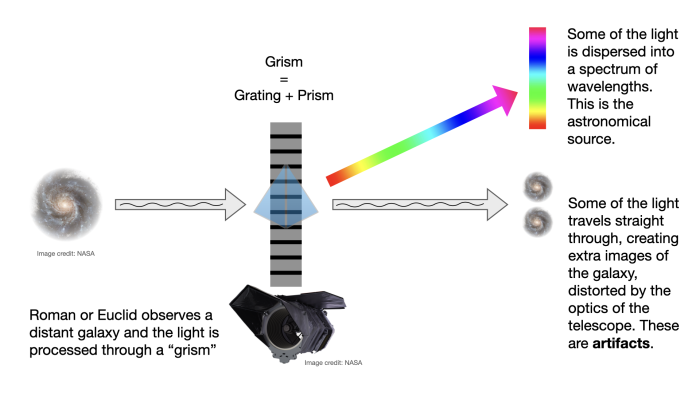
| Zeroth-order sources | Light passing through a grism without being dispersed | Creates extra images that are not separate galaxies |
| Bad pixels | Detector defects or unusable pixels | Can create false signals or gaps |
| Camera/electronics effects | Instrument behavior and electronic effects | Can introduce patterns unrelated to the astronomical source |
| Stray or reflected light | Light entering or reflecting within the instrument | Can produce unwanted structures |
These features do not necessarily mean that the telescope is broken. In many cases, they are expected effects of observing with complex optical and electronic instruments.
Each telescope can also have its own patterns. Zooniverse describes these artifact patterns as being somewhat like a fingerprint for a telescope.
That is one reason new observatories require careful data-processing work.
Why Spectroscopy Makes Artifact Detection Important
Artifact InSPECtor focuses on spectroscopy, a technique astronomers use to study light by separating it into different wavelengths.
NASA explains spectroscopy using a simple comparison: a prism can spread white light into a rainbow. A spectrograph does something similar with astronomical light, although it does so with much greater precision.
A spectrum can reveal information that an ordinary image cannot easily provide.
By examining the wavelengths of light from a galaxy, astronomers can learn about its chemical composition, the ages of stars within it, movement through space and other physical properties. Spectral shifts can also be used to determine how far away galaxies are.
That is especially valuable for missions studying the history and expansion of the universe.
The problem is that a spectrum does not always arrive as a perfectly clean line of useful information. Instrument-generated features can appear alongside the real signal.
Scientists therefore need to know which pixels belong to the astronomical data and which should be excluded from analysis.
How Euclid Data Is Being Used
The first data used by Artifact InSPECtor comes from ESA's Euclid mission.
Euclid is designed to study large parts of the universe and help researchers investigate dark matter, dark energy and the evolution of cosmic structures.
Its first Quick Data Release, known as Q1, was published in March 2025. ESA says the release covered 63.1 square degrees of the Euclid Deep Fields and contained roughly 30 million objects. It included imaging and spectroscopic information along with supporting data products.
The Artifact InSPECtor project works with part of this data, particularly the galaxy spectra produced through grism observations.
A grism combines characteristics of a diffraction grating and a prism. It spreads incoming light by wavelength so scientists can study the spectrum of a galaxy.
The resulting data can look very different from the colorful space photographs that are normally shared with the public.
The project explains that multiple spectra may appear as horizontal streaks, while bright emission lines can appear as smaller blobs. Volunteers must learn to distinguish those genuine signals from artifacts.
What Does the AI Actually Do?
Artifact InSPECtor uses a machine-learning model called the Segment Anything Model, or SAM.
SAM was developed by Meta AI and is designed to identify and segment objects in images. The Artifact InSPECtor researchers adapted the idea for a very different environment: astronomical data.
The important point is that SAM was not originally trained specifically for the kinds of telescope spectroscopy being examined by this project.
That is why it can make mistakes.
The researchers first use the model to generate segmentation maps that highlight areas it believes are artifacts. Volunteers then inspect those results and decide whether the computer's mask is correct.
The process can be simplified like this:
Telescope data → AI detects possible artifact → Human checks AI result → Human classification becomes training information → Researchers improve the model → Improved model can process future telescope data
This is one of the most important ideas behind the project.
The humans are not simply "cleaning pictures" one by one. They are providing examples that can help improve an automated scientific system.
How Human Volunteers Help the AI
A volunteer does not need to be an astronomer to take part.
NASA says the project provides an in-project tutorial and can be completed using an internet-connected computer, tablet or smartphone. The tutorial takes approximately 10–15 minutes, after which volunteers can continue classifying data.
The volunteer sees telescope data with areas highlighted by the computer.
Some parts may be colored blue to show what the AI believes should be masked.
The volunteer then checks whether the highlighted region actually covers the artifact correctly.
According to the project's instructions, a good mask should cover the artifact without unnecessarily removing surrounding useful information. Extra scattered pixels or masks that become much larger than the real artifact can create another problem: scientists could lose valid data.
The project therefore has two challenges at once:
Don't leave the artifact behind.
And:
Don't remove real astronomical information by masking too much.
That balance is extremely important.
A Small Blob Could Actually Be Important
One of the interesting parts of Artifact InSPECtor is that not every unusual-looking feature should be removed.
For example, a faint galaxy might have a very weak continuum but still show a strong emission line.
That emission line can appear as a small bright blob.
A person unfamiliar with spectroscopy might think the blob looks like an error. But it could actually contain scientifically useful information about the galaxy.
This is one reason human review is valuable.
A computer can recognize visual patterns very quickly, but it does not automatically understand the scientific meaning of every unusual pattern. Human classifications can provide better examples of where the computer is getting things right and where it is going wrong.
The Strange “Figure Eight” Is Not a New Galaxy
Another example is the project's zeroth-order source.
When a grism spreads light into a spectrum, most of the light is dispersed. But some light can travel through without being dispersed.
This produces an additional image of the galaxy.
In Euclid Q1 data, these features can have a double-lobed or figure-eight appearance. They are not two new galaxies. They are optical artifacts created by the grism.
This is a good example of why artifact detection cannot simply be based on asking whether something "looks like a galaxy."
A feature can look real while still being produced by the telescope itself.
What Cosmic Rays Look Like
Cosmic rays are another source of unwanted features.
These are high-energy particles that can strike a telescope's detector.
The impact can leave long, thin streaks in the data. The appearance can depend on the angle at which the particle hits the detector.
For astronomers, these streaks have to be distinguished from actual astronomical signals.
The telescope has still captured real information, but parts of the detector output may not represent the galaxy or star being studied.
Diffraction Spikes Can Also Confuse the System
Stars can produce distinctive spikes in telescope data because of the way light interacts with mirrors and the structures holding them in place.
These are called diffraction spikes.
They are associated with real stars, but in the Artifact InSPECtor workflow they are not the galaxy spectra researchers are trying to analyze. The project notes that the AI model can struggle with these features as well.
This illustrates another important point: an astronomical object can be real while a particular feature associated with it may still be undesirable for a specific scientific analysis.
Artifact InSPECtor and the Nancy Grace Roman Space Telescope
The connection to Roman is one of the main reasons the project has attracted attention in 2026.
NASA's Nancy Grace Roman Space Telescope launched on August 30, 2026, aboard a SpaceX Falcon Heavy from Kennedy Space Center in Florida.
As of September 19, 2026, Roman is still in its commissioning phase and travelling toward the Sun-Earth L2 region, roughly one million miles from Earth. NASA says the spacecraft is undergoing deployments, instrument activations, calibrations and tests during this period.
NASA currently anticipates releasing Roman's first images in early 2027.
This timing matters for Artifact InSPECtor.
The researchers are using Euclid because it provides experience with data from an observatory whose instruments and observing methods have important similarities to Roman.
The project's stated goal is to use what is learned from Euclid artifacts to improve models that will analyze Roman data.
Why Euclid and Roman Are So Important Together
Euclid and Roman are not identical telescopes, but both are built to collect enormous amounts of information about the universe.
NASA says Roman's mission will investigate dark energy, dark matter, exoplanets and a broad range of other astrophysical questions. Its Wide Field Instrument will survey large areas of the sky in infrared wavelengths.
Euclid is already collecting observations, while Roman has now begun its journey to its operating orbit.
That creates an interesting opportunity.
Researchers can use real Euclid observations to learn what kinds of artifacts appear in this type of data before Roman starts full science operations.
The result could be a more prepared data-processing system when Roman begins producing its own large scientific archive.
The Project Is Not Replacing Astronomers With AI
A common misunderstanding about projects like this is that the computer is expected to do everything by itself.
That is not what Artifact InSPECtor is doing.
Instead, the project uses a human-plus-machine approach.
The AI handles an initial pattern-recognition job. People review the results. Researchers use the human classifications to improve the model.
The project team has specifically stated that the classifications will be aggregated for model improvement. Zooniverse's FAQ also says volunteer-identifiable information is not used for the retraining work.
This approach is useful because large astronomical datasets are too big for scientists to inspect pixel by pixel forever, while automated systems can make mistakes when they encounter patterns they were not trained to recognize.
What Happens to the Human Classifications?
The classifications do not simply disappear after a volunteer clicks a button.
They become part of the project's research process.
The researchers plan to use the classifications to fine-tune their own version of SAM for astronomical artifact detection in grism data. They state that the improved astronomical version is intended to be publicly released after the project, together with a peer-reviewed journal article.
The project's longer-term goal is to create better segmentation maps for Roman.
Eventually, the researchers plan to make the final artifact-masking model available through NASA's Roman Research Nexus, giving astronomers a way to use it while working with Roman observations.
That means the project is being designed not just as a public education exercise but as part of a larger scientific data-processing workflow.
What Is the Roman Research Nexus?
The Roman Research Nexus is NASA's cloud-based scientific environment for working with Roman data.
NASA announced that the Nexus opened in January 2026, before Roman launched. The platform provides tools such as pre-installed software, Jupyter notebook tutorials, simulated Roman datasets and collaborative workspaces.
The reason a system like this is needed is the scale of Roman's expected data.
NASA estimates that Roman will produce around 20 petabytes of data during its primary five-year mission.
That amount of information cannot be treated like a small collection of ordinary images.
Researchers need software pipelines, databases, cloud computing, machine learning and quality-control systems that allow them to work efficiently.
Artifact InSPECtor is designed to become one useful part of that wider ecosystem.
Current Status of Artifact InSPECtor in September 2026
As of September 19, 2026, Artifact InSPECtor is active on Zooniverse and is based on Euclid Q1 data.
The project page lists its launch date as September 1, 2026. Its researchers are currently using volunteer classifications to assess and improve the machine-learning system.
At the same time, NASA's Roman mission is moving through commissioning after its August 30 launch. On September 15, NASA reported that Roman's primary Wide Field Instrument had been activated as part of its continuing series of calibrations and tests.
The broader timeline can therefore be viewed like this:
| Date/Period | Development | Status |
|---|---|---|
| March 19, 2025 | Euclid Q1 data release | Released |
| September 1, 2026 | Artifact InSPECtor launches on Zooniverse | Active |
| August 30, 2026 | Roman launches | Completed |
| September 2026 | Roman commissioning and instrument testing | Ongoing |
| October 21, 2026 | Euclid Data Release 1 | Tentatively scheduled |
| Early 2027 | Roman first images expected | Planned |
| After project completion | Improved astronomy-focused artifact model | Planned |
ESA notes that the October 21, 2026 Euclid Data Release 1 date is tentative, so it should be treated as a planned date rather than a guaranteed release date. (Cosmos)
What Artifact InSPECtor Could Mean for Astronomy
The value of Artifact InSPECtor is not that it makes space telescope images prettier.
The goal is scientific accuracy.
Researchers use spectra to extract measurements about distant galaxies. Those measurements can contribute to studies of galaxy evolution, cosmic distances and the expansion history of the universe.
When an artifact is mistaken for genuine information, it can interfere with that analysis.
When too much genuine information is removed, that can also create a problem.
The project is therefore trying to find a practical middle ground: identify the unwanted features while preserving the real astronomical signal.
This is especially important as telescopes such as Euclid and Roman move into an era of extremely large surveys.
NASA says Roman will survey huge numbers of galaxies and produce vast quantities of data every day. Efficient automated processing will therefore be essential for scientists who need to turn raw observations into useful measurements.
The Bigger Role of Citizen Science
Artifact InSPECtor is also another example of how members of the public can contribute to real scientific research.
Zooniverse reported in July 2026 that its volunteers had reached 1 billion classifications across the platform. NASA-sponsored Zooniverse projects alone had accumulated about 120 million classifications from 324,000 volunteers since 2020, according to NASA.
That experience is relevant to Artifact InSPECtor.
Some scientific tasks are repetitive but still require human judgment. A citizen-science platform can distribute those tasks among many people.
The computer processes patterns at scale.
Humans provide judgment and correction.
Scientists design the experiment and interpret the results.
That combination can be particularly useful for astronomy, where modern telescopes generate far more data than researchers could reasonably inspect manually.
A message from the Artifact InSPECtor team captures the idea clearly:
“Your work to identify artifacts tells us which data to keep for scientific analysis.” (Zooniverse)
Who Is Behind Artifact InSPECtor?
Artifact InSPECtor brings together researchers working in astronomy, machine learning and citizen science.
The project's listed team includes Aimee Schechter, a postdoctoral researcher at the University of Minnesota Institute for Astrophysics and project lead; Bharath C. Nagam, also a University of Minnesota postdoctoral researcher; Kameswara Mantha of the University of Missouri–Kansas City; Hugh Dickinson of The Open University; Claudia Scarlata and Lucy Fortson of the University of Minnesota; along with other collaborators.
The wider Zooniverse effort involves the Adler Planetarium and University of Oxford, with the University of Minnesota serving as a major institutional partner.
The project also receives NASA funding and uses Euclid data provided by the ESA/Euclid Consortium.
Current Projects and Status
| Project/Activity | Role | Status | Current Information |
|---|---|---|---|
| Artifact InSPECtor | Citizen-science artifact classification | Active | Uses Euclid Q1 spectroscopy data |
| SAM artifact detection | Initial automated segmentation | Active in research workflow | AI proposes artifact masks for human checking |
| Human classifications | Model evaluation and training data | Ongoing | Volunteers check AI decisions |
| Astronomy-focused SAM | Improved artifact model | In development | Researchers plan to fine-tune it using classifications |
| Roman artifact masking | Future application | Planned | Intended to support analysis of Roman data |
| Roman Research Nexus deployment | Distribution of final model | Planned | Project says model will be publicly deployed there |
| Roman Space Telescope | Future data source | Commissioning | Launched Aug. 30, 2026; first images expected early 2027 |
| Euclid Data Release 1 | Larger Euclid data release | Planned | ESA currently lists Oct. 21, 2026 as tentative |
What Artifact InSPECtor Does Not Do
It is also important to clear up a common misunderstanding.
Artifact InSPECtor does not physically repair a space telescope.
It does not send commands to Euclid or Roman.
It does not repair a damaged camera.
And it does not simply take an old photograph and magically make it perfect.
Instead, the project deals with data analysis. It helps identify portions of telescope data that may have been produced by unwanted instrument effects and works toward creating better masks so those areas can be excluded from scientific measurements.
That distinction matters because "fixing space telescope data" is really shorthand for improving the way researchers process and interpret the data.
Why This Matters for Dark Energy
One of the biggest scientific reasons for improving this type of data processing is the study of the expanding universe.
Scientists can use observations of distant galaxies and their spectra to determine distances and study how the universe has changed over time.
Euclid is designed in part to investigate dark energy, while Roman will use several methods to study dark energy and dark matter.
The cleaner and more reliable the underlying measurements are, the more confidently researchers can use those observations in larger cosmological studies.
Artifact InSPECtor is therefore not discovering dark energy by itself.
Instead, it is helping with a much more basic but important question:
Which parts of the telescope data should scientists trust and analyze?
Getting that answer right can influence everything that comes afterward.
What Happens Next?
The coming months are likely to be important for the project.
Artifact InSPECtor is currently learning from Euclid data while Roman moves through commissioning.
NASA has said Roman's instruments will continue to undergo calibration and testing during the approximately three-month commissioning period, with first images expected in early 2027.
Meanwhile, ESA's next major Euclid data release is currently scheduled for October 21, 2026, although ESA labels the date tentative.
The combination of new data and better machine-learning methods could give astronomers stronger tools for dealing with the enormous datasets expected from the next generation of space observatories.
How People Can Participate
Artifact InSPECtor is designed so that members of the public can participate without specialist astronomy training.
NASA says participants need only an internet-connected computer, tablet or smartphone and can learn the classification process through the project's built-in tutorial.
Participants examine real Euclid data, look at the AI's proposed artifact masks and indicate whether those masks are correct.
That means even a short session can become part of a real scientific workflow.
The project is hosted by Zooniverse, where volunteers can also communicate with researchers and other participants.
References
Zooniverse — Artifact InSPECtor
Zooniverse — Artifact InSPECtor Research
Zooniverse — Artifact InSPECtor FAQ
ESA — Euclid Q1 Data Release Documentation
ESA — Euclid Data Release Timeline