
Hibernation Tech for Space: Can Humans Sleep to Mars?
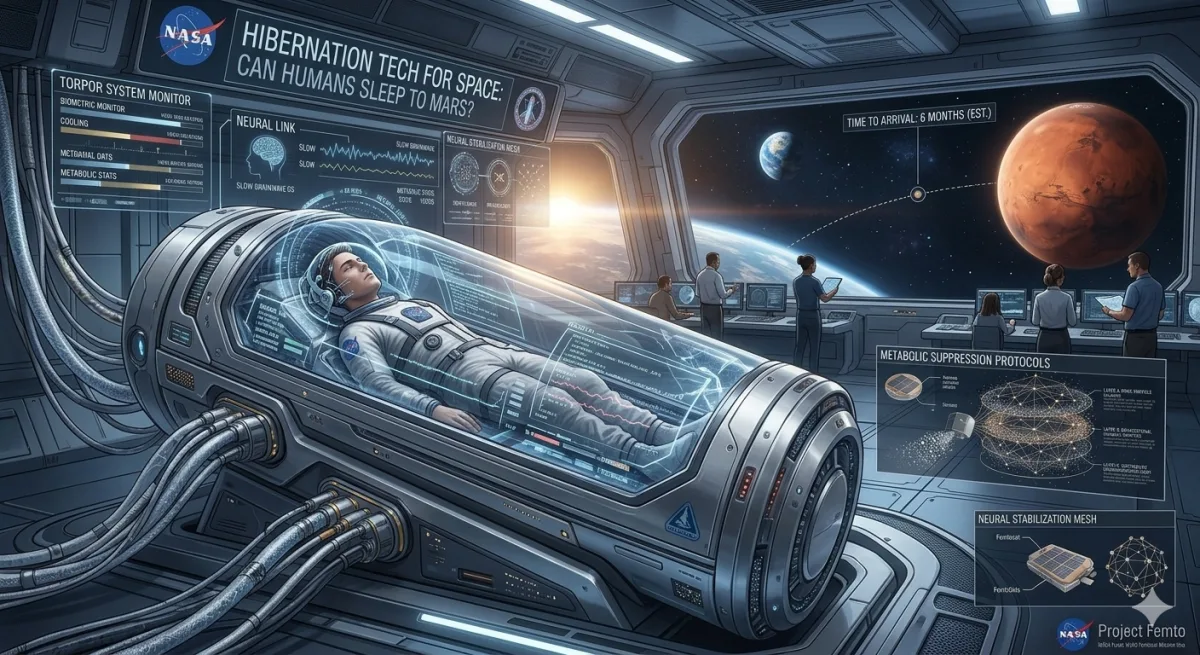
Hibernating astronauts sounds like science fiction, but the scientific idea behind it is real enough that NASA and the European Space Agency have studied it as a possible technology for future Mars missions. The idea is not to freeze people like in a movie. Instead, researchers are exploring synthetic torpor—an artificially induced, reversible state in which metabolism, body temperature, heart activity and other functions are greatly reduced. In theory, astronauts placed in torpor for much of a long interplanetary journey would need less food, water and oxygen, produce less waste, require less living space and potentially spend less time dealing with some psychological problems of confinement.
ESA studies have even found that a Mars spacecraft designed around hibernating crew members could be substantially smaller. But there is a major catch: humans cannot currently be placed into a safe, deep, reversible hibernation state for months at a time. Research has made progress in understanding torpor in animals and in developing medically useful forms of metabolic suppression, but a human Mars hibernation system remains a future technology, not something astronauts can use today.
Summary
-
Technology: Synthetic torpor / human hibernation
-
Main idea: Temporarily lower metabolism and body temperature to reduce the body's resource demands
-
Potential destination: Mars and other deep-space missions
-
Main organizations studying the concept: NASA, ESA and university research groups
-
Current human capability: No demonstrated long-duration human hibernation
-
Most advanced evidence: Animal experiments and medical research into controlled hypometabolic states
-
Potential benefits: Lower food and water needs, smaller spacecraft, reduced waste, less confinement, possible protection against some space hazards
-
Major challenge: Humans are not natural hibernators
-
Another challenge: Long-term effects on the brain, circulation, muscles, bones, immune system and other organs remain unresolved
-
Radiation question: Hibernating animals show interesting radiation resistance, but it is not established that human torpor would protect astronauts from chronic space radiation
-
Current status: Research and engineering studies, not a flight-ready technology
-
Bottom line: Humans may eventually use controlled torpor on deep-space missions, but scientists have not yet demonstrated that people can safely "sleep" through a Mars transfer. (PubMed Central (PMC))
What Does "Hibernation" Mean in Space?
The word hibernation can be misleading.
When people hear the term, they often imagine an astronaut lying inside a futuristic capsule, completely unconscious for months, waking up when the spacecraft reaches Mars. That is close to science fiction.
Scientists generally use the word torpor when discussing the biological state they hope to reproduce.
Torpor is a controlled reduction in metabolism. Animals that naturally enter torpor can reduce energy expenditure dramatically, lower body temperature and slow many bodily processes. Hibernation is often a longer or repeated pattern involving torpor and periods of arousal.
The proposed human version is usually called synthetic torpor: a medically or technologically induced hypometabolic condition in a species that does not naturally use regulated hibernation in the same way.
That distinction matters because sleep is not the same as torpor.
Normal human sleep still requires the body to maintain its usual basic metabolism, temperature regulation and many physiological functions. Torpor would involve a much deeper reduction in energy use.
So the phrase "sleep to Mars" makes a great headline, but scientifically the goal is more complicated: make the body temporarily operate at a much lower metabolic level while keeping it alive and capable of recovery.
Why Would Astronauts Need Hibernation?
A human Mars mission is extremely demanding even before scientists start talking about hibernation.
A traditional exploration scenario can involve months traveling from Earth to Mars, a long stay on or around Mars depending on orbital opportunities, and another lengthy journey home. NASA planning documents have used mission assumptions involving roughly six months of transit in each direction and a total mission measured in years.
During that time, astronauts must be supplied with everything they need to survive.
They need food and water. They need oxygen and carbon-dioxide removal. They need space for sleeping, exercise, hygiene, medical care and work. They also need systems capable of protecting them against radiation and dealing with equipment failures.
The longer the mission becomes, the more mass the spacecraft has to carry.
ESA has pointed out just how large that logistical problem can become. In its Mars hibernation study, engineers estimated roughly 30 kg of food, water and oxygen-related consumables per astronaut per day as part of the mission planning challenge.
Reducing those requirements could change the spacecraft itself.
That is why hibernation is not simply a medical idea. It is also an engineering idea.
How Synthetic Torpor Could Work
There is no single proven method for putting a human into long-term torpor.
Researchers are investigating several biological pathways and technologies.
One possible approach involves manipulating the body's temperature regulation system. Studies in rodents have shown that specific groups of neurons in the hypothalamus can trigger a torpor-like state. In 2020, researchers reported that activating particular hypothalamic neurons in mice produced a prolonged hypothermic and hypometabolic condition resembling hibernation. The animals recovered without obvious tissue or behavioral damage in the reported experiments.
Another 2020 study identified neurons in the anterior and ventral parts of the medial and lateral preoptic area that are associated with mouse torpor. Researchers were able to reactivate neurons associated with natural torpor and induce key features of that state.
These discoveries are important because they suggest that torpor is not simply a passive result of getting cold.
The brain actively participates in controlling it.
That could eventually allow scientists to develop medical technologies that deliberately switch metabolic suppression on and off.
However, a mouse is not a human.
Researchers still have to understand how these biological control systems work in humans, how they could be controlled safely, and how a person could remain stable for extremely long periods.
The ESA Mars Hibernation Study
ESA has conducted some of the most detailed engineering work on what a hibernating Mars spacecraft could look like.
Its Concurrent Design Facility studied a human Mars mission and redesigned the spacecraft around the assumption that crew members would spend much of the transit in torpor. Engineers considered not only biology but spacecraft architecture, logistics, radiation shielding, power consumption, safety and crew psychology.
The result was striking.
ESA reported that the spacecraft's mass could potentially be reduced by about one-third because the vehicle would require less crew living space and fewer consumables.
In the concept, astronauts would occupy individual small pods.
These would function as both living quarters and hibernation units.
The crew would be cooled and maintained in torpor during the cruise phase. ESA's design study used a roughly 180-day Earth-to-Mars cruise as part of its scenario and included a 21-day recovery period after the hibernation phase.
The study was not a demonstration that humans can safely do this.
It was an engineering assessment showing what could become possible if the biology can eventually be made reliable.
That distinction is extremely important.

NASA's Role in Human Torpor Research
NASA has also funded research into torpor-based spacecraft concepts.
One major effort came through the NASA Innovative Advanced Concepts program, where SpaceWorks proposed a Torpor-Inducing Transfer Habitat for Human Stasis to Mars. The concept was built around placing astronauts into an inactive, non-cryonic torpor state during the in-space portions of a Mars mission.
A later Phase II effort expanded the concept.
NASA's description says the project investigated an advanced habitat capable of cycling crew members through inactive, non-cryonic torpor states and included further work on medical questions, habitat engineering and prolonged hypothermia studies.
NASA's TechPort database now describes these projects as completed technology projects. That means they are important research and concept studies, but it should not be interpreted as NASA having a working human hibernation spacecraft ready for Mars.
Major Benefits of Human Hibernation
1. Less Food and Water
This is probably the simplest advantage to understand.
If astronauts spend much of the journey in a profound low-metabolism state, their bodies should need substantially less energy.
ESA's research group has said torpor could potentially reduce food and water requirements by up to 75%, although that number comes from the assumptions and biological modeling surrounding the concept rather than an achieved human result.
Less consumables means less launch mass.
And less launch mass is extremely valuable in spaceflight.
2. Smaller Spacecraft
Normal astronauts need enough room to move, exercise, work and live for months.
Hibernating crew members would need far less active living space during the cruise.
ESA's engineering work found that this could reduce spacecraft mass by roughly one-third in the studied Mars scenario.
That is potentially a major change.
A spacecraft would no longer have to be designed as a small home for six people for an entire multi-year mission.
Instead, much of the interior could be designed around compact hibernation modules.
3. Less Waste
Active humans produce waste continuously.
Food consumption, drinking, hygiene and normal metabolism all create additional demands on life-support systems.
Lowering metabolism would reduce many of these requirements.
Earlier research has argued that torpor could enormously reduce waste production during long missions.
4. Less Psychological Stress
A trip to Mars can involve months of isolation inside a confined spacecraft.
Astronauts would live with the same small group of people, far from Earth, with limited privacy and delayed communication.
NASA research has repeatedly identified psychological and behavioral health as important issues for long-duration missions. More recent research also continues to examine how isolation, microgravity and other stresses could affect astronauts' brains and nervous systems.
Torpor could reduce the amount of time astronauts spend consciously experiencing that environment.
Instead of spending six months fully awake on the journey, a crew might spend much of the trip in a low-metabolism state.
That does not solve every psychological problem, but it could change the problem dramatically.
5. Potential Protection Against Some Space Hazards
One of the most interesting possibilities is radiation.
Hibernating animals have shown increased resistance to certain types of radiation damage, and researchers have investigated whether the biochemical changes associated with torpor could provide protection during spaceflight.
But this is where headlines can easily get ahead of the science.
Researchers do not yet know that human torpor would protect astronauts from the chronic low-dose radiation environment of deep space.
A major scientific review specifically noted that evidence from hibernating animals does not establish whether synthetic torpor would protect humans against the long-term, low-dose radiation astronauts would experience.
So hibernation should not currently be advertised as a substitute for radiation shielding.
The Biggest Problem: Humans Are Not Bears
One of the biggest obstacles is also the most obvious.
Humans do not naturally hibernate.
Bears, bats, rodents and other animals have evolved biological systems that allow them to drastically reduce metabolic activity and recover from those states.
Our bodies work differently.
Scientists need to find ways to reproduce at least some of those mechanisms without causing injury.
This becomes especially difficult when body temperature falls.
A person's heart, blood vessels, lungs, brain and other systems must continue operating.
At very low temperatures, circulation changes and biochemical reactions slow dramatically.
Research into human red blood cells, for example, is examining how their physical properties change as temperature falls because maintaining adequate circulation would be essential to any future human synthetic-torpor technology. A 2024 study found major temperature-dependent changes in the viscoelastic behavior of human and bat red blood cells and suggested that understanding these effects could eventually help researchers address low-temperature circulation.
In other words, putting a person into a hibernation-like state is not simply a matter of turning down the thermostat.
The Brain Is Another Major Challenge
The brain may be one of the most difficult organs to protect during artificial torpor.
Deep-space missions already expose astronauts to a combination of microgravity, radiation, isolation and other stresses.
A 2025 Nature Reviews Neuroscience review described microgravity and cosmic radiation as important risks to the central nervous system during long-duration exploration.
A 2026 review went further, discussing neurological complications associated with long-duration spaceflight and identifying synthetic torpor among emerging countermeasures that researchers are considering alongside artificial gravity, advanced monitoring and other technologies.
But mentioning synthetic torpor as a possible countermeasure does not mean the problem has been solved.
Scientists still need to understand what prolonged metabolic suppression would do to memory, cognition, blood flow, sleep architecture, brain structure and recovery.
What About Muscle and Bone Loss?
Microgravity is already known to be a major problem for astronauts.
When people do not use their muscles and bones normally, their bodies change.
This is why astronauts aboard the International Space Station follow exercise programs.
A theoretical benefit of animal hibernation is that hibernating species can avoid some forms of severe muscle wasting despite remaining inactive for long periods.
ESA's engineering study therefore considered the possibility that astronauts in torpor could avoid some of the muscle and bone losses expected from conventional inactivity.
However, this is another area where animal biology cannot simply be transferred to humans.
Researchers must demonstrate that humans can remain physiologically stable for months and then regain normal strength and function.
The astronaut would eventually have to wake up and work on Mars.
That means recovery is almost as important as hibernation itself.
Waking Up May Be Harder Than Falling Asleep
One of the overlooked challenges of hibernation technology is recovery.
Imagine keeping an astronaut in a deeply reduced metabolic state for months.
Then imagine having to wake that person quickly because of a spacecraft emergency.
The astronaut cannot simply open their eyes and immediately repair a life-support system.
They may need time for their metabolism, circulation, brain and other systems to return to normal operating conditions.
ESA's concept therefore included a recovery period of around 21 days after the Mars cruise rather than assuming the crew could instantly return to full activity.
That creates another mission-design problem.
The spacecraft would need a safe process for:
entering torpor → maintaining torpor → detecting medical problems → waking an astronaut → restoring full physiological function.
Every stage would need backup systems.
What Happens During an Emergency?
This is one of the most difficult engineering questions.
Suppose one astronaut develops a dangerous medical problem while everyone is in torpor.
Who wakes up?
How quickly?
Who operates the spacecraft?
What if a computer failure occurs?
What if the cooling system fails?
What if a solar storm creates a radiation emergency?
What if the spacecraft loses power?
ESA's Mars study specifically examined emergency procedures and crew safety. It concluded that a future hibernation habitat would require sophisticated monitoring and automation, including artificial-intelligence-assisted monitoring. (European Space Agency)
This means a hibernation spacecraft would have to behave almost like a highly autonomous medical facility.
It could not depend entirely on Earth.
NASA has long recognized that communication with Mars can involve substantial delays, meaning mission crews cannot always wait for immediate instructions from Earth during emergencies.
A sleeping crew therefore creates an interesting contradiction: the astronauts are less demanding on the spacecraft, but the spacecraft becomes more responsible for keeping them alive.
Could Drugs Put Humans Into Torpor?
Researchers have explored pharmacological approaches to metabolic suppression, but there is no approved drug that allows a healthy person to safely enter a months-long hibernation state comparable to animal hibernation.
One research direction has been moderate or shallow metabolic depression rather than immediately attempting extreme torpor.
A major NASA-supported review proposed shallow metabolic depression as a possible first step toward synthetic torpor. The authors described methods involving enhanced slow-wave sleep and moderate sedation and defined this first-level metabolic reduction as roughly 20% below basal metabolic rate.
This is a useful way of understanding the field.
Scientists may not need to go directly from normal human physiology to "six months asleep."
The pathway could begin with smaller, safer reductions in metabolism.
Then researchers could progressively learn how to make those states deeper, longer and more controllable.
The Difference Between Human Hibernation and Cryonics
Another important distinction is between torpor and cryogenic preservation.
The Mars concepts generally discussed by NASA and ESA are non-cryonic.
That means astronauts would not be frozen solid and later revived.
NASA's SpaceWorks concept explicitly describes an inactive, non-cryonic torpor state. NASA also notes that full cryopreservation and restoration remains a long way off.
That means the realistic scientific vision is much closer to controlled extreme metabolic slowdown than to the frozen humans seen in science-fiction movies.
Major Research Milestones
| Year | Research or Development | Why It Matters |
|---|---|---|
| 2013 | NASA funds SpaceWorks' torpor-inducing Mars habitat concept | Established a detailed engineering case for human torpor in Mars missions |
| 2016 | NASA funds a follow-up SpaceWorks Phase II project | Expanded work into medical, engineering and prolonged hypothermia questions |
| 2018 | Reviews describe synthetic torpor as a possible technology for spaceflight | Helped connect animal biology with future human exploration |
| 2020 | Researchers identify neural circuits capable of triggering torpor-like states in rodents | Provided important clues about how hypometabolism is biologically controlled |
| 2022 | ESA publishes detailed Mars hibernation engineering findings | Estimated major reductions in spacecraft mass and consumables |
| 2023 | ESA continues hibernation and torpor research through its topical-team program | Maintains the subject as an active research area |
| 2024 | Research examines human red blood cell behavior at temperatures relevant to hibernation | Helps address circulation challenges at low temperature |
| 2025 | Nature Metabolism review highlights major advances in synthetic torpor research | Shows growing interest in metabolic control for medicine |
| 2026 | New neurological research includes synthetic torpor among possible countermeasures for deep-space health | Demonstrates continued scientific interest, while the technology remains experimental |
The timeline shows gradual progress rather than a sudden breakthrough. Researchers have moved from theoretical spacecraft studies toward increasingly detailed biological questions, but the central problem—safe long-term human torpor—has not yet been solved. (NASA)
Major Space Hibernation Studies
| Organization/Research Group | Focus | Status |
|---|---|---|
| NASA / SpaceWorks | Torpor-inducing Mars transfer habitat | Completed NIAC concept studies |
| ESA Concurrent Design Facility | Spacecraft architecture built around crew hibernation | Engineering study |
| ESA Hibernation and Torpor Topical Team | Biology, medical potential and Mars mission applications | Ongoing research area |
| University research groups | Neural mechanisms controlling torpor in rodents | Experimental animal research |
| Medical researchers | Therapeutic hypothermia and metabolic suppression | Active medical research |
| Space-medicine researchers | Radiation, neurological and physiological effects | Active research |
NASA's TechPort records show that the SpaceWorks projects have been completed, while ESA continues to describe hibernation and torpor as a research field rather than a flight-ready capability. (techport.nasa.gov)
Current Status in 2026
As of September 1, 2026, there is still no demonstrated technology that can safely put healthy human astronauts into deep torpor for the duration of a Mars journey and then bring them back to normal function.
That is the most important fact to remember.
There has been genuine progress.
Researchers understand much more about the neurological mechanisms behind torpor in animals than they did several years ago. Synthetic torpor is now discussed as a serious area of biomedical research rather than simply a science-fiction idea. A 2025 Nature Metabolism review highlighted discoveries that have opened new opportunities for controlling metabolic suppression, including work identifying torpor-regulating neurons.
Recent 2026 neurological research also lists synthetic torpor among possible future countermeasures for the health problems associated with deep-space missions.
But these developments should not be confused with human trials.
The research still involves significant animal experimentation, medical analogues and engineering studies.
There is no operational Mars spacecraft where astronauts enter medically induced hibernation before launch.
Could Humans Eventually Sleep to Mars?
Possibly—but nobody can say that it will definitely happen.
The basic scientific idea has enough supporting evidence to justify continued research.
Animals demonstrate that mammalian bodies can enter remarkably deep hypometabolic states.
Scientists have identified specific neural pathways involved in torpor.
Medical research has already learned how controlled hypothermia can alter metabolism and protect certain patients in specific circumstances.
Engineers have demonstrated on paper that a spacecraft designed around hibernation could be considerably smaller and lighter.
And recent scientific work continues to investigate synthetic torpor as a possible tool for long-duration exploration.
But the gap between "this works in animals" and "we can safely do it to astronauts for six months" is enormous.
Before humans could sleep their way to Mars, scientists would need reliable answers about metabolism, cardiovascular function, temperature control, brain function, immune response, muscle and bone preservation, nutrition, infection risk, emergency arousal and long-term recovery.
They would also need hardware capable of keeping each astronaut alive automatically for months.
That is not a small technical problem.
It is an entire new branch of human space medicine.
What Could the First Human Torpor Mission Look Like?
The first realistic human test would probably not involve sending someone directly to Mars.
A safer development path would likely involve progressively longer periods of controlled metabolic suppression on Earth, followed by increasingly realistic spaceflight experiments.
Researchers could move from short-duration medical applications to longer experiments, then possibly animal spaceflight missions, then tightly controlled human trials under medical supervision, and eventually short-duration human spaceflight demonstrations.
The 2020 NASA-supported work on shallow metabolic depression explicitly argued for a multistep development plan, rather than jumping immediately to deep human torpor.
That approach makes sense.
The technology would have to be proved in stages because failure in a spacecraft millions of kilometers from Earth could be catastrophic.
Why This Technology Matters Even If Mars Hibernation Never Happens
One of the most interesting things about synthetic torpor is that Mars may not be its only application.
ESA has pointed out that research into hibernation and torpor could also have medical uses on Earth. Controlled metabolic reduction may eventually have applications in surgery, critical care, emergency medicine and other situations in which temporarily reducing the body's energy demands could improve survival or treatment options.
This is often how space technology develops.
A problem that looks like it belongs in a spacecraft can eventually produce a useful medical technology on Earth.
The opposite can also happen.
Medical advances in controlling temperature, metabolism and sedation may eventually make human deep-space torpor more realistic.
Why Hibernation Could Be a Game-Changer for Mars
The biggest advantage may not be that astronauts spend the journey asleep.
The real advantage is that the entire spacecraft could be redesigned around a sleeping crew.
Less food means less cargo.
Less water means less mass.
Less living space means a smaller habitat.
Less waste means simpler life support.
Less active time could reduce some psychological burdens.
Centralized shielding could be placed around compact hibernation pods.
More spacecraft mass could potentially be allocated to propulsion, shielding and mission equipment rather than permanent crew living space.
ESA's engineering assessments show why this idea is attractive: the biological state could influence virtually every part of spacecraft architecture.
That is why scientists and engineers continue to study it even though human implementation is still far away.
The Biggest Questions Scientists Still Need to Answer
The field still has several major unanswered questions.
Can humans safely enter deep torpor?
This is the first hurdle.
Can they remain there for months without dangerous complications?
A state lasting hours or days is very different from one lasting half a year.
Can astronauts retain enough muscle and bone function?
A crew that arrives on Mars unable to walk would not be useful.
Can their brains recover normally?
Cognitive performance will be essential for a Mars mission.
Can the process be reversed quickly?
Emergency situations may require rapid waking.
Can a spacecraft monitor them without continuous human intervention?
The answer will almost certainly require highly reliable automation and medical monitoring.
Would torpor actually reduce radiation damage in humans?
Animal findings are promising, but chronic human deep-space exposure remains uncertain. (PubMed Central (PMC))
How would humans receive nutrition and hydration?
A long-duration torpor system would need a safe way to maintain the body's basic requirements without conventional eating and drinking.
Can astronauts be woken repeatedly?
ESA and other researchers have considered torpor cycles, but repeated entry and recovery create another layer of physiological complexity. (NASA)
References
European Space Agency — Human hibernation in space: CDF brings science fiction to reality
ESA research and mission-design study
European Space Agency — Hibernating astronauts would need smaller spacecraft
ESA spacecraft-mass and hibernation study
European Space Agency — Hibernate for a trip to Mars, the bear way
ESA overview of Mars hibernation research
ESA Exploration Science — Hibernation and Torpor
ESA hibernation and torpor research program
NASA TechPort — Torpor Inducing Transfer Habitat for Human Stasis to Mars
NASA technology project record
NASA TechPort — Advancing Torpor Inducing Transfer Habitats for Human Stasis to Mars
NASA Phase II technology project record
NASA — Torpor Inducing Transfer Habitat for Human Stasis to Mars
NASA project description
NASA — Advancing Torpor Inducing Transfer Habitats for Human Stasis to Mars
NASA Phase II description
Nature — Neurons that regulate mouse torpor
Nature research on torpor-regulating neurons
Nature — A discrete neuronal circuit induces a hibernation-like state in rodents
Nature research on induced torpor in rodents
Nature Metabolism — Synthetic torpor: advancing metabolic regulation for medical innovations
2025 review of synthetic torpor research
Nature Reviews Neuroscience — Brains in space
2025 review of neurological risks in deep space
npj Microgravity — Neurological complications in microgravity and long-duration spaceflight
2026 review including synthetic torpor as an emerging countermeasure
PubMed — Shallow metabolic depression and human spaceflight: a feasible first step
Research on gradual metabolic suppression for spaceflight
PubMed — Staying Cool in Space: A Review of Therapeutic Hypothermia and Potential Application for Space Medicine
Review of hypothermia and potential space-medicine applications
PubMed — Hibernation for space travel: Impact on radioprotection
Review of hibernation and radiation protection