

Fastest-Growing Black Hole Ever Discovered: Cosmic Monster Eats One Sun Per Day
A single black hole can shine brighter than all the stars in its galaxy combined? Astronomers recently found a strange object in a galaxy called SDSS J110546.07+145202.4 that is doing exactly that. Located 1.8 billion light years away, this black hole is acting in a way that experts have never seen before in our local neighborhood of space.
A Rare Discovery in the Leo Constellation
Scientists from the Max Planck Institute for Radio Astronomy have been watching a specific spot in the constellation Leo for eight years. They found a supermassive black hole that is producing intense radio waves. These bright flashes only last for a few days or weeks but this one is staying bright for years. You are looking at the first event of its kind ever recorded by humans.
The team used many different tools to gather their data - They looked at multiple types of light, including
- X-rays
High energy light that shows very hot areas. - Radio waves
Long distance signals that reveal moving particles. - Visible light
The same kind of light your eyes can see. - Infrared
Heat signatures from dust and gas.
Why This Black Hole is Growing So Fast
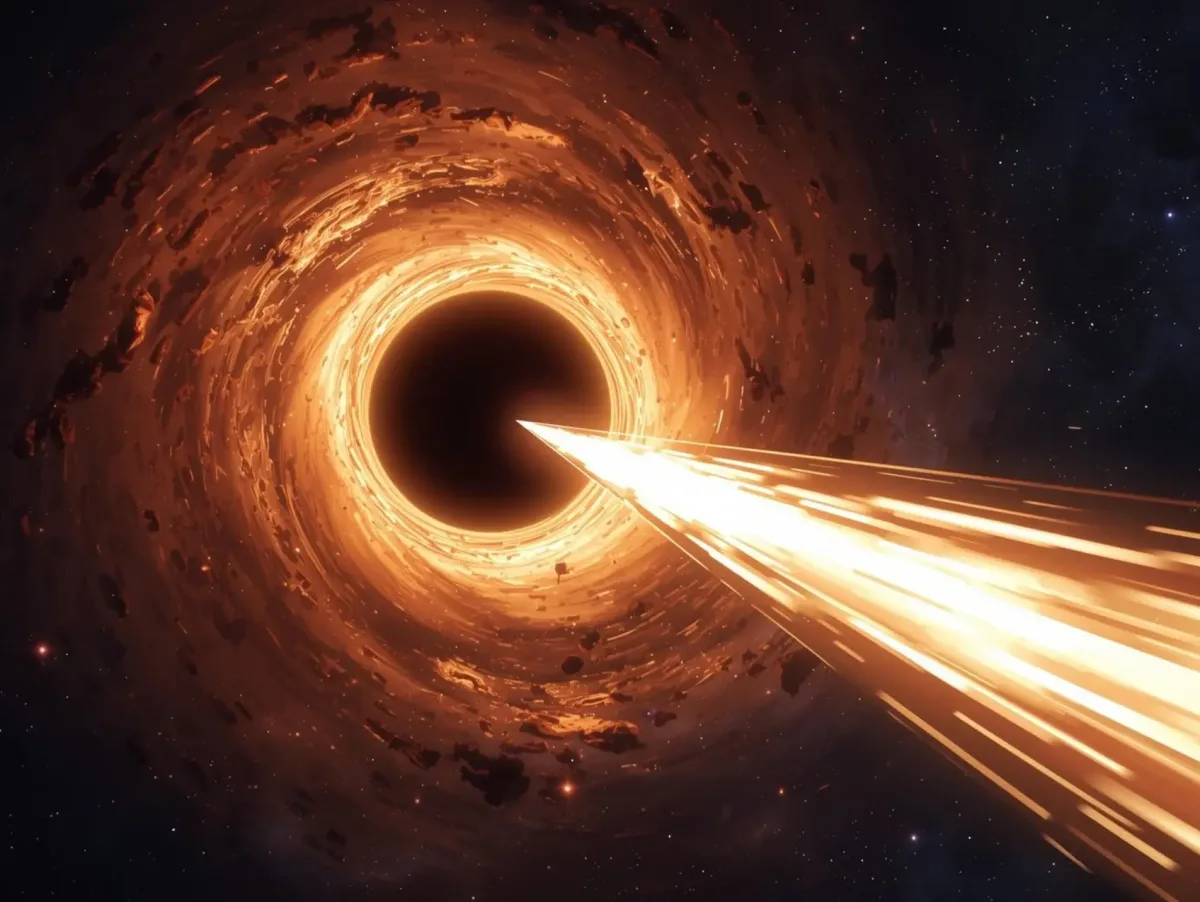
This black hole is special because it is not very heavy compared to others but it is eating material at a massive speed. As gas and dust fall toward the center, they form a spinning disk - this process creates a jet of energy that shoots out into space. Researchers call this an Active Galactic Nucleus or AGN for short.
Because the black hole is small but hungry, it is growing much faster than its neighbors. You can think of it as a small engine producing a huge amount of power. Experts are still trying to figure out why this specific black hole started eating so much material all at once and why it has not stopped yet.
A Window Into the Ancient Universe
This behavior is common for galaxies that existed billions of years ago when the universe was very young. This galaxy is relatively close to us in terms of cosmic distance. It exists within the last 2 billion years of history, which makes it a "living fossil" that you can study in great detail. It acts like a time machine that stays close enough for our telescopes to see clearly.
By studying this nearby example, you can learn about
- How the very first black holes formed.
- The way energy jets push against surrounding stars.
- The physics of matter under extreme pressure.
New Tools for Future Space Exploration
The research team believes this is just the beginning of a new category of space objects. In the coming years, new technology like the Square Kilometer Array will start working - these massive telescope sets will be sensitive enough to find thousands of these fast growing black holes across the sky - this will help you understand how galaxies change over billions of years.
Follow-up studies are already planned - Scientists want to use the Very Long Baseline Array to get an even sharper image of the center of this galaxy. Every new piece of data helps explain how the massive gravity wells shape the universe you live in today.
FAQ
What is a supermassive black hole?
It is a massive object at the center of a galaxy with gravity so strong that even light cannot escape it. They can be millions or billions of times heavier than our Sun.
Is this black hole a danger to Earth?
No, it is located 1.8 billion light years away - It is so far that its activity only affects its own local galaxy and does not reach our solar system.
What makes this specific discovery special?
Many bright radio signals from black holes disappear quickly - this one has stayed bright for eight years, which is the first time astronomers have seen such a long lasting event from a small black hole.
References
- NASA Science - Black Holes: https://science.nasa.gov/universe/black-holes
- ESA - Webb Spots Greedy Supermassive Black Hole in Early Universe: https://www.esa.int/Science_Exploration/Space_Science/Webb/Webb_spots_greedy_supermassive_black_hole_in_early_Universe
- Space.com - 2024: A Big Year for Black Hole Discoveries: https://www.space.com/2024-big-year-black-holes
- Physics.org - Rule-Breaking Supermassive Black Hole Discovered: https://phys.org/news/2026-01-supermassive-black-hole-early-universe.html
- AAS Nova - A New Way to Grow a Supermassive Black Hole: https://aasnova.org/2024/07/19/a-new-way-to-grow-a-supermassive-black-hole
- NASA Chandra - Astronomers Find Early Fast-Feeding Black Hole: https://www.nasa.gov/missions/chandra/astronomers-find-early-fast-feeding-black-hole-using-nasa-telescopes
- Science Alert - Scientists Found a Black Hole That Breaks The Rules: https://www.sciencealert.com/scientists-found-a-black-hole-that-breaks-the-rules-of-astrophysics
- Science Daily - Astronomers found a black hole growing way too fast: https://www.sciencedaily.com/releases/2026/01/260124003816.htm
- APS Physics - Eating Without Limit: https://link.aps.org/doi/10.1103/Physics.17.180
- Astrobites - It's over 4000! This supermassive black hole has gone Super-Eddington: https://astrobites.org/2024/05/21/super-eddington-bh-1-5gyr