
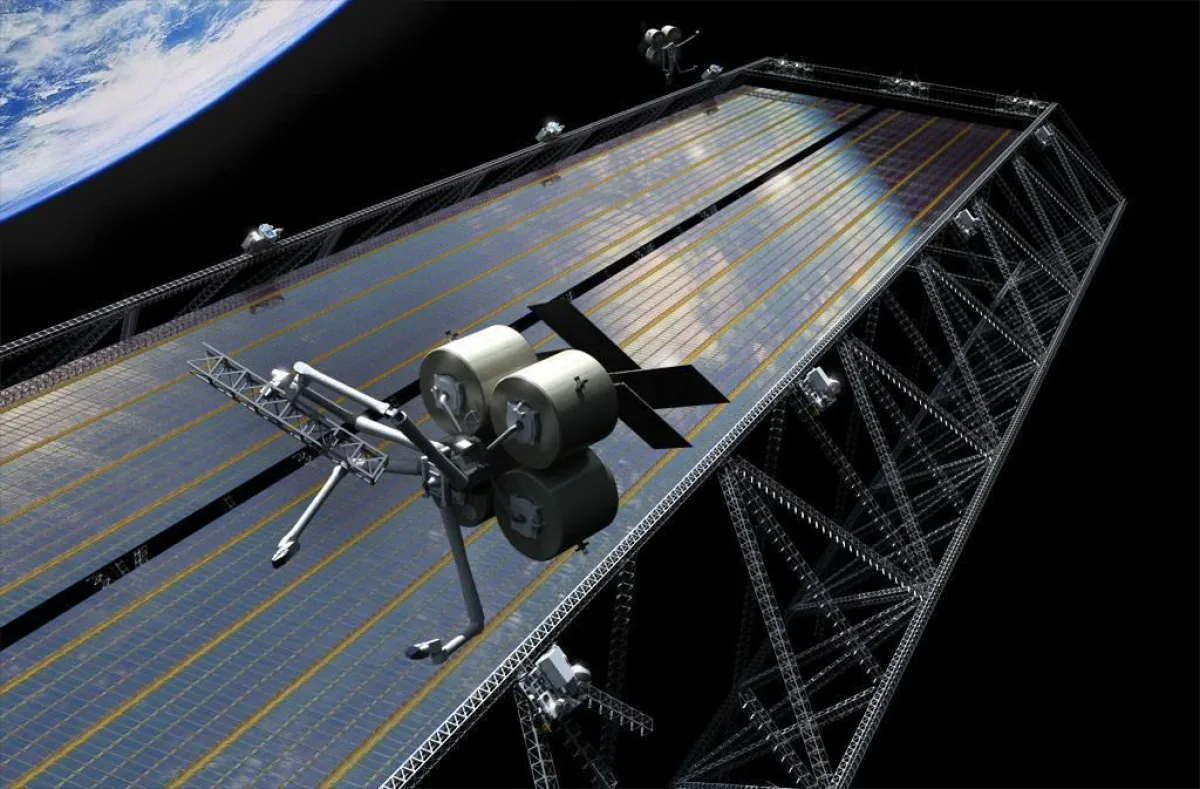
Extruding Aluminium in Orbit: Building Mega Truss Systems
Building enormous structures in space could become much easier if engineers can manufacture structural materials directly in orbit instead of producing everything on Earth and launching it aboard rockets. One promising approach is aluminium extrusion, a manufacturing process that shapes metal into long, lightweight structural components. Combined with robotic assembly, advanced materials and in-space manufacturing, this technology could eventually support enormous space telescopes, solar power stations, communication antennas and orbital infrastructure. Although large-scale aluminium extrusion in orbit has not yet become an established operational capability, research into metal manufacturing and space-based construction is moving forward.
Summary
-
Technology: In-space aluminium extrusion and structural manufacturing.
-
Main objective: Produce lightweight, strong structural components directly in orbit.
-
Key materials: Aluminium alloys, advanced composites and other aerospace-grade materials.
-
Manufacturing method: Metal extrusion, additive manufacturing and robotic assembly.
-
Main applications: Space telescopes, satellite platforms, solar arrays and communication antennas.
-
Major advantage: Reducing dependence on launching fully assembled structures from Earth.
-
Key challenges: Microgravity, temperature control, material quality, energy requirements and automated construction.
-
Research programmes: NASA's In-Space Servicing, Assembly and Manufacturing (ISAM) initiatives and DARPA's NOM4D programme.
-
Long-term goal: Build space infrastructure measuring tens or even hundreds of metres.
Understanding Aluminium Extrusion in Space
Aluminium is widely used in aerospace engineering because it combines relatively low weight with useful strength, corrosion resistance and good manufacturing properties.
On Earth, aluminium extrusion involves heating an aluminium billet and forcing it through a specially designed opening called a die. The material emerges in a continuous shape determined by the die's design.
This process can produce long structural sections with different cross-sectional shapes, including hollow tubes, rectangular beams and specialised support channels.
These components are useful for constructing frameworks because engineers can design them to provide strength without adding unnecessary material.
Taking this manufacturing process into orbit could offer another way to produce large structural components without transporting every finished beam from Earth.
However, extrusion in space requires specially designed machinery. Engineers must control temperature, material movement, pressure and the final shape while accounting for the unusual conditions of microgravity.
Why Build Mega Truss Systems in Orbit?

Traditional spacecraft structures must be designed around the dimensions and weight restrictions of launch vehicles.
Even when engineers create folding or deployable structures, there are limits to how large and complicated these systems can become.
Mega truss systems offer a different approach.
A truss is a structural framework made from interconnected beams arranged in triangular or other geometric patterns. The arrangement distributes loads across the structure, helping it maintain stability while using relatively little material.

In orbit, these frameworks could support enormous equipment that would be difficult to transport as one complete structure.
For example, a space telescope could use an extended truss framework to position mirrors and scientific instruments at carefully controlled distances.
Similarly, large solar power installations could require extensive support structures to hold solar panels and related equipment.
NASA's In-Space Servicing, Assembly and Manufacturing programme identifies the construction of large structures as an important future application. Its research includes manufacturing possibilities such as jointless truss beams and robotic assembly.

How Aluminium Extrusion Could Work in Orbit

A future orbital extrusion system could begin with aluminium feedstock transported from Earth.
Rather than launching hundreds of finished structural beams, a spacecraft could carry compact supplies of raw material alongside specialised manufacturing equipment.
Once in orbit, an automated production system would process the material into structural components.
The manufacturing process would involve several important stages:
Material preparation: Aluminium feedstock would be stored and prepared for processing. Its composition and quality would need to meet the structural requirements of the intended application.
Heating and shaping: A controlled manufacturing system would heat the aluminium and force it through a precision die to produce the required profile.
Cooling and inspection: The manufactured section would undergo controlled cooling and quality inspection to identify dimensional problems or material defects.
Cutting and connection: Structural sections would be prepared for joining using suitable mechanical connections or other validated joining techniques.
Robotic assembly: Robotic systems would position and connect the finished sections to create larger truss frameworks.
This approach could eventually allow spacecraft to manufacture structural components when needed rather than depending entirely on preassembled equipment.
It is important to distinguish conventional metal extrusion from metal additive manufacturing. They are different processes, although both could contribute to future orbital construction.
The Engineering Challenges
Manufacturing aluminium structures in orbit is not simply a matter of taking an industrial machine into space.
Microgravity changes how materials behave during processing. Molten metal movement, cooling, heat transfer and material handling require careful control.
A 2026 review published in Acta Astronautica examines these challenges and explains why metal manufacturing processes need adaptation before they can become reliable orbital technologies. It also identifies solid-state manufacturing approaches as promising alternatives to some traditional melting-based processes.
Other important challenges include:
-
Temperature management: Heating and cooling metal consistently requires specialised thermal control.
-
Power consumption: Industrial manufacturing equipment can require considerable electrical energy.
-
Structural precision: Long beams must meet strict dimensional and mechanical requirements.
-
Material reliability: Every manufactured component must withstand the forces and temperature changes expected during operation.
-
Automation: Robotic systems must position and connect components accurately without constant human intervention.
-
Safety: Manufacturing equipment must contain heat, moving parts and potentially hazardous materials safely.
These challenges explain why researchers are investigating several manufacturing methods instead of relying on one technology.
Current Research and Space Manufacturing Developments

Several research programmes are helping establish the foundations for manufacturing large structures beyond Earth.
One important initiative is NOM4D. Led by DARPA, the programme investigates how lightweight materials and specialised manufacturing processes could produce large, precise structures in space.
In February 2025, DARPA announced that its final programme phase would include small-scale orbital demonstrations involving the University of Illinois Urbana-Champaign and Caltech.
The Illinois team is developing a process for manufacturing carbon-fibre composite tubes in orbit. These tubes could subsequently become components of enormous structural frameworks.
The programme also includes research into robotic assembly. Importantly, these announced demonstrations concern composite manufacturing and structural assembly, not aluminium extrusion.

The University of Illinois reported in April 2026 that its Mission Illinois demonstration was scheduled for a launch to the International Space Station in late June 2026. The proposed experiment would manufacture a hollow composite cylinder for testing after its return to Earth. A completed orbital demonstration has not been independently established by the available reporting as of October 30, 2026.
NASA has also investigated orbital manufacturing through its OSAM-2 project, which was designed to demonstrate robotic production and assembly of structural beams. The project concluded in 2023 before its planned flight demonstration, although its research and engineering lessons remain relevant.

Aluminium Extrusion Compared with Other Orbital Manufacturing Methods
|
Technology |
Manufacturing approach |
Potential application |
|---|---|---|
|
Aluminium extrusion |
Shapes metal through a precision die |
Structural beams and support frames |
|
Metal additive manufacturing |
Builds components through deposited material |
Specialised metal parts |
|
Composite extrusion |
Produces continuous composite structural sections |
Lightweight truss frameworks |
|
Robotic assembly |
Connects separately manufactured components |
Large antennas and telescopes |
Each technology has different advantages. Future orbital construction facilities could potentially combine several methods depending on the materials, structural requirements and available manufacturing equipment.
Future Applications of Mega Truss Systems

The ability to manufacture structural components in orbit could influence several areas of space development.
Large space telescopes: Enormous truss frameworks could support larger mirrors and instruments, potentially improving astronomical observations.
Space-based solar power: Large structural systems could support extensive solar arrays designed to collect energy in orbit.
Communication infrastructure: Large antennas could provide improved communication and scientific observation capabilities.
Orbital research facilities: Future space laboratories and platforms could use modular frameworks that can be expanded as requirements change.
Space servicing stations: Large structures could provide support for spacecraft maintenance, equipment storage and future orbital operations.
NASA has highlighted large telescopes, antennas, habitats and other infrastructure as potential applications of in-space assembly and manufacturing.
Why This Technology Matters
The biggest opportunity is changing how humanity approaches construction beyond Earth.
Instead of designing every space structure around the dimensions of a rocket, engineers could eventually transport raw materials and manufacture larger components after reaching orbit.
Aluminium extrusion could become one part of this development because it offers a familiar way to produce long, consistent structural profiles.
However, successful orbital construction will depend on more than the extrusion machine. Material science, robotic assembly, structural inspection, energy management and reliable connections must work together.
A particularly important development will be creating manufacturing systems capable of producing components with predictable mechanical properties under space conditions.
Conclusion
Extruding aluminium in orbit represents an interesting possibility for the future of large-scale space construction. Although the technology has not yet reached routine operational use, advances in orbital manufacturing, robotic assembly and structural engineering are gradually making the idea more realistic.
Research programmes from NASA, DARPA and academic institutions demonstrate that engineers are actively exploring ways to manufacture and assemble structures beyond Earth.
The next major achievement may not simply be building a larger satellite. It could be developing the ability to construct enormous infrastructure directly in space, one structural component at a time.
References
-
University of Illinois – Building Out of This World: On-Orbit Manufacturing.