
DNA Sequencing in Orbit: Identifying Space Station Mutations
DNA sequencing aboard the International Space Station (ISS) is helping scientists investigate how living organisms respond to the unusual conditions of space. Using compact laboratory equipment, astronauts can examine genetic material without always having to send samples back to Earth. This technology has opened new opportunities to identify microorganisms, study changes in DNA, and investigate how microgravity and space radiation affect living cells. Research involving bacteria such as Bacillus subtilis has also revealed differences in genetic activity and mutation patterns between spaceflight and ground-based experiments. These discoveries could help scientists protect astronauts during longer missions to the Moon and Mars.
Introduction
Space is an extremely different environment from Earth. Living organisms travelling beyond our planet encounter microgravity, increased exposure to radiation, and other conditions that can affect how their cells function.
One important area of research is understanding what happens to DNA under these conditions. DNA contains the genetic instructions that control how organisms develop, grow, and function. Changes to this genetic material can influence how cells behave, including how they respond to environmental stress.
Scientists are using DNA sequencing to investigate these changes aboard the International Space Station. Instead of depending entirely on laboratories on Earth, researchers can now perform important genetic experiments while astronauts are still in orbit.
According to NASA, this development is particularly important for understanding biological risks during extended space exploration. Source: NASA.

How DNA Sequencing Works in Space
DNA sequencing is the process of identifying the order of chemical building blocks in DNA. These building blocks, known as bases, form the genetic instructions found in living organisms.
One technology used aboard the ISS is the MinION nanopore DNA sequencer, developed by Oxford Nanopore Technologies.
The device works by passing DNA molecules through extremely small openings called nanopores. As DNA moves through these openings, it produces changes in electrical current. Scientists analyse these changes to determine the DNA sequence.
This makes it possible to identify microorganisms and investigate genetic material using relatively compact equipment.
NASA explains that the technology is useful for identifying microorganisms in the space station environment, including organisms collected from surfaces and other locations. Source: NASA Science.
Another important technology is the miniPCR system. It uses polymerase chain reaction (PCR) to make multiple copies of selected DNA sections, providing enough genetic material for further examination.
Together, these technologies have made genetic research more practical aboard the ISS.

The First DNA Sequencing Experiment in Orbit
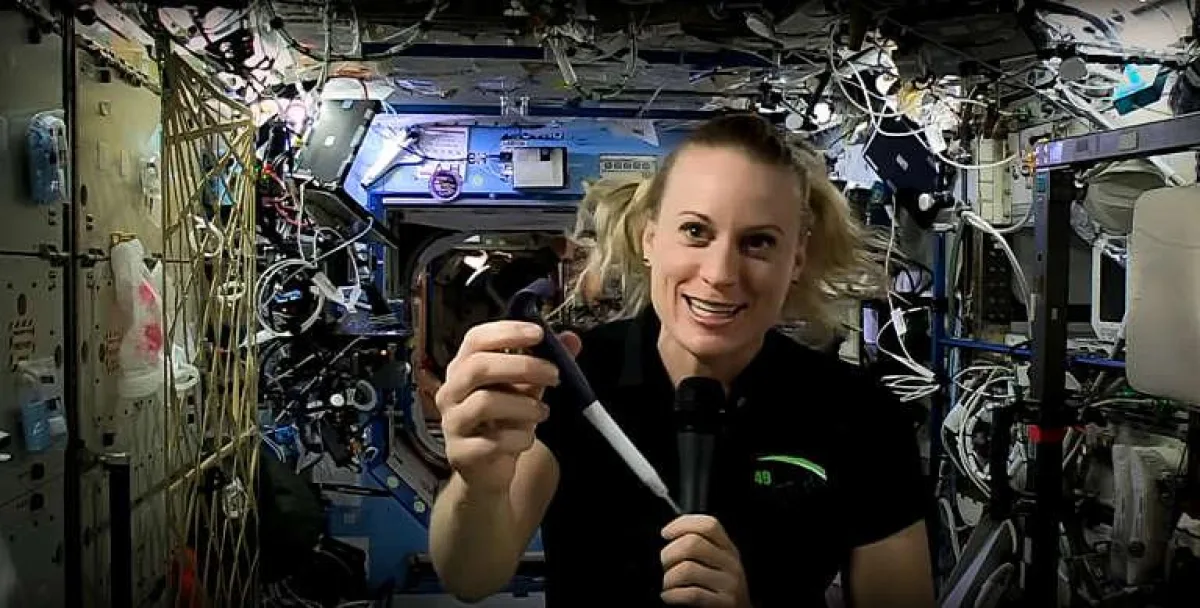
A major milestone occurred in August 2016 when NASA astronaut Kate Rubins performed the first DNA sequencing experiment in space using the MinION device.
The experiment demonstrated that DNA sequencing could work in the microgravity environment of the International Space Station.
The achievement was important because scientists had previously depended heavily on returning biological samples to Earth for detailed genetic analysis.
In August 2017, astronaut Peggy Whitson combined the miniPCR system with the MinION sequencer to identify an unknown microorganism collected aboard the station.
NASA reported that the identification matched the results obtained by researchers on Earth, demonstrating the potential of performing microbial identification directly in orbit.
In August 2018, astronaut Ricky Arnold advanced the process by using a method called swab-to-sequencer. This approach allowed scientists to collect microorganisms from surfaces and analyse their DNA without first needing to grow the bacteria in laboratory cultures.
These developments represented major steps towards faster biological monitoring during space missions.
Source: NASA – DNA Sequencing in Space Timeline.

Identifying Mutations in Space
Identifying microorganisms and identifying mutations are two different but connected scientific activities.
Microbial identification helps researchers determine which organisms are present in a particular environment. Mutation research examines changes in the genetic material of those organisms.
Scientists can investigate mutations by sequencing DNA and comparing the results with reference genetic sequences or samples collected under different experimental conditions.
NASA's research involving Bacillus subtilis, a type of bacterium, has provided important findings in this area.
Earlier Biological Research in a Canister (BRIC) experiments, including BRIC-18, BRIC-21, and BRIC-23, identified differences in bacterial gene activity and DNA mutation patterns between spaceflight samples and ground-based controls.
Researchers are also investigating DNA organisation, including DNA supercoiling and methylation. These processes influence how genetic material is organised and how genes are used by cells.
The findings suggest that spaceflight conditions can affect bacterial genetic activity in several ways. However, researchers continue investigating the mechanisms behind these changes.
Source: NASA – BRIC-26 Investigation.
How Space Radiation Affects DNA
Radiation is one of the major concerns associated with long-duration human spaceflight.
On Earth, the atmosphere and magnetic field provide significant protection against certain forms of radiation from space. Astronauts travelling beyond this protection can experience greater exposure.
Radiation can damage DNA, while the body's ability to repair that damage may also be affected by spaceflight conditions.
NASA is investigating these processes to understand how astronauts' cells respond to genetic damage and how the body repairs affected DNA.
This research matters because future missions could keep astronauts away from Earth for extended periods. Understanding DNA damage and repair could help scientists develop better ways to assess and manage biological risks.
Source: NASA – Station Science 101: Studying DNA in Space.
Why Scientists Need to Identify Space Station Microorganisms
The International Space Station is a closed living environment where astronauts work, sleep, exercise, and conduct scientific experiments.
Microorganisms can be found on surfaces, in the air, and in water systems. Although many are harmless, scientists need to understand which organisms are present and whether their behaviour changes under spaceflight conditions.
Some microorganisms can respond to environmental stress by changing their gene activity. Researchers are particularly interested in understanding whether these changes affect their ability to survive cleaning procedures or respond to antimicrobial treatments.
DNA sequencing provides a way to monitor these organisms more accurately.
NASA's microbial research also includes the 3D Microbial Monitoring experiment, which collected more than 800 microbial samples throughout the station in 2021. Researchers used DNA sequencing and other methods to build a detailed picture of the microbial environment.
Source: NASA – Our Relationship to Microbes on the International Space Station.
Important DNA Sequencing Milestones
| Year | Scientific development |
|---|---|
| April 2016 | First DNA amplification aboard the ISS using miniPCR. |
| August 2016 | First DNA sequencing in space by Kate Rubins. |
| August 2017 | Peggy Whitson identifies an unknown station microorganism using sequencing technology. |
| August 2018 | Ricky Arnold demonstrates the swab-to-sequencer method. |
| May 2019 | Christina Koch performs the first CRISPR gene-editing experiment aboard the ISS. |
| February 2021 | More than 800 microbial samples collected for the 3D Microbial Monitoring experiment. |
| May 2024 | GiSMOS begins targeted genetic profiling of microorganisms in the station's water system. |
Source: NASA – DNA Sequencing in Space Timeline.
What This Research Means for Future Space Missions
DNA sequencing in orbit could become an important part of future human exploration.
During a mission to Mars, for example, astronauts cannot depend on immediate laboratory support from Earth. Being able to identify microorganisms and investigate genetic changes aboard a spacecraft could help crews make better-informed decisions about their environment and health.
The technology could also improve research into how living organisms respond to prolonged exposure to microgravity and radiation.
However, important scientific questions remain. Researchers still need to understand which genetic changes are temporary, which persist after returning to Earth, and how different environmental conditions contribute to those changes.
NASA's continuing investigations into DNA structure, gene activity, and microbial behaviour are helping scientists build a clearer picture of these processes.
Conclusion
DNA sequencing in orbit represents an important development in space biology. What began with the first successful DNA sequencing experiment aboard the International Space Station in 2016 has developed into a wider field of research involving microbial identification, genetic analysis, and investigations into DNA damage and repair.
By studying microorganisms and genetic changes directly in space, scientists are learning more about how life responds to conditions beyond Earth.
As preparations for longer human missions continue, this knowledge could become increasingly important. Understanding DNA in space is not simply about identifying mutations. It is also about understanding how living organisms survive, adapt, and function in environments far removed from our planet.
References
-
NASA – DNA Sequencing in Space Timeline.
-
NASA Science – BRIC-26: Alteration of Bacillus subtilis DNA Architecture in Space.
-
Castro-Wallace et al. – Nanopore DNA Sequencing and Genome Assembly on the International Space Station. Scientific Reports, 2017.
-
NASA – Our Relationship to Microbes on the International Space Station.
-
NASA Science – Cell and Molecular Biology Research Hardware.