
Direct Fusion Drive: Powering a 2-Year Flight to Pluto
Travelling to Pluto takes years with conventional spacecraft propulsion. NASA's New Horizons mission demonstrated this when it travelled for more than nine years before reaching the dwarf planet in July 2015. However, researchers have been investigating a different approach that could significantly reduce journey times: Direct Fusion Drive (DFD). Developed as a concept by Princeton Satellite Systems in collaboration with researchers at Princeton Plasma Physics Laboratory, this technology combines nuclear fusion propulsion with onboard electrical power generation. Its proposed capabilities could make future Pluto missions faster and more scientifically productive, potentially allowing spacecraft to carry larger instruments, orbit Pluto and even deploy landers.
Source: NASA – Fusion-Enabled Pluto Orbiter and Lander.

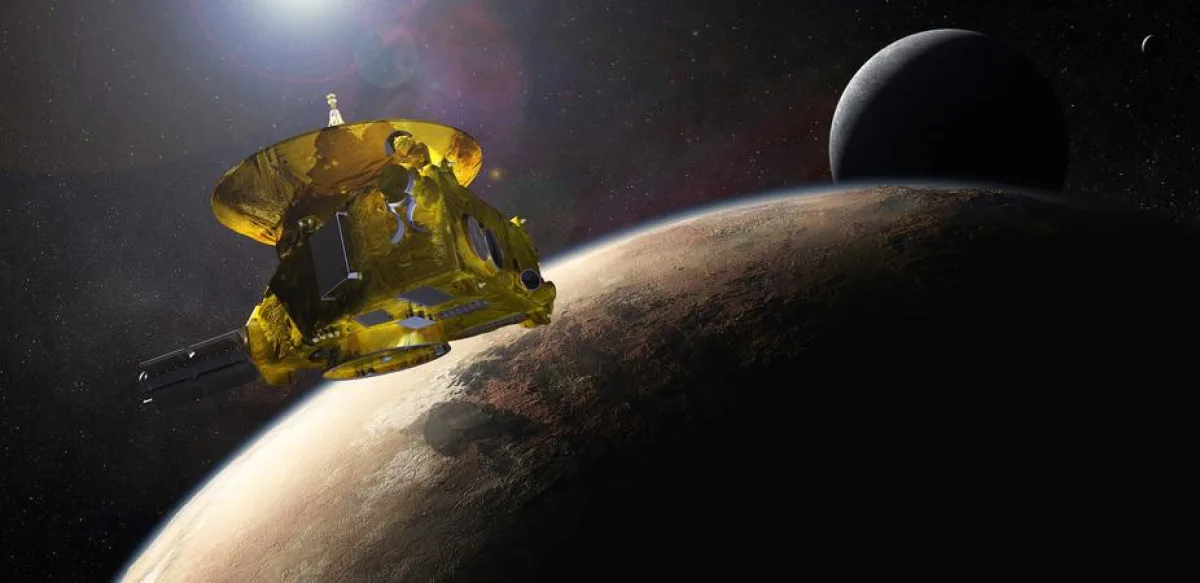
Artist's illustration of Pluto and a spacecraft exploring the distant dwarf planet. Image: NASA mission imagery.
Why Travelling to Pluto Takes So Long
Pluto is located in the outer region of our solar system, beyond Neptune. Its enormous distance from Earth makes space exploration particularly challenging. Spacecraft must travel billions of kilometres while carrying enough fuel, electricity and scientific equipment to complete their missions.
NASA's New Horizons spacecraft provides a good example. It launched on January 19, 2006, and reached Pluto on July 14, 2015. That journey took approximately nine and a half years. Despite travelling at remarkable speeds, the spacecraft was designed primarily for a flyby rather than entering Pluto's orbit.
The mission successfully returned detailed images and scientific information about Pluto, transforming our understanding of the distant world.
Source: NASA – New Horizons Mission Overview.

NASA's New Horizons mission provided humanity's first close-up exploration of Pluto.
What Is Direct Fusion Drive?
Direct Fusion Drive is an advanced propulsion concept that uses nuclear fusion to generate energy and propel spacecraft.
Unlike conventional chemical rockets, which burn propellants to produce thrust, a fusion-powered spacecraft would use energy released through nuclear reactions. This energy could help heat and accelerate propellant, generating the force required to move the spacecraft through space.
The concept is based on the Princeton Field-Reversed Configuration (PFRC), a proposed fusion reactor design associated with Princeton Plasma Physics Laboratory researcher Samuel Cohen.
One of the most interesting features of the technology is that it is designed to provide both propulsion and electrical power. This means a spacecraft could potentially use the same integrated system to travel through space and operate its scientific instruments.
Source: NASA – Fusion-Enabled Pluto Orbiter and Lander.

Conceptual illustration of a Direct Fusion Drive propulsion system.
How Does the Technology Work?
The Direct Fusion Drive concept uses a magnetic field to contain and control extremely hot plasma.
Plasma is a state of matter containing electrically charged particles. Under suitable conditions, the nuclei of certain atoms can combine through nuclear fusion, releasing energy.
The proposed PFRC system uses magnetic confinement and radio-frequency heating to create the conditions required for fusion research.
In the spacecraft concept, the resulting energy would contribute to heating and accelerating propellant. The accelerated material would leave the engine and produce thrust, pushing the spacecraft forward.
An important advantage is the proposed ability to generate useful electricity alongside propulsion. This could reduce the need for separate power-generation systems.
However, this remains an engineering concept. A fully operational Direct Fusion Drive spacecraft engine has not yet demonstrated these capabilities in space.
Source: Princeton Plasma Physics Laboratory – Direct Fusion Drive Research Paper.
The Proposed Pluto Mission
One of the most interesting applications of Direct Fusion Drive is a proposed mission involving a Pluto orbiter and lander.
Princeton Satellite Systems investigated this concept through NASA's Innovative Advanced Concepts programme. The research examined whether a fusion-powered spacecraft could carry a substantial scientific payload to Pluto within a considerably shorter period than conventional missions.
The NASA project description discusses delivering approximately 1,000 kilograms into Pluto orbit in four years. It also describes the possibility of providing up to one megawatt of electrical power for scientific equipment after arrival.
That level of proposed power could support advanced instruments, communications equipment and a lander.
This is particularly important because New Horizons could only conduct a brief flyby. An orbiter would offer researchers a much longer opportunity to study Pluto and its moons.
Source: NASA TechPort – Fusion-Enabled Pluto Orbiter and Lander.

Concept artwork showing the proposed Pluto orbiter and lander mission.
What Could Scientists Discover on Pluto?
A spacecraft capable of entering orbit around Pluto could provide a much more detailed understanding of the dwarf planet.
Scientists could investigate its surface, atmosphere, geological features and seasonal changes. They could also study Charon, Pluto's largest moon, alongside its smaller moons.
A lander could potentially collect information directly from Pluto's surface, depending on the final mission design.
The additional electrical power proposed for a Direct Fusion Drive mission could also support stronger communications systems and more advanced scientific equipment.
These capabilities would represent a significant improvement over a short flyby mission.
Source: NASA – Pluto Exploration.

Pluto's famous heart-shaped region, photographed by NASA's New Horizons spacecraft.
Major Challenges Facing Direct Fusion Drive
Despite its potential, Direct Fusion Drive faces substantial scientific and engineering challenges.
The first is achieving reliable fusion conditions within a compact system suitable for spacecraft. Fusion research involves extremely high temperatures and complex magnetic confinement systems.
Another challenge is managing heat. A spacecraft engine would require suitable thermal-control systems to handle the energy produced during operation.
Engine weight, radiation protection, long-term reliability and the ability to operate continuously in deep space would also need to be addressed.
These challenges explain why the technology should not be confused with an engine that is already ready for a Pluto mission.
Source: Princeton Plasma Physics Laboratory – Fusion Research.
Latest Developments as of November 14, 2026
NASA's public TechPort record identifies the Fusion-Enabled Pluto Orbiter and Lander as a completed technology project. This refers to the completion of the funded study, not the construction and testing of a flight-ready fusion engine.
The wider field of fusion research continues to develop. Princeton Plasma Physics Laboratory remains involved in experimental research into plasma physics and fusion systems.
However, there is no verified announcement establishing a launch date for a Direct Fusion Drive-powered Pluto spacecraft or confirming that a two-year Pluto journey is ready to take place.
The proposed technology remains an interesting direction for future space exploration.
Source: NASA TechPort – Project Status | Princeton Plasma Physics Laboratory – Latest Research.
Direct Fusion Drive vs Conventional Spacecraft Propulsion
|
Feature |
Conventional propulsion |
Proposed Direct Fusion Drive |
|---|---|---|
|
Energy source |
Chemical or electrical systems |
Nuclear fusion |
|
Propulsion |
Rocket exhaust or accelerated ions |
Fusion-assisted propellant acceleration |
|
Electrical power |
Separate power systems may be required |
Integrated power-generation capability |
|
Pluto mission |
New Horizons took about 9.5 years |
Four-year mission concept studied |
|
Pluto landing |
Not achieved by New Horizons |
Proposed mission includes a lander |
|
Technology status |
Operational |
Experimental concept |
Sources: NASA – New Horizons | NASA – Fusion-Enabled Pluto Orbiter and Lander.
Why Direct Fusion Drive Matters for Future Space Exploration
The importance of Direct Fusion Drive goes beyond travelling to Pluto.
If researchers can successfully develop compact, reliable fusion propulsion systems, similar technology could potentially support missions to Uranus, Neptune and other distant destinations.
It could also make it easier to transport larger scientific instruments and supplies, allowing spacecraft to conduct more complicated investigations.
For space exploration, reducing travel time is only one part of the advantage. Having sufficient power to operate advanced scientific equipment after arrival could be equally important.
Direct Fusion Drive therefore represents an interesting research direction for future spacecraft engineering.
Source: Cohen and colleagues – Direct Fusion Drive for Interstellar Exploration.
A two-year journey to Pluto powered by Direct Fusion Drive is an exciting possibility, but it is not yet an established scientific achievement.
The technology has been investigated through research supported by NASA's Innovative Advanced Concepts programme, with a proposed Pluto mission targeting approximately four years of travel for a 1,000-kilogram payload.
Its combination of propulsion and electrical power could change how scientists approach deep-space exploration if the engineering challenges can eventually be overcome.
For now, Direct Fusion Drive remains a promising concept rather than an operational spacecraft engine. Nevertheless, the research raises an important question about the future of space travel: could nuclear fusion eventually make journeys to the outer solar system considerably faster?
Source: NASA TechPort – Fusion-Enabled Pluto Orbiter and Lander.