
Detecting Oceans on Super-Earths: The Exo-Oceanography Guide
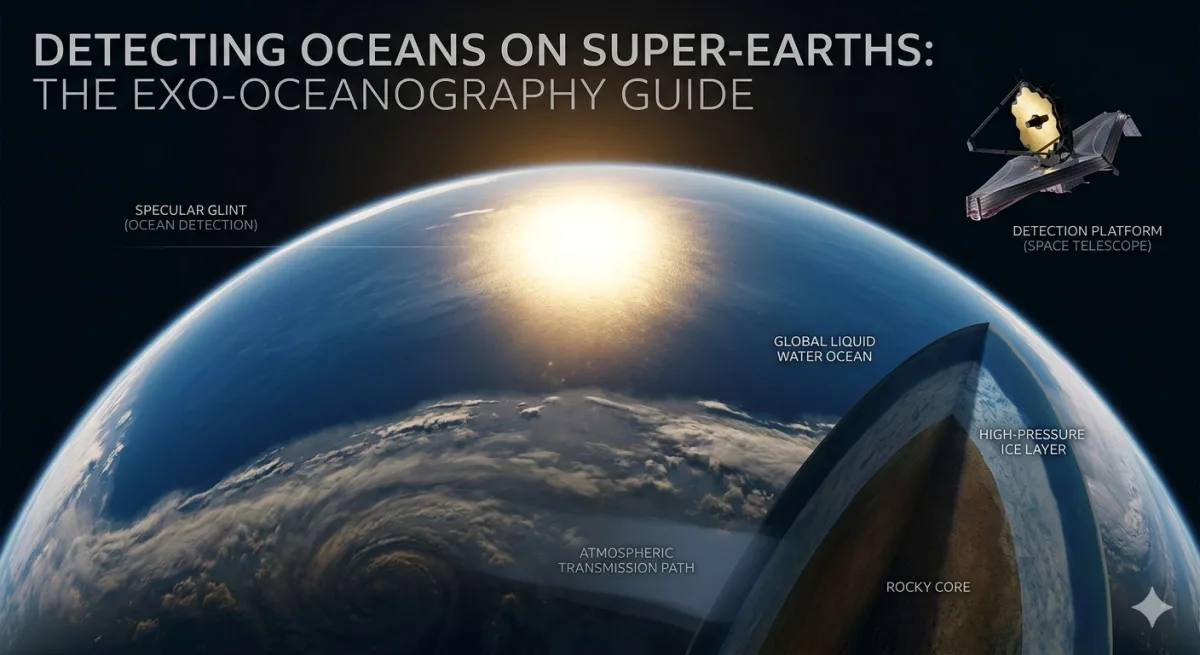
Detecting an ocean on a super-Earth is much harder than simply detecting water. Astronomers cannot point a telescope at one of these distant planets and clearly see a blue sea. Instead, they combine a planet's mass and radius, the gases in its atmosphere, changes in brightness as it orbits its star, reflected light, polarization, clouds and other clues. These measurements can show that a world is unusually rich in water and may even indicate conditions that allow liquid water to exist. But water can also be trapped deep inside a planet, locked under high-pressure ice, mixed into its mantle, or present as vapor and supercritical fluid. This is why the search for exo-oceans is really a search for several pieces of evidence that agree with one another. In 2026, worlds such as LHS 1140 b, K2-18 b and the newly reported non-transiting candidate KIC 9139163/HD 176071 b are helping scientists improve the methods that could eventually reveal oceans on planets beyond the Solar System.
Summary
-
Topic: Detecting oceans on super-Earth exoplanets
-
Super-Earth: A planet more massive than Earth but smaller than Neptune; NASA notes that these worlds can be rocky, gaseous or a mixture of materials.
-
Main problem: Finding water does not automatically prove that liquid water exists on the surface.
-
Main measurements: Mass, radius, density, atmospheric spectra, reflected light, thermal emission, phase curves and polarization.
-
Important candidates: LHS 1140 b, Kepler-138 c and d, K2-18 b, TOI-1452 b and the 2026 non-transiting candidate around KIC 9139163.
-
Best-known direct ocean clue: Ocean glint, a bright reflection produced when starlight hits a relatively smooth liquid-water surface at the right angle.
-
Major obstacle: Clouds, hazes, stellar activity and the different ways water can be stored inside a planet can mimic or hide an ocean signal.
-
James Webb Space Telescope: Already measures atmospheric molecules on exoplanets using spectroscopy, but an atmospheric water signal alone does not establish a surface sea.
-
Roman Space Telescope: Launched on August 30, 2026, and is now beginning its commissioning and instrument checks, including technology for direct imaging of exoplanets.
-
PLATO: ESA's exoplanet mission is currently undergoing final preparations and is planned for launch in 2027.
-
Ariel: ESA's mission for studying exoplanet atmospheres is currently scheduled for launch in 2031 and will examine about 1,000 planets.
-
Current scientific position: No observation has yet produced an unambiguous confirmation of an Earth-like surface ocean on a super-Earth. The strongest cases remain model-based interpretations that need further observations.
What Is a Super-Earth?
The name super-Earth can be misleading.
It does not mean "Earth 2.0," and it does not automatically mean a planet with oceans, continents or an atmosphere like Earth's.
NASA uses the term for a broad class of exoplanets that are more massive than Earth but lighter than the Solar System's ice giants, Uranus and Neptune. These planets can be made of rock, gas, water or mixtures of different materials.
That variety is one reason ocean detection is difficult.
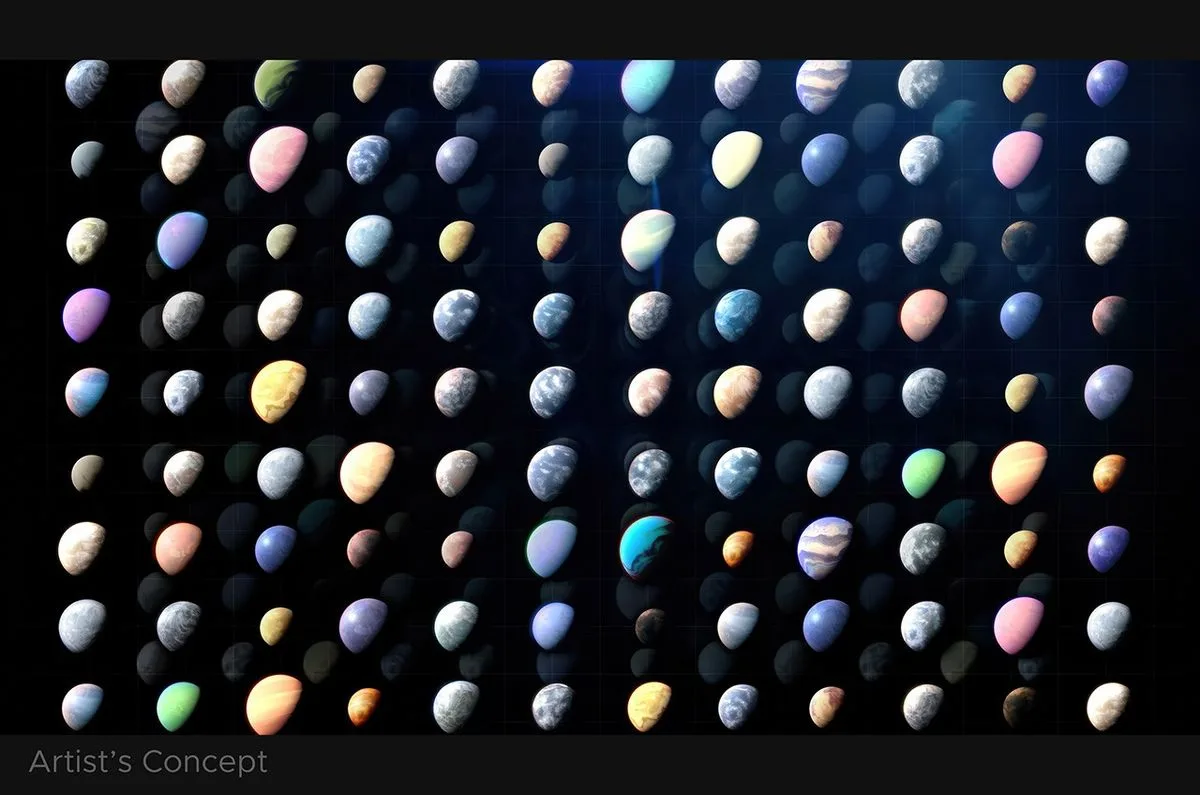
Imagine two planets that are both about twice Earth's size. One could have a rocky interior with a relatively thin atmosphere. Another could have a large amount of water surrounding a rocky core. A third could have a thick hydrogen and helium envelope that makes it look much larger than its solid interior.
From millions or billions of kilometres away, these different planets can initially look surprisingly similar.
This is where exo-oceanography becomes interesting.
Scientists are trying to determine not only whether a planet contains water, but where that water is, what state it is in and whether any of it could exist as liquid water at the surface.
Why Detecting an Ocean Is So Difficult
On Earth, an ocean is easy to recognize. It occupies huge areas of the surface and reflects sunlight in characteristic ways. We can see coastlines, waves, clouds, changing weather and the chemistry of the water.
An exoplanet does not give us that luxury.
Even nearby exoplanets appear as tiny points of light. In most cases, we cannot resolve their surfaces at all.
There is another problem: water has many forms.
A planet may contain:
-
water vapor in its atmosphere
-
liquid water at the surface
-
water ice
-
high-pressure forms of ice
-
supercritical water
-
water mixed into its mantle
-
water chemically stored in minerals
-
large quantities of water deep inside its core or mantle
This last point is especially important. A 2024 Nature Astronomy study found that, according to its interior models, more than 95% of a planet's bulk water inventory could remain deep in the core and mantle for some super-Earth and sub-Neptune cases. In those situations, a planet can be water-rich without being covered by an enormous surface ocean.
So when astronomers say a planet could be a water world, they are not necessarily saying it looks like Earth with one global sea.
The First Clue: Mass, Radius and Density
One of the most important steps is surprisingly simple: measure the planet's mass and radius.
Once both are known, scientists can calculate its average density.
The basic relationship is:
Density = Mass ÷ Volume
Because a planet's volume depends strongly on its radius, even a modest increase in radius can dramatically change the amount of material needed to produce a particular mass.
A dense planet is easier to explain with a large rocky and metallic interior.
A lower-density planet may require a large amount of water, ice or gas.
NASA has long used the mass-radius relationship to explain why super-Earths can have very different compositions. A planet's measured density can help rule out some interior models, although it almost never identifies one exact composition by itself.
A useful example: Kepler-138
Kepler-138 c and Kepler-138 d became important because their masses and sizes indicated that they were much less dense than ordinary rocky planets.
A detailed study published in Nature Astronomy found evidence that Kepler-138 d contains a large volatile-rich layer and estimated about 11% of its mass in volatiles, with a water mantle and atmosphere extending roughly 2,000 kilometres in the model. The researchers concluded that such planets are not simply rocky super-Earths and may resemble large versions of the Solar System's icy moons.
But even in this impressive case, density alone cannot show an astronomer standing on an ocean shore.
It tells us something more basic:
The planet contains too much low-density material to be explained comfortably as an ordinary rocky world.
That is a major clue, not a photograph of an ocean.
How Astronomers Measure the Mass
Mass can often be estimated through the radial velocity method.
A planet's gravity pulls slightly on its star as the planet orbits. The star moves back and forth by a tiny amount.
Spectrographs can measure this motion through changes in the star's spectrum.
For transiting planets, another powerful method is transit timing variation. In a multi-planet system, planets can tug on one another, slightly changing when each planet crosses the face of its star.
Combining these methods with transit measurements can produce both mass and radius, which then gives density.
This combination is extremely important for distinguishing a rocky super-Earth from a volatile-rich world.
Detecting Water in an Atmosphere
The next major tool is spectroscopy.
Light carries information about matter.
Different molecules absorb specific wavelengths of light. When astronomers split starlight into its component wavelengths, those absorption patterns appear as recognizable features.
This is one of the key ways the James Webb Space Telescope studies exoplanets.
During a transit, a planet passes between its star and Earth. Some of the star's light travels through the planet's atmosphere before reaching the telescope.
Different gases remove different wavelengths from that light.
Researchers can then compare the observed spectrum with laboratory and theoretical models to work out which molecules are present. NASA describes this technique as transmission spectroscopy.
Water vapor can be detected this way.
But there is a critical warning:
Water vapor is not the same thing as a liquid ocean.
A hot planet can have large amounts of water vapor and still be far too hot for a surface sea.
NASA's observations of WASP-96 b, for example, demonstrated a clear atmospheric water signature, but that does not mean WASP-96 b has an Earth-like liquid ocean.
This is one of the most important rules in exoplanet science:
Detecting H₂O does not automatically mean detecting an ocean.
Atmospheric Chemistry Can Strengthen the Case
Water becomes more interesting when it appears alongside other gases and when the planet's temperature and internal structure fit a model that allows liquid water.
For example, scientists may look at:
H₂O + CO₂ + atmospheric pressure + temperature + planet mass + planet radius
No single measurement is enough.
The goal is to determine which planetary models can explain all of the observations at the same time.
This is why atmospheric retrieval has become such an important part of exoplanet science. Researchers run large numbers of physical and chemical models and compare them with the observed spectrum. NASA notes that modern atmospheric studies rely heavily on this type of modeling, while also warning that clouds and hazes can block light from deeper atmospheric layers and make composition estimates more difficult.
K2-18 b: A Famous Ocean Candidate With a Complicated Story
Few planets demonstrate the difficulty better than K2-18 b.
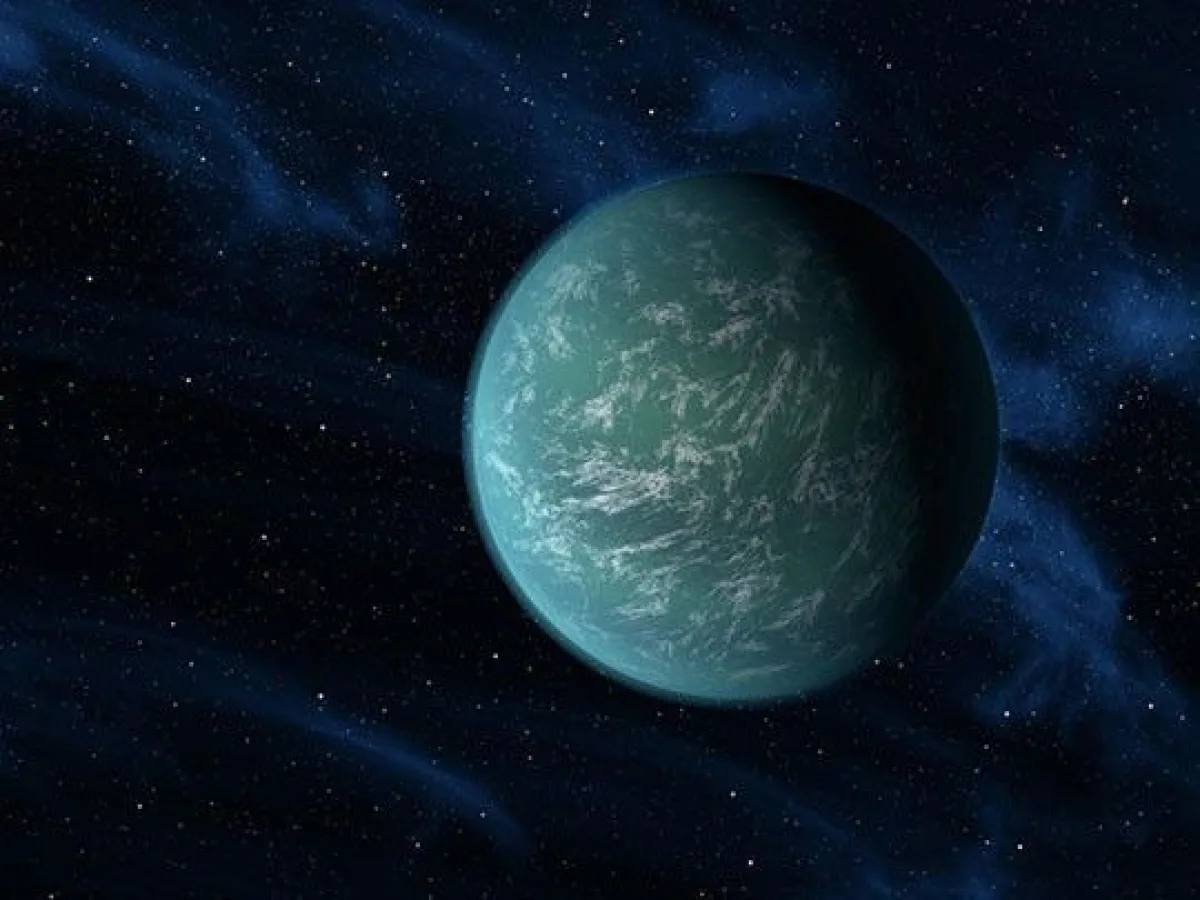
The planet is a temperate sub-Neptune orbiting a cool red dwarf. It became especially interesting because observations found methane and carbon dioxide in its atmosphere, while models suggested that its interior could be water-rich.
A 2025 JWST study led by Renyu Hu and colleagues reported robust detections of methane and carbon dioxide and argued that the planet could be explained either by a thick water-rich envelope or by a thinner atmosphere above a liquid-water ocean. The same study found no detectable water vapor, ammonia or carbon monoxide and described possible dimethyl sulfide signals as only marginal.
Other researchers have reached more cautious conclusions.
A comprehensive 2025 reanalysis of earlier K2-18 b JWST data confirmed methane but reported no statistically significant and reliable evidence for carbon dioxide or dimethyl sulfide in its analysis. Their models showed that an oxygen-poor mini-Neptune could reproduce the observations without requiring a liquid-water surface.
That disagreement is scientifically useful.
It shows why astronomers do not treat a single atmospheric spectrum as proof of an ocean.
The planet remains an important target, but its exact nature is still being investigated.
LHS 1140 b: Another Major Test Case
LHS 1140 b is another important planet in the search for water-rich worlds.
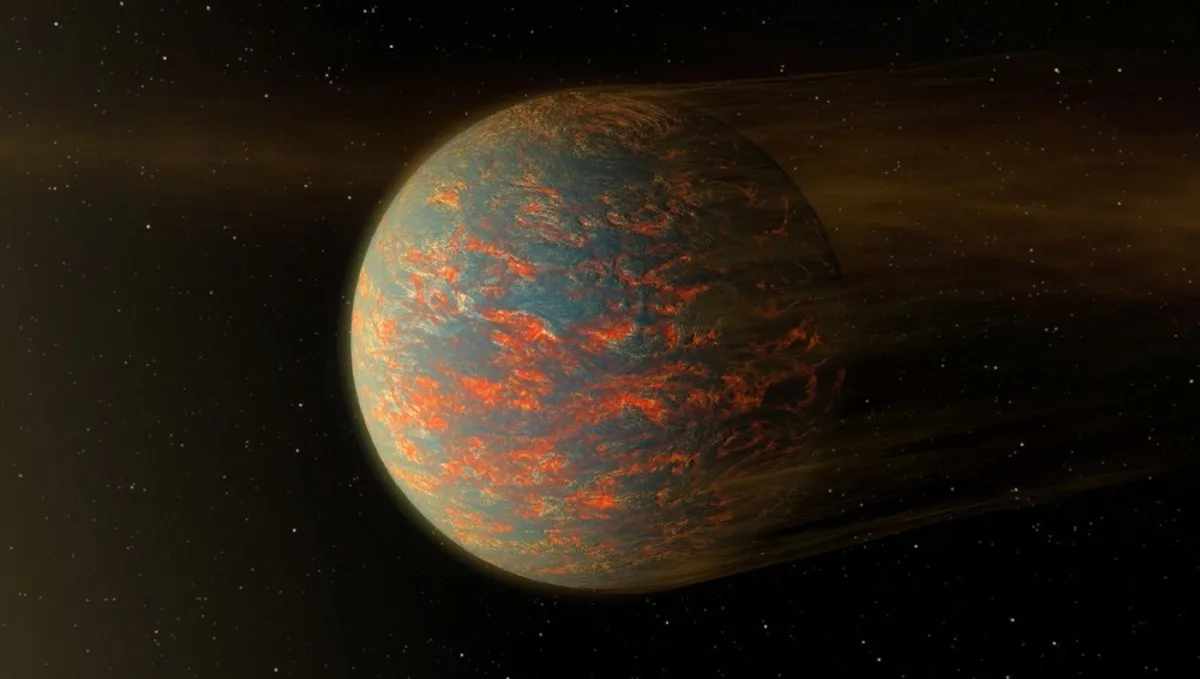
It is about 1.7 times Earth's radius and roughly 5.6 times Earth's mass, orbiting in the habitable zone of a cool red dwarf. Its mass and radius make its low density difficult to explain using a simple Earth-like rocky model.
A 2024 JWST study found its transmission spectrum inconsistent with a broad range of hydrogen-rich atmospheres and argued that a water-world interpretation better explains the observations. The paper suggested a higher-molecular-weight atmosphere, potentially containing nitrogen, water and carbon dioxide, and found that liquid-water oceans could be possible under suitable climate conditions.
But 2026 observations have added another layer of uncertainty.
Several recent studies examined possible helium absorption associated with atmospheric escape. Four JWST/NIRISS observations reported in August 2026 did not detect helium absorption at the level of an earlier ground-based claim. The researchers cautioned that variability cannot be completely ruled out and that additional observations are needed.
This does not disprove the possibility that LHS 1140 b is water-rich.
It shows something more important: even determining whether a planet has an atmosphere can require repeated observations before scientists can be confident about what they are seeing.
Ocean Glint: Looking for the Reflection of a Sea
One of the most exciting proposed ways to find a surface ocean is called ocean glint.
Think about sunlight reflecting from a calm lake.
From most angles, water scatters light in many directions. But when the geometry is right, a relatively smooth water surface can act like a mirror and send a concentrated flash of reflected light toward an observer.
Earth does this.
From space, patches of ocean can produce strong glints.
Astronomers therefore want to search for the same effect on distant planets.
A planet with an ocean could become unusually bright at particular orbital phases, especially when only part of the planet's illuminated side is visible. Computer simulations show that this feature could help distinguish a liquid surface from a world covered only by clouds or dry land.
The problem with glint
Glint is not automatically proof of water.
Clouds can scatter light.
Ice particles can reflect light.
Other shiny surfaces can create confusing signals.
This means astronomers would prefer to observe the planet at several wavelengths and at several points in its orbit instead of relying on one bright measurement.
Over time, the ocean signal might appear, disappear and change as clouds and continents move across the visible hemisphere.
That changing pattern would be much more informative than a single bright point.
Rotational Mapping: Making a Single Pixel Tell a Story
Even when a telescope cannot resolve a planet's surface, repeated observations can reveal changes in brightness as the planet rotates.
Imagine reducing Earth to one pixel.
That single pixel would contain no visible continents.
But if you measured its brightness again and again, different surfaces would rotate into and out of view.
Oceans, deserts, clouds and vegetation would reflect light differently.
Researchers have demonstrated with Earth observations that repeated single-pixel measurements can recover useful information such as the planet's rotation and cloud patterns. NASA and JPL have used Earth-observing data to show how this kind of approach can help us understand what a distant planet might look like to a future telescope.
On an exoplanet, repeated brightness measurements could potentially reveal a repeating pattern consistent with large ocean-covered regions.
The challenge is separating the surface signal from clouds.
A cloudy planet can look very different from one observation to the next even when the continents and oceans have not moved.
Polarization: Another Way to Search for Water
Light does not only carry information about brightness and color.
It also carries information about polarization.
This is especially interesting for ocean detection.
When light reflects from a liquid water surface, the orientation and strength of its polarization can change in a recognizable way.
Research using atmospheric-ocean models has shown that ocean glint produces characteristic signatures in both total reflected light and polarized light. In some simulated cases, polarization features can help separate an ocean signal from false positives caused by dry surfaces and clouds.
This could eventually become a powerful partner to spectroscopy.
Instead of asking:
"Does this planet reflect a lot of light?"
Astronomers could ask:
"How is that reflected light polarized, and does the pattern match a liquid surface?"
That is a much more specific question.
Water Clouds and Rainbows
There is another possible clue: liquid-water clouds.
On Earth, the tiny droplets in clouds can create rainbows.
The physics behind a rainbow is quite specific. Light enters a roughly spherical liquid droplet, is refracted, internally reflected and refracted again as it leaves.
This is different from the behavior of ice crystals.
Scientists have therefore proposed using polarization and phase-dependent brightness patterns to search for the signatures of liquid water clouds on exoplanets.
The broader idea is important because liquid-water clouds could provide supporting evidence that temperatures somewhere in the planetary atmosphere are compatible with liquid water. NASA's exoplanet science planning has discussed water clouds and polarization as tools that could help identify potentially habitable conditions.
But again, this would not automatically prove a surface ocean.
A planet could potentially have atmospheric liquid droplets without having a global ocean like Earth's.
The strongest case would come from combining cloud evidence with surface glint, atmospheric composition and a suitable temperature structure.
Thermal Emission Can Help Too
Planets also emit energy as infrared radiation.
A planet's thermal emission can reveal information about its temperature and atmospheric structure.
This is especially useful for hot planets, where the planet itself produces a relatively strong infrared signal.
The problem is that a temperate ocean world is much harder to study.
Its thermal emission is faint.
Clouds can hide deeper layers.
Atmospheric circulation can move heat from one side of a planet to another.
Still, repeated measurements of the day side and night side can help scientists understand whether the atmosphere is redistributing heat efficiently.
That information matters because a temperature map helps determine whether liquid water is physically plausible.
Phase Curves: Watching a Planet Go Through Its "Moon Phases"
A phase curve tracks how the brightness of a planet changes during its orbit.
It is similar to watching the phases of the Moon.
The visible amount of the planet's illuminated side changes as the planet travels around its star.
Scientists can measure how much reflected or emitted light reaches Earth at each orbital phase.
This can reveal:
-
cloud distribution
-
atmospheric circulation
-
heat redistribution
-
reflective surfaces
-
day-night temperature differences
-
unusual atmospheric behavior
Phase curves are particularly useful when a planet does not transit.
A striking example appeared in 2026 with the candidate planet associated with KIC 9139163, also identified with HD 176071.
The research team combined data from NASA's Kepler and TESS missions with HARPS-N spectroscopy. The companion candidate has an estimated mass of about 7.3 Earth masses and a radius of about 2.43 Earth radii. Its measured bulk density is consistent with a hot water-rich world.
The important point is how it was studied.
The candidate does not cross in front of its star from Earth's point of view.
Instead, its presence is inferred from changes in the star's observed brightness associated with the companion's reflected and emitted light, together with radial-velocity measurements. The Kepler and TESS phase curves also changed over time, suggesting a changing brightness distribution and possibly evolving clouds.
This is a major lesson for ocean detection:
A planet does not necessarily need to transit for astronomers to learn about its atmosphere and reflective properties.
The 2026 study describes the object as a non-transiting companion candidate, and its water-rich interpretation remains a model-based result rather than a direct observation of a liquid ocean.
Comparing the Major Water-World Clues
| Method | What astronomers measure | What it can tell us | Main limitation |
|---|---|---|---|
| Mass + radius | Gravity and planetary size | Average density and possible bulk composition | Different interiors can produce similar densities |
| Transmission spectroscopy | Starlight passing through atmosphere | Gases such as H₂O, CO₂ and CH₄ | Water vapor does not prove liquid surface water |
| Thermal emission | Infrared light from planet | Temperature and atmospheric structure | Temperate planets are very faint |
| Phase curves | Brightness through an orbit | Clouds, heat movement and reflective properties | Requires precise long-term measurements |
| Ocean glint | Specular reflection | Possible liquid surface | Clouds and other reflective surfaces can create false signals |
| Polarization | Orientation and strength of reflected light | Surface and cloud clues, including possible ocean signatures | Extremely difficult for distant planets |
| Rotational mapping | Repeating brightness changes | Possible land/ocean/cloud distribution | Clouds can mask the surface |
| Water clouds/rainbows | Scattering and polarization features | Possible liquid droplets in atmosphere | Does not by itself prove an ocean |
The strongest future detections will probably come from combining several of these methods rather than relying on one measurement. (Astrobiology NASA)
Why Clouds Are Such a Big Problem
Clouds are both useful and frustrating.
They can provide information about atmospheric chemistry and climate.
At the same time, they can hide the very surface astronomers are trying to study.
A thick cloud layer can block reflected light from an ocean below.
It can also change the apparent color of a planet.
A hazy atmosphere can flatten or weaken molecular features in a transmission spectrum.
This is why a planet with a "quiet" or featureless spectrum is not necessarily empty.
It may simply be hiding beneath high-altitude clouds or haze.
NASA's exoplanet research programs specifically emphasize the importance of including clouds and hazes in atmospheric retrieval models because they can block radiation from deeper atmospheric levels and complicate abundance measurements.
The Star Can Create Another Problem
Sometimes the problem is not the planet.
It is the star.
Starspots, bright regions, magnetic activity and changing stellar brightness can contaminate an exoplanet spectrum.
This is especially important for planets orbiting red dwarf stars because the planet can cover a relatively large fraction of the star during a transit, but the star itself may also be highly active.
The recent LHS 1140 b helium studies demonstrate how difficult this can be. Differences in stellar helium behavior may influence measurements that initially appear to be caused by atmospheric escape from the planet.
For ocean studies, this means astronomers must understand the star before interpreting very small signals from the planet.
Why the Habitable Zone Is Not Enough
The phrase habitable zone is often misunderstood.
It means the region around a star where, under suitable atmospheric conditions, liquid water could exist on a planet's surface.
It does not mean every planet in that zone has an ocean.
A planet may have lost its atmosphere.
It may have become frozen.
It may have a runaway greenhouse climate.
It may have too much water.
It may be covered in high-pressure ice.
It may not have enough atmospheric pressure to maintain surface liquid water.
NASA describes the habitable zone as an initial way to identify promising environments, not as proof that a planet is actually habitable.
For ocean detection, the habitable zone is therefore the beginning of the investigation, not the conclusion.
Water-Rich Does Not Always Mean Earth-Like
This distinction deserves special attention.
A water-rich super-Earth could be a strange world unlike anything in our Solar System.
For example, a very large water inventory can produce extremely high pressures deep inside the planet.
Under those pressures, water can form exotic high-pressure ice phases rather than the familiar ice we see on Earth.
Another planet may have a thick steam atmosphere sitting above a very deep water layer.
Another may have water chemically trapped inside its rocky interior.
NASA's analysis of Kepler-138 c and d noted that their high temperatures could mean water exists as a dense vapor, high-pressure liquid or supercritical fluid rather than as a simple Earth-like surface ocean.
This is why scientists increasingly use terms such as water-rich world, water world or volatile-rich planet carefully.
Those terms describe composition models, not necessarily a giant blue sea.
The 2026 Example of HD 176071 b
The newly reported candidate associated with KIC 9139163 shows how far detection techniques are moving.
The candidate has an estimated radius of about 2.43 Earth radii and a mass near 7.3 Earth masses. Its density is consistent with a hot water-rich composition.
But it is extremely close to its star, completing an orbit in about 0.6 days.
That means this is not an Earth-like ocean planet.
The water-rich interpretation describes its probable bulk composition under the tested models, while the extreme irradiation means any water would exist under conditions very different from Earth's oceans.
The study also found changes in its phase curves between Kepler and TESS observations separated by roughly six years, suggesting that its atmospheric brightness distribution changed over time. (arXiv)
This is exactly the kind of evidence that can improve future exo-ocean studies.
Astronomers are learning to combine:
reflected light + orbital phase + spectroscopy + radial velocity + atmospheric models
rather than searching for one magical "ocean signal."
What Future Telescopes Could Change
James Webb Space Telescope
JWST is already one of the most important tools for studying exoplanet atmospheres.
Its infrared instruments can identify molecules and measure atmospheric properties that were difficult to study with earlier observatories.
But JWST is not a camera that can simply zoom in and photograph an exoplanet ocean.
Its strength is spectroscopy and detailed atmospheric characterization.
Nancy Grace Roman Space Telescope
NASA's Nancy Grace Roman Space Telescope launched on August 30, 2026.
As of September 2026, NASA is conducting early instrument activation and testing. The telescope's Coronagraph Instrument is designed to suppress starlight and demonstrate direct-imaging technology for exoplanets. NASA says its first science images are expected by early 2027. (European Space Agency)
Roman is not being launched specifically to photograph Earth-like oceans.
Instead, its coronagraph is an important technology step toward future telescopes capable of studying much fainter and smaller worlds.
ESA's PLATO
ESA's PLATO mission is designed to find and characterize terrestrial planets, especially around Sun-like stars.
Current ESA information lists the launch for 2027, after the mission completed its construction and entered final testing. PLATO will use 26 cameras to monitor more than 200,000 stars and measure tiny changes in brightness caused by transiting planets. (European Space Agency)
PLATO's main contribution to ocean studies will be the discovery and precise characterization of promising planets.
By finding planets with known sizes, orbits and well-characterized host stars, it can help create better targets for atmospheric follow-up.
ESA's Ariel
Ariel is designed specifically for a large-scale survey of exoplanet atmospheres.
ESA currently lists a 2031 launch date and says the spacecraft is intended to study about 1,000 exoplanets. Its instruments will cover infrared wavelengths where many atmospheric molecules leave strong signatures. (European Space Agency)
Ariel will not directly photograph an ocean either.
Its value will come from creating a much larger sample of atmospheric measurements, making it easier to compare planetary composition, temperature, host stars and formation histories.
Habitable Worlds Observatory
The longer-term goal is an observatory specifically built to directly study Earth-like exoplanets.
NASA's Habitable Worlds Observatory, or HWO, is still a future mission concept rather than a launched telescope. Its planned science includes directly imaging Earth-like worlds and examining reflected light for atmospheric signatures connected to habitability.
In 2026, NASA continued technology-development work for HWO, including new programs intended to mature instruments and prepare the scientific foundation for the mission concept.
A future telescope of this type could combine direct imaging, spectroscopy and time-dependent observations.
That is where genuine surface-ocean searches become much more realistic.
Current Ocean-World Targets and What We Know
| Planet | Why it matters | Current interpretation | Major uncertainty |
|---|---|---|---|
| LHS 1140 b | Temperate super-Earth with low density and important JWST observations | Water-rich world remains a major possibility | Atmosphere and surface conditions are still being tested |
| Kepler-138 c/d | Unusually low densities and strong evidence for volatile-rich compositions | Water-rich worlds with large volatile layers | Water may not all be a surface ocean |
| K2-18 b | Temperate sub-Neptune with atmospheric methane and carbon dioxide observations | Water-rich/ocean interpretations remain under study | Atmospheric retrievals have produced differing conclusions |
| TOI-1452 b | Super-Earth in a potentially interesting orbital environment | Candidate water world | Internal composition is not directly measured |
| KIC 9139163 / HD 176071 candidate | Non-transiting world studied through phase curves and radial velocity | Hot water-rich composition is favored by the reported models | It is not a direct observation of a surface ocean |
NASA has described TOI-1452 b as a super-Earth whose density could be consistent with a deep ocean, but the agency also emphasizes that ocean planets are difficult to confirm. (NASA Science)
What Would Count as Strong Evidence of an Exo-Ocean?
A really convincing detection would probably involve several independent clues.
For example, astronomers might detect a planet with:
-
A mass and radius consistent with a water-rich interior.
-
An atmosphere whose chemistry fits long-term interaction with a water reservoir.
-
Temperatures and pressures compatible with liquid water somewhere near the surface.
-
Repeated reflected-light observations showing phase-dependent ocean glint.
-
Polarization behavior consistent with reflection from liquid water.
-
Rotation-dependent changes that fit an ocean-covered surface.
-
Clouds whose properties support an active water cycle.
-
A stable signal that survives different data reductions and atmospheric models.
The more independent measurements agree, the harder it becomes to explain the observations using a completely different planet type.
This is the real goal.
Scientists are not simply hunting for a single molecule.
They are searching for a consistent planetary story.
What Could Fool Astronomers?
Several things can produce false or misleading signals.
Water vapor without liquid water
A planet can have enormous amounts of atmospheric water while remaining too hot for a surface ocean.
High-pressure water
Water deep inside a planet may be compressed into forms that are very different from Earth's ordinary surface ocean.
Clouds
Clouds can reflect large amounts of light and hide the surface beneath them.
Ice
Ice can also create reflective signals that complicate the interpretation of bright regions.
Atmospheric gases from non-biological chemistry
A gas associated with life on Earth is not automatically evidence of life somewhere else.
Scientists must determine whether geological, atmospheric or photochemical processes could create the same gas.
Stellar activity
Changing starspots and other stellar features can contaminate very small planetary signals.
Interior water
A planet may contain a large amount of water without having most of it on the surface.
These problems are not failures of exoplanet science.
They are the reason the field is becoming more careful.
Why Multiple Observations Matter
One observation gives a snapshot.
Several observations give a pattern.
Patterns are much more powerful.
Suppose a planet's brightness changes every time the same orbital phase comes around.
That could tell astronomers something about its atmosphere.
If the signal changes slowly over several years, it could reveal changing clouds or weather.
If spectroscopy shows a matching atmospheric composition, the explanation becomes stronger.
If polarization also behaves as expected from a liquid surface, the case becomes stronger again.
This is how exo-oceanography is likely to progress.
Not with one spectacular image, but through thousands of small measurements that fit together.
The Future of Ocean Detection
The next stage of exoplanet research will increasingly combine different kinds of data.
A planet first discovered by a transit survey could later be studied with JWST.
Radial velocity could provide a better mass.
Phase-curve measurements could reveal its reflective behavior.
A future direct-imaging telescope could then observe the planet in reflected light.
A spectropolarimeter might examine the same planet's polarized signal.
Each technique answers a different question.
Transit photometry: How big is it?
Radial velocity: How massive is it?
Density: What could it be made of?
Spectroscopy: What is in its atmosphere?
Thermal emission: How hot is it?
Phase curves: How does its brightness change around the orbit?
Glint: Is there evidence of a reflective liquid surface?
Polarization: Does the reflected light behave like it came from water or clouds?
Rotational mapping: Does the planet have persistent surface patterns?
This layered approach could eventually transform "maybe a water world" into a much more specific statement about a planet's surface environment.
Why the Search Matters
Finding an ocean outside the Solar System would be scientifically important even if there were no life there.
Earth's oceans affect its climate, atmosphere, chemistry and geology.
A distant ocean world could help scientists understand how planets form and how water moves between atmospheres, surfaces and interiors.
It could also show whether planets with large amounts of water are common or rare.
That matters because the history of water is tied closely to planetary evolution.
How much water does a planet receive while forming?
How much is lost to space?
How much sinks into the interior?
How long can an ocean survive?
Does a deep water layer help stabilize climate?
Can an ocean exist under a thick atmosphere?
These questions are not limited to the search for extraterrestrial life.
They are questions about how planets work.
Career Impact on Exoplanet Science So Far
The search for oceans has already changed how astronomers think about planets between Earth and Neptune.
For years, many smaller planets were broadly treated as rocky worlds.
Observations of low-density planets such as Kepler-138 c and d demonstrated that some planets in the super-Earth size range can be much more volatile-rich than expected. (Nature)
JWST has added another major step by showing that atmospheric compositions can be measured in unprecedented detail for selected exoplanets. (NASA Science)
At the same time, the debates surrounding K2-18 b and LHS 1140 b show that better instruments do not automatically produce simple answers.
They often reveal new questions.
That is a normal part of scientific progress.
Why These Worlds Stand Out
The most interesting super-Earths are not necessarily the ones with the most dramatic headlines.
The useful targets are the planets where scientists can measure several properties accurately.
A nearby world with a well-known mass, radius, orbit and host star may be more scientifically valuable than a more distant planet with only a weak atmospheric signal.
The same principle applies to ocean searches.
The ideal candidate would have a relatively bright host star, a favorable planetary orbit, an atmosphere that can be measured, and conditions that allow different observations to reinforce one another.
Future telescopes should improve all of these measurements.
References
NASA Science — What Is a Super-Earth?
NASA: What Is a Super-Earth?
NASA Science — Webb's Impact on Exoplanet Research
NASA: Webb's Impact on Exoplanet Research
NASA Science — How Will Webb Study Exoplanets?
NASA: How Will Webb Study Exoplanets?
NASA Science — Two Super-Earths May Be Mostly Water
NASA: Two Super-Earths May Be Mostly Water
NASA Science — Discovery Alert: TOI-1452 b
NASA: Intriguing New Super-Earth TOI-1452 b
NASA Astrobiology — Spotting the Glint of Extrasolar Oceans
NASA Astrobiology: Spotting the Glint of Extrasolar Oceans
NASA — Habitable Worlds Observatory
NASA: Habitable Worlds Observatory
NASA — HWO Science
NASA: Habitable Worlds Observatory Science
NASA — Roman Exoplanet Science
NASA: Roman Exoplanets
NASA — Roman Direct Imaging
NASA: Roman Direct Imaging
NASA — Roman Instrument Activation, September 15, 2026
NASA: Roman Activates Its Primary Instrument
ESA — PLATO Mission
ESA: PLATO
ESA — PLATO Factsheet
ESA: PLATO Factsheet
ESA — Ariel Mission
ESA: Ariel
ESA — Ariel Instruments
ESA: Ariel's Instruments
Nature Astronomy — Evidence for the Volatile-Rich Composition of Kepler-138 d
Nature Astronomy: Kepler-138 d Water World Study
Nature Astronomy — The Interior as the Dominant Water Reservoir in Super-Earths and Sub-Neptunes
Nature Astronomy: Water Stored Inside Super-Earths
CaltechAUTHORS — LHS 1140 b Is a Potentially Habitable Water World
Caltech: LHS 1140 b Water World Study
2025 JWST Study — A Water-Rich Interior in K2-18 b
Research paper: A Water-Rich Interior in K2-18 b
2025 K2-18 b Reanalysis
Research paper: K2-18 b JWST Reanalysis
2026 — Hidden Worlds: Non-Transiting Candidate Around KIC 9139163
Research paper: Hidden Worlds / KIC 9139163
2026 — Strict Limits on Helium Absorption from LHS 1140 b
Research paper: LHS 1140 b Helium Study
2026 — No Helium Detected in LHS 1140 b from JWST
Research paper: No Helium Detected in LHS 1140 b