
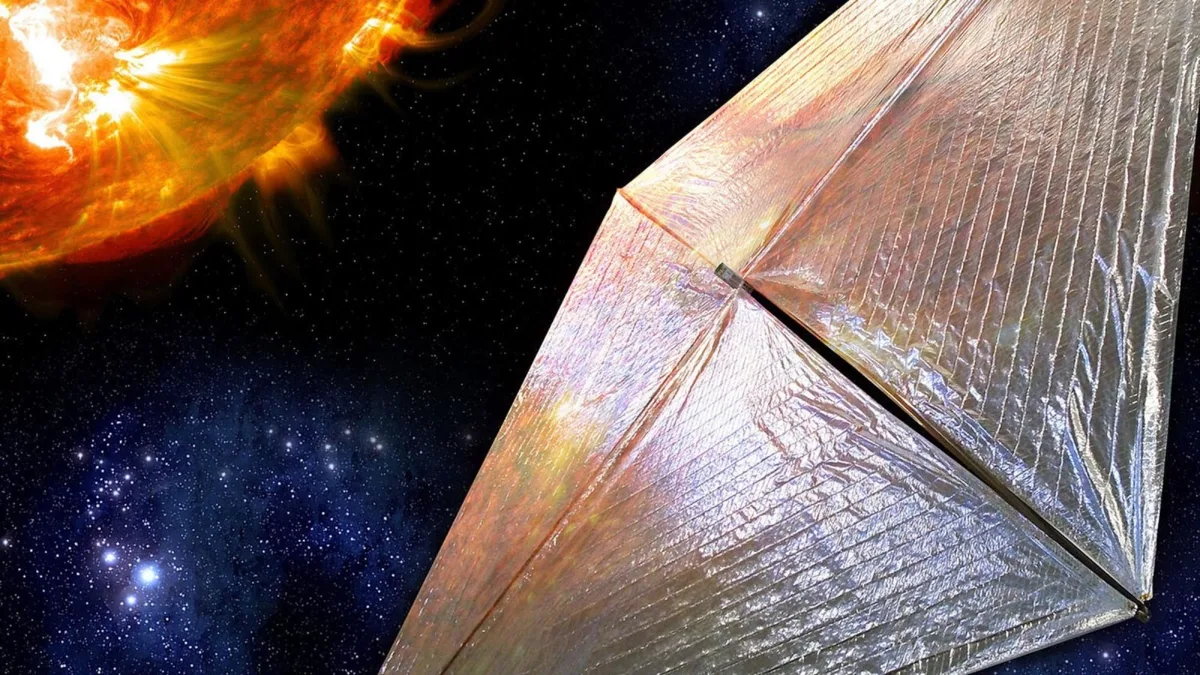
Deployable Gossamer Structures: Launching Giant Solar Sails
Giant solar sails could change how spacecraft travel through the solar system. Instead of depending entirely on conventional rocket propulsion, these spacecraft use the pressure of sunlight to move through space. However, building a sail large enough to capture meaningful sunlight presents a major engineering challenge. Deployable gossamer structures offer a possible solution by allowing enormous, lightweight sails to be folded into compact spacecraft for launch and unfolded after reaching orbit. Recent developments from NASA, NOAA and aerospace engineering companies are bringing this technology closer to practical deep-space applications.
Introduction: Why Giant Solar Sails Matter
Spacecraft traditionally use chemical rockets or electric propulsion systems to travel and manoeuvre in space. Solar sails offer another possibility: using sunlight itself as a source of propulsion.
Sunlight consists of particles called photons. Although photons have no rest mass, they carry momentum. When they strike a highly reflective surface, they transfer a small amount of momentum to it. This creates a continuous force that can gradually change a spacecraft's speed and trajectory.
Unlike conventional propulsion systems, solar sails do not need to carry fuel for their primary propulsion. However, their acceleration is relatively small, meaning they need time to build up significant velocity.
Source: NASA – Solar Sail Propulsion: Enabling New Destinations for Science Missions.

What Are Deployable Gossamer Structures?
Gossamer structures are extremely lightweight engineering systems designed to unfold into large structures after a spacecraft reaches space. They are made using thin films, flexible materials, lightweight composite beams and specialised deployment mechanisms.
Their main advantage is that they occupy very little space during launch. Once the spacecraft reaches its intended orbit, the folded materials can be released and expanded into much larger structures.
For solar sails, the structure must perform two jobs: support the reflective membrane and maintain its shape while the spacecraft travels through space. Engineers must also ensure that the materials survive launch vibrations, temperature changes and the vacuum of space.
Source: German Aerospace Center (DLR) – Gossamer-1 Project.
<figure><img src="https://www.nasa.gov/wp-content/uploads/2024/04/acs3-flight-sail-test-fit-20220506-02.webp?w=1536" alt="NASA engineers testing a large reflective solar sail membrane on the ground" loading="lazy" style="width:100%;height:auto;"><figcaption>NASA's Advanced Composite Solar Sail System membrane during ground deployment testing. Credit: NASA.</figcaption></figure>
How Do Engineers Launch Giant Solar Sails?
Launching a giant solar sail requires more than simply folding a reflective sheet. The entire structure must be designed to fit inside a rocket while remaining strong enough to deploy successfully later.
One important component is the deployable boom. These lightweight beams act like the supporting poles of a traditional sailboat. They extend outward from the spacecraft and hold the reflective membrane in position.
Some designs use composite booms made from carbon fibre and polymer materials. Others explore inflatable structures that become rigid after deployment, while alternative designs use flexible, coiled or folding mechanisms.
The NASA Advanced Composite Solar Sail System demonstrates how this approach works. Its spacecraft was designed to carry an approximately 80-square-metre sail inside a compact 12-unit CubeSat. Its composite booms could be rolled into a small package before deployment.
Source: NASA – Advanced Composite Solar Sail System.
NASA's ACS3 Mission: A Major Demonstration
One of the most important demonstrations of deployable solar sail technology is NASA's Advanced Composite Solar Sail System, known as ACS3.
The spacecraft launched on April 23, 2024, aboard a Rocket Lab Electron rocket from New Zealand. After completing its commissioning activities, it successfully deployed its approximately 80-square-metre sail on August 28, 2024.
The mission demonstrated that lightweight composite booms could support a large reflective membrane after being stored in a much smaller spacecraft. NASA also intended to investigate spacecraft attitude control and orbital manoeuvring using the sail.
The mission provided valuable engineering experience for future systems that may require significantly larger sail surfaces. NASA's technical reporting, published in 2026, also discusses the challenges encountered and lessons learned during the demonstration.
Sources: NASA – ACS3 Mission Information | NASA Technical Reports Server – ACS3 Mission Results and Lessons Learned.
The Engineering Challenges Behind Giant Sails
Although the concept sounds straightforward, deploying a giant solar sail presents several difficult engineering problems.
1. Material strength and weight
A solar sail needs a large surface area, but adding too much weight reduces its efficiency. Engineers must develop reflective membranes that are extremely thin without becoming too fragile.
2. Deployment accuracy
A sail must unfold without becoming twisted, tangled or unevenly stretched. A small deployment problem could affect the entire spacecraft's ability to control its movement.
3. Structural stability
The supporting booms must remain sufficiently rigid after deployment. Changes in temperature and mechanical forces can affect their shape and performance.
4. Space environment
Solar sails must operate in a vacuum while experiencing radiation, temperature variations and prolonged exposure to sunlight. Their materials must withstand these conditions throughout the mission.
These challenges explain why ground testing, computer simulations and smaller demonstration missions remain important before engineers attempt much larger structures.
Sources: NASA – ACS3 Technology and Deployment | ScienceDirect – Considerations in the Design and Deployment of Flexible Booms for a Solar Sail.
NOAA's Giant Solar Sail Development in 2026
A particularly important development was announced by the US National Oceanic and Atmospheric Administration (NOAA) on May 4, 2026.
Working with NASA Marshall Space Flight Center and Applied Aerospace & Defense, NOAA supported the development of a large solar sail membrane measuring approximately 1,653 square metres when fully deployed. That is roughly equivalent to four basketball courts placed side by side.
The membrane uses an ultra-thin reflective polyimide material coated with aluminium. During launch, it is designed to fit into a space approximately the size of a microwave oven. Once in space, lightweight carbon-fibre booms extend to support the enormous reflective surface.
The project aims to improve space-weather observation by allowing instruments to operate closer to the Sun. Better observations could help scientists identify solar activity earlier and provide additional warning time for potentially disruptive solar storms.
NOAA and NASA are also exploring a possible demonstration mission called the Space Storm Solar Sail Sentinel (S5). However, as of November 11, 2026, funding for that proposed mission has not been confirmed.
Source: NOAA – NOAA Glides into the Future with Solar Sail Technology.
A New Generation of Larger Solar Sails
The development of giant solar sails is also attracting aerospace engineering companies.
On April 14, 2026, aerospace company Opterus announced that it had received a $10.2 million NASA contract to develop a structural deployment system for a future solar sail spacecraft.
The planned system will support a sail measuring approximately 1,600 square metres using four composite booms, each measuring 30 metres. The company is developing its Trussed Collapsible Tubular Mast technology, which allows the supporting structures to remain compact during launch before unrolling into their deployed configuration.
The proposed system is approximately 20 times larger in sail area than NASA's 80-square-metre ACS3 demonstration. Delivery to NASA is planned for early 2028, although this is a development milestone rather than a confirmed launch date.
This project demonstrates how research into lightweight structures is moving towards larger engineering applications.
Source: Opterus – Awarded $10.2 Million NASA Contract to Engineer Solar Sail Propulsion System.

Potential Applications Beyond Space Exploration
Giant solar sails could eventually support several important space missions.
-
Space-weather monitoring: Solar sail spacecraft could help position scientific instruments at useful observation points closer to the Sun.
-
Asteroid exploration: Their continuous propulsion could support missions that require long-distance travel and careful orbital adjustments.
-
Deep-space exploration: Solar sails could provide another propulsion option for missions travelling beyond Earth's immediate neighbourhood.
-
Communications infrastructure: Future designs could support spacecraft operating in locations useful for communications and exploration.
-
Solar observation: Specialised sails could help spacecraft maintain observation positions that are difficult to reach using conventional propulsion.
These applications remain dependent on further engineering development and successful mission demonstrations.
Sources: NASA – Solar Sail Propulsion | NASA – Advanced Composite Solar Sail System.
The Future of Deployable Gossamer Structures
The future of giant solar sails will depend on how successfully engineers solve the challenges of deployment, structural stability, material durability and spacecraft control.
NASA's ACS3 demonstration has already shown that a relatively small spacecraft can carry and deploy a much larger reflective structure. NOAA's 2026 development programme and Opterus's NASA contract indicate that the next generation of systems is being designed on a considerably larger scale.
However, giant solar sails are not yet a replacement for conventional spacecraft propulsion. Their acceleration is modest, their deployment systems require careful engineering, and future missions must demonstrate that their structures can operate reliably over extended periods.
The important development is that engineers are learning how to transport enormous structures into space without launching them in their fully expanded form.
Deployable gossamer structures could therefore become an important part of future spacecraft design, helping scientists explore new destinations and develop more efficient ways to observe our solar system.
Source: NASA Technical Reports Server – ACS3 Mission Results and Lessons Learned.