

Defining Sovereign Borders in Space: Where Does Orbit Begin?
There is no single internationally agreed altitude where Earth's airspace legally ends and outer space begins. The Kármán line at 100 kilometres (62 miles) above mean sea level is the best-known scientific and operational convention, and organizations such as the Fédération Aéronautique Internationale (FAI) use it for astronautics and records. However, international space law does not currently establish 100 km, 80 km, or another altitude as a universally binding legal boundary. This matters because States exercise sovereignty over the airspace above their territory, while outer space is governed by a very different legal principle: it is free for exploration and use and cannot be claimed as national territory. The United Nations has been discussing the definition and delimitation of outer space for decades, and the issue remained active in recent sessions and working papers.
Summary
-
Subject: Legal and scientific boundary between airspace and outer space
-
Most widely used convention: Kármán line at 100 km (62 miles)
-
Alternative used in the United States: 50 statute miles, or about 80 km, for certain human-spaceflight recognition purposes
-
International legal boundary: No universally agreed altitude
-
Main legal issue: States have sovereignty over their airspace, while outer space cannot be appropriated by national sovereignty
-
Main international forum: United Nations Committee on the Peaceful Uses of Outer Space and its Legal Subcommittee
-
Kármán line status: A practical convention rather than a universally binding border
-
Orbital flight: Not identical to simply crossing the Kármán line
-
Stable low orbit: Generally requires a considerably higher altitude because atmospheric drag remains important at lower altitudes
-
Current situation in 2026: The international community continues discussing whether and how outer space should be formally defined and delimited
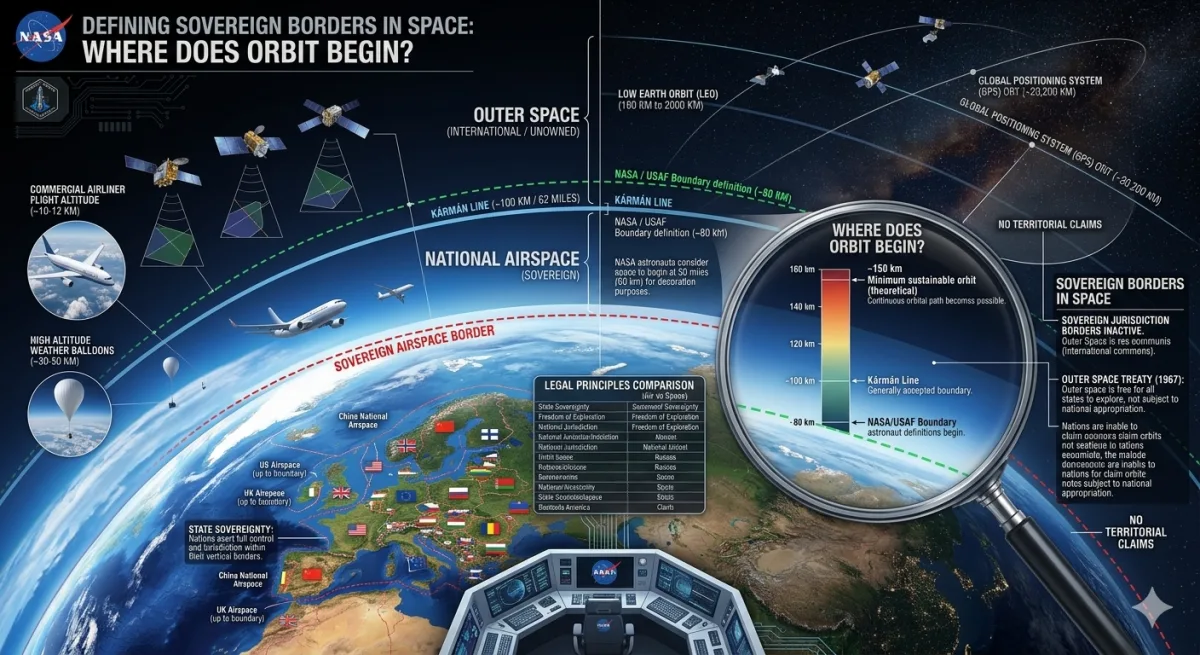

Why Is There a Border Question at All?
At first, the answer seems obvious. Aircraft fly in the atmosphere, spacecraft fly in space, so there should be a line between the two.
The problem is that nature did not create one.
Earth's atmosphere gradually becomes thinner with increasing altitude. There is no point where a spacecraft suddenly passes through an invisible wall and enters a completely different physical environment. NASA explains that there is no clear physical boundary between the atmosphere and outer space. Instead, scientists often use the Kármán line, approximately 100 km above Earth's surface, as a convenient convention.
The legal problem is even more important than the scientific one.
Under the 1944 Chicago Convention, States recognize complete and exclusive sovereignty over the airspace above their territories. Outer space, however, is governed by the Outer Space Treaty, whose principles state that outer space is free for exploration and use by all States and is not subject to national appropriation.
That creates an unanswered vertical question:
At what exact altitude does national airspace end and outer space begin?
International law has never settled that question with a universally accepted number.
What Is the Kármán Line?
The Kármán line is the most famous proposed answer to the question of where space begins.
Today it is commonly placed at 100 kilometres above sea level, equal to about 62 miles.
The idea is associated with Hungarian-American physicist Theodore von Kármán, who worked on the problem of how high conventional aeronautical flight could operate as the atmosphere became increasingly thin.
The basic scientific concept is easy to understand.
An aircraft generates lift by moving through air. As altitude increases, the air becomes thinner, so a vehicle must travel increasingly fast to generate sufficient aerodynamic lift. At extreme altitudes, the speed needed for aerodynamic flight approaches the speed associated with orbital motion. The distinction between an aircraft and a spacecraft therefore becomes less useful.
The FAI adopted 100 km as its conventional boundary for astronautics and has continued to use that value. Its own historical explanation describes the 100 km figure as the boundary separating aeronautics and astronautics.
Importantly, the FAI itself has acknowledged that the scientific question is more complicated than a single number.
In 2018, it discussed research suggesting that an altitude around 80 km could have a strong scientific basis for an alternative boundary. Later discussions, however, favored retaining 100 km for practical continuity. Minutes from the 2024 FAI/ICARE discussion record a consensus to retain the 100 km Kármán line, while also recognizing that the line is a convention rather than a perfectly defined physical boundary.
Is the Kármán Line an International Law?
No.
This is one of the most important distinctions in the entire debate.
The Kármán line is widely recognized and useful, but it is not a universal international treaty boundary separating national airspace from outer space.
The United Nations has been dealing with the issue for decades. Official UNOOSA material says there has historically been no agreed answer to the altitude at which activities should legally be regarded as taking place in outer space, rather than airspace.
The International Civil Aviation Organization has also acknowledged that the delimitation between airspace and outer space remains unclear. In an ICAO working paper, the organization noted that States accept that sovereignty over airspace is not unlimited but that the precise delimitation between airspace and outer space has not been clearly established.
So saying that "space begins at 100 km" is useful for general audiences, but saying "international law says space begins at exactly 100 km" would be inaccurate.
Why Can't the World Simply Agree on 100 Kilometres?
It sounds like a straightforward solution, but there are several legal and technological reasons why governments have been cautious.
The first is that airspace and outer space have different legal regimes.
If an area is national airspace, the State below it has sovereignty. The State can regulate aircraft operating there and can impose aviation rules and restrictions. ICAO describes the principle as complete and exclusive State sovereignty over the airspace above national territory.
Outer space works differently.
The Outer Space Treaty says that outer space is free for exploration and use by all States and cannot be appropriated through sovereignty, occupation or other means.
A formal boundary would therefore create a clearly defined transition between two very different legal systems.
The second problem is technology.
Modern aerospace vehicles do not fit neatly into one category.
A conventional passenger aircraft operates in the atmosphere. A satellite operates in outer space. But rockets, reusable launch vehicles, spaceplanes and suborbital vehicles can travel through both environments during a single mission.
A vehicle can launch from Earth, travel through national airspace, cross what people informally call the edge of space, enter a high-altitude trajectory and then return through the atmosphere.
This creates difficult questions.
Which law governs the vehicle while it is passing through the airspace of another country?
Does crossing 80 km matter legally?
Does crossing 100 km matter?
Does it matter whether the vehicle is making an orbital flight or only a short suborbital flight?
Should the legal status depend on altitude, the vehicle's function, its trajectory, or some combination?
These questions have been debated within the United Nations for many years.
Airspace and Outer Space Are Not the Same Thing
The simplest way to understand the issue is to compare the two legal environments.
| Area | Basic principle | Sovereignty | Typical activities |
|---|---|---|---|
| National airspace | Governed primarily by air law | State has sovereignty | Aircraft, aviation |
| Near-space region | No universally fixed legal category | Depends on applicable law | High-altitude research and aerospace vehicles |
| Outer space | Governed by international space law | Cannot be claimed as national territory | Satellites, spacecraft, space stations |
| Low Earth orbit | Part of outer space | No national territorial sovereignty | Earth observation, communications, crewed spacecraft |
The exact vertical transition between the first and third categories is the problem.
It is also why the term "sovereign border in space" can be misleading.
A country does not own outer space above its territory in the same way that it owns land or has sovereignty over its national airspace.
The Outer Space Treaty explicitly rejects national appropriation of outer space.
Where Does Orbit Begin?
This is a slightly different question from asking where space begins.
A spacecraft can reach an altitude of 100 km without establishing a stable orbit around Earth.
An orbit requires sufficient horizontal velocity for the spacecraft to continually fall around Earth rather than simply traveling upward and coming back down.
NASA defines an orbital flight as a trajectory with enough velocity to place the spacecraft into orbit around Earth. A suborbital flight can reach space without having the velocity needed to achieve orbit.
This distinction is important for understanding why the Kármán line should not be confused with an "orbit line."
A vehicle can cross 100 km during a suborbital flight and still return to Earth without completing an orbit.
The International Space Station, by contrast, operates hundreds of kilometres above the surface. NASA gives the station's typical altitude as approximately 400 km, while the Hubble Space Telescope operates at roughly 550 km.
NASA educational material has also used approximately 160 km as a theoretical minimum altitude for a stable Earth orbit, explaining that atmospheric resistance at lower altitudes rapidly degrades an orbit.
In real operations, spacecraft generally orbit much higher.
This means there are at least three different ideas that are often confused:
The edge of space: commonly around 100 km.
The beginning of orbital flight: determined primarily by velocity and trajectory, not simply by crossing a specific altitude.
A practical long-lived low Earth orbit: normally considerably higher because the upper atmosphere still creates drag.
Why 80 Kilometres Also Appears in Discussions
You may see some sources say that space begins at 80 km, approximately 50 miles above Earth.
This is not necessarily a mistake.
Different organizations have historically used different standards for different purposes.
The U.S. Federal Aviation Administration, for example, uses 50 statute miles, about 80 km, for its commercial human-spaceflight recognition system. However, the FAA explicitly states that it does not define where space begins. (FAA)
That distinction is crucial.
The FAA's 50-mile threshold is a regulatory and recognition standard. It is not a declaration that international law has established 80 km as the universal boundary of outer space.
The result is that two numbers can appear repeatedly:
80 km: used by some U.S. institutions and historical aerospace practices.
100 km: the internationally famous Kármán line and the FAI's retained standard.
Neither should automatically be described as the universally binding legal boundary.
Why the Boundary Matters for Sovereignty
The absence of a clear boundary is not merely an academic debate.
It can have real consequences for governments, airlines, launch providers and spacecraft operators.
Imagine a reusable vehicle launched from one State that flies on a trajectory near or above another State before returning to Earth.
If the vehicle is in national airspace, the sovereignty of the underlying State is directly relevant.
If it is in outer space, the legal situation is fundamentally different.
The problem becomes particularly interesting for suborbital transportation.
A suborbital vehicle may travel much higher than ordinary aircraft but never achieve orbit. Such a vehicle can move through several different physical regions during one journey.
The United Nations has specifically examined questions involving suborbital flights and aerospace objects because technological developments are making the traditional distinction between aircraft and spacecraft less straightforward. Recent UN documents continue to identify suborbital flights as an issue requiring attention.

What Does the Outer Space Treaty Actually Say?
The foundational international agreement is the 1967 Outer Space Treaty.
It entered into force on 10 October 1967 and established several of the basic principles that still govern international space activities. (United Nations Office of Legal Affairs)
For the boundary question, several provisions are especially important.
Article I states that the exploration and use of outer space should be carried out for the benefit and interests of all countries. It also establishes freedom of exploration and use by all States. (UNOOSA)
Article II provides the major sovereignty principle: outer space cannot be subject to national appropriation by claims of sovereignty, occupation or other means.
Article III connects space activities with broader international law.
Other provisions make States responsible for national space activities, including activities carried out by non-governmental entities, and establish liability principles for space objects.
What the treaty does not do is provide a numerical altitude such as 80 km or 100 km and declare, "this is where outer space begins."
That omission is the core of the present debate.
The United Nations Has Been Debating This for Decades
The issue of the definition and delimitation of outer space has been on the international agenda for a very long time.
The UN Legal Subcommittee has repeatedly examined possible approaches.
One major disagreement is between what are often described as spatial and functional approaches.
A spatial approach favors establishing a physical altitude or zone that legally separates airspace from outer space.
A functional approach focuses more on what an object or activity is doing rather than assigning a single altitude line.
Supporters of a fixed altitude argue that certainty would help regulators, spacecraft operators and States understand which legal regime applies.
Others argue that an artificial line could create unnecessary problems as technology changes and vehicles become increasingly capable of operating across both environments.
Recent UN documentation shows that these differences remain alive.
A 2025 UN working paper encouraged dialogue toward developing a shared stance on the definition and delimitation of outer space, while other recent discussions recorded differing views over whether a boundary should be legally fixed, whether it should be no higher than 110 km, or whether defining one was even necessary at the present stage of technological development.
That is a strong indication that the debate is not settled.
What Would Happen If a Legal Boundary Were Adopted?
A universally accepted boundary could provide greater legal certainty.
For example, a treaty could establish a defined altitude where national airspace ends and outer space begins.
That could help clarify questions concerning launch, reentry, aerospace vehicles and the legal status of certain flights.
It might also help reduce arguments about whether a particular activity should be regulated under aviation law or space law.
But a treaty boundary could also create new problems.
States would need to agree not only on the altitude but also on how the rule applies to:
-
Launch vehicles
-
Reusable spacecraft
-
Suborbital passenger vehicles
-
Hypersonic aircraft
-
Spaceplanes
-
Ballistic trajectories
-
Reentry vehicles
-
Atmospheric research vehicles
The problem becomes more difficult because Earth's atmosphere changes gradually rather than ending at one altitude.
What Happens to a Rocket Passing Through Another Country's Airspace?
This is one of the hardest practical questions.
A rocket does not simply rise vertically through an imaginary doorway.
Launch trajectories are often designed to move across large areas and eventually toward orbital paths.
The legal status of passage through another State's airspace can therefore become important.
International space law establishes freedom to explore and use outer space, but because there is no universally agreed vertical boundary, the relationship between that freedom and national airspace sovereignty is not reduced to one simple altitude rule.
ICAO documents have noted this difficulty and the continuing need to consider the interaction between aviation and space activities.
This is one reason why the boundary question matters increasingly as commercial launches and reusable spacecraft become more common.
Space Tourism Makes the Question More Important
Space tourism has made the phrase "where does space begin?" more than a theoretical question.
Commercial vehicles can carry passengers above the traditional aircraft environment without entering orbit.
The FAA's current human-spaceflight recognition system illustrates this difference. Individuals reaching at least 50 statute miles aboard an FAA-licensed or permitted launch or reentry vehicle can be recognized on the agency's website, but the FAA explicitly says this threshold does not represent an official definition of where outer space begins.
That means a passenger might reach the 80 km threshold used by the FAA's recognition system while the internationally famous Kármán line remains another 20 km higher.
Neither number automatically resolves the international legal question.
Does the Atmosphere Really End at 100 Kilometres?
No.
This is another common misunderstanding.
The atmosphere continues far above the Kármán line.
NASA explains that the exosphere extends from roughly 700 km to as much as 10,000 km, and even that is not a perfect "end" to the atmosphere because particles gradually merge with the broader space environment.
NASA also notes that there is no sharp physical boundary between atmosphere and space.
In fact, the hydrogen geocorona associated with Earth's atmosphere can extend extraordinarily far from Earth.
So the Kármán line should not be interpreted as saying:
"There is air below 100 km and absolutely no atmosphere above it."
That is not physically correct.
It is a useful boundary for human classification, not a sudden natural wall.
The Kármán Line Is Better Understood as a Convention
The FAI's own later discussions are useful here.
During the 2024 ICARE plenary meeting, participants discussed the scientific assumptions behind the Kármán line and recognized that different parameters can produce different possible altitudes.
The group ultimately decided to retain 100 km for practical reasons and continuity. The discussion also explicitly recognized the Kármán line as a convention. (FAI)
This is a good way to understand the concept.
A convention is not necessarily arbitrary. It can be extremely useful even when nature does not provide a perfect dividing line.
The 100 km convention gives scientists, organizations, record keepers, educators and the public a common reference point.
It simply should not be confused with a universal treaty boundary.
Latest Developments as of September 15, 2026
The boundary question remains unresolved internationally.
Recent UN records show that the definition and delimitation of outer space continues to be treated as an active issue within the UN space-law framework. Documentation from 2025 included a working paper aimed at encouraging dialogue toward a shared position, alongside national submissions and discussions about suborbital flights and the practical consequences of the lack of a fixed boundary.
The issue is therefore not an abandoned historical argument. It remains relevant as commercial and governmental space operations expand.
At the same time, the FAI continues to use the 100 km Kármán line as its practical convention. Its recent deliberations support retaining that figure. (FAI)
The FAA continues to use 50 statute miles (80 km) for its human-spaceflight recognition system while explicitly stating that it does not define where space begins. (FAA)
The legal landscape around space operations is also developing more broadly. NASA's Artemis Accords, for example, now have 71 signatory nations, following Türkiye's signing on August 31, 2026. The accords reinforce principles concerning peaceful exploration, transparency, space resources, coordination of activities and orbital-debris mitigation under the wider framework of the Outer Space Treaty. (NASA)
These developments do not create a new global altitude boundary, but they show how quickly the governance of space is evolving.
Current Legal and Scientific Status
| Question | Current answer as of September 15, 2026 |
|---|---|
| Is there a clear physical edge to the atmosphere? | No |
| Is the Kármán line widely recognized? | Yes |
| Is it located at 100 km? | Yes, under the FAI convention |
| Is 100 km a universal treaty boundary? | No |
| Is 80 km used by some U.S. organizations? | Yes |
| Does the FAA define where space begins? | No |
| Does international law establish a specific altitude? | No universally agreed altitude |
| Does the Outer Space Treaty prohibit national appropriation of outer space? | Yes |
| Is the UN still discussing the boundary? | Yes |
| Does crossing 100 km automatically mean achieving orbit? | No |
Current Projects and Developments
| Project / Development | Status | Date / Period | Notes |
|---|---|---|---|
| UN definition and delimitation discussions | Ongoing international discussion | 2025–2026 | No universal altitude agreement has been reached |
| FAI Kármán line | Active convention | Current | 100 km remains the retained FAI value |
| FAA human-spaceflight recognition | Active | Current | Uses 50 statute miles for recognition, not as a universal definition |
| Artemis Accords | Active and expanding | Current | 71 signatories as of August 31, 2026 |
| Suborbital-flight legal questions | Ongoing | Current | Increasing importance as aerospace vehicles develop |
The UN material shows that governments hold different views about whether a precise boundary is necessary, while FAI practice continues to favor continuity with the 100 km convention. (UNOOSA)
Frequently Asked Questions
How high is the Kármán line?
The Kármán line is conventionally placed at 100 kilometres (62 miles) above Earth's surface. The FAI continues to retain 100 km as its practical standard. (FAI)
Is 100 km officially the beginning of outer space?
It is widely used as a practical convention, but international law does not universally establish 100 km as the legal beginning of outer space. (UNOOSA)
Why do some sources say space begins at 80 km?
Some organizations, particularly in the United States, have used approximately 80 km (50 statute miles) for specific purposes. The FAA uses 50 statute miles for its human-spaceflight recognition system but explicitly says it does not define where space begins. (FAA)
Does crossing the Kármán line mean you are in orbit?
No. Reaching 100 km and achieving orbit are different things. Orbital flight requires enough velocity to remain in an orbit around Earth. (FAA)
How high is the International Space Station?
The ISS normally orbits at roughly 400 km above Earth's surface, considerably higher than the Kármán line. (NASA Jet Propulsion Laboratory)
Does Earth's atmosphere end at 100 km?
No. Earth's atmosphere gradually becomes thinner with altitude and extends much farther outward. NASA notes that the exosphere can extend from roughly 700 km to 10,000 km, and the boundary with outer space is not sharp. (NASA Science)
Does a country own the space above its territory?
A State has sovereignty over its national airspace, but outer space cannot be claimed as national territory under the Outer Space Treaty. (ICAO)
Is there currently an international agreement defining where space begins?
No universally accepted international altitude has been established. The United Nations continues to consider the definition and delimitation of outer space.
Why does the boundary matter for space tourism?
Suborbital vehicles can travel through the atmosphere and reach space without entering orbit. A legally defined boundary could affect how different activities are regulated, although the current international framework does not provide one universal altitude. (FAA)
Will the Kármán line ever become an international legal boundary?
It is possible, but there is no certainty that governments will ultimately choose 100 km. Some governments favor greater legal certainty through a fixed boundary, while others question whether a fixed altitude is necessary or desirable. Recent UN discussions show that the issue remains unresolved. (UNOOSA)
References
United Nations Office for Outer Space Affairs — Outer Space Treaty
The primary source for the principles governing exploration, use and national appropriation of outer space. UNOOSA: Outer Space Treaty
United Nations Office for Outer Space Affairs — Definition and Delimitation of Outer Space
Background material on the long-running international debate over where airspace ends and outer space begins. UNOOSA: Definition and Delimitation of Outer Space
United Nations — Treaty Collection
Official treaty information and participation records for the Outer Space Treaty and related agreements. UN Treaty Collection: Outer Space Treaties
International Civil Aviation Organization — State Sovereignty Over Airspace
Official explanation of the international principle that States have complete and exclusive sovereignty over the airspace above their territory. ICAO: State Sovereignty Over Airspace
Fédération Aéronautique Internationale — Kármán Line
Historical explanation of the 100 km convention and its development. FAI: 100 km Altitude Boundary for Astronautics
Fédération Aéronautique Internationale — Statement About the Kármán Line
Discussion of scientific arguments around 80 km and the continuing debate over the conventional boundary. FAI: Statement About the Kármán Line
NASA Science — Earth's Atmosphere
Explanation of the lack of a sharp physical boundary between atmosphere and space and the conventional use of 100 km. NASA Science: Earth's Atmosphere
Federal Aviation Administration — Human Space Flight
Current explanation of the FAA's 50-statute-mile recognition threshold and its statement that it does not define where space begins. FAA: Human Space Flight
NASA — Artemis Accords
Current information on international space cooperation, including the 71 signatories recorded as of August 31, 2026. NASA: Artemis Accords