
Cryovolcanism on Triton: How Ice Geysers Erupt in Deep Space
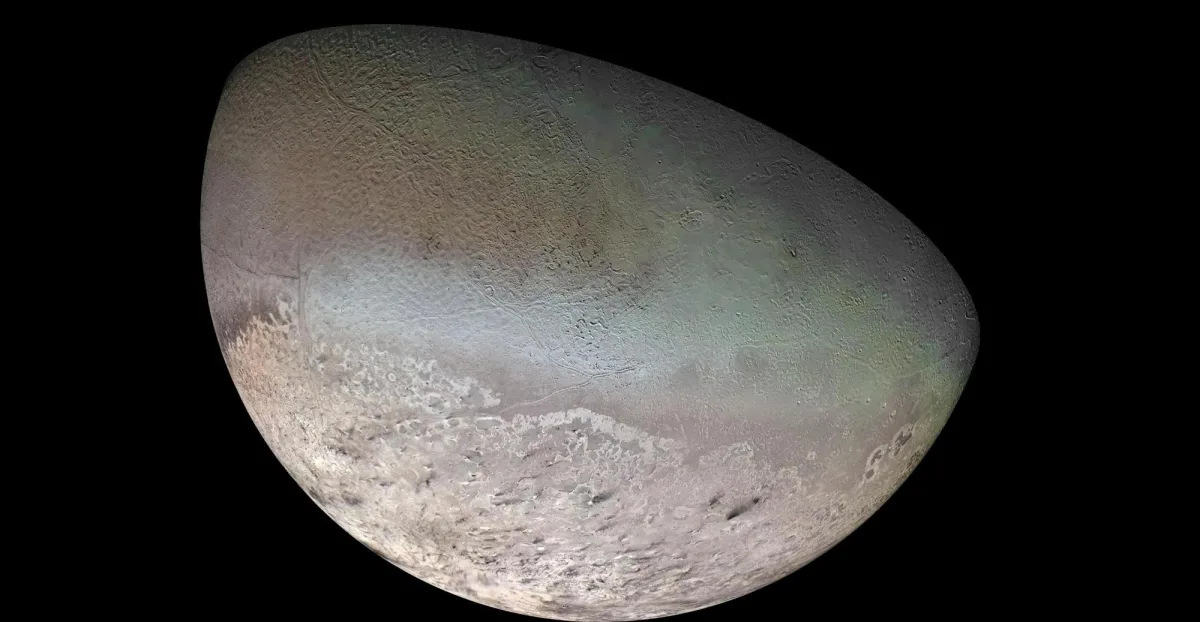
Triton, Neptune's largest moon, is one of the most fascinating places in our solar system. Despite temperatures reaching approximately -235°C, this frozen world displays signs of geological activity, including powerful geyser-like eruptions that send nitrogen gas and dark particles high above its surface. These unusual events offer scientists an opportunity to understand how icy worlds can remain active far from the Sun.
The Frozen Moon With Unexpected Volcanic Activity

Imagine a world where the surface is colder than almost anywhere else in the solar system, yet powerful eruptions can send material kilometres into the atmosphere. That is the strange environment of Triton, Neptune's largest natural satellite.
Discovered on October 10, 1846, by British astronomer William Lassell, Triton is approximately 2,700 kilometres in diameter. It is particularly unusual because it travels around Neptune in the opposite direction to the planet's rotation, an orbital movement known as retrograde motion. Scientists believe Triton originally formed in the Kuiper Belt before Neptune's gravity captured it.
Source: NASA – Triton: Neptune's Largest Moon.
Triton's surface is covered with extremely cold materials, including frozen nitrogen. Its thin atmosphere consists mainly of nitrogen, with smaller amounts of methane. When NASA's Voyager 2 spacecraft passed Neptune in 1989, it discovered evidence of active geysers, revealing that this distant frozen moon was far more geologically interesting than scientists had expected.
Source: NASA – Voyager 2 Discoveries on Triton.
What Is Cryovolcanism?

On Earth, volcanoes release molten rock, ash and extremely hot gases from beneath the ground. Cryovolcanism works differently. Instead of molten rock, cryovolcanoes involve icy materials and volatile substances such as water, ammonia, methane and nitrogen.
These materials can move from beneath a moon's surface and erupt through cracks or openings. Depending on the conditions, the released material may contain liquid, vapour, ice particles or a combination of these substances.
Cryovolcanism is particularly important when studying distant moons because it provides evidence that geological activity does not always require the extreme temperatures associated with Earth's volcanoes.
Source: U.S. Geological Survey – Cryovolcanism on the Icy Satellites.
However, there is an important scientific distinction concerning Triton. Its famous geysers may be powered mainly by sunlight heating nitrogen ice close to the surface rather than by liquid material rising from deep inside the moon. Therefore, the eruptions are often discussed alongside cryovolcanism, but their exact mechanism remains a subject of scientific investigation.
Source: NASA Technical Reports Server – Triton's Geyser-Like Plumes.
How Do Triton's Ice Geysers Erupt?

Triton's geysers are not powered by the same underground lava systems found on Earth. One leading explanation involves sunlight penetrating a thin, translucent layer of nitrogen ice.
Although Triton receives far less sunlight than Earth, a small amount of solar energy can still produce important changes on its surface. When sunlight passes through certain layers of nitrogen ice, it can warm darker material underneath. This creates a greenhouse-like effect beneath the frozen surface.
As the trapped heat increases, nitrogen ice begins turning directly into gas through a process called sublimation. The gas builds pressure beneath the surface until it finds a weak point or opening.
When the pressure becomes strong enough, nitrogen gas escapes violently, carrying dark particles and icy material into the atmosphere. This produces the spectacular geyser-like plumes observed by Voyager 2.
Source: U.S. Geological Survey – Energy Sources for Triton's Geyser-Like Plumes.
What Did Voyager 2 Discover in 1989?

The discovery of Triton's geysers remains one of the most important moments in the exploration of Neptune's moons.
During its August 1989 flyby, Voyager 2 photographed several active eruptions near Triton's southern polar region. Scientists identified at least four geyser-like plumes. The best-documented columns reached approximately eight kilometres above the surface, while dark clouds spread downwind for more than 100 kilometres.
Researchers estimated that some eruptions could release hundreds of kilograms of nitrogen gas every second. These observations demonstrated that a world with an extremely cold surface could still experience dramatic geological processes.
Source: Soderblom and colleagues – Triton's Geyser-Like Plumes, Science (1990).
Could Triton Have an Underground Ocean?

Beyond its geysers, Triton has attracted attention because scientists suspect that liquid water may exist beneath its frozen exterior.
One possible explanation involves heat generated during Triton's capture by Neptune. The gravitational interactions associated with this event may have produced enough internal energy to separate its rocky and icy materials and potentially create conditions for an underground ocean.
Internal heating, radioactive decay and tidal processes could also help maintain heat within the moon. However, scientists have not directly confirmed the existence of a present-day ocean beneath Triton's surface.
A 2026 scientific review identified the possible subsurface ocean, habitability and interaction between Triton's interior, surface and atmosphere as important priorities for future exploration.
Source: Triton as an Archetype for Icy Ocean Worlds: Key Scientific Drivers for Future Exploration (2026).
Why Scientists Want to Explore Triton Again

Voyager 2 remains the only spacecraft to have visited Neptune and Triton at close range. This means that much of what scientists know about the moon comes from observations made during a relatively brief encounter in 1989.
New research published in 2026 continues to increase scientific interest in Triton. A study in Nature Astronomy proposed that Triton's unusual history of capture by Neptune could have produced internal conditions capable of supporting a modern magnetic dynamo. This is a theoretical proposal, not a direct detection of such a dynamo.
Source: Nature Astronomy – A Modern Dynamo at Triton as a Consequence of Its Capture by Neptune (2026).
A future spacecraft mission could investigate its surface chemistry, geological structures, possible underground ocean and atmospheric activity. Such observations would help determine whether Triton's eruptions are mainly driven by seasonal sunlight or whether deeper internal processes also play a significant role.
Source: NASA – Triton Ocean Worlds Surveyor Scientific Objectives.
Frequently Asked Questions
1. What is cryovolcanism?
Cryovolcanism is volcanic-like activity in which icy substances, gases or liquids erupt instead of molten rock.
Source: USGS – Cryovolcanism on the Icy Satellites.
2. What makes Triton special?
Triton is Neptune's largest moon and one of the few known worlds with observed active geyser-like eruptions.
Source: NASA – Triton.
3. How cold is Triton?
Voyager 2 measured surface temperatures of approximately -235°C.
Source: NASA – Triton.
4. What comes out of Triton's geysers?
The observed plumes contain nitrogen gas and dark particles, with nitrogen ice also involved in proposed eruption models.
Source: USGS – Triton's Geyser-Like Plumes.
5. When were Triton's geysers discovered?
They were discovered during Voyager 2's flyby in August 1989.
Source: NASA – Triton.
6. Does Triton have an underground ocean?
A subsurface ocean is considered possible, but it has not been directly confirmed.
Source: 2026 Scientific Review of Triton.
7. Is Triton still volcanically active?
Voyager 2 observed active geysers in 1989. Whether those same eruptions or similar activity continue today has not been established through direct spacecraft observations.
Source: NASA – Triton.
8. Has another spacecraft visited Triton?
No. Voyager 2 remains the only spacecraft to have conducted a close flyby of Triton.
Source: NASA – Triton.
Conclusion
Triton demonstrates that the outer solar system is far from inactive. Beneath its frozen appearance lies a world with unusual geological features, powerful nitrogen eruptions and the possibility of an underground ocean.
Its geysers challenge our understanding of how planetary activity works in extremely cold environments. Although important questions remain unanswered, future exploration could reveal whether Triton is simply a frozen moon with unusual surface eruptions or one of the most fascinating ocean worlds in our solar system.
Source: NASA – Triton.