Chasing the Sun: How Satellite Orientations Protect Astronomy
Satellites do more than provide communication, navigation, and weather forecasts. Their orientation in space also plays an important role in protecting astronomical observations. By carefully controlling where satellites point, how their surfaces reflect sunlight, and how they move across the sky, engineers can reduce unwanted light, limit interference with telescopes, and help astronomers observe distant stars, galaxies, and other celestial objects. As satellite constellations grow, managing their brightness and orbital behavior has become an important challenge for modern astronomy.
Summary
-
Satellite orientation determines how sunlight reflects from a spacecraft toward Earth and ground-based telescopes.
-
Bright satellite trails can interfere with astronomical images, especially during twilight and long-exposure observations.
-
Engineers use spacecraft attitude control, surface treatments, and operational planning to reduce unwanted reflections.
-
Astronomers and satellite operators increasingly work together to limit interference with scientific observations.
-
Space telescopes also depend on precise orientation to keep the Sun, Earth, and Moon away from sensitive instruments.
-
Satellite orientation is only one part of the solution; orbital altitude, satellite brightness, telescope design, and the number of spacecraft also matter.

What Satellite Orientation Means
Satellite orientation, also called spacecraft attitude, describes the direction a satellite faces in space. A satellite may turn its body, adjust its solar panels, or change the direction of its instruments to perform different tasks.
These movements are essential to everyday space operations. Communication satellites must direct antennas toward the correct locations. Earth-observation satellites need to point cameras at specific areas. Space telescopes must maintain precise alignment with distant targets while protecting sensitive instruments from unwanted light and heat. NASA explains that systems using star trackers, Sun sensors, gyroscopes, and other equipment help spacecraft determine and control their orientation.
However, orientation also affects astronomy in another way: it influences how much sunlight a satellite reflects toward an observer on Earth.
A satellite's surface may appear relatively faint from one direction but become much brighter when its panels or body reflect sunlight toward a telescope. By carefully adjusting the spacecraft's position, engineers can sometimes reduce these bright reflections and limit their impact on astronomical research.
How Satellites Interfere With Astronomy
Modern telescopes collect light from objects that are extremely far away, including distant galaxies, newly forming stars, and potentially hazardous asteroids. Many observations require long exposures because the light reaching Earth is faint.
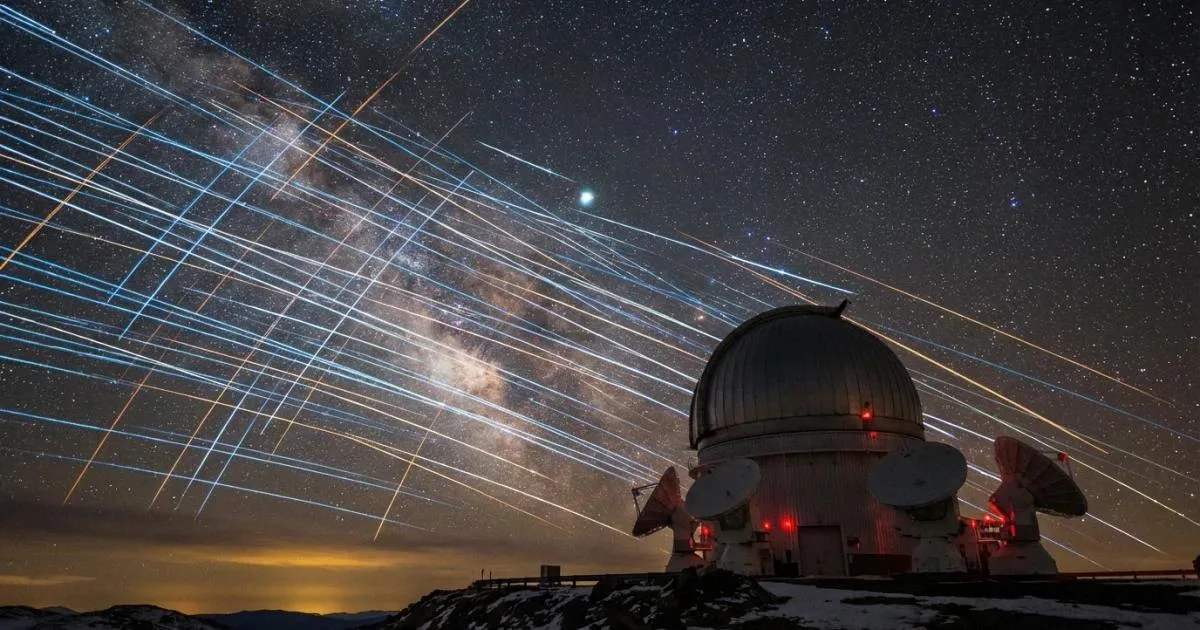
When a sunlit satellite passes through a telescope's field of view, it can leave a bright line across an image. This streak may obscure stars, interfere with measurements, or force astronomers to repeat observations. A single trail does not necessarily destroy an entire image, but repeated interruptions can make scientific surveys less efficient.
The problem is growing alongside large satellite constellations designed to provide global internet and communications. A 2025 study published in Nature examined how satellite megaconstellations could affect several space-based astronomical observatories. It found that satellites can interfere with observations even when they are illuminated mainly by sunlight reflected from Earth or the Moon. The brightness of a trail depends on several factors, including satellite size, surface reflectivity, distance, speed, illumination, and orientation.
This means that satellite orientation is important, but it is not the only factor determining how visible a spacecraft becomes.
How Changing Orientation Can Protect the Night Sky

The basic principle is simple: the direction a surface faces affects where its reflected light travels.
When a satellite's surface reflects sunlight directly toward an observer, it can appear unusually bright. Changing the angle of that surface may redirect some of the reflected light away from ground-based telescopes.
Satellite operators can use attitude-control systems to manage spacecraft orientation during selected phases of a mission. For example, they may adjust panel angles, reduce unwanted reflections during twilight, or choose configurations that limit sudden brightness increases known as flares.
The United Nations Office for Outer Space Affairs documented several mitigation approaches in a 2025 technical report. These included special reflective films, changes to spacecraft surface design, darkened components, adjustments to solar-panel orientation, and operating strategies intended to reduce satellite brightness. The report also noted that these measures have not eliminated the problem.
There are practical limits. Solar panels must still receive enough sunlight to generate electricity, and satellites must maintain suitable temperatures and reliable communications. Engineers therefore need to balance scientific concerns with the spacecraft's operational requirements.
Dark Coatings and New Engineering Solutions
Orientation changes work best when combined with improvements to satellite materials and design.
One promising approach is to use surfaces that reflect less light toward Earth. Dark coatings can reduce reflections, although they must be carefully selected because absorbing more sunlight can increase heating and affect the spacecraft's thermal balance.
Research published in the Monthly Notices of the Royal Astronomical Society on June 30, 2026, examined an aerospace-qualified, ultra-black coating through laboratory measurements and computer simulations. The study found that the material could substantially reduce predicted satellite brightness compared with conventional reflective surfaces in the configurations examined. The researchers also investigated how changing the orientation of coated surfaces affected brightness. An in-orbit demonstration was planned to test the approach under real operating conditions. These results are promising, but they do not yet establish that the coating will solve satellite interference across all spacecraft designs.
Another proposed approach uses retroreflective coatings designed to direct more incoming light back toward its source. A paper published in Acta Astronautica in June 2026 discussed this as a possible way to reduce unwanted satellite reflections. It remains a proposed mitigation strategy rather than a universal, proven solution.
The most effective long-term strategy will likely combine better orientation control, carefully tested materials, suitable orbital choices, and more accurate information about satellite positions.
Space Telescopes Also Depend on Precise Orientation
Protecting astronomy is not only about making satellites less visible. The telescopes themselves must also be positioned carefully.
The Hubble Space Telescope, for example, uses a pointing-control system to turn toward scientific targets and maintain stable observations. NASA explains that Hubble must remain at least 50 degrees away from the Sun because direct sunlight can harm sensitive detectors, create unwanted light inside the telescope, and cause thermal problems.
This illustrates why orientation is fundamental to astronomy. Whether the goal is to keep a satellite from reflecting sunlight toward Earth or to keep a telescope's instruments safely directed away from intense light, spacecraft positioning helps determine what scientists can observe.
Space-based telescopes also face interference from satellites crossing their viewing areas. A study published in Nature in 2025 highlighted this concern for multiple observatories, showing that moving astronomical instruments beyond Earth's atmosphere does not automatically eliminate the problem.
International Cooperation Is Becoming More Important
No single satellite company or observatory can solve the problem alone. Astronomers need reliable information about satellite positions, while operators need practical guidance on reducing interference without compromising spacecraft safety.
The European Space Agency announced on October 8, 2026, that it had entered into an agreement with the International Astronomical Union's Centre for the Protection of the Dark and Quiet Sky to strengthen cooperation on protecting astronomical observations. The initiative reflects growing recognition that satellite operations and scientific exploration must be managed together.
Astronomers can also use satellite-tracking information to predict when spacecraft may cross a telescope's field of view. Better predictions allow observatories to adjust schedules where possible, although this cannot prevent every interruption.
The challenge is becoming more urgent. In a July 1, 2026, announcement, the European Southern Observatory discussed research warning that proposed satellite deployments could have severe consequences for astronomy if their number and brightness are not adequately controlled.
Orientation adjustments can help, but they must form part of a broader plan that addresses satellite numbers, brightness, orbital altitude, and operational transparency.
The Future of Astronomy in a Crowded Orbit
Satellites provide valuable services, from internet access to weather monitoring and disaster response. Protecting astronomy does not require abandoning those benefits. It requires designing and operating spacecraft with greater care for the scientific environment they share.
Better attitude control, low-reflectivity materials, accurate orbital data, and cooperation between satellite operators and astronomers can all reduce interference. However, their effectiveness will depend on how widely these approaches are adopted and how well they perform across different missions.
The night sky is a scientific resource as well as a source of wonder. By controlling how satellites face the Sun, where their surfaces direct reflected light, and when they move across sensitive observing areas, engineers can help preserve humanity's ability to study the universe.
The goal is not to stop satellites from operating. It is to make modern space activity compatible with the discoveries that telescopes continue to bring within our reach.
References
-
European Space Agency. Keeping the sky dark and quiet. October 8, 2026.
-
European Southern Observatory. Beyond the limit: one million satellites and mirrors in space pose grave threat to the night sky. July 1, 2026.
-
Monthly Notices of the Royal Astronomical Society. Reducing the impact of satellite brightness for astronomy: laboratory characterization and simulations. June 30, 2026.
-
Acta Astronautica. Mitigating satellite trails through retroreflective coatings: A proposal for preserving the night sky. June 2026.
-
United Nations Office for Outer Space Affairs. Technical report on the impact of satellite constellations and mitigation measures. 2025.