
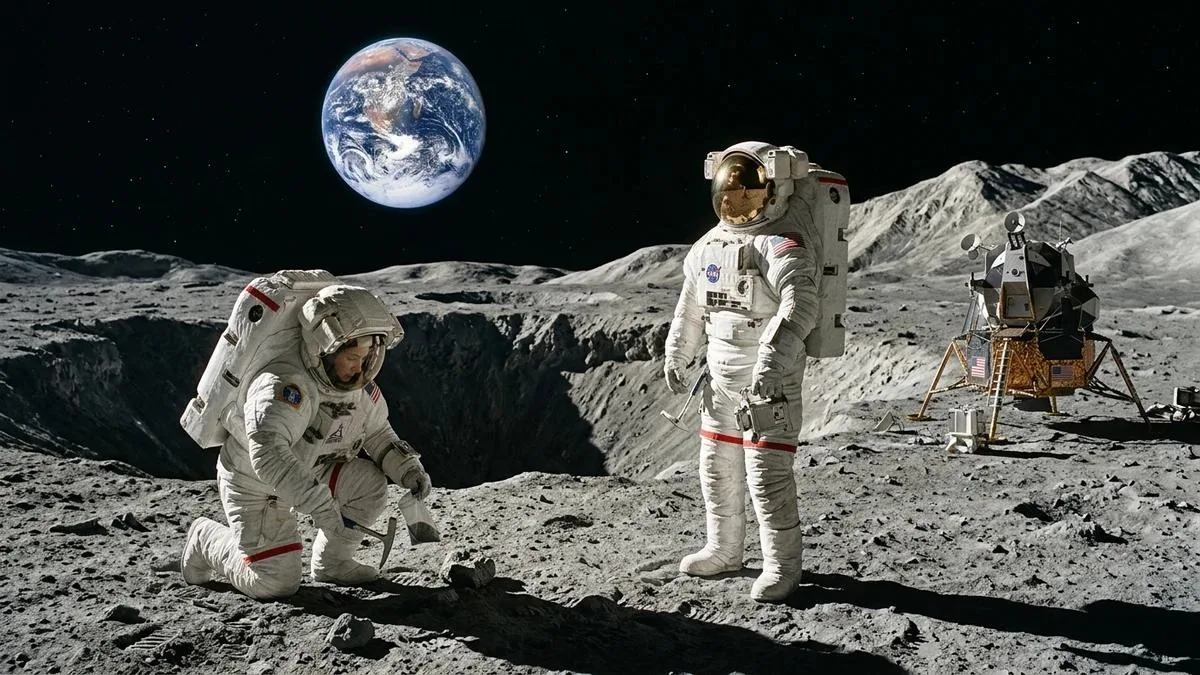
Can Earth Microbes Survive the Lunar South Pole Environments?
Yes, some microbes from Earth may survive for a limited time in certain protected areas near the Moon’s south pole. In a study published on August 19, 2026, NASA researchers reported that some microorganisms associated with humans could potentially remain alive in small lunar environments protected from intense sunlight and ultraviolet radiation. However, survival does not mean that microbes can grow, reproduce, or establish a living population on the Moon. The discovery raises important questions about space exploration, the protection of lunar environments, and the possibility of Earth organisms contaminating future scientific investigations.
Summary
-
Main question: Can microorganisms from Earth survive on the Moon?
-
Latest finding: A 2026 study identified possible microbial survival areas near the lunar south pole.
-
Main challenge: Extreme temperatures, radiation, ultraviolet light, and the Moon's near-vacuum environment.
-
Possible survivors: Certain fungi and bacteria, depending on their resistance and the local conditions.
-
Most promising locations: Small, sheltered areas with persistent shadows and low ultraviolet exposure.
-
Water: Water ice exists in some permanently shadowed lunar regions, but its presence does not prove that liquid water is available for microbial growth.
-
Scientific concern: Microbes carried by astronauts could contaminate lunar samples and complicate the search for evidence of extraterrestrial life.
-
Important distinction: Researchers have identified potential survival conditions, not evidence of a thriving microbial population on the Moon.
What Makes the Lunar South Pole So Extreme?


Unlike Earth, the Moon has no substantial atmosphere to distribute heat, block much of the harmful radiation, or maintain conditions suitable for familiar forms of life. Its surface is exposed to the space environment, and temperatures vary dramatically depending on sunlight and terrain.
NASA reports that permanently shadowed regions near the lunar south pole can reach approximately minus 203°C (minus 334°F), while nearby sunlit locations can become much warmer. Some lunar cold traps are even colder.
These extreme conditions create three major obstacles for microbes.
First, there is intense radiation. Ultraviolet light can damage the biological molecules that microorganisms need to survive. Energetic particles from space also pose a threat, particularly over extended periods.
Second, temperatures can be dangerously low or high. Many organisms cannot remain active under such conditions. Although some microbes can tolerate extreme cold, that does not automatically mean they can withstand every other lunar hazard.
Third, the Moon has almost no atmosphere. Its surface environment lacks the familiar pressure and atmospheric protection that most Earth organisms depend on.
Yet the lunar south pole is not equally hostile everywhere. Crater walls, ridges, rocks, and other terrain features create small areas that receive little or no direct sunlight. These sheltered locations may provide better conditions for microbial survival than exposed ground.
What Did NASA's 2026 Research Discover?
On August 19, 2026, NASA reported research examining whether microorganisms associated with human spaceflight could survive in different environments near the lunar south pole.
The study, published in Science Advances, investigated possible survival locations around three areas: Nobile Rim, Connecting Ridge, and De Gerlache Rim. Researchers combined lunar temperature and elevation information with models of sunlight and radiation exposure. They then compared those environmental conditions with information about the resistance of selected microorganisms.
The organisms considered included Aspergillus niger, Bacillus subtilis, Staphylococcus aureus, Deinococcus radiodurans, and several Fusarium species.
These organisms were relevant because some are associated with human skin or environments encountered during spaceflight, while others are known for particular survival capabilities.
The researchers identified potential survival areas ranging from larger sections of crater terrain to very small locations. Some of the modeled areas could provide conditions in which certain microorganisms might remain alive for at least one Earth day.
This finding is important because it challenges the assumption that every exposed lunar surface is equally unsuitable for microbial survival.
However, the study was based on environmental modeling and existing information about microbial resistance. It does not demonstrate that these organisms have already survived naturally on the lunar south pole.
Which Earth Microbes Could Survive on the Moon?
Not all microorganisms respond to extreme conditions in the same way. Their chances of survival depend on the species, its biological state, how much radiation it receives, and the length of exposure.
Some bacteria can form protective structures called endospores. These structures help them remain dormant when conditions become unsuitable for growth. Certain fungi can also produce resistant spores that tolerate some environmental stresses.
The 2026 study identified Aspergillus niger as particularly resistant to ultraviolet radiation among the organisms considered. Its modeled survival potential extended into some areas receiving sunlight, although this does not mean that it could grow there.

Aspergillus niger
A widespread fungus that produces dark spores. Its ultraviolet resistance made it a notable organism in the 2026 lunar survival analysis.

Bacillus subtilis
A bacterium capable of forming resistant endospores. Earlier research examined its spores under simulated lunar surface conditions.

Deinococcus radiodurans
A bacterium known for its resistance to radiation and other stresses. Such resistance does not guarantee survival under every combination of lunar conditions.
The key point is that resistance to one hazard does not provide complete protection against all the others. A microorganism that tolerates radiation might still be unable to survive a particular temperature, vacuum exposure, or prolonged combination of environmental stresses.
Could Microbes Grow and Reproduce on the Moon?
This is where the distinction between survival and life becomes especially important.
A microorganism may remain alive while dormant without actively growing or reproducing. In this state, its biological activity can be greatly reduced, allowing it to endure conditions that would prevent normal growth.
The NASA-reported research identified possible conditions for short-term survival, not environments that support a growing microbial community. The researchers found no evidence that the lunar south pole provides all the necessary conditions for Earth microbes to grow and reproduce naturally.
Liquid water is a major challenge. Although scientists have confirmed water ice at the Moon's poles, frozen water in a permanently shadowed crater is not the same as accessible liquid water at a temperature suitable for microbial activity.
The Moon's low pressure and extreme environmental conditions create further obstacles.
Therefore, the discovery should not be interpreted as proof that Earth microbes could establish colonies across the lunar surface. Surviving temporarily in a protected location is very different from living and multiplying there.
Why Is Water Ice Important?

Water ice is one of the most important scientific resources found in the Moon's polar regions.
NASA observations indicate that ice is present in some permanently shadowed craters and other cold locations. Researchers continue to investigate its distribution, composition, and possible origins.
For future exploration, lunar ice could potentially help provide water for astronauts and serve as a source of hydrogen and oxygen after suitable processing.
For astrobiology, however, the question is more complicated. Water is essential for all known forms of life, but its presence alone does not make an environment habitable. Temperature, availability of liquid water, energy sources, nutrients, and other chemical conditions also matter.
The coldest lunar regions may preserve ice and certain chemical materials for very long periods. They may also protect some biological material from direct sunlight. But scientists have not established that these locations can support naturally growing Earth microorganisms.
Why Future Moon Missions Must Prevent Contamination

As astronauts and robotic missions explore the Moon, they may unintentionally transport microorganisms from Earth.
Microbes can be associated with human skin, clothing, equipment, spacecraft interiors, and other parts of a mission. Space agencies already use cleaning and sterilization procedures to reduce biological contamination on spacecraft.
The potential survival of microbes in lunar shadowed regions makes this concern particularly important.
Imagine that a future mission collects a lunar sample and scientists later discover biological material in it. They would need to determine whether the material originated on the Moon or arrived with a spacecraft or astronaut.
If contamination is not carefully controlled and documented, it could make scientific results harder to interpret. This is particularly relevant to research investigating the Moon's chemical history and searching for evidence of life beyond Earth.
NASA's 2026 report therefore highlights the importance of characterizing lunar environments before human activity changes them and of tracking potential biological contamination during exploration.
References
-
NASA, Human-Related Microbes May Survive Moon’s South Pole, NASA Finds (August 19, 2026). Read the NASA report.
-
Science Advances research indexed by PubMed, Potential survivable niches for microbial life on the lunar south pole. Read the research abstract.
-
NASA, The Lunar South Pole Region. Explore the lunar environment.
-
NASA, Ice Confirmed at the Moon’s Poles. Read about lunar water ice.
-
NASA, Weather on the Moon. Explore lunar temperatures and conditions.
-
PubMed, Survival of bacterial spores under some simulated lunar surface conditions (1971). Read the earlier study.