
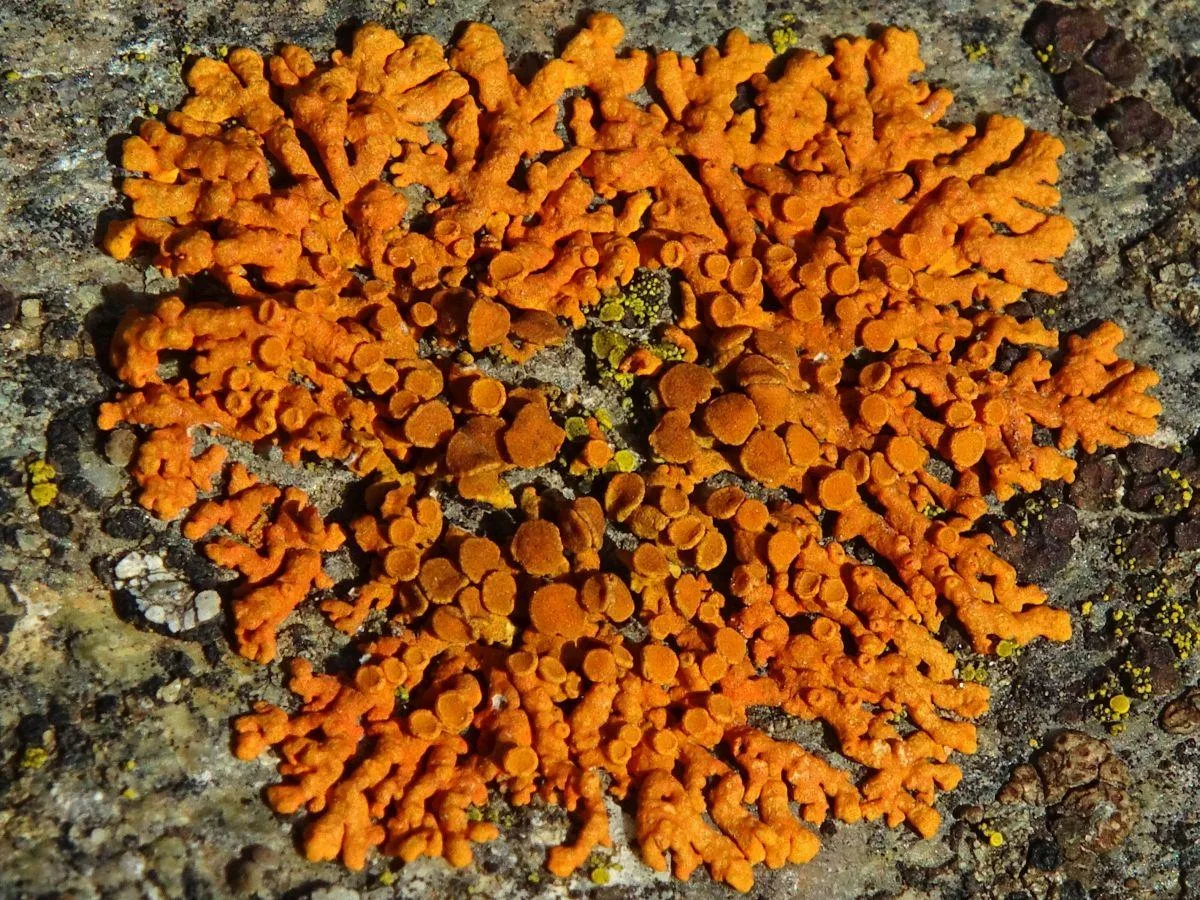
Can Earth Lichen Survive the Venusian Upper Atmosphere?
Could a living organism from Earth survive floating in the clouds of Venus? Scientists have explored this fascinating possibility because some Earth lichens can withstand extreme temperatures, intense radiation, dehydration and other harsh environmental conditions. Venus has a particularly hostile surface, but its upper atmosphere presents a different environment, with temperatures and pressures that are much closer to conditions found on Earth. Although certain layers of Venus's atmosphere might offer temporary opportunities for microbial survival, the clouds contain highly concentrated sulfuric acid and very little available water. Earth lichen therefore represents an interesting subject for astrobiology research, but its ability to survive and grow in the Venusian atmosphere remains unproven.
Introduction: Why Scientists Are Interested in Venus's Clouds
Venus is often described as Earth's sister planet because the two worlds have similar sizes and masses. However, their environments are dramatically different. Venus has an extremely hot surface, with temperatures around 465°C, and an atmosphere dominated by carbon dioxide. Its atmospheric pressure at ground level is also roughly 92 times that of Earth.
These conditions make the Venusian surface unsuitable for known Earth organisms.
However, scientists have identified a different area worth investigating: the planet's upper atmosphere. At altitudes of approximately 47–60 kilometres, temperatures and atmospheric pressures become much less extreme. Some regions have conditions that resemble those found in Earth's lower atmosphere.
This has encouraged researchers to investigate whether microorganisms could survive inside Venus's clouds. Earth lichens are particularly interesting because they have demonstrated an extraordinary ability to withstand environmental stress.
What Makes Earth Lichen So Resilient?

Lichens are unusual living organisms formed through a partnership between fungi and photosynthetic partners, usually algae or cyanobacteria. The fungus provides structure and protection, while the photosynthetic partner produces food using sunlight.
This partnership allows lichens to survive in environments where many other organisms struggle.
They can grow on rocks, tree bark, exposed mountains and other surfaces with limited nutrients. Some species can tolerate prolonged dehydration, freezing temperatures and intense sunlight.
One particularly interesting experiment involved two lichen species: Rhizocarpon geographicum and Xanthoria elegans.

In 2005, researchers sent samples into space aboard the European Space Agency's Foton-M2 mission. The organisms were exposed to the vacuum of space, extreme temperature changes, solar ultraviolet radiation and cosmic radiation for approximately 14.6 days.
After returning to Earth, researchers discovered that the lichens had retained substantial biological activity. Following rehydration, they recovered their metabolic activity within 24 hours.
The results, published in the journal Astrobiology in 2007, demonstrated that lichens could withstand conditions that would severely damage many other organisms.
However, surviving space exposure does not automatically mean surviving Venus. The experiment demonstrated resistance to several physical stresses, not resistance to concentrated sulfuric acid.
What Is the Venusian Upper Atmosphere Like?

Venus's atmosphere contains several layers of thick clouds, primarily composed of sulfuric acid droplets suspended in the atmosphere.
The most interesting region for habitability research lies approximately 47–60 kilometres above the surface.
Within parts of this region, atmospheric temperatures range from around 0°C to 100°C, while pressures are much closer to Earth's surface pressure than those experienced on Venus itself.
These conditions create an interesting scientific possibility.
Some Earth microorganisms can survive within comparable temperature and pressure ranges. Sunlight also penetrates parts of the cloud layer, potentially providing energy for photosynthetic organisms.
A 2021 review published in Astrobiology, titled Venus, an Astrobiology Target, compared Venusian atmospheric conditions with the known limits of terrestrial life. It identified temperature and pressure as potentially manageable factors while highlighting acidity and water availability as major obstacles.
The atmosphere may therefore be physically less hostile than Venus's surface, but its chemical environment remains extremely challenging.
The Biggest Problem: Sulfuric Acid

The greatest obstacle to lichen survival on Venus is the sulfuric acid found in its clouds.
Lichens can tolerate difficult environmental conditions, but their resilience has limits. Their fungal and photosynthetic components depend on biological structures and chemical processes that may be damaged by highly concentrated acids.
Venusian cloud droplets are not ordinary water droplets. They contain concentrated sulfuric acid, creating an environment very different from the moist conditions in which Earth lichens normally become metabolically active.
A major 2021 study published in Nature Astronomy, titled Water Activity in Venus's Uninhabitable Clouds and Other Planetary Atmospheres, examined how much water is actually available for biological processes in Venus's atmosphere.
The researchers calculated that water activity in Venusian cloud droplets could be as low as 0.004. This is dramatically below the approximate 0.585 minimum known for the most extreme terrestrial organisms.
Water activity is important because living organisms need access to water for essential chemical reactions. The presence of water molecules alone does not guarantee that organisms can use them.
This finding presents a serious challenge to the possibility of Earth-based life surviving in Venus's clouds.
Could Lichen Adapt to Venusian Conditions?
The question becomes more complicated when scientists consider whether some biological components could remain dormant rather than actively growing.
Lichens have an impressive ability to enter inactive states during dehydration. When water becomes available again, their biological processes can recover.
This ability could theoretically help them tolerate periods of environmental stress.
However, dormancy cannot solve every problem. Concentrated sulfuric acid can attack biological structures, while the lack of available water prevents normal metabolic activity.
A 2023 study published in Proceedings of the National Academy of Sciences investigated the stability of nucleic acid bases in concentrated sulfuric acid. The research explored whether some fundamental chemical building blocks associated with life could remain stable under conditions resembling those in Venus's clouds.
Another study published in Astrobiology in 2024 investigated the stability of 20 biologically important amino acids in concentrated sulfuric acid. These investigations provide useful information about the chemistry of potential life in Venus's atmosphere, but they do not demonstrate that lichens or other organisms can survive there.
For Earth lichen, the challenge would involve maintaining the survival of both partners in its biological partnership, not simply protecting one component.
What Would Happen to Lichen in Different Parts of Venus's Atmosphere?
The atmospheric environment changes with altitude. Therefore, survival prospects would depend heavily on where an organism was located.
|
Environmental factor |
Venusian upper atmosphere |
Importance to lichen |
|---|---|---|
|
Temperature |
Approximately 0–100°C in relevant regions |
Some temperatures are biologically tolerable |
|
Pressure |
Relatively close to Earth's surface pressure |
Less challenging than Venus's surface |
|
Sunlight |
Sunlight penetrates cloud layers |
Potential energy source |
|
Acidity |
Highly concentrated sulfuric acid |
Major biological threat |
|
Water availability |
Extremely low |
Prevents normal metabolism |
|
Radiation |
Solar and ultraviolet exposure |
Lichens have demonstrated some resistance |
What Does Recent Research Tell Us?
Research into Venusian habitability continues to develop. Scientists are investigating atmospheric chemistry, cloud composition and whether unusual chemical processes could support life.
In 2024, researchers published Venus' Atmospheric Chemistry and Cloud Characteristics Are Compatible with Venusian Life in Astrobiology. The paper examined whether certain chemical properties of Venus's atmosphere could be compatible with hypothetical life.
The researchers discussed major uncertainties surrounding water availability, cloud chemistry and possible biological processes. Their work does not establish that life exists on Venus, but it shows why the planet remains scientifically interesting.
For Earth lichen, however, the evidence remains much more limited. There is no confirmed experiment demonstrating that an intact terrestrial lichen can survive, remain metabolically active or reproduce inside Venus's sulfuric acid clouds.
Future research would need to test how lichens respond to carefully simulated combinations of Venusian temperature, pressure, acidity and water availability.
Could Future Space Missions Provide an Answer?

Future Venus exploration could improve scientists' understanding of the atmosphere.
NASA's planned DAVINCI mission is designed to investigate Venus's atmospheric composition and structure through a descent probe. Other proposed and planned Venus missions also aim to improve knowledge of the planet's atmosphere and surface.
Measurements of cloud droplets, atmospheric chemistry and trace gases could help researchers determine how hostile the environment really is.
Such missions could also improve the search for possible biosignatures, although detecting an unusual chemical substance would not automatically establish that it came from living organisms.
Scientists would need multiple independent lines of evidence before making such a conclusion.
Final Verdict: Can Earth Lichen Survive Venus's Upper Atmosphere?
Earth lichen has demonstrated remarkable resistance to extreme environmental conditions, including dehydration, vacuum exposure and radiation. Its ability to recover after exposure to space makes it an interesting candidate for studying the limits of life beyond Earth.
However, Venus presents a different challenge. Its upper atmosphere contains highly concentrated sulfuric acid, and the extremely low availability of water creates conditions that are far outside the known requirements of terrestrial life.
The most reasonable scientific conclusion is that Earth lichen has not been shown to survive Venus's upper atmosphere. Its resistance to space conditions provides an interesting starting point for research, but it does not establish resistance to Venusian cloud chemistry.
Future laboratory experiments and atmospheric exploration could provide better answers. For now, the possibility remains an interesting scientific question rather than a demonstrated form of extraterrestrial survival.
References
-
Sancho et al. (2007). Lichens Survive in Space: Results from the 2005 LICHENS Experiment. Astrobiology. Read scientific study.
-
European Space Agency. Lichen Survives in Space. ESA research report.
-
Hallsworth et al. (2021). Water Activity in Venus's Uninhabitable Clouds and Other Planetary Atmospheres. Nature Astronomy. Read research paper.
-
Limaye et al. (2021). Venus, an Astrobiology Target. Astrobiology. Read research paper.
-
Cockell et al. (2021). Biologically Available Chemical Energy in the Temperate but Uninhabitable Venusian Cloud Layer. Read research paper.
-
Seager et al. (2023). Stability of Nucleic Acid Bases in Concentrated Sulfuric Acid. PNAS. Read research paper.
-
Seager et al. (2024). Stability of 20 Biogenic Amino Acids in Concentrated Sulfuric Acid. Astrobiology. Read research paper.
-
Bains et al. (2024). Venus' Atmospheric Chemistry and Cloud Characteristics Are Compatible with Venusian Life. Astrobiology. Read research paper.