
Asteroid Deflection Algorithms: Calculating Target Nuclear Impacts
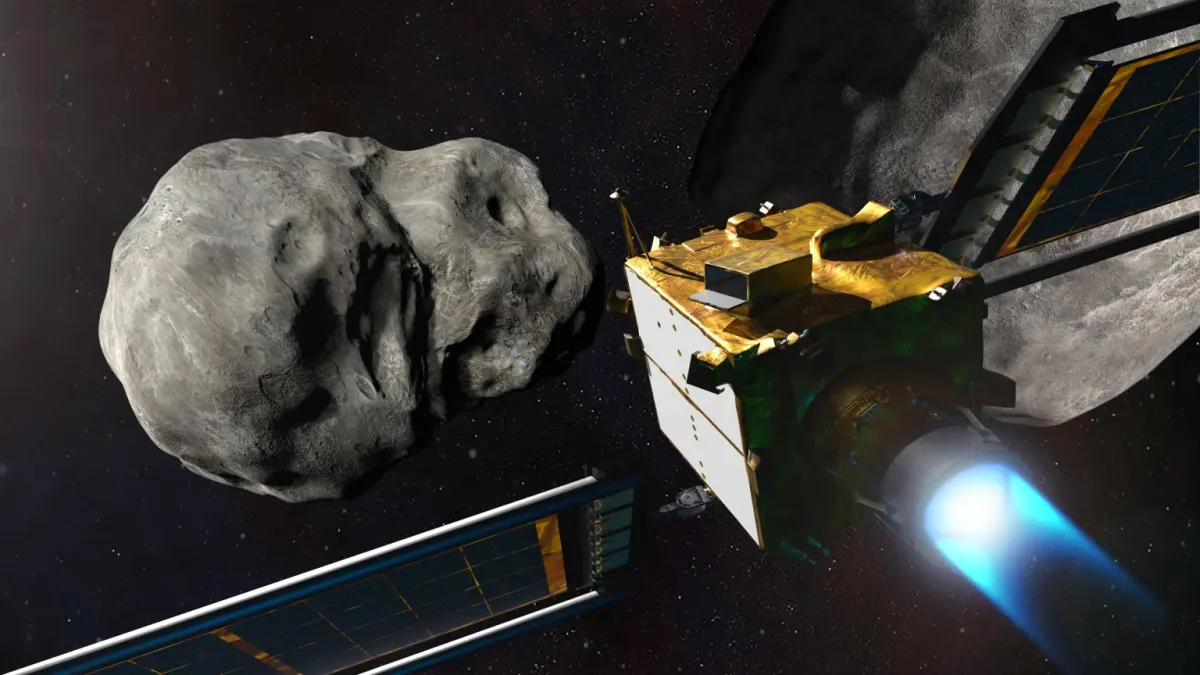
Asteroid deflection is not simply a matter of hitting a space rock with enough force. Scientists must first determine the asteroid's orbit, calculate how uncertain that orbit is, estimate the consequences of different interventions, and then model how a small change in the asteroid's motion could grow into a much larger change in its future position. Modern planetary-defense systems combine astronomy, orbital mechanics, probability, spacecraft navigation, computer simulations and continual observations. NASA's DART mission provided the first full-scale demonstration that human technology can measurably change an asteroid's motion, while ESA's Hera mission is now being used to study the result in much greater detail. Nuclear explosive concepts have also been examined in planetary-defense research, particularly as a theoretical option for unusually difficult scenarios, but detailed nuclear targeting calculations are not the normal basis of public planetary-defense planning.
Summary
- Subject: Asteroid deflection algorithms and planetary defense
- Main goal: Change the future trajectory of a hazardous asteroid so it does not collide with Earth
- Key technologies: Orbit determination, uncertainty analysis, Monte Carlo simulation, spacecraft navigation and trajectory optimization
- Important demonstration: NASA's Double Asteroid Redirection Test (DART)
- DART target: Dimorphos, the smaller body in the Didymos binary asteroid system
- DART result: The impact shortened Dimorphos's orbital period by roughly 33 minutes after the effects settled
- Current follow-up: ESA's Hera spacecraft is scheduled to study the Didymos system in late 2026
- Other major development: NASA's NEO Surveyor is being developed to improve detection and characterization of potentially hazardous objects
- Nuclear research: Nuclear explosives have been studied as a planetary-defense option, but detailed calculations are highly specialized and are not necessary for understanding the basic algorithmic problem
- Core idea: Early detection provides more time for a small trajectory change to become a large miss distance
What Is an Asteroid Deflection Algorithm?
An asteroid-deflection algorithm is essentially a computer-based method for answering a difficult question:
Where will an asteroid be in the future, and how could its future path be changed safely if necessary?
An asteroid does not travel through space on a perfectly predictable straight line. Its motion is affected by the gravity of the Sun, planets, moons and sometimes other bodies. Solar radiation, outgassing in some objects and uncertainties in measurements can also complicate predictions.
Scientists therefore begin with observations rather than with the assumption that the asteroid's orbit is already known perfectly.
NASA's Center for Near-Earth Object Studies, for example, uses observations to determine an object's orbit and then evaluates many possible future orbital paths. Its Sentry system uses uncertainty analysis and virtual asteroids to study potential future encounters with Earth.
The algorithm is therefore less like a simple "aiming system" and more like a constantly updated prediction system.
Every new observation can change the calculation.
Step 1: Finding the Asteroid
The first requirement for planetary defense is detection.
Astronomers use ground-based observatories and space telescopes to find faint moving objects against the background of stars. Once an object is detected, additional observations help determine its position and movement.
The better the observations, the better scientists can estimate the asteroid's orbit.
This is one reason NASA's NEO Surveyor mission is important. The infrared space telescope is specifically designed to locate potentially hazardous asteroids and comets, including dark objects that can be difficult to see using visible-light observations. NASA currently lists the mission as targeted for launch no earlier than September 2027, while agency planning documents maintain a readiness commitment extending into 2028.
Finding an asteroid early can be more valuable than having a more powerful deflection method later.
Step 2: Calculating the Orbit
Once enough observations are collected, researchers calculate the orbit that best matches the available measurements.
But there is an important problem: observations always contain uncertainty.
A telescope does not provide an infinitely precise measurement. The asteroid's exact position and velocity therefore exist within a range of possibilities.
NASA describes these possibilities using what are called virtual asteroids.
Imagine thousands or millions of slightly different versions of the same asteroid. Each one fits the observations reasonably well, but each follows a slightly different future path.
The computer can then propagate these possible orbits forward in time.
Some may pass safely.
Some may come closer to Earth.
A very small subset could potentially intersect Earth's future position.
This approach allows scientists to estimate impact probability instead of treating one calculated orbit as absolute truth.
Step 3: Building an Impact Probability
An asteroid's future location becomes less certain the farther researchers project its orbit.
This is especially important when an asteroid makes a close planetary approach because gravity can magnify small differences between possible orbital paths.
Sentry therefore uses statistical and numerical methods to examine the uncertainty region around an asteroid's predicted orbit.
One technique involves Monte Carlo sampling, in which many possible orbital solutions are simulated.
The important point is that the algorithm is not asking:
"Will this asteroid hit Earth?"
It is asking:
"Given everything we currently know, what range of future outcomes remains possible?"
That difference matters because a prediction can change when new observations arrive.
An object that initially appears concerning may later be ruled out as additional data reduces orbital uncertainty.
Step 4: Calculating the Required Trajectory Change
If an asteroid were confirmed to be dangerous, scientists would look at whether its future trajectory could be changed.
The basic principle is surprisingly simple.
An asteroid does not necessarily have to be moved very far.
It may only need a small change in velocity early enough that, after years of traveling through space, the asteroid arrives at a different location when Earth reaches the same region of space.
This is why warning time is so important.
A tiny trajectory change accumulated over a long period can produce a large difference later.
Planetary-defense researchers therefore consider the available warning time, asteroid properties, orbital geometry, uncertainty and possible intervention methods together rather than treating them as separate problems.
DART: The Real-World Test
The most important modern test of asteroid deflection was NASA's Double Asteroid Redirection Test, or DART.
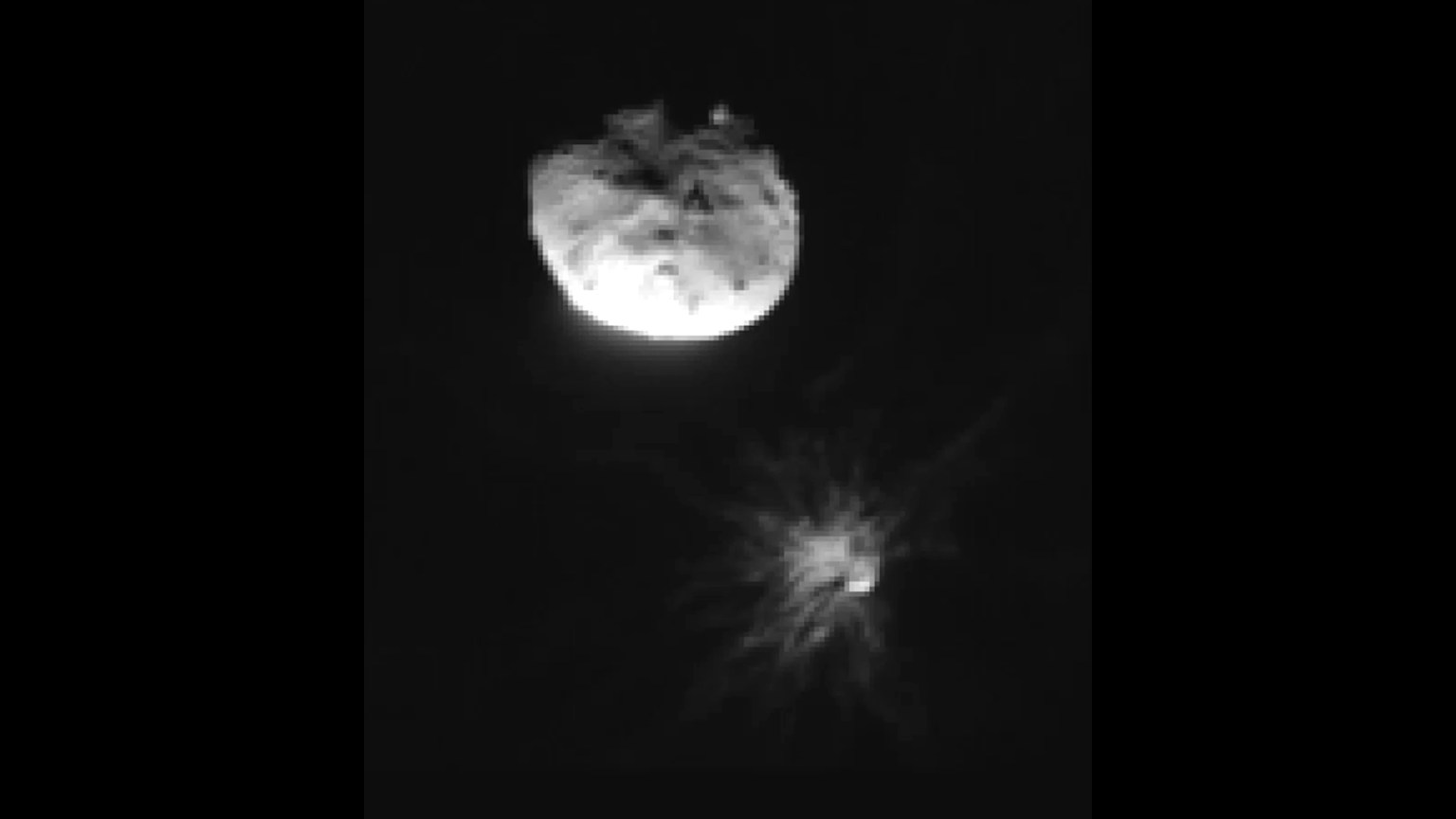
On September 26, 2022, DART deliberately collided with Dimorphos, a roughly 160-meter-wide asteroid moonlet orbiting the larger asteroid Didymos.
The objective was not to destroy the asteroid.
It was to measure whether a spacecraft could alter its motion.
NASA confirmed that the impact changed Dimorphos's orbit. Initial measurements showed the orbital period became about 32 minutes shorter, while later analysis found a final change of approximately 33 minutes and 15 seconds after additional material was ejected from the asteroid following the collision.
The result was important because the experiment demonstrated that a controlled spacecraft impact can produce a measurable orbital change.
It also demonstrated that the asteroid's response cannot be understood simply by considering the spacecraft hitting the surface.
Material thrown away from the asteroid contributed additional momentum.
That effect is called ejecta recoil.
NASA's analysis found that the material ejected into space substantially increased the momentum transferred to Dimorphos.
How Algorithms Learn From DART
DART also demonstrated why asteroid-deflection algorithms need accurate physical information.
Before a real mission, scientists need to know things such as:
| Property | Why It Matters |
|---|---|
| Mass | Determines how much the asteroid responds to an intervention |
| Size | Helps estimate its physical response |
| Shape | Changes impact geometry and surface interaction |
| Rotation | Affects how different areas of the asteroid are exposed |
| Surface structure | Influences how material responds |
| Internal structure | Helps determine whether the body behaves more like solid rock or a loose aggregate |
| Orbital state | Determines its future path |
| Observation uncertainty | Determines confidence in the predicted trajectory |
DART showed that even when a spacecraft successfully hits its target, understanding the exact result requires much more information.
That is the reason ESA's Hera mission is so important.
Hera: Turning One Experiment Into Better Models
ESA's Hera spacecraft launched on October 7, 2024 and is traveling toward the Didymos system.
As of 2026, the mission is on course for a rendezvous in November 2026.
Hera will investigate Dimorphos in detail, measuring properties such as its mass, shape, surface and internal structure. It will also study the crater produced by DART.
Why does this matter for algorithms?
Because a successful experiment is much more valuable when scientists understand why it worked.
Researchers want to improve their models so that future missions can make better predictions about how different asteroids may respond to an intervention.
ESA explains that Hera's measurements are intended to help turn kinetic impact from a single demonstration into a better understood and potentially repeatable planetary-defense technique.
Where Nuclear Concepts Fit Into Planetary Defense
Nuclear explosive concepts have appeared in planetary-defense studies for decades.
The National Academies included nuclear methods alongside civil defense, slow-push methods and kinetic impactors in its assessment of asteroid-hazard mitigation. The report treated nuclear intervention as a specialized option for difficult situations rather than as the standard solution for every asteroid threat.
The important scientific point is that a nuclear planetary-defense scenario would still begin with the same fundamental problems:
- Determine the asteroid's orbit.
- Measure the uncertainty in that orbit.
- Characterize the asteroid.
- Estimate possible physical responses.
- Simulate future trajectories.
- Evaluate whether a proposed intervention reduces the probability of an Earth impact.
The dangerous misconception is that planetary defense is simply a matter of calculating a "target point" and choosing an explosive.
In reality, the hardest parts are often uncertainty, asteroid structure, navigation, timing and predicting how the object responds.
Public scientific descriptions therefore focus heavily on detection, orbit determination, physical modeling and trajectory prediction rather than giving a simple formula for nuclear targeting.
Why Asteroid Structure Is So Important
Two asteroids of the same diameter could respond very differently to the same intervention.
One could behave like a relatively coherent rocky body.
Another might be a loose collection of rocks and dust held together by weak gravity.
Scientists sometimes describe these loosely assembled objects as rubble piles.
DART's observations indicated that Dimorphos is a loosely packed object, which made the mission especially useful for studying how momentum transfer works in a complex asteroid environment.
This creates a major modeling challenge.
A computer simulation must account for physical behavior that cannot always be observed directly from Earth.
That is why close-up missions such as Hera are so valuable.
The Role of Monte Carlo Simulation
Monte Carlo methods are especially useful when there is uncertainty.
Instead of calculating one future orbit, a program can simulate a large population of possible orbital states.
For example, the general process can look like this:
Observations → Orbit Estimate → Uncertainty Region → Thousands of Possible Orbits → Future Encounters → Impact Probability
The same general concept can be used when evaluating a possible deflection.
Instead of asking whether one predicted mission trajectory works, scientists can examine a range of possible conditions.
The more uncertainty exists, the broader the range of outcomes becomes.
That is why additional observations are so valuable.
A Simplified Planetary-Defense Algorithm
At a high level, a planetary-defense computer system can be thought of as following this sequence:
| Stage | Main Question |
|---|---|
| Detection | What object have we found? |
| Orbit determination | Where is it going? |
| Uncertainty analysis | How certain are we? |
| Impact monitoring | Could it intersect Earth's future position? |
| Characterization | What is the object physically like? |
| Mission analysis | Could an intervention change its trajectory? |
| Simulation | What outcomes are possible? |
| Observation | Did the intervention produce the expected result? |
| Recalculation | How has the predicted future changed? |
This is an important distinction between science-fiction depictions and real planetary defense.
The calculation does not end after an intervention.
The asteroid must continue to be observed.
The new observations are fed back into the model.
The predicted orbit is updated again.
Planetary defense is therefore a continuous feedback system.
Why Early Detection Matters
The biggest advantage in asteroid defense is often not a larger spacecraft or a more powerful intervention.
It is time.
With sufficient warning, even a relatively small change in an asteroid's trajectory can accumulate into a substantial miss distance.
With little warning, the options become much more limited.
The National Academies' planetary-defense review emphasized that different mitigation methods have different warning-time requirements and that the usefulness of any approach depends strongly on the size and physical properties of the threatening object.
This is one reason NASA and international partners invest so heavily in asteroid discovery and tracking.
The Torino Scale and Public Communication
Scientists also need a clear way to communicate potential asteroid hazards.
The Torino Impact Hazard Scale is an integer scale from 0 to 10 used to communicate the potential significance of an asteroid or comet impact scenario.
It combines information about the likelihood and consequences of a potential impact and is designed primarily for public communication.
A high-quality planetary-defense system therefore has two sides:
Technical analysis — detailed orbital and physical calculations.
Public communication — explaining the level of concern in a way that avoids unnecessary panic.
Both are important.
What Makes These Algorithms Difficult?
The mathematics of orbital motion is well established.
The difficult part is uncertainty.
Scientists may not know:
- The asteroid's exact mass
- Its complete internal structure
- Its exact shape
- How loose or compact its material is
- How it rotates
- How its surface behaves
- How much material an intervention could eject
- How small navigation errors could affect the final result
These uncertainties are why planetary defense cannot rely on a single calculation.
It requires repeated observations, multiple simulations and independent checks.
The National Academies has also emphasized that uncertainty in asteroid physical properties remains a major issue when estimating the effectiveness of mitigation methods.
Current State of Asteroid Deflection Research in 2026
The field has moved beyond purely theoretical discussions.
DART has demonstrated that a spacecraft can change the motion of an asteroid.
Hera is now heading toward the same asteroid system to investigate exactly what happened.
NASA's NEO Surveyor is being developed to improve detection and characterization of hazardous asteroids and comets.
Meanwhile, systems such as NASA's Sentry continue monitoring known near-Earth objects and updating impact probabilities as new observations become available.
ESA reported in March 2026 that Hera had completed another deep-space maneuver and remained on course for its Didymos rendezvous later in the year.
These developments show that planetary defense is increasingly becoming a practical engineering discipline rather than only a theoretical field.
Facts
- DART was the first mission to deliberately change the motion of a celestial body.
- Dimorphos originally took about 11 hours and 55 minutes to orbit Didymos.
- After DART, the final measured orbital-period reduction reached about 33 minutes and 15 seconds.
- Dimorphos is roughly 150–160 meters across, depending on the measurement source and mission estimate.
- ESA's Hera mission is expected to reach the Didymos system in November 2026.
- NASA's Sentry system can analyze thousands of possible future asteroid trajectories when evaluating impact possibilities.
Asteroid deflection algorithms are not simply calculations for hitting a target in space. They are large systems that combine observations, mathematics, probability, physics, spacecraft navigation and continuous updates.
NASA's DART mission demonstrated that humanity can change an asteroid's motion. ESA's Hera mission is now taking the next step by studying that experiment in detail. NASA's NEO Surveyor is expected to strengthen the detection side of planetary defense, while impact-monitoring systems such as Sentry continue calculating the future paths of known near-Earth objects.
Nuclear concepts remain part of the historical and scientific discussion of asteroid mitigation, but the central lesson of modern planetary defense is broader: the earlier an asteroid is discovered and the better its orbit is understood, the more opportunity scientists have to change its future path.
That is why the most important planetary-defense algorithm may begin long before any deflection mission launches.
It begins with finding the asteroid.
References
NASA — DART Mission
NASA Planetary Defense: DART
NASA — DART Orbit Change Results
NASA: Asteroid's Orbit and Shape Changed After DART
NASA/JPL — Sentry Earth Impact Monitoring
NASA JPL Sentry Impact Monitoring
NASA/JPL — NEO Surveyor
NASA JPL NEO Surveyor
ESA — Hera Mission
ESA Hera Mission
ESA — Hera Science
ESA Hera Science and DART Follow-Up
National Academies — Defending Planet Earth
National Academies: Defending Planet Earth
National Academies — 2023 Planetary Defense Strategy
National Academies: Planetary Defense
NASA — Torino Impact Hazard Scale
NASA CNEOS Torino Scale