
Artemis III Surface Landing: Picking the Lunar South Pole Sites
Parts of the lunar south pole have stayed dark for billions of years, potentially holding secrets about the history of our solar system? This region is the next destination for human boots on the ground. NASA is preparing to send the Artemis III crew to a place where no person has ever walked. The mission is not just about landing - it is about finding a location where astronauts can live, work and survive in a harsh environment.
Choosing a landing site is a massive puzzle - Scientists must balance the need for darkness to find ice with the need for light to power the lander. You might think any flat spot will do but the south pole is a rugged area of deep craters and tall peaks. NASA recently refined their list to focus on areas that offer the best chance for success.
The Scientific Goals of the Mission
The main reason you are going to the south pole is to find water - this water is not liquid - it is ice hidden inside craters that never see the sun - these dark zones are some of the coldest places in the universe. Scientists want to study this ice to understand where it came from and if we can use it for future travel.
Besides water, the rocks in this area are very old - They hold clues about how the Moon besides Earth formed. When the crew arrives, they will collect samples that are different from those gathered during the Apollo missions - these materials help explain how the lunar surface changed over billions of years.

The Nine Candidate Landing Regions
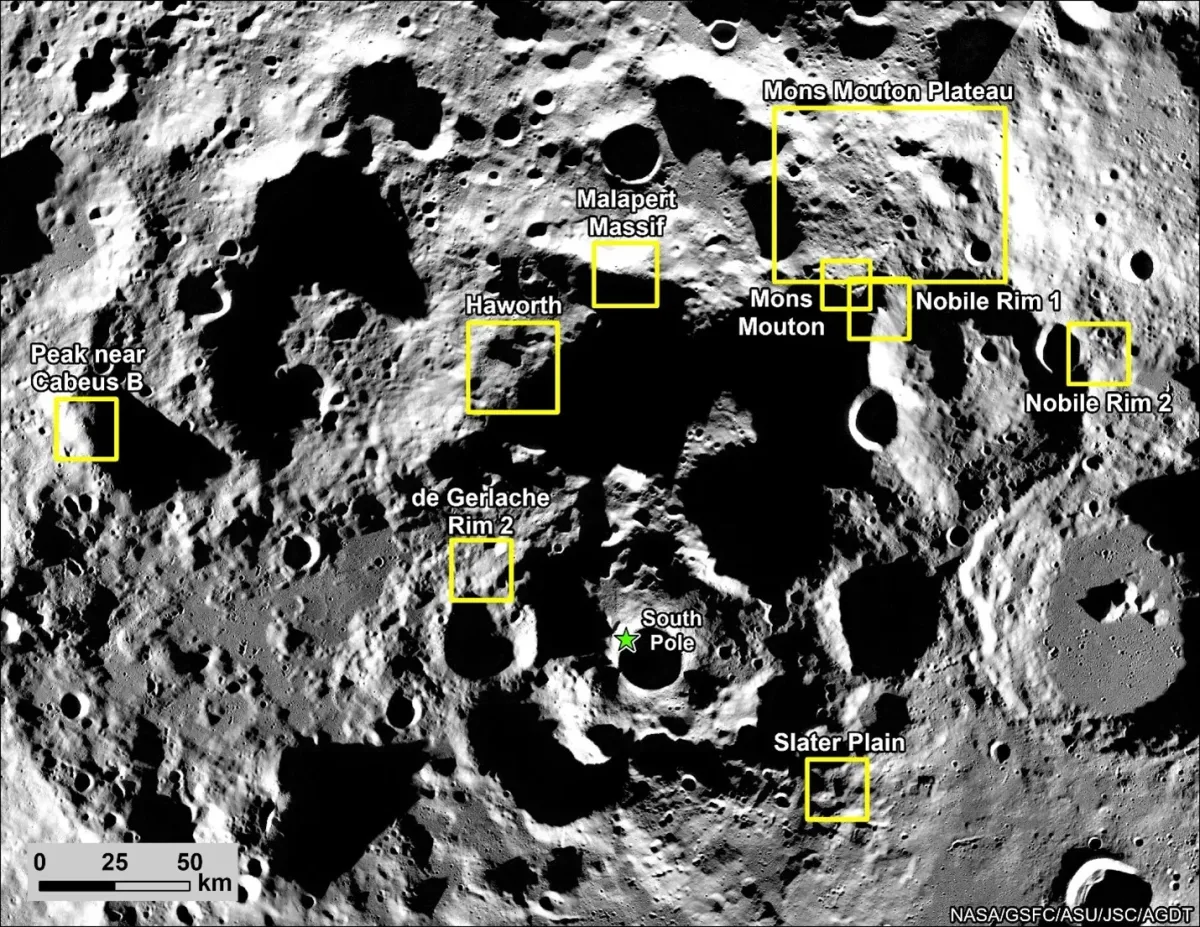
NASA recently narrowed down the choices from thirteen original spots to nine specific regions - these areas are located near the south pole and offer different types of ground to explore. Each spot has unique features, like high ridges or flat plains. The current candidate regions are
- Peak near Cabeus B or Haworth
High areas with nearby deep shadows. - Malapert Massif next to Mons Mouton
Large mountains that offer great views and signal paths. - Nobile Rim 1 and 2
Edges of a large crater named Nobile. - de Gerlache Rim 2 & Slater Plain
Relatively flat areas that are easier for a lander to touch down.
These regions give NASA many options - If the launch date changes, some sites might be better because the sun will be at a different angle. Having nine choices ensures that the mission can proceed even if the timing shifts. You can think of these as a diverse set of "parking spots" for the spacecraft.
How NASA Picks the Perfect Spot
Safety is the most important factor when you are landing a spacecraft. The ground must be flat enough so the lander does not tip over. It also needs to be free of large rocks that could damage the legs of the ship. NASA uses high resolution photos from satellites to check the terrain of every candidate site.
Sunlight is another big requirement - The lander and the suits for the astronauts use solar panels for energy. The crew needs a spot that stays in the sun long enough to finish their work. They also need to be close enough to walk into the shadows where the ice is hidden. Balancing light and shadow is a difficult task for the planners.
Why the South Pole Matters for Humans
If we find enough ice, we can turn it into drinking water or oxygen for breathing. We can even break it apart to make rocket fuel, which means the Moon could become a gas station for ships going to Mars. You are watching the first steps toward a long term home away from Earth.
The south pole is also a great place for telescopes - Because it is quiet and some parts are very cold, it is perfect for looking deep into space. Establishing a base here is the start of a new era. We are moving from just visiting the Moon to actually staying there for long periods.
FAQ
Why is the south pole better than the equator?
The south pole has water ice in shadowed craters, which is not found at the warmer equator - this ice is essential for long term survival and fuel production.
When will the landing happen?
NASA is currently planning the Artemis III mission for the mid-2020s. The exact date depends on the progress of the spacecraft and the landing system.
How many people will land on the Moon?
The mission aims to put two astronauts on the lunar surface, while two others stay in orbit around the Moon - this crew will include the first woman and the first person of color to walk on the lunar surface.
References
-
NASA. (2024). "NASA Provides Update on Artemis III Moon Landing Regions." NASA News Release. https://www.nasa.gov/news-release/nasa-provides-update-on-artemis-iii-moon-landing-regions
-
Washington University in St. Louis. (2024). "NASA Provides Update on Artemis III Moon Landing Regions." Department of Earth, Environmental, and Planetary Sciences. https://eeps.washu.edu/news/nasa-provides-update-artemis-iii-moon-landing-regions
-
USGS. (2024). "Down Selected Artemis III Candidate Landing Site Navigational Grids." U.S. Geological Survey. https://www.usgs.gov/data/down-selected-artemis-iii-candidate-landing-site-navigational-grids
-
Wikipedia. (2026). "Artemis III." https://en.wikipedia.org/wiki/Artemis_III
-
NASA. (2026). "Artemis III Mission Overview." https://www.nasa.gov/mission/artemis-iii
-
Universe Today. (2024). "NASA Focusses in on Artemis III Landing Sites." https://www.universetoday.com/articles/nasa-focusses-in-on-artemis-iii-landing-sites
-
BBC. (2026). "What is Nasa's Artemis III mission and will it go to the Moon?" https://www.bbc.com/news/articles/cr5j40ezgz4o
-
European Space Agency. (2026). "Artemis III." https://www.esa.int/Science_Exploration/Human_and_Robotic_Exploration/Orion/Artemis_III