
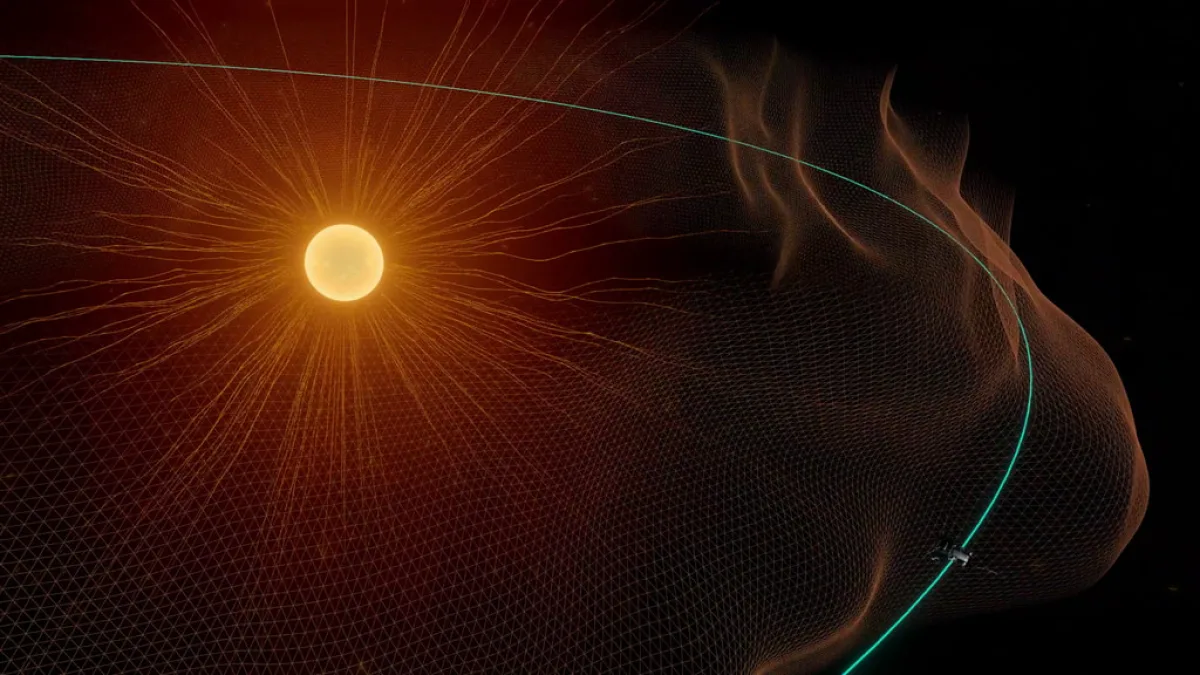
Alfvén Waves Unlocked: The Force Heating the Solar Corona
Alfvén waves are magnetic waves that travel through the Sun’s electrically charged plasma. They are one of the leading explanations for how energy moves from the lower solar atmosphere into the corona, where temperatures can reach about 2 million °C even though the Sun’s visible surface is around 5,500 °C. Recent observations from NASA’s Parker Solar Probe, ESA’s Solar Orbiter and the Daniel K. Inouye Solar Telescope have strengthened the evidence that Alfvén waves transport significant energy and help heat and accelerate the solar wind. Scientists now have much better evidence for their role, although Alfvén waves are not necessarily the entire answer to the coronal-heating mystery.
Summary
| Topic | Details |
|---|---|
| Main subject | Alfvén waves |
| Discovered theoretically | 1942 by physicist Hannes Alfvén |
| Environment | Magnetized plasma |
| Major role | Transporting magnetic energy through solar plasma |
| Solar connection | Coronal heating and solar-wind acceleration |
| Important missions | Parker Solar Probe and Solar Orbiter |
| Recent evidence | Small-scale torsional Alfvén waves observed in the corona |
| Current status | Major heating mechanism under active investigation |
What Are Alfvén Waves?
The Sun is not simply a ball of hot gas. Much of its outer atmosphere is made of plasma, an electrically charged state of matter containing ions and electrons. Because plasma responds strongly to magnetic fields, disturbances in those fields can travel through it as waves.
These are known as Alfvén waves, named after Swedish physicist Hannes Alfvén. He predicted their existence in 1942 while developing the theory of magnetohydrodynamics, which describes how electrically conducting fluids interact with magnetic fields. Alfvén later received the 1970 Nobel Prize in Physics for fundamental work connected to magnetohydrodynamics.
A simple way to picture an Alfvén wave is to imagine a stretched magnetic field line being disturbed. Instead of the disturbance staying in one location, it travels along the magnetic field, carrying energy with it.
The important point is that an Alfvén wave can move energy without needing to transport matter in the same way that a conventional sound wave does.

Why Is the Solar Corona So Hot?
This is one of the oldest major questions in solar physics.
The visible surface of the Sun, called the photosphere, has a temperature of roughly 5,500 °C. Yet the corona, which lies above it, can reach around 2 million °C and even higher during energetic solar events. In other words, the Sun's atmosphere becomes dramatically hotter after moving away from its visible surface.
That appears strange because we normally expect temperatures to decrease as we move farther from a heat source.
Scientists call this the coronal heating problem.
For decades, researchers have investigated several possible explanations. Magnetic reconnection, tiny explosive events called nanoflares, electrical currents and waves are among the mechanisms being studied. These possibilities do not necessarily exclude one another.
Alfvén waves are particularly interesting because they provide a natural way of carrying energy from the lower atmosphere upward into the corona.
How Can Alfvén Waves Heat the Corona?
Energy can enter the Sun's atmosphere through the constant movement of magnetic-field structures. Convection beneath the visible surface moves and shakes magnetic fields, generating disturbances that can travel upward.
As Alfvén waves move through the corona, some of their energy can be transferred to particles. Depending on the physical conditions, the waves can interact with ions and electrons, develop turbulence or become damped. The energy that leaves the wave can then contribute to heating the plasma.
The process is not as simple as saying that every magnetic wave automatically becomes heat. How, where and how quickly the energy is converted remains an active research question.
Recent theoretical work has also investigated inertial Alfvén waves, which operate on very small scales. A 2026 study in the Journal of Geophysical Research: Space Physics found that these waves can transport energy along magnetic fields and that damping can transfer energy to particles, potentially contributing to heating and particle acceleration in the low corona.
Parker Solar Probe Gets Close to the Answer
NASA's Parker Solar Probe was built specifically to investigate the Sun's atmosphere, solar wind and the source of the energy that drives these phenomena.
The spacecraft became the first spacecraft to fly through the Sun's corona in 2021. Its mission is designed to measure the environment close to the Sun rather than trying to understand everything from Earth, roughly 150 million kilometres away.
One important discovery concerns magnetic switchbacks—sudden bends or reversals in the solar magnetic field detected in the solar wind.
In 2024, combined observations from Parker Solar Probe and ESA's Solar Orbiter showed that large-scale magnetic oscillations associated with Alfvén waves can provide energy that helps heat and accelerate fast solar wind. ESA described the observations as evidence identifying Alfvén waves as the energy source behind the heating and acceleration of the fastest solar wind.

New Evidence From the Solar Corona Itself
Another important step came from observations made using the Daniel K. Inouye Solar Telescope.
A 2025 Nature Astronomy study, published in the journal's 2026 volume, reported evidence for small-scale torsional Alfvén waves in the quiet solar corona. These waves twist magnetic structures back and forth.
The researchers reported that the observed waves could carry a substantial fraction of the energy needed to power the quiet corona and solar wind. They also noted that the measured wave amplitudes may be underestimated because observations look through layers of plasma along the line of sight.
This matters because scientists previously had evidence for larger-scale Alfvénic motions, but establishing a widespread small-scale component in the corona was much more difficult.
Latest Evidence at a Glance
| Evidence | What It Shows | Why It Matters |
|---|---|---|
| Parker Solar Probe | Alfvénic magnetic structures near the Sun | Shows energy moving through the solar wind |
| Solar Orbiter + Parker | Large-scale magnetic waves linked with fast solar wind | Supports wave-driven heating and acceleration |
| Inouye Solar Telescope | Small-scale torsional Alfvén waves | Shows waves exist throughout the quiet corona |
| 2026 theoretical modelling | Energy transfer and damping at small scales | Helps explain how wave energy can become particle heating |
Alfvén Waves and the Solar Wind
The solar wind is the continuous flow of charged particles escaping from the Sun.
Alfvén waves are closely connected to this process because they can transport energy outward through the Sun's magnetic field.
ESA and NASA's joint observations showed that the fastest solar wind is associated with large-scale magnetic deflections that behave like Alfvén waves. This provides an important link between magnetic energy near the Sun and the high-speed plasma eventually flowing into interplanetary space.
The research is also important beyond basic solar physics. The solar wind contributes to space weather, which can affect satellites, communications, navigation systems and electrical infrastructure on Earth. Understanding how the solar wind is created and accelerated may therefore improve our ability to understand and eventually forecast some space-weather conditions.
What Parker Solar Probe Is Doing Now
As of October 2, 2026, Parker Solar Probe remains an active mission.
NASA reported that the spacecraft completed its 29th close approach to the Sun on September 4, 2026, reaching about 3.8 million miles from the solar surface and a maximum speed of approximately 430,000 miles per hour. During the encounter, its scientific instruments gathered measurements inside the solar corona, including observations near the Sun's north pole.
The spacecraft's continuing observations give scientists an unusual opportunity to study how magnetic energy changes as it travels away from the Sun.
Is the Mystery Solved?
Not completely.
Alfvén waves now have strong observational and theoretical support as an important part of coronal heating and solar-wind acceleration. However, researchers continue to investigate how wave energy is generated, how much of the available energy reaches the corona and precisely how that energy is converted into heat.
Other processes may also contribute. Research on electrical currents and magnetic reconnection, for example, indicates that different heating mechanisms can operate together.
So the modern picture is becoming more detailed: rather than searching for a single magic process, scientists are investigating how waves, turbulence, magnetic reconnection and small-scale energy dissipation interact.
Alfvén waves have moved from an elegant theoretical prediction to one of the most closely studied physical processes in the Sun's atmosphere. Observations from Parker Solar Probe and Solar Orbiter have connected these magnetic waves with the heating and acceleration of the fast solar wind, while new observations from the Inouye Solar Telescope have revealed small-scale torsional waves inside the quiet corona.
The evidence does not mean that every detail of the coronal-heating mystery has been solved. Instead, scientists now have a much clearer picture of one of the ways energy can travel through the Sun's atmosphere and eventually become heat.
As Parker Solar Probe continues its mission, researchers are getting closer to answering one of solar physics' biggest questions: how does the Sun move magnetic energy from its turbulent surface into the million-degree atmosphere surrounding it?
References
NASA Science — Parker Solar Probe mission: NASA Parker Solar Probe
NASA Science — The Sun's temperature and coronal-heating problem: NASA Sun Facts
ESA — Solar Orbiter and Parker Solar Probe observations of Alfvén waves: ESA: Solar Orbiter shows how solar wind gets a magnetic push
Nature Astronomy — Evidence for small-scale torsional Alfvén waves: Nature Astronomy study
Journal of Geophysical Research: Space Physics — Kinetic modelling of inertial Alfvén waves: AGU research paper