
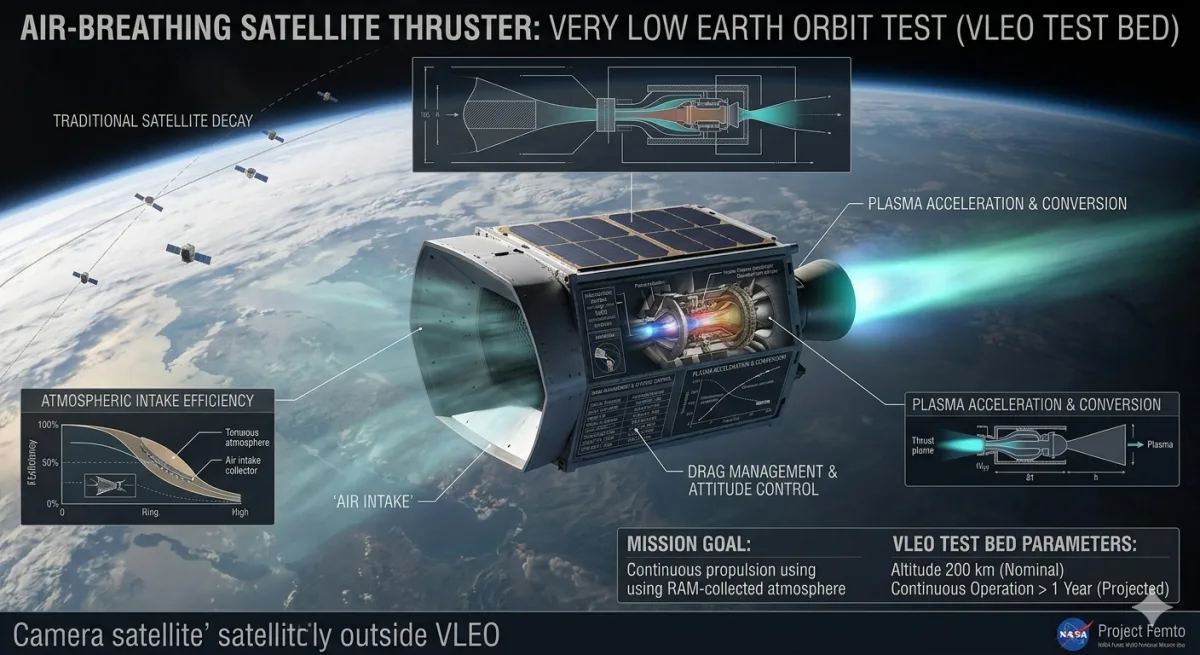
Air-Breathing Satellite Thruster: The Very Low Earth Orbit Test That Could Change How Satellites Stay in Space
An air-breathing satellite thruster is designed to solve one of the biggest problems of Very Low Earth Orbit (VLEO): atmospheric drag. Instead of carrying all its propellant from Earth, a spacecraft with air-breathing electric propulsion (ABEP) collects the extremely thin atmosphere that already exists around it, compresses and ionizes those particles, and throws them back out at high speed to create thrust. The concept has been researched for years, including a 2018 ESA ground demonstration and later European and U.S. programs. In 2026, however, the technology is moving closer to an actual orbital test. Spanish company Kreios Space says it plans to fly its ABEP system on a satellite built around Kongsberg NanoAvionics' MP42 platform, with its technology roadmap pointing toward a 2027 first satellite launch and a larger 2028 mission. The important point is that the upcoming demonstration is not yet an in-orbit success story: the key test is still ahead.
Summary
| Item | Details |
|---|---|
| Technology | Air-Breathing Electric Propulsion, or ABEP |
| Main purpose | Counter atmospheric drag in Very Low Earth Orbit |
| Orbit regime | Generally below about 450 km; many ABEP concepts target roughly 150–300 km |
| Basic idea | Collect atmospheric particles, ionize them and accelerate them to produce thrust |
| Main advantage | Greatly reduces dependence on stored onboard propellant |
| Main problem | The atmosphere is extremely thin, while nitrogen and oxygen are harder to use than conventional propellants such as xenon |
| Earlier milestone | ESA-led air-breathing thruster ground firing in 2018 |
| 2026 milestone | ESA reported positive net thrust in the MISTRAL/VOLTA development work |
| Major planned flight | Kreios Space ABEP satellite demonstration |
| Satellite bus | Kongsberg NanoAvionics MP42 |
| Current status | Technology development and mission preparation; orbital demonstration still ahead |
| Important future program | DARPA's Otter program |
| Potential applications | Earth observation, communications, persistent VLEO platforms and advanced maneuvering |
What Is an Air-Breathing Satellite Thruster?
The name can sound strange because satellites do not normally "breathe" anything.
An air-breathing satellite thruster is essentially a propulsion system that uses the thin atmosphere around a spacecraft as its propellant.
Normal electric-propulsion satellites carry a supply of gas such as xenon. The gas is fed into an electric thruster, turned into plasma, accelerated and expelled. The resulting momentum pushes the spacecraft in the opposite direction.
An ABEP spacecraft attempts to remove the need to carry that propellant.
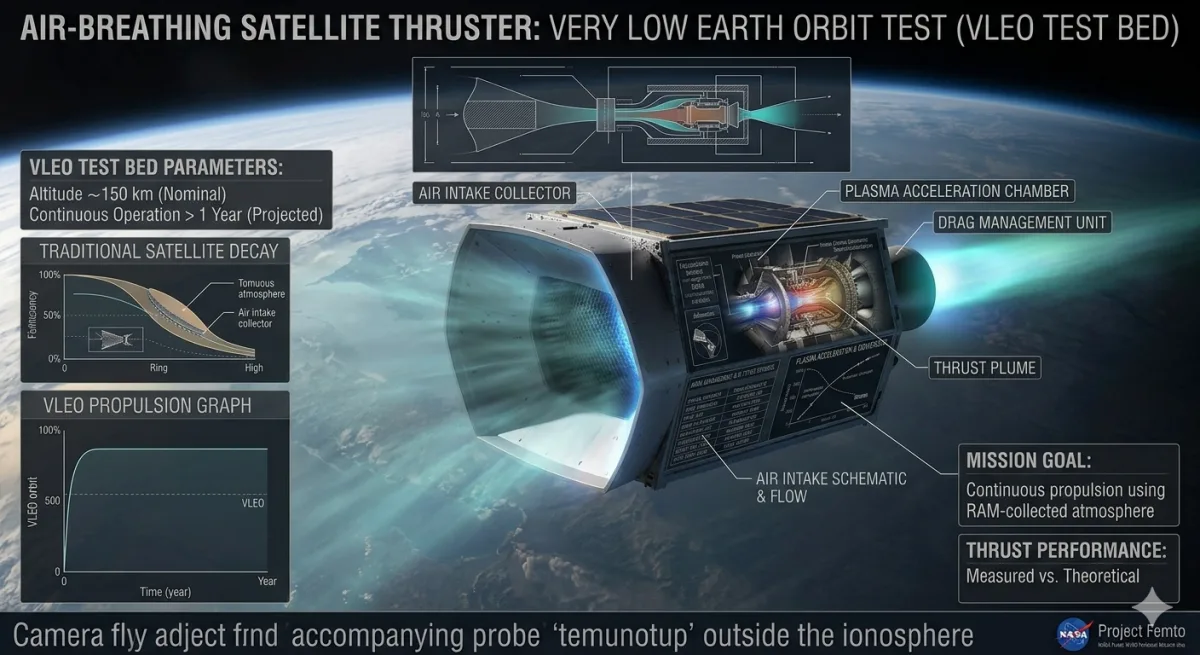
The satellite flies through the upper atmosphere at several kilometres per second. An intake positioned toward the direction of flight captures some of the molecules hitting the spacecraft. The captured gas is then compressed or conditioned and fed into an electric propulsion system. The thruster ionizes the gas and accelerates the charged particles out of the spacecraft.
The result is thrust.
This means the same environment that normally creates a problem for a satellite becomes part of the solution.
The distinction is important: ABEP does not mean a spacecraft can operate in ordinary atmospheric air like an aircraft. The atmosphere at these altitudes is incredibly thin. The engineering challenge is to collect enough particles, efficiently enough, to generate more thrust than the drag produced by the satellite and its intake.
Why Very Low Earth Orbit Is So Difficult
Very Low Earth Orbit, or VLEO, generally refers to orbital altitudes below about 450 kilometres, although different studies use somewhat different boundaries. Some ABEP research concentrates on the 100–300 km region, with ultra-low Earth orbit sometimes used for the lowest portion of that range.
Flying this low has major advantages.
For Earth observation, getting closer to the surface can improve ground resolution without necessarily requiring a much larger optical instrument. Research has also identified potential improvements for radar and lidar performance, communications link budgets, geospatial positioning and revisit times. Lower altitudes can also offer advantages related to radiation and the long-term orbital-debris environment.
But there is a major trade-off.
At these altitudes, there is still enough atmosphere to produce significant aerodynamic drag.
A satellite that loses altitude because of drag becomes even more affected by the atmosphere as it descends. Without enough propulsion, orbital decay eventually wins.
That is why satellites at extremely low altitudes need a propulsion system that can continually compensate for the drag.
The Old Solution: Carry More Propellant
The traditional answer is straightforward: carry fuel or electric-propulsion propellant.
ESA's GOCE gravity-mapping satellite provides a useful real-world example. GOCE operated at roughly 260 km and used an electric ion propulsion system to continuously compensate for atmospheric drag. ESA says the spacecraft carried 40 kg of xenon and used its thruster to maintain its unusually low orbit. The mission ended after 4 years and 8 months in 2013.
That illustrates the limitation.
Even an efficient electric propulsion system is ultimately constrained by its propellant supply. Once the propellant is gone, a satellite cannot continue compensating for drag indefinitely.
ABEP attacks that limitation at the source.
How the Air-Breathing Thruster Works
An air-breathing electric propulsion system can be simplified into several stages.
First, the satellite's intake faces the direction of travel.
As the spacecraft moves through VLEO, the intake encounters atmospheric particles. At around 200 km altitude, the spacecraft is travelling at approximately 7.8 km/s, according to ESA's description of its original air-breathing propulsion work.
The second stage is collection and compression.
The intake has to collect particles efficiently without creating so much additional drag that the entire system becomes counterproductive. This is much harder than simply putting a pipe on the front of a spacecraft.
The third stage is ionization.
The incoming atmospheric gas must be transformed into plasma. The atmosphere in VLEO contains nitrogen, oxygen and other species, and those gases present a more difficult propulsion problem than conventional electric-propulsion propellants such as xenon. Nitrogen and oxygen have different ionization characteristics, and molecular gases can involve additional energy losses through dissociation and excitation.
Finally, the ions are accelerated.
Electric and magnetic fields can be used to accelerate the charged particles out of the spacecraft at high velocity. That exhaust creates the thrust needed to counter the atmospheric drag.
The ideal outcome is simple:
Thrust > Drag
When that condition is achieved, the spacecraft can maintain its orbit without consuming a conventional stored propellant supply.
The Biggest Engineering Problem: The Atmosphere Is Both Fuel and Enemy
ABEP sounds almost too simple until the physics are considered.
The atmosphere is extremely thin at VLEO altitudes.
That means a spacecraft needs a very efficient collection system to capture useful quantities of gas. At the same time, the intake itself produces aerodynamic resistance.
The thruster therefore has to accomplish several difficult tasks at once:
| Challenge | Why It Matters |
|---|---|
| Atmospheric collection | Too few captured particles means too little propellant |
| Intake drag | The collector cannot create more drag than the propulsion system can offset |
| Compression | The collected particles must reach conditions suitable for the thruster |
| Ionization | Nitrogen and oxygen are difficult electric-propulsion propellants |
| Oxygen exposure | Atomic oxygen can damage spacecraft materials and propulsion components |
| Power | Solar arrays must supply enough electrical power |
| Thermal control | Plasma generation and VLEO aerodynamic effects create thermal-management problems |
| Atmospheric variability | Density changes with altitude and solar activity |
| Ground testing | Laboratories struggle to perfectly reproduce the orbital environment |
Recent peer-reviewed research continues to identify low-pressure discharge, nitrogen/oxygen ionization, propellant utilization, thrust-to-power ratio and system integration as major technological barriers.
This is why the phrase "air-breathing satellite" should not be interpreted as though the technology is already mature.
It is promising, but still experimental.
The 2018 ESA Milestone
The current push has a long history.
On March 5, 2018, ESA announced what it called a world-first firing of an electric thruster designed to ingest scarce atmospheric molecules and use them as propellant. The test took place on the ground in a vacuum facility designed to simulate the environment around 200 km altitude.
The test was important because the researchers did not simply study an ordinary thruster using air. They built a system around the idea of collecting incoming atmospheric particles and converting those particles into usable propellant.
ESA explained that the system used a specialized intake and a dual-stage thruster. The incoming molecules were collected, charged and accelerated.
But there is a crucial distinction.
That 2018 achievement was a ground test, not an operational satellite demonstration in orbit.
That difference still matters today.
ESA's MISTRAL and VOLTA Development
More recent European work has moved the concept further.
Through the MISTRAL activity, the European Space Agency supported Italian company Celeste and the Sant'Anna School of Advanced Studies in developing the VOLTA air-breathing electric propulsion system for small satellites. ESA's 2026 update says the project demonstrated positive net thrust, meaning the propulsion system generated more thrust than the drag created by its collector.
That is a major technical milestone because simply firing a thruster is not enough.
An ABEP system has to work as a complete system.
The intake creates drag.
The thruster creates thrust.
The useful question is whether the final balance is positive.
ESA described the MISTRAL result as a world-first experimental demonstration of a full end-to-end system capable of positive net thrust using residual atmosphere in VLEO, and said the technology is being advanced toward possible commercial applications. (European Space Agency)
This is one of the most important developments behind today's renewed attention to air-breathing satellites.
Kreios Space Moves Toward an Orbital Test
The biggest near-term development is coming from Spain.
On August 4, 2026, Kreios Space announced that it had selected Kongsberg NanoAvionics to provide the satellite bus for its first ABEP demonstration. The companies say the mission is intended to demonstrate air-breathing electric propulsion in VLEO. (kreiosspace.com)
Kreios says its spacecraft will use the MP42 microsatellite bus, with the completed spacecraft expected to weigh about 200 kg including its optical payload, although the payload itself has not yet been publicly identified.
Kreios's own technology roadmap currently lists:
-
2021: K-1 thruster prototype
-
2023: K-2 prototype integrated with the intake
-
2024: K-3 thruster generation
-
2025: development of the first satellite model
-
2026: development of a second satellite model
-
2027: planned launch of Kreios-1
-
2028: planned launch of Kreios-2 for a multi-year VLEO commercial mission
There is a small but important point of uncertainty around the schedule.
Kreios's own roadmap lists 2027 for Kreios-1, while a separate Payload Space report described the company's first VLEO flight as targeting 2028. This means the exact operational launch date should not yet be presented as fixed.
As of September 2, 2026, the safest description is therefore that Kreios is preparing for a first orbital demonstration, with 2027 appearing in the company's roadmap and 2028 also reported as a target in industry coverage.
What Will the Kreios Satellite Actually Test?
The purpose is not simply to prove that a plasma can be produced.
The real question is whether an entire spacecraft can operate in a VLEO environment while using collected atmospheric gas as its propulsion resource.
According to industry reporting, the spacecraft could begin at roughly 300–350 km and then descend while firing its propulsion system at different altitudes. This would allow researchers to study how the system performs as atmospheric conditions change. (Payload)
That would be extremely valuable.
Atmospheric density is not constant. It changes with altitude and solar conditions, meaning the amount of gas available to an ABEP spacecraft can vary significantly.
A successful test would therefore need to answer questions such as:
Can the intake collect enough particles?
Can the thruster operate reliably with those particles?
Can the propulsion system compensate for drag?
How much electrical power does the system require?
How does performance change as altitude changes?
How does the spacecraft behave in the real orbital environment?
Those are the questions that ground testing cannot answer completely.
Current and Planned Air-Breathing Propulsion Projects
| Project | Organization | Status as of Sept. 2026 | Purpose |
|---|---|---|---|
| Kreios-1 | Kreios Space + NanoAvionics | Mission development | Planned first orbital ABEP demonstration |
| Kreios-2 | Kreios Space | Planned | Multi-year commercial VLEO mission |
| MISTRAL/VOLTA | ESA, Celeste, Sant'Anna | Ground technology demonstrated | CubeSat-scale positive-net-thrust demonstration |
| Otter | DARPA | Development/testing program | Long-duration VLEO ABEP orbital demonstration |
| Viridian ABEP | Viridian Space Corporation | Technology development | VLEO propulsion and air-scooping systems |
| ABIE-X | Research team led by Japanese institutions | Proposed mission | On-orbit proof-of-concept for air intake, compression and plasma generation |
| AETHER/BREATHE | European research efforts | Technology research | Development and testing of air-breathing propulsion |
DARPA's Otter Program
Kreios is not the only organization preparing for an orbital demonstration.
The U.S. Defense Advanced Research Projects Agency, or DARPA, is developing the Otter program.
DARPA defines VLEO for the program as altitudes of approximately 90–450 km. Its goal is to develop, demonstrate and collect on-orbit data for air-breathing electric propulsion technologies.
The agency says the program will culminate in a long-duration spaceflight demonstration lasting more than one year, described as an "orbiting wind tunnel."
The reason for that unusual approach is straightforward: the real environment is difficult to reproduce accurately on the ground.
The spacecraft would provide data under actual VLEO conditions so engineers can compare orbital results against ground-test measurements and improve their models.
DARPA's planning documents describe a progression from analysis and testing to propulsion development, a demonstrator satellite and finally the long-duration flight demonstration, with the U.S. Space Force identified as the anticipated transition partner. (
Viridian Is Also Working on Air-Breathing Propulsion
Another U.S. player is Viridian Space Corporation.
U.S. government Small Business Innovation Research records show that Viridian has received multiple awards connected to VLEO air-breathing propulsion.
One 2025 Phase II award focused on air-breathing electric propulsion with oxygen resilience for long-duration operation in VLEO. The program aims to collect and process atmospheric gases for a Hall-effect thruster while dealing with the damaging effects of oxygen-rich conditions.
Another 2025 award focuses on resilient VLEO operations using an air-scooping electric thruster. The government description says the technology is intended to harvest atmospheric gas at very low altitudes and use it as propellant for sustained station keeping and maneuvering.
Viridian also received an NSF Phase II SBIR award in 2026 worth $1,218,494 for air-breathing electric propulsion research aimed at creating spacecraft that use the atmosphere as an in-situ resource.
These efforts show that air-breathing propulsion is not being pursued by just one company.
What Makes VLEO Attractive for Satellites?
One of the strongest arguments for VLEO is better observation performance.
A satellite closer to Earth can potentially obtain higher-resolution imagery from the same general class of optical payload. Research has also identified benefits for radar, lidar, communications and revisit performance.
That could be useful for:
Earth observation: Higher-resolution imaging can help with environmental monitoring, mapping, infrastructure analysis and disaster response.
Communications: Lower altitude can improve link budgets and reduce latency in some mission architectures.
Rapid monitoring: A VLEO constellation could potentially observe changes on Earth's surface more frequently.
Smaller payloads: Improved resolution from lower altitude can reduce some payload size and mass requirements.
The problem has always been endurance.
A spacecraft that can see Earth extremely well but cannot remain in its orbit for long is not commercially useful.
ABEP attempts to solve that endurance problem.
Why the Technology Is Still Not Easy
Calling atmospheric gas "free fuel" is technically convenient but somewhat misleading.
The gas is freely available, but collecting and processing it requires:
-
A specialized intake
-
Structural mass
-
Electrical power
-
Plasma-generation hardware
-
Thermal management
-
Materials that can survive atomic oxygen
-
Sophisticated spacecraft control
The propulsion system also cannot simply use ordinary electric-thruster designs without modification.
Research shows that nitrogen and oxygen can be harder to ionize efficiently than xenon, while their lower mass can affect propulsion performance. The system must also work at the very low pressures found in VLEO.
This is why the latest research is looking not only at individual thrusters but at complete spacecraft architectures.
Recent engineering studies have examined the optimal shape of VLEO satellites and how factors such as frontal area, side area and solar-array size influence the overall balance between drag, available power and propulsion performance.
The Atomic Oxygen Problem
Atomic oxygen is another major issue.
At VLEO altitudes, oxygen species can interact aggressively with spacecraft surfaces. Materials that perform well in ordinary spacecraft environments may degrade more rapidly.
That affects the intake, spacecraft body and propulsion system.
It is also one reason several air-breathing propulsion projects emphasize cathode-less or oxygen-resilient technologies. Viridian's government-funded work, for example, specifically targets oxygen-resilient propulsion technology.
The goal is not simply to make the engine work once.
A commercial satellite needs it to keep working for months or years.
Why Ground Testing Is So Important
It may seem strange that engineers need such complicated vacuum chambers to test a satellite that will eventually fly through the atmosphere.
The problem is scale.
The atmosphere at VLEO is so thin that laboratories have difficulty reproducing the combination of pressure, composition, particle flux and spacecraft velocity present in orbit.
A 2025 technical paper on ABEP testing noted that realistic VLEO simulation is one of the central development challenges. Researchers have been building specialized flow-generation and vacuum facilities to reproduce representative conditions.
The BREATHE project, associated with European ABEP research, specifically investigated how to create more representative test conditions for systems intended to operate around 200 km altitude.
This explains why an orbital demonstration is so important.
A laboratory test can prove that the physics works.
An orbital test can show whether the engineering works in the actual environment.
Latest Developments as of September 2, 2026
The air-breathing satellite story has moved considerably during 2026.
The clearest recent developments are:
June 2026: ESA highlighted the MISTRAL/VOLTA work and reported experimental positive net thrust from the air-breathing system.
August 4, 2026: Kreios Space announced that it had selected Kongsberg NanoAvionics to provide the satellite platform for its planned ABEP orbital demonstration.
August 2026: NanoAvionics listed the Kreios mission as its announced world-first air-breathing electric propulsion satellite project.
2026: DARPA's Otter program remains focused on developing and eventually demonstrating air-breathing propulsion during a long-duration VLEO mission.
The key development is that the field is moving from laboratory demonstrations toward actual flight hardware.
Is the World's First Air-Breathing Satellite Already in Orbit?
No.
This point needs to be made clearly.
ESA demonstrated an air-breathing propulsion concept on the ground in 2018. ESA's newer MISTRAL/VOLTA work has demonstrated positive net thrust experimentally. But those achievements are different from operating an ABEP-equipped spacecraft in orbit.
Kreios Space's 2026 announcement concerns a planned orbital demonstration. The company itself describes its first satellite as a future VLEO mission, while its technology roadmap places the Kreios-1 launch in 2027.
So the phrase "world's first air-breathing satellite" should currently be understood as a claim about the planned first orbital demonstration, not proof that such a commercial satellite has already completed an orbital mission.
That distinction is especially important when technology stories are presented in headlines.
Current Project Status
| Project | Current Status | Next Major Step |
|---|---|---|
| Kreios-1 | Satellite development | Orbital technology demonstration |
| Kreios-2 | Planned second-generation spacecraft | Future commercial VLEO mission |
| MISTRAL/VOLTA | Positive-net-thrust ground demonstration | Further maturation and qualification |
| DARPA Otter | Development and ground-testing phase | Long-duration orbital demonstration |
| Viridian ABEP | Multiple government-supported development programs | Further propulsion and spacecraft testing |
| ABIE-X | Mission concept and experimental development | Proposed on-orbit validation |
What a Successful Orbital Demonstration Would Mean
A successful demonstration would be much more important than another new satellite engine.
It could change how engineers think about spacecraft operating in the lowest practical orbital regimes.
Today, there is a basic relationship:
Lower altitude → better observation possibilities → more atmospheric drag → more propulsion required
ABEP attempts to break that relationship.
The satellite could potentially descend toward lower altitudes and compensate for the increasing atmospheric drag by collecting more atmosphere and converting it into propulsion.
That would open the possibility of spacecraft that remain much closer to Earth while continuing to operate for long periods.
For Earth observation companies, that could mean better images.
For communications systems, it could mean different network architectures.
For defense and security missions, persistent maneuverability at very low altitude could be particularly valuable.
DARPA's description of Otter specifically highlights the possibility of extended mission duration and the ability to maneuver without the traditional limitation imposed by finite propellant.
Future Applications
The most obvious application is Earth observation.
A VLEO satellite carrying an optical camera could potentially achieve improved spatial resolution because it is significantly closer to the ground.
But the applications could go beyond cameras.
Possible future uses include:
High-resolution imaging: Monitoring infrastructure, land use, environmental changes and disasters.
Radar and lidar: Lower altitude can provide advantages in signal-to-noise performance under appropriate designs.
Communications: Lower orbits can offer lower propagation delay and potentially improved communications link characteristics.
Persistent platforms: A satellite that can compensate for drag without carrying a large propellant supply could remain in VLEO for much longer.
Agile spacecraft: An ABEP platform combined with additional propulsion or aerodynamic control could potentially maneuver dynamically in an environment traditionally viewed as too difficult for long-term operation.
The Bigger Idea Behind Air-Breathing Satellites
The most interesting part of this technology is not the thruster itself.
It is the change in philosophy.
Traditional spacecraft are designed around the idea that almost everything needed for a mission has to be launched from Earth.
Fuel is launched from Earth.
Replacement parts are launched from Earth.
Energy comes from solar arrays, but propulsion resources are limited by what is carried onboard.
An air-breathing spacecraft takes advantage of an environmental resource that is already there.
It does not mean the satellite becomes completely self-sufficient.
It still needs electricity.
It still needs solar panels.
It still needs sophisticated electronics and thermal systems.
But it changes one important equation: the satellite no longer has to carry all of its propulsion mass from launch.
That could be a major advantage for long-duration operations.
Why This Test Matters
The coming VLEO tests are important because the technology has reached a point where researchers are no longer asking only whether the basic physics works.
That part has been demonstrated.
The next question is whether the full spacecraft can survive and operate in the real environment.
The 2018 ESA experiment proved that atmospheric molecules could be collected and used in an electric propulsion concept. The MISTRAL/VOLTA work provided a more recent positive-net-thrust demonstration. Kreios is now preparing for an actual spacecraft mission, while DARPA is pursuing a separate long-duration orbital demonstration. (European Space Agency)
The result of those missions could determine whether VLEO becomes a practical commercial orbital regime or remains primarily an engineering research challenge.
Career Highlights of the Technology
| Year | Milestone |
|---|---|
| 2009–2013 | ESA's GOCE demonstrates sustained drag compensation around 250–260 km using xenon electric propulsion |
| 2015 onward | ABEP research expands around the possibility of long-duration VLEO operations |
| 2018 | ESA-led team fires an air-breathing electric thruster in a ground simulation |
| 2020s | European research programmes including AETHER and BREATHE develop intake, thruster and test technologies |
| 2024 | DARPA launches the Otter program |
| 2025 | Multiple VLEO propulsion and ABEP development projects receive new research funding |
| 2026 | ESA reports positive net thrust from the MISTRAL/VOLTA work |
| August 2026 | Kreios Space announces NanoAvionics partnership for planned orbital ABEP demonstration |
| 2027 | Kreios technology roadmap currently targets launch of Kreios-1 |
| 2028 | Kreios roadmap currently identifies Kreios-2 as its planned first multi-year VLEO commercial mission |
References
European Space Agency — World-first firing of air-breathing electric thruster
ESA's 2018 air-breathing propulsion test
European Space Agency — MISTRAL/VOLTA positive-net-thrust demonstration (European Space Agency)
ESA OSIP Highlights July–December 2025
European Space Agency — MISTRAL activity (activities.esa.int)
ESA Activities Portal – MISTRAL
European Space Agency — GOCE facts and propulsion (European Space Agency)
DARPA — Otter air-breathing propulsion program (darpa.mil)
DARPA Otter Program
Kreios Space — VLEO technology roadmap (kreiosspace.com)
Kreios Space Technology
Kreios Space — NanoAvionics partnership announcement (kreiosspace.com)
Kreios Space announcement
Kongsberg NanoAvionics — latest company announcements (NanoAvionics)
NanoAvionics
ScienceDirect — Review of plasma thruster technology for ABEP, 2026 (ScienceDirect)
ScienceDirect — On-orbit ABIE-X air-breathing ion-engine mission concept, 2026 (ScienceDirect)
Springer — Air-breathing electric propulsion mission characterization (Springer Link)
Springer — Review of air-breathing electric propulsion technology verification (Springer Link)
MDPI — VLEO satellite development and remote sensing review, 2026 (MDPI)
U.S. SBIR — Viridian air-breathing propulsion awards (SBIR)