
The Planetary Protection Protocol: Preventing Mars Microbe Contamination
Planetary protection is the international practice of preventing spacecraft from carrying Earth organisms to Mars while also protecting Earth from any potentially harmful material brought back from Mars. Because Mars remains one of the most important places in the search for life beyond Earth, missions are subject to special cleanliness, contamination-control, documentation and containment requirements. In 2026, NASA and the Committee on Space Research (COSPAR) are continuing to update these rules as scientists learn more about Mars and prepare for increasingly ambitious robotic and human exploration.
Summary
- Subject: Planetary protection and Mars exploration
- Main concern: Biological contamination between Earth and Mars
- Forward contamination: Earth microbes accidentally carried to Mars
- Backward contamination: Potential Martian material brought back to Earth
- Important organizations: NASA, COSPAR, ESA and other space agencies
- Mars mission categories: Category III for many orbiters and Category IV for landers
- Sample-return classification: Category V, Restricted Earth Return
- Current development: NASA established the M-FORCE team in August 2026 to reassess Mars contamination risks
- Main goal: Protect scientific investigations and Earth's biosphere
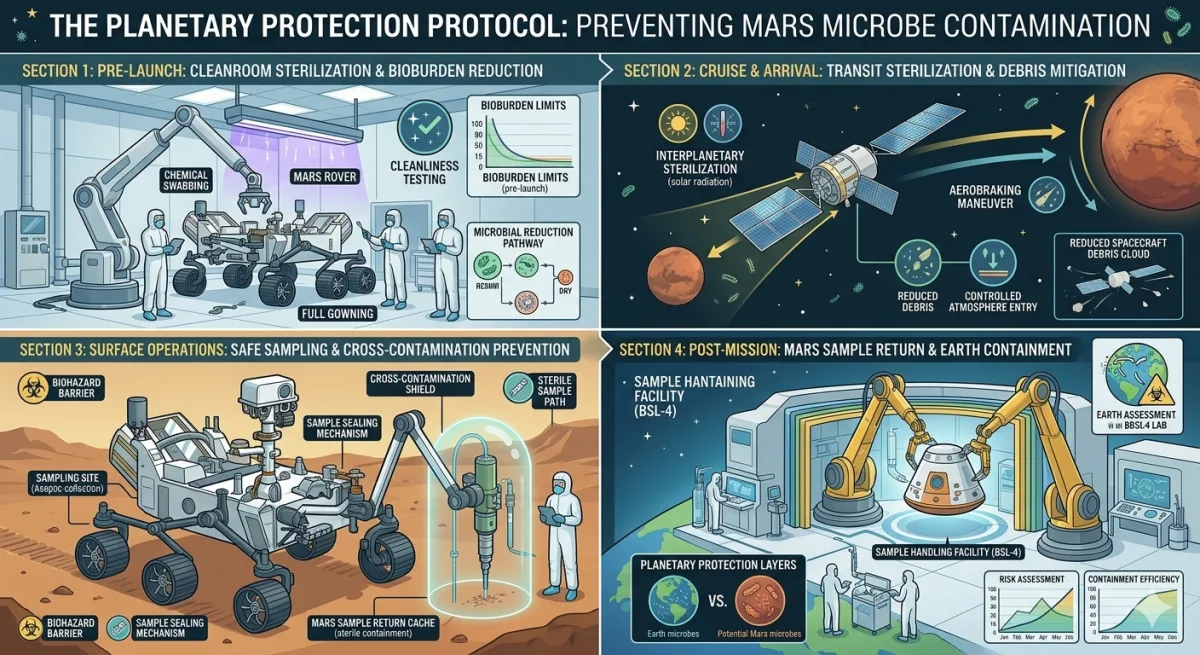
What Is Planetary Protection?
Planetary protection is designed to protect both sides of the Earth-Mars relationship.
The first side is forward contamination. This happens when microorganisms or other biological material from Earth are carried aboard a spacecraft and reach another world. Mars is particularly important because scientists are still investigating whether it ever supported life and whether environments capable of supporting life may exist beneath its surface.
The second side is backward contamination, which concerns material returned from another world to Earth. For Mars sample-return missions, scientists must consider the possibility—however uncertain—that Martian samples could contain unknown biological material. NASA therefore treats Mars sample return as a Restricted Earth Return mission.
Why Mars Needs Special Protection
Mars is cold, dry and exposed to intense radiation, but it has also preserved evidence of ancient water and environments that may once have been habitable. Some subsurface locations could potentially offer conditions more favorable to microbial survival.
That creates a scientific problem. If a spacecraft carries Earth microbes to Mars, scientists could later detect those organisms—or their biological signatures—and mistakenly interpret them as evidence of Martian life.
NASA's planetary-protection research therefore studies which microorganisms can survive spacecraft assembly, launch and spaceflight, as well as extreme Martian conditions. Cleanroom workers and spacecraft assembly environments are important parts of this research because they are major sources of terrestrial microorganisms.
How Mars Missions Are Classified
Planetary-protection requirements depend on the destination and the type of mission. Mars orbiters and landers do not automatically receive exactly the same requirements.
| Mission Type | NASA Planetary Protection Category | Main Concern |
|---|---|---|
| Mars flyby or orbiter | Category III | Avoiding harmful contamination of scientifically important regions |
| Mars lander or probe | Category IV | Limiting biological contamination reaching the Martian environment |
| Lander investigating possible Martian life | Category IVb | Stronger protection because of direct life-detection goals |
| Mission entering a Mars Special Region | Category IVc | Protecting locations where terrestrial organisms might survive or reproduce |
| Mars sample return | Category V, Restricted Earth Return | Preventing potential Martian contamination of Earth |
NASA divides Mars lander missions into IVa, IVb and IVc, with stricter requirements applied when the mission has a greater potential to interfere with investigations of Martian life.
Cleaning and Contamination Control
Planetary protection begins long before a spacecraft reaches Mars.
Spacecraft hardware is built and handled in controlled environments designed to reduce biological contamination. NASA describes the use of cleanrooms, air filtration, protective clothing, personnel procedures and other controls to maintain required cleanliness levels.
Spacecraft may also undergo validated processes designed to reduce microbial populations. Testing and documentation are important because planetary protection is not simply a matter of saying that a spacecraft is "clean." Mission teams must demonstrate compliance with the requirements assigned to their mission.
The goal is not to make every spacecraft biologically sterile in an absolute sense. Instead, planetary-protection rules establish risk-based requirements that are matched to the mission and the scientific importance of its destination.
Protecting Earth From Returned Mars Material
The second major challenge comes when material travels in the opposite direction.
Mars sample return is classified as Category V Restricted Earth Return. The basic idea is that returned material must remain contained until scientists can determine whether it presents biological or other relevant risks.
NASA's current planning documents describe a system that includes containment, transportation controls and a dedicated Sample Receiving Facility. The samples would be examined in highly controlled conditions before being distributed for wider scientific study.
As of September 28, 2026, NASA has not finalized a single official Mars Sample Return implementation architecture. NASA's earlier plan was to study two possible approaches before selecting a way forward, while current NASA material continues to describe the mission as a future mission concept.
NASA's New Mars Protection Review in 2026
Planetary protection is not a fixed set of rules. It changes as scientific knowledge improves.
On August 28, 2026, NASA announced the creation of M-FORCE, a new external Tiger Team focused on Mars Forward Operational Risk and Contamination Evaluation. NASA said the team will use more than 60 years of atmospheric and surface information to update assumptions and calculations used in planetary-protection protocols.
The work is intended to refine NASA's understanding of contamination risk for future Mars Category III orbiters and Category IVa landed missions using technical, biological and environmental modeling.
COSPAR has also updated its international Planetary Protection Policy. Its newest version was published in January 2026 and includes structural changes and a unified policy for icy worlds.
Why Planetary Protection Matters
Planetary protection is about more than keeping spacecraft clean. It protects the credibility of future scientific discoveries.
If humans eventually determine that Mars once contained life, researchers will need confidence that evidence was genuinely Martian rather than something introduced from Earth. At the same time, if samples are returned, Earth must be protected from unknown biological material while scientists study it.
The rules therefore help preserve Mars as a scientific record while allowing exploration to continue.
Current Planetary Protection Status
| Area | Current Situation in 2026 |
|---|---|
| Mars exploration | Active robotic exploration continues |
| COSPAR policy | Updated in 2026 |
| NASA planetary-protection requirements | Governed by current NASA policy and technical standards |
| Mars Sample Return | Still being developed; no final architecture confirmed in current NASA material |
| Mars contamination research | Active, including NASA's new M-FORCE effort |
| Future human missions | Require continued assessment of forward and backward contamination risks |
Frequently Asked Questions
What is planetary protection?
It is the practice of preventing harmful biological contamination between Earth and other worlds.
What is forward contamination?
Forward contamination means carrying Earth organisms or biological material to another planetary body.
What is backward contamination?
Backward contamination refers to potentially harmful extraterrestrial material being returned to Earth.
Why is Mars treated differently from the Moon?
Mars has much greater scientific importance in the search for past or present extraterrestrial life, so many Mars missions face stricter planetary-protection requirements.
Are there confirmed microbes living on Mars?
No confirmed indigenous Martian life has been discovered. The possibility of ancient or present life is one reason contamination control remains important.
Are Mars spacecraft completely sterile?
Planetary protection relies on defined contamination limits, cleaning, sterilization where required, monitoring and verification rather than assuming absolute sterility.
Will Mars samples simply be opened in an ordinary laboratory?
No. Returned samples subject to Restricted Earth Return requirements are intended to remain contained until appropriate safety and scientific assessments are completed.
Is planetary protection still changing?
Yes. NASA and international scientific organizations continue updating requirements as new information about Mars, spacecraft contamination and biological survival becomes available.
References
NASA Planetary Protection Policy and Requirements
NASA Planetary Protection Program
NASA/JPL Planetary Protection Missions
NASA/JPL Planetary Protection Research
COSPAR Policy on Planetary Protection — 2026 update
NASA M-FORCE Mars contamination assessment — August 28, 2026