

The Geopolitics of Civil Space Exploration on the Moon and Mars
The next phase of civil space exploration is becoming a geopolitical contest as much as a scientific one. The United States is building the Artemis Accords into a 71-country diplomatic framework while developing a commercial and international lunar architecture around Artemis, Gateway and commercial landers. China is developing its own Moon strategy through Chang’e missions and the International Lunar Research Station, with Russia and a growing group of international partners involved. Mars is different: it is still primarily a scientific and technological arena, but China’s Tianwen-3 sample-return mission and NASA’s changing Mars strategy show that planetary exploration is increasingly connected to national prestige, industrial capacity, technological leadership and future human-exploration ambitions. The biggest geopolitical questions are no longer simply who can reach the Moon or Mars first. They are who sets the rules, who builds the infrastructure, who controls access to important locations and services, how space resources are used, and whether competing national programs can coexist without turning civil exploration into another arena of strategic rivalry.
Summary
-
Subject: Geopolitics of civil exploration on the Moon and Mars
-
Main strategic arenas: Lunar south pole, lunar communications/navigation, space resources, Mars science and sample return
-
Leading geopolitical blocs: U.S.-led Artemis coalition and China-led International Lunar Research Station framework
-
Artemis Accords: 71 signatories as of September 7, 2026
-
China's lunar strategy: Chang’e exploration, crewed lunar landing ambitions and ILRS development
-
Key current Chinese mission: Chang’e-7, whose 2026 launch window was not completed because the mission did not meet launch conditions
-
Major U.S. development: Artemis III has been restructured as a 2027 Earth-orbit test mission, with the first planned Artemis lunar landing now targeted for Artemis IV in early 2028
-
Commercial role: Companies are increasingly becoming infrastructure providers rather than simply government contractors
-
Legal foundation: The 1967 Outer Space Treaty remains the central international legal framework
-
Major legal uncertainty: How increasingly valuable lunar resources and areas of intense activity should be governed
-
Mars competition: China plans Tianwen-3 for around 2028, while NASA is reassessing the architecture and cost of Mars Sample Return
-
Central geopolitical risk: Rival infrastructure networks could produce parallel space ecosystems rather than one shared system
-
Central opportunity: Scientific cooperation can continue even while national strategic competition increases
Introduction: Space Exploration Is Becoming Geopolitical Again
For much of the period after the Apollo era, human exploration of the Moon seemed to occupy a secondary place in international politics. The focus shifted toward low-Earth orbit, especially the Space Shuttle, the International Space Station and satellite services.
That is changing.
The Moon is becoming the center of a new international exploration economy. Countries are developing landers, rovers, communications systems, navigation networks and scientific instruments. Governments are also building diplomatic coalitions around their exploration programs.
Mars is entering the same discussion, although more slowly. Unlike the Moon, Mars is still too distant and difficult for permanent human activity to be an immediate reality. But robotic exploration, sample return, communications infrastructure and technologies needed for future crewed missions are already becoming matters of national capability and international influence.
This means that civil space exploration has acquired a new geopolitical dimension.
The competition is not necessarily about placing a flag on another world. It is increasingly about infrastructure, standards, partnerships, scientific data, industrial capacity, resources and the ability to shape future rules.
The legal starting point remains the Outer Space Treaty, which establishes that the exploration and use of outer space, including the Moon and other celestial bodies, should be carried out for the benefit and in the interests of all countries. It also establishes the basic principle that celestial bodies are not subject to national appropriation.
The political challenge is that these broad principles were created during a very different technological era.
Why the Moon Matters So Much
The Moon is close enough to Earth to support repeated robotic missions and, increasingly, human missions. That makes it a practical testing ground for technologies that could eventually be used farther away.
But the Moon is not strategically valuable simply because it is nearby.
The lunar south pole is especially important because some areas receive unusually favorable sunlight while permanently shadowed regions may contain water ice. Water could potentially support life-support systems and, after processing, could contribute to propellant production. ESA describes the south pole as a particularly important area because of both its lighting conditions and permanently shadowed regions containing potential ice resources.
That creates an obvious geopolitical problem.
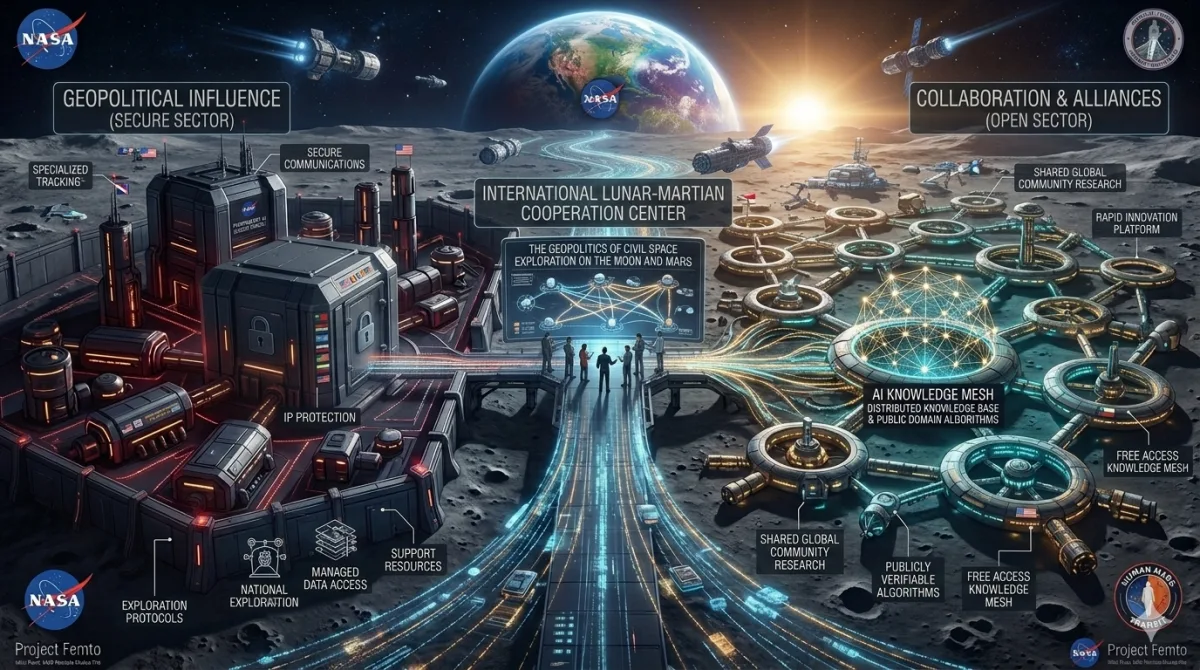
If several countries and companies want to operate in the same comparatively attractive regions, questions arise over landing locations, communications, power systems, scientific sites, traffic management and interference.
The Outer Space Treaty does not permit countries to claim lunar territory as sovereign territory. However, future operations will still require practical arrangements around specific sites.
That is why the language of coordination, non-interference and safety zones is so important.
The Legal Foundation: Who Owns the Moon?
No country legally owns the Moon.
The 1967 Outer Space Treaty is the foundation of modern international space law. It entered into force in October 1967 and established basic principles for the exploration and use of outer space.
Among its central ideas is that outer space cannot simply become another territory for national acquisition.
The difficulty becomes greater when discussion turns from territory to resources.
The Moon contains materials that future missions might seek to use locally. Governments and companies are therefore increasingly interested in questions such as whether extracting and using lunar material is compatible with the existing treaty system.
The 1979 Moon Agreement goes further than the Outer Space Treaty. It says that the Moon and its natural resources are the common heritage of mankind and calls for an international regime governing exploitation of resources when such exploitation becomes feasible.
However, the Moon Agreement has never attracted the same level of participation as the Outer Space Treaty. As of September 7, 2026, the UN Treaty Collection lists 17 parties and 11 signatories. (United Nations Treaty Collection)
This creates one of the central divisions in space governance.
Many major space powers are operating primarily under the Outer Space Treaty framework rather than the Moon Agreement's broader resource-management model.
The Artemis Accords: A New Political Framework
The United States responded to the changing lunar environment by developing the Artemis Accords.
NASA and the U.S. Department of State created the Artemis Accords in 2020 with the original group of signatories. The framework is designed around safe, peaceful and responsible civil exploration of the Moon, Mars and other destinations.
The Accords do not replace the Outer Space Treaty. Instead, they reinforce existing obligations and establish additional principles for participating countries.
Among their major themes are peaceful exploration, transparency, scientific-data sharing, assistance to astronauts, interoperability and avoiding harmful interference between activities.
The diplomatic reach of the agreement has expanded quickly.
On August 31, 2026, Türkiye became the 71st Artemis Accords signatory. NASA describes the coalition as committed to peaceful and transparent exploration of the Moon, Mars and beyond.
That number matters geopolitically because the Accords are becoming more than a technical document. They increasingly represent a network of countries that intend to work together within a common set of exploration principles.
The implication is important: the first major geopolitical contest in lunar exploration may be over standards and partnerships before it is over lunar territory.
China's Parallel Lunar Strategy
China is developing a different but equally ambitious model.
The country's International Lunar Research Station, or ILRS, is intended to create a long-term scientific and technological presence on and around the Moon.
China and Russia formally announced cooperation on the project in 2021. Their joint statement described the ILRS as a project for peaceful exploration and use of the Moon and said cooperation would be guided by international law and relevant treaties.
China has also worked to attract additional international participation.
CNSA has described the ILRS as an expandable scientific facility involving infrastructure on the lunar surface, in lunar orbit and on Earth. Chinese officials have said the basic model is intended for the lunar south pole by 2035. (State Council Information Office)
The strategy combines exploration with infrastructure.
China plans to use missions such as Chang’e-7 and Chang’e-8 to investigate the lunar south pole and test technologies related to resource utilization. (State Council of China)
This is why the ILRS is geopolitically significant.
It is not merely a single spacecraft. It represents an attempt to establish a durable exploration ecosystem with its own partners, scientific contributions, communications, infrastructure and future human-exploration objectives.
Chang’e-7 Shows How Quickly the Competition Is Moving
China's Chang’e-7 mission illustrates the current transition from exploration to infrastructure-building.
The mission is designed to conduct environmental and resource surveys at the lunar south pole using orbiting, landing, roving and hopping systems. China also plans international scientific participation.
But an important update occurred in August 2026.
On August 23, 2026, Chinese authorities said Chang’e-7 did not meet launch conditions, meaning the planned launch window for that year would not proceed.
That correction matters because older reports still describe Chang’e-7 as simply a 2026 mission.
As of the current research cutoff, the more accurate description is that Chang’e-7 is a planned south-pole mission whose intended 2026 launch opportunity was missed.
This is also a useful reminder about space geopolitics: ambitious schedules are politically important, but actual launch and mission readiness ultimately determine the pace of competition.
Artemis Is Also Changing
The U.S. Artemis program has undergone major changes.
Older Artemis timelines described Artemis III as the mission that would return astronauts to the lunar surface. NASA's current 2026 architecture is different.
Artemis III is now scheduled for 2027 as a crewed demonstration mission in low-Earth orbit. The four-person crew will practice rendezvous and docking between Orion and commercial lunar-lander test systems developed by SpaceX and Blue Origin. It will not itself be the lunar landing mission.
The first planned crewed lunar landing under the revised architecture is Artemis IV, currently targeted for early 2028. NASA says Artemis IV will take astronauts toward the lunar south pole, with two astronauts descending to the surface for approximately a week.
This distinction is essential when discussing current Moon geopolitics.
Major Moon Programs and Their Geopolitical Meaning
| Program | Main actor(s) | Current position | Geopolitical importance |
|---|---|---|---|
| Artemis | United States and international partners | Active; Artemis III planned for 2027, Artemis IV lunar landing targeted for early 2028 | Builds a broad U.S.-centered exploration coalition |
| Artemis Accords | 71 countries as of Sept. 7, 2026 | Expanding | Creates shared principles for participating states |
| Gateway | NASA, ESA, JAXA, CSA, MBRSC and industry | Under development | Creates an international lunar-orbit architecture |
| CLPS | NASA and U.S. commercial providers | Active | Shifts parts of lunar exploration toward commercial services |
| ILRS | China, Russia and international partners | Development | Provides an alternative multinational lunar architecture |
| Chang’e-7 | China and international partners | 2026 launch opportunity missed | South-pole resource and environmental exploration |
| Chang’e-8 | China and international partners | Planned around 2028 | Resource-utilization demonstrations and ILRS preparation |
| Moonlight | ESA, Canada and partners | Development | Potential shared lunar communications/navigation infrastructure |
| Argonaut | ESA and European industry | First mission planned for 2030 | Gives Europe greater independent lunar access |
Sources: NASA, ESA, CNSA and government publications. (NASA)
Gateway and the Importance of Infrastructure
The most important geopolitical assets in future lunar exploration may not be flags or bases.
They may be services.
NASA's Gateway is designed as a lunar-orbiting station supporting scientific research, lunar surface missions and future exploration. International contributors include NASA, ESA, JAXA, the Canadian Space Agency and the Mohammed Bin Rashid Space Centre.
Its planned near-rectilinear halo orbit would provide access to the lunar surface, including the south-pole region.
At the same time, ESA is developing Moonlight, a communications and navigation system intended to provide connectivity and navigation services around the Moon. The planned system includes four navigation satellites and one communications satellite, with a strong focus on the lunar south pole.
This leads to an important geopolitical insight.
A country or coalition does not need to "own" the Moon to exercise significant influence there.
Influence could come from providing:
-
navigation
-
communications
-
landing services
-
power
-
transportation
-
scientific data
-
surface infrastructure
-
standards
-
emergency support
The future lunar economy could therefore resemble a network of services rather than a collection of national territories.
Commercial Companies Are Becoming Geopolitical Actors
The rise of private companies changes the traditional model of international space politics.
NASA's Commercial Lunar Payload Services program allows American companies to deliver science and technology payloads to the lunar surface. NASA currently lists 17 commercial lunar delivery contracts and more than 60 NASA payloads under the program, with a combined contract ceiling of $2.6 billion through November 2028.
That represents a major change in how a government can explore another world.
Instead of building every spacecraft itself, NASA can buy transportation and delivery as a service.
This lowers barriers to experimentation and creates an emerging lunar commercial sector.
It also creates new geopolitical questions.
A commercial company may be privately owned, but its technologies, launch systems and infrastructure can have national strategic importance. Governments therefore have to balance commercial freedom with national security, export controls, international treaty obligations and diplomatic relations.
The boundary between civil space infrastructure and strategic infrastructure is becoming less clear.
Europe Wants More Independent Capability
Europe is not simply choosing between Washington and Beijing.
ESA is building its own lunar capabilities while cooperating closely with Artemis partners.
Its Argonaut lunar lander program will provide European access to the lunar surface beginning in the 2030s. ESA says the first Argonaut mission is planned for 2030 and that the landers could carry scientific instruments, rovers, infrastructure and resources needed by astronauts. (European Space Agency)
This illustrates another important geopolitical trend: middle and major space powers want cooperation without complete technological dependence.
Countries can cooperate with the United States while simultaneously investing in their own independent systems.
That produces a more complicated international environment than the Cold War's simple two-superpower model.
India, Japan and Other Countries Are Becoming More Important
The future Moon environment will not be controlled solely by the United States and China.
India has already demonstrated independent lunar and Mars exploration capabilities, and its space sector is undergoing further expansion. A September 7, 2026 Reuters report noted that India's government continues to encourage greater private-sector involvement while maintaining ISRO's central role in national space research and technology.
Japan is also a major participant in NASA's Gateway architecture, while European and Canadian programs are contributing to lunar communications, navigation and surface exploration.
The broader pattern is clear: countries increasingly have a choice between joining large exploration coalitions, developing specialized capabilities, or attempting to do both.
For emerging space powers, cooperation can provide access to missions without requiring them to independently build every element of a deep-space program.
The Resource Question Could Become the Biggest Political Problem
Lunar resources are one of the most sensitive subjects in future space governance.
The question is not simply whether resources exist.
The real issue is what happens when one operator begins extracting them.
Suppose a company or government identifies an area with valuable ice and establishes equipment nearby. Another operator later wants to work in the same region.
Neither can legally turn the location into national territory.
But practical operations could still require physical separation for safety.
That is where competing interpretations of resource rights and "non-interference" could create political disputes.
The Artemis Accords support the establishment of temporary notification and coordination measures around activities when necessary for safety and to prevent harmful interference. The U.S. and its partners view this as compatible with the Outer Space Treaty rather than as territorial ownership.
Critics of this approach, however, have raised broader concerns in international legal discussions about whether bilateral or coalition-based arrangements could gradually produce de facto control over strategically valuable sites.
The United Nations remains an important forum for this debate.
In recent Legal Subcommittee work, states have continued discussions about possible legal models for the exploration, exploitation and utilization of space resources. (unoosa.org)
This debate is likely to become more important as actual resource-extraction demonstrations move closer.
Environmental Protection Will Also Become Geopolitical
Another underestimated problem is the lunar and planetary environment.
The Moon has no atmosphere comparable to Earth's, and lunar dust can be difficult for equipment and astronauts. Multiple missions operating around the same areas could create contamination and operational problems.
Mars has an even bigger issue because of planetary protection.
Scientists need to distinguish naturally occurring Martian environments from contamination introduced by Earth.
The more countries and companies that operate on Mars, the more complicated these rules become.
Civil exploration therefore requires not only diplomacy among governments but also agreed standards on:
-
landing sites
-
scientific protection
-
contamination control
-
sample handling
-
communications
-
data sharing
-
disposal of equipment
-
interference between missions
The UN's Long-term Sustainability Guidelines already provide a broad framework for sustainable space activity. COPUOS adopted 21 voluntary guidelines covering areas such as information exchange, registration, collision risk and responsible national regulation. (UN Office for Outer Space Affairs)
The challenge will be applying principles developed primarily for the orbital environment to increasingly complex lunar and planetary operations.
Mars: A Different Geopolitical Competition
Mars is not yet experiencing the same level of operational competition as the Moon.
There is no permanent human settlement there, and the planet is much farther away.
But Mars has a different type of geopolitical value.
It represents the ultimate test of deep-space technological capability.
A successful Mars sample-return mission requires sophisticated launch systems, spacecraft, entry technology, planetary landing, surface operations, sample handling and interplanetary navigation.
That makes Mars missions highly visible demonstrations of national scientific and industrial capacity.
China's Tianwen-3 Mission
China is moving strongly into this area.
Its Tianwen-3 mission is planned for launch around 2028, with the objective of returning Martian samples around 2031. China says the mission will include an orbiter, returner, lander and ascender architecture.
China is also opening the mission to international scientific cooperation.
In 2026, CNSA announced selected international scientific projects for Tianwen-3, including instruments involving scientists and institutions from multiple countries and territories.
This is geopolitically important because cooperation does not necessarily eliminate competition.
A country can lead a mission while inviting international researchers to participate.
That creates scientific influence, diplomatic relationships and technological partnerships at the same time.
NASA's Mars Sample Return Challenge
The United States and Europe have also been working toward Mars Sample Return, but the program has faced major cost and schedule challenges.
NASA announced that it was studying two potential architectures and expected to select a path forward in the second half of 2026.
As of the September 7, 2026 research cutoff, the important point is that older descriptions of the mission should not be presented as though its previous architecture and timetable remain fixed.
This creates a striking contrast.
China currently presents Tianwen-3 as a mission targeting approximately 2028 launch and 2031 sample return, while NASA is working through a major architectural reassessment.
That does not automatically mean China will succeed first. Deep-space missions are exceptionally difficult.
But the difference demonstrates why mission architecture and execution capacity are themselves geopolitical assets.
Mars Communications Will Become Strategic Infrastructure
Mars exploration also reveals another future issue: communications.
In May 2026, NASA issued a request for proposals for industry collaboration on a Mars Telecommunications Network. The proposed network would use high-performance Mars orbiters to support future surface, orbital and human missions.
This is a significant shift.
Just as lunar navigation and communications can become essential infrastructure around the Moon, Mars will eventually need communications networks capable of supporting multiple users and missions.
The first actors able to build reliable systems may influence future technical standards and commercial markets.
Civil Exploration and Military Power
Civil space exploration cannot be completely separated from national security.
The technologies overlap.
Launch systems, satellite communications, navigation, autonomous spacecraft, space-domain awareness, robotics and deep-space communications can all have both civilian and strategic applications.
That does not mean every lunar or Mars mission is secretly military.
The Outer Space Treaty establishes peaceful-use principles for celestial bodies and prohibits the placement of nuclear weapons or other weapons of mass destruction in orbit or on celestial bodies. It also contains restrictions concerning military activities on celestial bodies while allowing certain activities involving military personnel for peaceful purposes and scientific research.
The geopolitical challenge is therefore one of dual use.
A communications system built for astronauts could also be strategically important.
A navigation network built for scientific missions could become critical infrastructure.
A powerful launch vehicle developed for planetary exploration may also have broader national-security significance.
This does not invalidate civil cooperation, but it makes transparency more important.
Parallel Space Ecosystems Could Become the New Reality
One of the biggest risks is not necessarily an armed confrontation.
It could be technological fragmentation.
Imagine two broad ecosystems developing around the Moon.
One relies on NASA, Artemis Accords partners, Gateway, U.S. commercial landers, ESA systems and related standards.
Another revolves around China's ILRS, Chinese spacecraft, Chinese communications infrastructure and its international partners.
Both could conduct peaceful scientific exploration.
Both could comply with many parts of international law.
Yet their infrastructure might not be fully interoperable.
That would produce something similar to competing technological ecosystems on Earth.
The result could be duplicate standards, duplicated infrastructure and political pressure on smaller countries to choose one network over another.
Current Developments and Future Direction
| Initiative | Current status as of Sept. 7, 2026 | Next important milestone | Geopolitical significance |
|---|---|---|---|
| Artemis Accords | 71 signatories | Continued expansion and implementation | U.S.-centered diplomatic network |
| Artemis III | Planned for 2027 as Earth-orbit demonstration | Orion/lander docking tests | Reduces risk before lunar landing |
| Artemis IV | Planned for early 2028 | Crewed lunar-surface mission | Major U.S. return to lunar south pole |
| Gateway | Under development | First elements and Artemis IV integration | Shared international lunar infrastructure |
| CLPS | Active | More commercial lunar deliveries | Builds private lunar logistics market |
| Chang’e-7 | 2026 launch opportunity missed | Revised future launch timing | Chinese south-pole exploration |
| Chang’e-8 | Planned around 2028 | Resource-utilization experiments | Supports ILRS development |
| ILRS | Under development | Basic model targeted for 2035 | China-led alternative lunar architecture |
| Argonaut | In development | First mission planned for 2030 | Greater European autonomy |
| Moonlight | In development | Initial services targeted before full deployment | Potential international lunar communications/navigation service |
| Tianwen-3 | Development | Launch around 2028 | China's major Mars sample-return effort |
| Mars Sample Return | NASA architecture under reassessment | Selection of future architecture | U.S.-European response to Mars exploration challenge |
| Mars Telecommunications Network | Industry procurement stage | Development of future Mars communications capacity | Foundation for larger Mars exploration campaigns |
Sources: NASA, ESA, CNSA, UNOOSA and associated government publications.
The Role of Russia
Russia remains an important historical space power and was an original participant in the International Space Station era.
In lunar exploration, Russia's most visible current geopolitical connection is its cooperation with China through the ILRS framework. The 2021 CNSA-Roscosmos joint statement formally established cooperation on the station.
Russia also contributes scientific hardware to Chinese lunar missions. CNSA has said a Russian lunar dust and electric-field instrument is among the international instruments associated with Chang’e-7.
Russia's role therefore illustrates a broader trend: states that once participated in Western-led international projects can develop new partnerships as geopolitical relationships change.
The Future of International Cooperation
Competition does not mean cooperation will disappear.
In fact, cooperation may become even more important because no single country can easily provide every technology required for sustained exploration.
The Moon offers many possible areas for collaboration:
-
scientific instruments
-
communications
-
navigation
-
robotics
-
sample analysis
-
environmental monitoring
-
emergency support
-
medical research
-
transportation
-
surface infrastructure
China's Tianwen-3 program is already incorporating international scientific instruments, while Artemis and Gateway involve multiple countries.
That suggests a possible future model where political competition and scientific cooperation exist simultaneously.
Countries do not have to agree on every geopolitical issue to work together on planetary science.
What Developing Space Nations Stand to Gain
The new Moon and Mars environment is particularly important for emerging space nations.
Building a complete lunar program independently can cost enormous amounts of money and require decades of technical development.
International partnerships therefore provide a path into deep-space exploration.
Smaller countries can contribute:
-
scientific instruments
-
software
-
sensors
-
communications technology
-
research expertise
-
astronauts
-
universities
-
specialized manufacturing
In return, they gain scientific data, engineering experience, international partnerships and access to future space infrastructure.
China has explicitly promoted international participation in the ILRS, while the Artemis Accords provide another route for countries seeking participation in U.S.-associated lunar exploration. (State Council Information Office)
The result could be a much wider space community than existed during the original Space Race.
Why the Moon and Mars Matter Beyond Space
The geopolitical importance of lunar and Martian exploration extends beyond the destinations themselves.
The programs stimulate development in:
-
robotics
-
artificial intelligence
-
autonomous navigation
-
advanced materials
-
communications
-
propulsion
-
energy systems
-
remote operations
-
manufacturing
-
planetary science
They can also influence education and national industrial policy.
Space exploration has always been partly about prestige, but the modern version is increasingly about technological ecosystems.
A successful lunar program can strengthen an entire country's aerospace industry.
A strong commercial space sector can create companies capable of selling services internationally.
A deep-space communications network can support future scientific and commercial markets.
Major Geopolitical Questions for the Next Decade
Several questions will determine whether lunar and Martian exploration becomes cooperative or fragmented.
Who Sets the Rules for Lunar Resources?
Existing treaties provide the foundation, but resource activity will test how those rules should be interpreted in practice.
The international community will have to determine how to balance resource use, commercial incentives, safety and the principle that celestial bodies cannot become national territory.
Who Controls Critical Infrastructure?
Communications and navigation may become as important as physical landings.
A coalition that provides reliable infrastructure could acquire substantial diplomatic and commercial influence.
Can Different Systems Interoperate?
The Moon could eventually host multiple national and commercial networks.
Interoperability will determine whether they function as one global exploration environment or several separate technological zones.
Will Scientific Data Remain Open?
Scientific cooperation works best when researchers can access information.
But countries may eventually face tension between open science and national or commercial interests.
Can Smaller Countries Avoid Choosing Sides?
The rise of competing exploration coalitions could create pressure on developing space nations.
Countries will likely want partnerships with multiple powers rather than becoming technologically dependent on one side.
Can Civil Exploration Remain Clearly Civil?
As infrastructure becomes more valuable, the distinction between civil and strategic capabilities will become harder to maintain.
Transparency and international communication will therefore become increasingly important.
References
-
NASA — Artemis Accords: Current list and principles of the Artemis Accords, including the 71st signatory, Türkiye. (NASA)
-
United Nations Treaty Collection — Outer Space Treaty: International legal foundation for space exploration. (United Nations Treaty Collection)
-
United Nations Treaty Collection — Moon Agreement: Current treaty participation and text information. (United Nations Treaty Collection)
-
United Nations Office for Outer Space Affairs — Long-Term Sustainability Guidelines: UN framework for sustainable space activity. (UN Office for Outer Space Affairs)
-
NASA — Artemis III: Current 2027 mission architecture and objectives. (NASA)
-
NASA — Artemis IV: Current early-2028 lunar landing plan. (NASA)
-
NASA — Gateway: International lunar-orbit infrastructure and partner agencies. (NASA)
-
NASA — Commercial Lunar Payload Services: Current commercial lunar delivery program. (NASA)
-
ESA — Moonlight: European lunar communications and navigation program. (ESA CSC)
-
ESA — Argonaut: European lunar lander program. (European Space Agency)
-
CNSA — China/Russia ILRS Joint Statement: Official foundation of Chinese-Russian cooperation on ILRS. (CNSA)
-
Chinese Government/Xinhua — Chang’e-7: Current 2026 mission status and planned south-pole activities. (State Council of China)
-
CNSA — International Lunar Research Station: Chinese plans for ILRS development and international participation. (CNSA)
-
CNSA — Tianwen-3: Current Mars sample-return plans and international cooperation. (CNSA)
-
NASA — Mars Sample Return: NASA's continuing reassessment of Mars Sample Return architecture. (NASA)
-
NASA — Mars Telecommunications Network: 2026 industry initiative for future Mars communications infrastructure. (NASA)
-
Reuters — India Space Sector, September 7, 2026: Current development of India's commercial and government space ecosystem. (Reuters)