
Deep Space Network Stress Points: Scaling for Massive Fleets
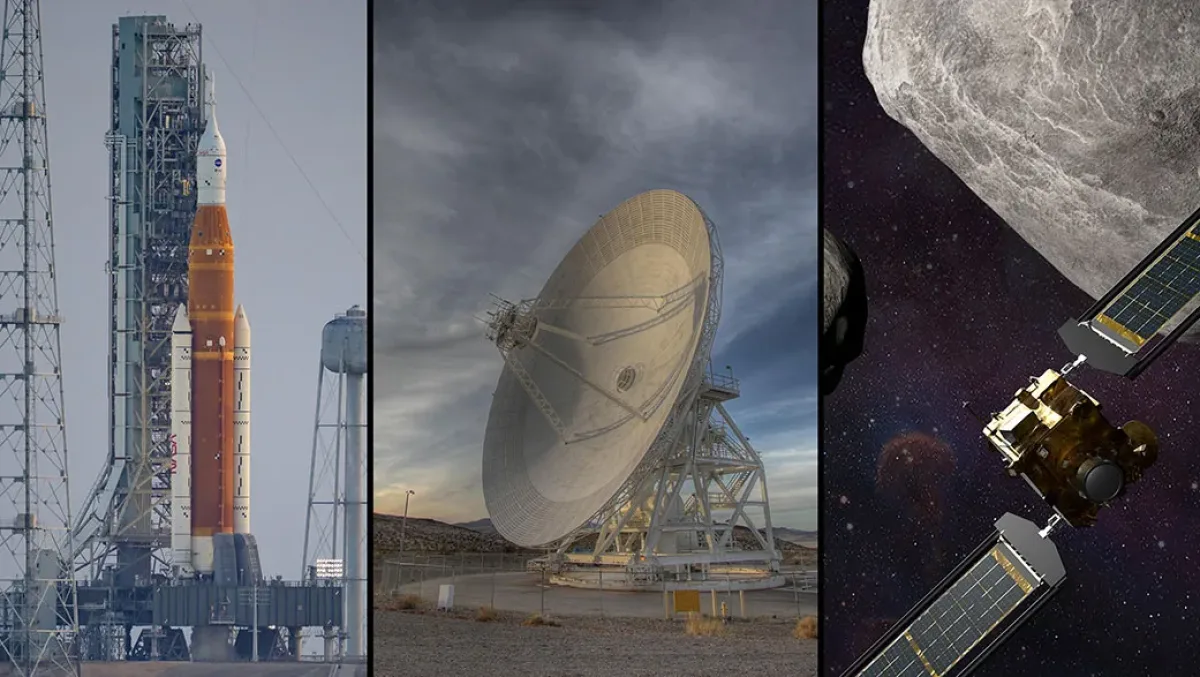
NASA’s Deep Space Network (DSN) is facing a communications challenge that is becoming harder to ignore: more spacecraft are exploring the Moon, Mars, the outer solar system and interstellar space, while the basic number of high-performance antennas on Earth remains limited. The DSN operates three strategically positioned complexes in Goldstone, California; Madrid, Spain; and Canberra, Australia. In August 2026, NASA brought its newest antenna, Deep Space Station 23 (DSS-23), into operational service at Goldstone to add capacity. NASA is also developing new communications approaches, including larger use of optical communications, lunar networking and a planned Mars Telecommunications Network. The goal is no longer simply to communicate with individual spacecraft, but to build a communications infrastructure capable of supporting a much larger and more demanding fleet.
Why the Deep Space Network Matters
A spacecraft thousands or millions of kilometers away cannot simply use a normal satellite connection to contact Earth. Deep-space missions depend on extremely sensitive ground systems capable of transmitting commands and receiving very weak signals.
That is where the Deep Space Network comes in.
The DSN is NASA's global system of large radio antennas used to communicate with spacecraft beyond Earth's immediate orbital environment. It provides telemetry, command, tracking and navigation support, while also contributing to scientific observations such as radio science and planetary radar.
Its three complexes are positioned roughly 120 degrees apart around Earth. As the planet rotates, a spacecraft visible to one station eventually moves below that station's horizon and can be picked up by another complex. This arrangement allows NASA to maintain long-duration communication with distant spacecraft.
The system has supported some of the most important robotic missions in space history, including Mars spacecraft, Voyager, New Horizons and missions studying distant worlds.
But the network was not designed for an unlimited number of spacecraft.
The Main Stress Point: Too Many Missions, Too Few Antennas
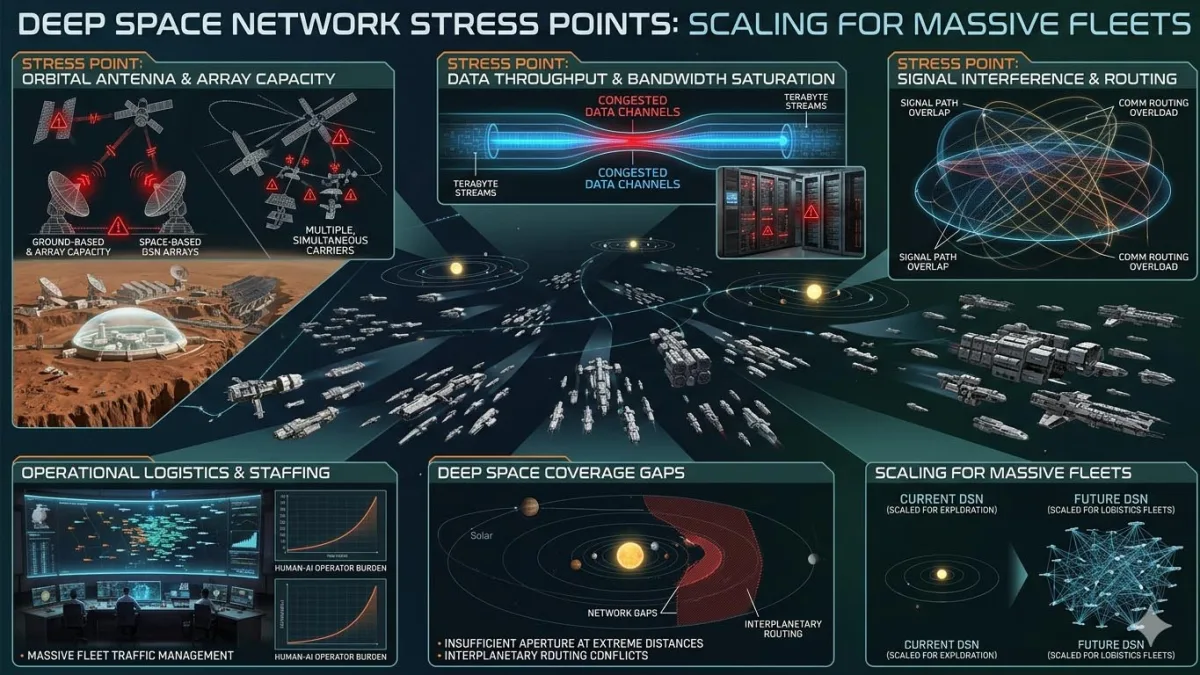
The biggest problem is not simply distance. It is scheduling.
NASA's DSN scheduling research states that demand for DSN services can exceed the capacity of the available antennas. The network can have roughly 400 to 500 scheduled activities during a typical week, with missions competing for limited communications time and dealing with many operational constraints.
A spacecraft may need only a few hours of communication each week during normal operations, but another spacecraft could suddenly require extensive support during a critical event.
A launch, landing, spacecraft emergency, orbital maneuver or major scientific observation can change priorities quickly.
NASA has systems and procedures for handling these conflicts. Mission teams can negotiate schedule changes, and spacecraft can sometimes store data onboard and transmit it later when antenna demand is lower.
That works reasonably well when mission numbers are manageable. The difficulty comes when many missions need support at the same time.
This is why a future with dozens or even hundreds of sophisticated deep-space spacecraft creates a major infrastructure question: How can Earth keep up with all those communications requests?
The Aging 70-Meter Antennas
Another major stress point is age.
Each DSN complex has a huge 70-meter antenna. These antennas are the largest and most sensitive dishes in the network, making them especially important for communicating with extremely distant spacecraft. NASA says the three 70-meter antennas have been operating for decades and are becoming increasingly expensive to maintain and repair.
This creates an unusual engineering problem.
The antennas are still extremely valuable, but relying heavily on a small number of very large dishes creates a bottleneck. When one of these major antennas is unavailable for maintenance or repair, the pressure on the rest of the network can increase.
NASA's strategy has therefore shifted toward adding more modern 34-meter antennas that can work individually or together.
DSS-23: A New Capacity Boost in 2026
One of the most important recent developments came in August 2026.
NASA officially introduced Deep Space Station 23, or DSS-23, at the Goldstone complex in California. The new antenna is 34 meters, or about 114 feet, across and is designed to support spacecraft using multiple radio frequencies.
DSS-23 began operational service on August 3, 2026, after testing from May through July. NASA says it has already communicated with missions including Chandra, Mars Reconnaissance Orbiter, Psyche, Juno and Voyager 1.
The antenna is part of NASA's long-running Aperture Enhancement Project, which began in 2009 to expand and modernize the DSN.
The project calls for six new 34-meter antennas across the network. NASA says the final enhancement-project antenna, Deep Space Station 33 at Canberra, is expected to come online in 2029. At that point, the DSN will have 13 antennas of the 34-meter class.
DSN Scaling at a Glance
| Area | Current Situation | Scaling Response |
|---|---|---|
| Global coverage | Three complexes in California, Spain and Australia | Maintain geographically distributed operations |
| Large antennas | Three 70-meter antennas remain critical | Add more 34-meter antennas and array them |
| Mission demand | Hundreds of scheduled activities occur weekly | Improve scheduling and automation |
| Data volume | New missions generate increasingly large datasets | Increase communications capacity and explore optical links |
| Mars communications | Existing systems support current missions | Develop a dedicated Mars Telecommunications Network |
| Lunar missions | Growing number of lunar activities | Build interoperable LunaNet and lunar relay infrastructure |
Why Scheduling Becomes a Bigger Problem With Massive Fleets
Imagine a future in which Mars has several orbiters, multiple landers, rovers and eventually human missions, while the Moon has its own collection of orbiters, relay satellites, landers and surface vehicles.
At the same time, spacecraft could still be operating at Jupiter, Saturn, asteroids, the outer planets and beyond.
The difficulty is that spacecraft do not all communicate in the same way or at the same time.
Some need continuous or near-continuous support during critical mission phases. Others can communicate only during certain windows. Some require higher data rates, while others mainly need command and navigation support.
This makes the DSN less like a simple collection of antennas and more like a giant traffic-management system.
As the fleet grows, automated scheduling becomes increasingly important. NASA already uses advanced scheduling systems because the combination of spacecraft requirements, antenna availability, maintenance, geometry and operational constraints makes manual planning extremely difficult.

More Antennas Alone Will Not Solve Everything
Adding antennas is important, but it is only one part of the answer.
NASA also needs to improve how communications are distributed through the larger space network.
The agency's Near Space Network already combines NASA-owned infrastructure with commercial providers. NASA describes this network as using more than 40 government or commercially owned antennas, along with space relay satellites, to support missions closer to Earth.
That model shows how future space communications may work: NASA does not necessarily have to own every antenna or communications asset.
Commercial companies, international partners and dedicated relay systems can become part of the overall architecture.
For deep space, however, the situation is more difficult. NASA's 2026 small-spacecraft systems guidance notes that commercial providers do not yet support missions in deep space or at Sun-Earth Lagrange points, meaning the DSN remains critical for missions operating in those environments.
Optical Communications Could Change the Equation
Another important solution is laser communication.
Radio remains the foundation of deep-space communications, but optical communications can potentially move much larger quantities of information.
NASA says optical communications can transmit data at rates roughly 10 to 100 times higher than radio for the same amount of power. The agency's Deep Space Optical Communications experiment also demonstrated high-speed laser communication over enormous distances, including a 267-megabit-per-second stream from about 19 million miles away during testing involving the Psyche mission.
The implication is significant.
Future spacecraft may generate far more scientific data than today's missions. High-resolution images, video, advanced instruments and complex sensor packages can produce enormous amounts of information.
Better links mean less time waiting for data to reach Earth and less pressure on communication windows.
Optical communications will not replace the DSN overnight, but they could become an important part of a hybrid future in which radio and laser systems work together.
The Moon Is Becoming a Network, Not Just a Destination
NASA is also moving toward a network-based approach around the Moon.
The agency's LunaNet framework is designed to provide internet-like connectivity, navigation, detection and information services, along with radio and optical science capabilities. It is designed so that government, industry and international partners can build compatible systems and operate them as part of a broader lunar network.
This is important because future lunar missions will not necessarily communicate with Earth independently all the time.
Relay spacecraft can collect information from multiple users and send that information onward.
That approach can reduce the burden placed on direct Earth-to-spacecraft communications and create a more flexible architecture for a growing lunar fleet.
Mars May Need Its Own Communications Network
Mars presents an even greater challenge.
Distance creates long delays, while the growing number of robotic and future human missions will increase demand for reliable, high-bandwidth communications.
In September 2026, NASA selected Blue Origin to develop a Mars Telecommunications Network. The planned system includes a high-performance communications spacecraft orbiting Mars and is designed to support current and future Mars missions. NASA says the network is expected to become operational at Mars by 2030.
This is an important shift in thinking.
Instead of making every rover or lander depend directly on Earth for every major communication need, a Mars telecommunications infrastructure can act as a local communications layer.
That architecture could support much larger numbers of spacecraft.
A New Model for Deep-Space Communications
The long-term answer is unlikely to be one single technology.
NASA's direction points toward several systems working together:
- More DSN antennas to increase available radio capacity.
- Antenna arrays that can combine multiple dishes for greater sensitivity and redundancy.
- Better automated scheduling to manage growing demand.
- Optical communications to move much larger volumes of data.
- Lunar relay networks to serve growing Moon-based operations.
- Mars telecommunications infrastructure to support future Red Planet missions.
- Commercial partnerships where private systems can provide useful communications services.
Together, these technologies can turn space communications from a collection of isolated point-to-point links into something much closer to a distributed network.
Current DSN Expansion Projects
| Project or System | Location/Range | Status as of October 1, 2026 | Purpose |
|---|---|---|---|
| DSS-23 | Goldstone, California | Operational | Adds new 34-meter communications capacity |
| Aperture Enhancement Project | Goldstone, Madrid, Canberra | Ongoing | Expands and modernizes the DSN |
| DSS-33 | Canberra, Australia | Planned for 2029 | Final antenna in the current enhancement project |
| Optical communications | Deep-space testing | Continuing technology development | Higher-rate data transmission |
| LunaNet | Moon | Under development | Interoperable lunar networking |
| Mars Telecommunications Network | Mars | Planned for operations around 2030 | High-bandwidth communications and navigation |
The DSS-23 addition is especially important because NASA describes it as part of the effort to move toward a more modernized DSN capable of supporting decades of future exploration.
The Real Stress Point Is Scale
The phrase "massive fleets" does not necessarily mean that hundreds of spacecraft are already demanding the DSN simultaneously.
The bigger issue is what happens as space exploration becomes more active.
A future fleet could include spacecraft operating around the Moon, Mars, asteroids, the outer planets and deep space at the same time. Each mission adds another set of communications requirements.
The DSN therefore has to scale in several dimensions at once: antenna capacity, data rates, reliability, scheduling, automation, redundancy and geographic coverage.
Simply building more giant antennas would help, but it would not completely solve the problem.
The future is more likely to involve a layered communications architecture in which DSN antennas remain the essential deep-space backbone while relay satellites, optical links, commercial providers and local networks handle other parts of the communications load.
Latest Developments as of October 1, 2026
The DSN is currently in a significant period of modernization.
The operational arrival of DSS-23 in August 2026 increased the network's available antenna capacity. NASA also expects the final antenna of the current enhancement project to enter service at Canberra in 2029.
At the same time, NASA is developing communications architectures for the Moon and Mars. LunaNet is being designed around interoperable lunar networking, while the Mars Telecommunications Network is intended to provide a dedicated high-bandwidth communications layer around Mars.
These developments show that the future of space exploration will depend not only on better spacecraft and rockets, but also on better infrastructure on the ground and throughout the solar system.
Frequently Asked Questions
What is the Deep Space Network?
The Deep Space Network is NASA's global system of large radio antennas used to communicate with spacecraft operating in deep space. It supports commanding, tracking, telemetry and navigation, as well as scientific observations.
Where is the Deep Space Network located?
The DSN has three main complexes: Goldstone in California, Madrid in Spain and Canberra in Australia. They are positioned around Earth to maintain communication as the planet rotates.
How many spacecraft use the DSN?
NASA said in August 2026 that the DSN supports more than 40 spacecraft exploring the solar system and interstellar space.
Why is the DSN under pressure?
The number of missions and communications requirements creates scheduling competition for limited antenna time. NASA's DSN research notes that demand can exceed available antenna capacity.
What is DSS-23?
DSS-23 is a new 34-meter radio-frequency antenna at NASA's Goldstone complex. It began operational service in August 2026 and is part of the DSN's modernization program.
Can laser communications replace radio?
Not completely. Optical communications can offer much higher data rates in suitable conditions, but radio remains essential for many spacecraft communications and provides capabilities that complement optical systems.
What is LunaNet?
LunaNet is NASA's framework for interoperable lunar communications and navigation services, designed to provide internet-like connectivity around the Moon.
What is NASA's Mars Telecommunications Network?
It is a planned communications system involving a high-performance telecommunications spacecraft around Mars. NASA selected Blue Origin in September 2026 to develop the system, with operations expected around 2030.
When will the current DSN antenna expansion be complete?
NASA says the current Aperture Enhancement Project is expected to be completed when Deep Space Station 33 enters service at Canberra in 2029.
Why does deep-space communication need such large antennas?
Signals from distant spacecraft become extremely weak by the time they reach Earth. Large, highly sensitive antennas are therefore needed to detect those signals and maintain reliable communication.
References
NASA — Deep Space Network. NASA Deep Space Network
NASA — What Is the Deep Space Network? NASA DSN Overview
NASA — What Does the DSN Do? DSN Functions and Operations
NASA — SCaN Services and Scheduling. NASA SCaN Services and Scheduling
NASA — New Next-Gen Dish Adds Muscle to NASA's Deep Space Network, August 25, 2026. DSS-23 and DSN Expansion
NASA — NASA Selects Blue Origin as Mars Telecommunications Network Provider, September 1, 2026. Mars Telecommunications Network
NASA — LunaNet. NASA LunaNet
NASA — History of the Networks. NASA Space Communications History
NASA JPL — Deep Space Network Now. DSN Now
NASA JPL — Deep Space Network Scheduling Research. DSN Service Scheduling Software Research